

Key Takeaways
- Damages calculation quantifies all losses caused by an injury to determine fair compensation. Courts aim to restore injured persons financially, not to punish defendants, by using documented economic and non-economic evidence. Proper documentation and understanding legal factors influence the final damages awarded in personal injury cases.
Damages calculation is the legal process of quantifying every economic and non-economic loss caused by an injury to determine fair financial compensation. Courts and attorneys use this process to apply the principle of restitutio in integrum, which means restoring the injured person to the financial position they held before the accident. The goal is not to punish the defendant. It is to make you whole. Understanding how damages are calculated gives you a realistic picture of what your claim may be worth before you ever walk into a negotiation.
How are damages calculated in personal injury cases?
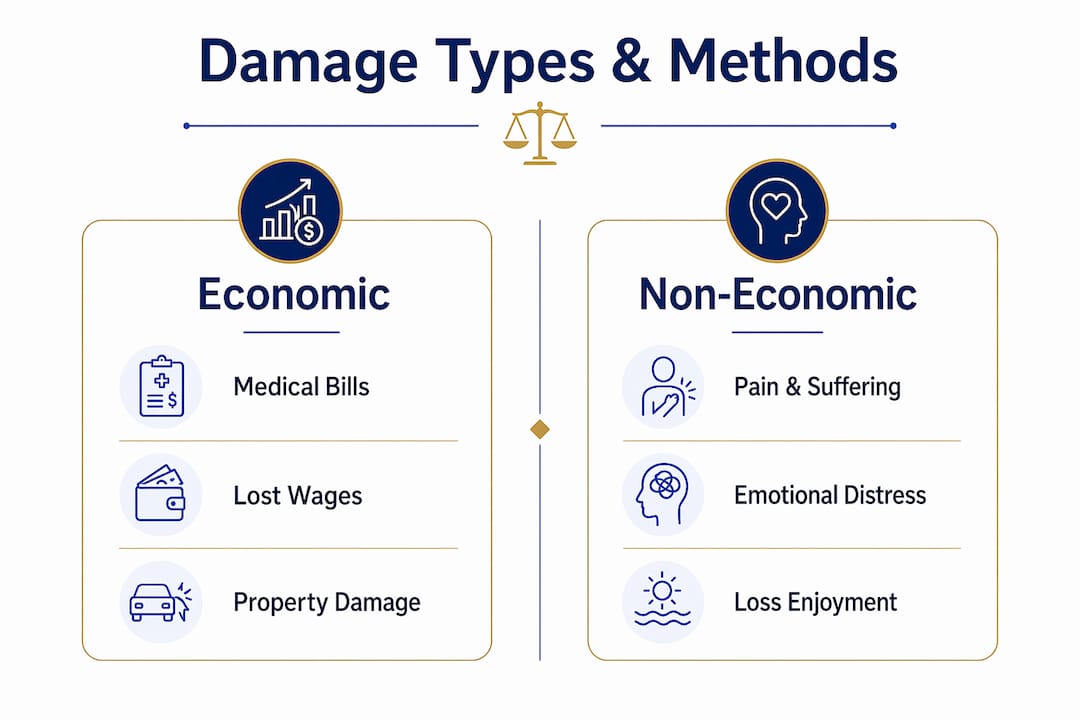
Personal injury damages fall into two categories: economic and non-economic. Economic damages cover losses with a clear dollar amount. Non-economic damages cover losses that are real but harder to measure, like pain, emotional distress, and reduced quality of life. Both categories combine to form your total compensation figure.

The damage assessment process starts with gathering documentation. Medical records, pay stubs, employer statements, and repair invoices all feed into the calculation. Courts require reasonable certainty, supported by verifiable medical and financial records, before approving any damage claim. Rough estimates alone will not hold up.
Georgia injury victims should also understand that recoverable damages vary by case type and jurisdiction. The legal framework shapes what you can claim and how much you can recover.
What are economic damages and how are they calculated?
Economic damages are the foundation of every personal injury claim. They represent your actual, documented financial losses. Future lost earnings consider career trajectory and typical earnings to retirement age, which means a young professional with a serious injury may recover far more than the immediate wage loss suggests.
The main categories of economic damages include:
- Past medical bills: Emergency room visits, surgeries, hospital stays, physical therapy, and prescription costs from the date of injury to the date of settlement or trial.
- Future medical costs: Ongoing care, rehabilitation, assistive devices, and home modifications projected by a medical expert.
- Lost wages: Income you missed while recovering, calculated from payroll records and employer statements.
- Lost earning capacity: The difference between what you could have earned and what you can earn now, based on expert economic analysis.
- Property damage: Repair or replacement costs for your vehicle or other damaged property.
Expert testimony drives the future cost projections. An economist or vocational expert will account for inflation, career advancement, and life expectancy when calculating long-term losses. Without that expert input, courts treat future damage claims as speculative.
Pro Tip: Request itemized medical statements rather than summary balances from every provider. Insurance adjusters scrutinize summary balances aggressively, while itemized bills provide the transparency needed to justify full reimbursement.
How are non-economic damages like pain and suffering calculated?
Non-economic damages cover losses that have no invoice attached. Pain and suffering, emotional distress, loss of enjoyment of life, and loss of consortium all fall into this category. Two accepted methods exist for calculating these losses: the multiplier method and the per diem method.
The multiplier method
The multiplier method takes your total economic damages and multiplies them by a factor that reflects injury severity. Multiplier factors range from 1.5 for minor soft-tissue injuries to 5 for catastrophic or permanent conditions. A broken wrist that heals fully in three months sits at the low end. A spinal cord injury with permanent disability sits at the high end.
The per diem method
The per diem method assigns a daily dollar rate to your pain and multiplies it by the number of days you suffered. If a daily rate is $250 and pain lasts 400 days, the calculation yields $100,000 in non-economic damages. Attorneys often use the plaintiff’s daily wage as the daily rate because it gives the number a concrete, defensible basis.
| Method | How it works | Best suited for |
|---|---|---|
| Multiplier | Economic damages × factor (1.5–5) | Permanent or long-term injuries |
| Per diem | Daily rate × recovery days | Injuries with a clear recovery timeline |
Choosing between the two methods depends on the nature of your injury. A defined recovery period favors the per diem approach. An open-ended or permanent condition favors the multiplier. Understanding pain and suffering valuation helps you see why the same injury type can produce very different numbers across different cases.
Pro Tip: The multiplier is not fixed by law. It is a starting point for negotiation. Document every way the injury has changed your daily life, from sleep disruption to missed family events, because those details move the multiplier upward.
What legal factors affect the final damage award amount?
The raw calculation of economic and non-economic losses rarely equals the final award. Several legal rules adjust the number before you receive a check.
- Comparative negligence. Georgia follows a modified comparative negligence rule. If a plaintiff is found to be 20% at fault, their recovery is reduced by 20%. If your fault reaches 50% or more, you recover nothing. Understanding the 50% fault rule is critical before accepting any settlement offer.
- Collateral source rule. Benefits you already received from insurance, workers’ compensation, or other sources can reduce your net award. Collateral offsets prevent double recovery and directly lower the final amount paid by the defendant. Many injured people overlook this adjustment and are surprised at settlement time.
- Duty to mitigate. You are legally required to take reasonable steps to limit your losses. Failure to mitigate can reduce the damage award by the avoidable portion. Skipping follow-up appointments or ignoring prescribed treatment gives the defense a clear argument to cut your award.
- Reasonable certainty standard. Every damage category must be supported by evidence, not estimates. Courts reject speculative claims without documentation. The stronger your records, the harder it is for the defense to challenge your numbers.
How do courts and attorneys use evidence in damage calculations?
Evidence is what separates a strong damage claim from a weak one. Attorneys build the calculation on a foundation of records that courts and insurance adjusters can verify independently.
The core evidence categories include:
- Medical records: Treatment notes, diagnostic imaging, surgical reports, and discharge summaries that establish the nature and extent of your injuries.
- Itemized billing statements: Line-by-line medical bills that show every charge, procedure code, and provider. Summary balances invite challenges; itemized bills shut them down.
- Payroll and tax records: W-2s, pay stubs, and employer letters that document your pre-injury income and the wages you lost.
- Expert economic reports: Projections from a forensic economist covering future lost earnings, adjusted for inflation and career trajectory.
- Expert medical opinions: Physician statements on future care needs, permanent impairment ratings, and long-term prognosis.
The importance of evidence in Georgia personal injury claims cannot be overstated. Gaps in documentation give the defense room to argue that losses were smaller or unrelated to the accident. Your attorney’s job is to close those gaps before the case reaches negotiation.
A personal injury documentation checklist helps you track what to collect from day one. Starting early prevents the loss of records that become harder to obtain as time passes.
Key Takeaways
Accurate damage calculations require verified economic records, accepted valuation methods for non-economic losses, and careful attention to legal adjustments like comparative negligence and collateral source offsets.
| Point | Details |
|---|---|
| Two damage categories | Economic losses use documented bills and wages; non-economic losses use the multiplier or per diem method. |
| Multiplier range | Factors run from 1.5 for minor injuries to 5 for catastrophic or permanent conditions. |
| Comparative negligence | Your fault percentage directly reduces your award; 50% or more bars recovery in Georgia. |
| Collateral source offsets | Benefits already received from insurance or other sources reduce the defendant’s payment. |
| Evidence is the foundation | Itemized bills, expert reports, and payroll records determine whether claims survive scrutiny. |
What most people get wrong about damage calculations
People tend to treat the multiplier as a fixed formula, as if there is a published table somewhere that spits out a number. There is not. Multiplier values are negotiable and depend on attorney skill, case venue, and insurance adjuster attitudes, not just injury severity. I have seen nearly identical injuries produce wildly different outcomes based entirely on how well the claim was documented and presented.
The collateral source offset is the adjustment that catches people off guard most often. You receive a settlement from your health insurer, feel relieved, and then discover that amount gets credited against the defendant’s obligation. It does not always work that way, but when it does, the surprise is significant. Ask your attorney about this before you accept any payment from any source.
My strongest practical advice: start documenting on day one. Photograph everything. Keep a daily journal of your pain levels, sleep quality, and activities you cannot perform. Courts and adjusters respond to specificity. A journal entry that says “could not lift my daughter for the third week in a row” is more persuasive than a general claim of ongoing pain. The dynamic nature of damage values means your case can grow stronger or weaker based entirely on the records you build right now.
Jewkes Firm can help you understand your claim’s full value
Calculating damages accurately takes legal knowledge, medical expertise, and negotiating experience working together. Jewkes Firm serves injured clients across South Atlanta and surrounding Georgia counties, handling personal injury cases from auto accidents and trucking crashes to slip and falls and medical malpractice.

Jewkes Firm operates on a contingency fee basis. You pay nothing unless they win your case. Their attorneys know how to build the documentation, engage the right experts, and push back against lowball multipliers and improper offsets. If you were injured and want to understand what your claim is actually worth, contact Jewkes Firm for a free consultation today.
FAQ
What is the difference between economic and non-economic damages?
Economic damages cover measurable financial losses like medical bills and lost wages. Non-economic damages cover intangible losses like pain, suffering, and emotional distress.
How is the multiplier chosen for pain and suffering?
The multiplier reflects injury severity and typically ranges from 1.5 to 5. It is negotiable and depends on case facts, jurisdiction, and the strength of your documentation.
Does my own fault reduce my personal injury damages?
Yes. Georgia’s comparative negligence rule reduces your award by your percentage of fault. If you are 50% or more at fault, you cannot recover anything.
Why do I need itemized medical bills instead of summary statements?
Insurance adjusters challenge summary balances because they lack detail. Itemized bills list every procedure and charge, making it much harder to dispute the full amount.
What happens if I do not follow my doctor’s treatment plan?
Failing to follow prescribed treatment violates your duty to mitigate damages. The defense can argue that your ongoing losses were avoidable, which reduces your final award.
Recommended
- What damages can Georgia injury victims actually recover?
- Why Hire a Personal Injury Lawyer in Georgia
- Examples of personal injury claims South Atlanta victims
- Understanding compensation types in Georgia injury cases