

What does a contingency attorney do in Atlanta personal injury cases?
A contingency attorney is a personal injury lawyer who gets paid only if you win. No settlement, no fee. That single principle changes everything about how you access legal help after an accident in Atlanta or anywhere in Georgia.
The attorney’s role goes well beyond showing up in court. From the moment you hire one, they take on the financial risk of your case alongside you. Their core responsibilities include:
- Evaluating whether your claim has merit and advising you on realistic outcomes
- Gathering evidence, interviewing witnesses, and building a case file
- Negotiating directly with insurance companies on your behalf
- Filing court documents and representing you at trial if a fair settlement cannot be reached
- Communicating with you throughout every stage so you always know where things stand
Georgia law governs how these arrangements work, and the Georgia Rules of Professional Conduct set clear standards attorneys must follow. The no-win, no-fee model levels the playing field for injured clients who cannot afford to pay a lawyer by the hour while they are still recovering from their injuries. You get the same quality of legal representation that would otherwise be out of reach financially.
How contingency fee arrangements work with Atlanta personal injury attorneys
The mechanics of a contingency fee agreement are straightforward, but the details matter. When you sign on with a contingency fee lawyer in Atlanta, you agree that the attorney receives a percentage of whatever money is recovered for you, whether through settlement or a court judgment.
Georgia attorneys typically charge a higher percentage if the case goes to trial or appeal than if it settles before a lawsuit is filed. Clients can negotiate different percentages for settlement versus trial or appeal stages, and your written agreement must spell out each rate clearly. The percentage at each stage should be listed explicitly so there are no surprises.

One critical distinction: fees can be calculated on the gross recovery (the total amount recovered before any expenses are subtracted) or the net recovery (what remains after case costs are deducted). That difference can shift thousands of dollars between your pocket and your attorney’s. The State Bar of Georgia specifically advises clients to ask which method their attorney uses before signing anything.
Attorneys also commonly advance case expenses out of their own pocket. Filing fees, expert witness costs, and investigation expenses are paid upfront by the attorney and then reimbursed from your settlement at the end.
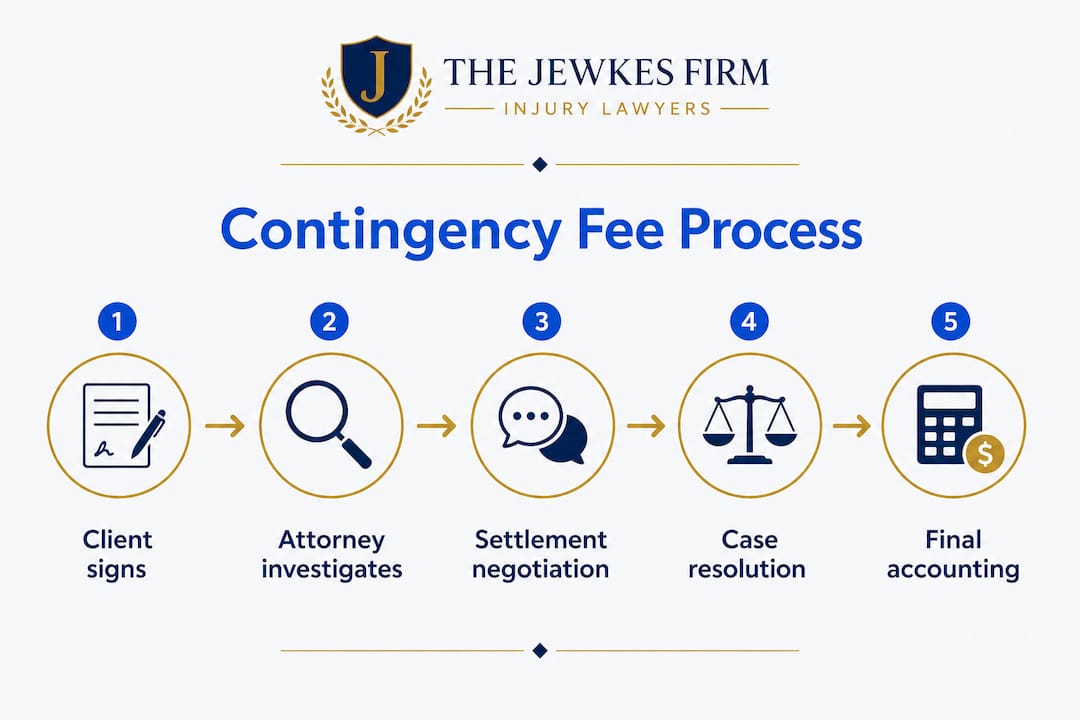
Fee percentages generally increase from pre-lawsuit settlement through trial and appeal. The written agreement must specify the exact percentages at each stage.
Key points to understand about how fees work in practice:
- The attorney earns nothing in fees if no money is recovered
- Case expenses may still be owed by the client even if the case is lost, depending on the contract terms
- The written agreement must state whether expenses come out before or after the fee percentage is applied
- You should receive a written statement at the end showing exactly how your recovery was divided
What Georgia law requires in a written contingency fee agreement
Georgia does not leave contingency fee contracts to a handshake. Georgia Rule of Professional Conduct 1.5 requires that every contingency fee agreement be in writing and signed by the client before representation begins. That is not a formality. It is a legal protection designed to keep you fully informed.
The written agreement must include:
- The exact percentage the attorney will receive at each stage (settlement, trial, appeal)
- A clear statement of which litigation expenses will be deducted from your recovery
- Whether those expenses are deducted before or after the contingency fee percentage is calculated
- Notice of any costs you may owe even if you do not win
At the close of your case, your attorney must provide a final written accounting that shows the total recovery, the fee taken, and every expense deducted. That transparency is your right under Georgia law, not a courtesy.
Contingency fees are prohibited in domestic relations cases (such as divorce or alimony disputes) and in criminal defense matters. This arrangement is specifically designed for personal injury and tort claims where a financial recovery is the goal.
How attorney fees differ from case costs in Atlanta personal injury cases
Attorney fees and case expenses are two separate things, and confusing them is one of the most common mistakes clients make. Your attorney’s fee is the percentage of the recovery they earn for their legal work. Case costs are the out-of-pocket expenses required to actually pursue your claim.
Common expenses in Atlanta personal injury cases include:
- Court filing fees
- Expert witness fees (medical experts, accident reconstruction specialists)
- Medical record retrieval costs
- Deposition and court reporter fees
- Investigation and surveillance costs
- Postage, copying, and administrative expenses
Attorneys typically advance these costs throughout the life of your case and collect reimbursement from your settlement or judgment at the end. Whether those costs are subtracted before or after the attorney’s percentage is applied makes a real difference to your final payout.
Here is a simple example. For example, if a case settles and there are expenses and an attorney fee percentage, whether the expenses are deducted before or after the fee calculation can significantly affect the amount the client ultimately receives. The State Bar of Georgia highlights this distinction as one every client should understand before signing a fee agreement.
Pros and cons of contingency fee agreements for Atlanta injury clients
Contingency fee arrangements exist because most accident victims cannot afford to pay a lawyer hundreds of dollars per hour while they are out of work and dealing with medical bills. The model solves a real access problem. But it comes with trade-offs worth understanding.
Benefits:
- You pay nothing upfront, which means you can pursue a legitimate claim regardless of your financial situation
- Your attorney’s financial interest is directly tied to yours. They earn more when you recover more.
- The attorney absorbs the risk of losing. If the case fails, they walk away without a fee.
- Attorneys who work on contingency tend to screen cases carefully, which means they take on claims they genuinely believe in
Potential drawbacks:
- The percentage taken from a large settlement can be a substantial sum, potentially more than you would have paid by the hour for a straightforward case
- If your case is complex, drags on for years, or goes through multiple appeals, the attorney’s costs and fees can significantly reduce your net recovery
- Clients sometimes feel less control over settlement decisions because the attorney’s fee is tied to the outcome; however, Georgia law upholds the client’s ultimate authority to accept or reject any settlement offer.
Understanding the no-win, no-fee principle fully means recognizing that “no fee” refers specifically to attorney fees. Case expenses may still be your responsibility if the case is lost, depending on what your contract says. Read that section of your agreement carefully before you sign. Learning about the benefits of hiring a personal injury lawyer in South Atlanta can help you weigh whether contingency representation fits your situation.
Expert tips for Atlanta clients on understanding contingency fee agreements
Signing a contingency fee contract without reading it carefully is one of the most avoidable mistakes an injury client can make. Legal experts recommend reviewing every term before you commit, and asking direct questions if anything is unclear.
Pro Tip: Before signing, ask your attorney to walk you through a hypothetical settlement calculation showing exactly how fees and expenses would be deducted. Seeing the math on paper removes any ambiguity about what you will actually take home.
Questions to ask before agreeing to a contingency fee arrangement:
- Is your fee calculated on the gross recovery or the net recovery after expenses?
- What is the percentage at each stage: pre-suit settlement, post-filing settlement, trial, and appeal?
- Who pays case expenses if I decide to change attorneys or end the representation early?
- What expenses am I responsible for if the case is lost?
- Will you provide a written accounting at the end showing every deduction?
If an attorney cannot answer these questions clearly, or is reluctant to put the answers in writing, that is a signal worth taking seriously. Georgia’s professional conduct rules exist precisely to protect you from vague or one-sided agreements. The State Bar of Georgia’s guidance on fee arrangements is publicly available and worth reviewing before your first consultation.
For practical guidance on choosing an injury attorney in South Atlanta, understanding how to evaluate fee agreements is one of the most useful skills you can bring to that first meeting.
How contingency fee disputes are resolved in Atlanta
Fee disputes between clients and attorneys do happen, and Georgia has a structured process for resolving them. The State Bar of Georgia operates an Attorney Fee Arbitration Program, which provides a formal but less costly alternative to litigation for clients who believe they were overcharged or that their fee agreement was not honored.
If an attorney withdraws from a case due to a disagreement over a settlement decision, the contract terms govern what fees are owed for work completed up to that point. Typically, the attorney may be entitled to fees based on the percentage of any settlement offer on the table at the time of withdrawal, or on an hourly basis if no offer exists. The client retains the ultimate right to decide whether to accept a settlement.
Clients who believe an attorney violated Georgia’s professional conduct rules can also file a grievance with the State Bar. Documented, written fee agreements make these disputes far easier to resolve because both parties have a clear record of what was agreed. That is one more reason why the written contract requirement under Rule 1.5 protects you directly.
How contingency fees compare to hourly and flat fee arrangements
Not every legal matter is handled on contingency, and understanding the differences helps you recognize why personal injury cases are particularly well suited to this model.
Hourly billing is the most common arrangement for business litigation, estate planning, and complex civil matters. You pay the attorney for every hour worked, regardless of the outcome. For a personal injury client who is already facing lost wages and medical expenses, hourly billing is often financially impossible.
Flat fee arrangements are common for predictable, defined tasks: drafting a will, handling an uncontested divorce, or filing a straightforward bankruptcy. The scope of work is known in advance, so the attorney can price it accurately. Personal injury cases are too unpredictable for flat fees. A case that looks simple can turn into a multi-year battle.
Contingency fees shift the financial risk to the attorney. That is the defining feature. The attorney invests their time, expertise, and money into your case with no guarantee of payment. For clients pursuing personal injury claims in Atlanta, this model provides access to experienced legal representation that would otherwise be out of reach. The trade-off is that the attorney’s percentage reduces your net recovery, but for most clients, recovering something with professional help far outpaces recovering nothing alone.
What types of cases do Atlanta contingency attorneys typically handle?
Contingency fee representation in Atlanta is concentrated in cases where a financial recovery is the primary goal and liability can be established. The most common case types include:
- Auto accidents: Rear-end collisions, intersection crashes, and highway accidents caused by negligent drivers
- Trucking and commercial vehicle crashes: Cases involving 18-wheelers, delivery trucks, and other commercial carriers operating on Atlanta’s interstates
- Slip and fall and premises liability: Injuries on unsafe property, including retail stores, apartment complexes, and construction sites
- Medical malpractice: Surgical errors, misdiagnosis, and medication mistakes that cause patient harm
- Wrongful death: Claims brought by surviving family members after a fatal accident caused by another party’s negligence
- Rideshare accidents: Crashes involving Uber, Lyft, or other app-based transportation services, which carry unique insurance complexities
- Dog bites and animal attacks: Georgia’s strict liability rules make these cases well suited to contingency representation
What these cases share is a clear defendant, a measurable injury, and the potential for a financial recovery. Attorneys evaluate these factors before agreeing to take a case on contingency because their fee depends on winning.
What a contingency attorney actually does during investigation and settlement
The attorney’s work begins long before any settlement offer arrives. During the investigation phase, your attorney builds the factual foundation of your claim. They collect police reports, medical records, and surveillance footage. They retain expert witnesses, including medical professionals and accident reconstruction specialists, whose fees they advance out of pocket. They identify all potentially liable parties, which in a trucking case, for example, might include the driver, the trucking company, and a cargo loader.

Once the investigation is complete, the attorney sends a demand letter to the at-fault party’s insurer. Negotiation then begins in earnest. Insurance companies have experienced adjusters whose job is to minimize payouts. Your attorney’s job is to counter that pressure with documented evidence and a credible threat of litigation. Clients who seek legal advice after an accident consistently recover more than those who negotiate directly with insurers.
If negotiation stalls, the attorney files suit and moves the case into discovery, depositions, and potentially trial. Throughout every stage, you retain the right to make the final call on whether to accept a settlement. Your attorney advises, negotiates, and advocates. The decision is always yours.
Key Takeaways
A contingency attorney in Atlanta represents personal injury clients at no upfront cost, earning a percentage of the recovery only if the case succeeds, with all terms governed by Georgia’s strict written agreement requirements under Rule 1.5.
| Point | Details |
|---|---|
| No-win, no-fee structure | Clients owe no attorney fees unless money is recovered through settlement or judgment. |
| Written agreement required | Georgia Rule of Professional Conduct 1.5 mandates a signed, written contract specifying all fee percentages and expense terms. |
| Fees vs. expenses | Attorney fees and case costs are separate; expenses are advanced by the attorney and reimbursed from the settlement. |
| Gross vs. net calculation | The fee percentage may be taken from your total recovery before expenses are deducted (gross) or from what remains after expenses (net); which method is used directly impacts your final payout, and Georgia clients should confirm this in writing before signing. |
| Prohibited case types | Contingency fees are not permitted in domestic relations or criminal defense matters in Georgia. |