
Key Takeaways
- Pain and suffering are non-economic damages that encompass physical pain and emotional distress resulting from an injury. These damages are distinct from medical bills and lost wages and are considered the human toll of an accident. Documenting both aspects thoroughly can strengthen personal injury claims and ensure proper legal compensation.
Pain and suffering are the non-economic damages that cover both the physical pain and emotional distress a person experiences after an injury. In personal injury law, these damages are distinct from medical bills or lost wages. They represent the human cost of an accident. Explaining pain and suffering accurately requires understanding how the body, brain, and emotions interact, because modern research confirms that pain is far more than a signal from damaged tissue. This article breaks down the science, psychology, and legal framework so you can understand what you or a loved one may be going through.
What is pain and suffering, exactly?
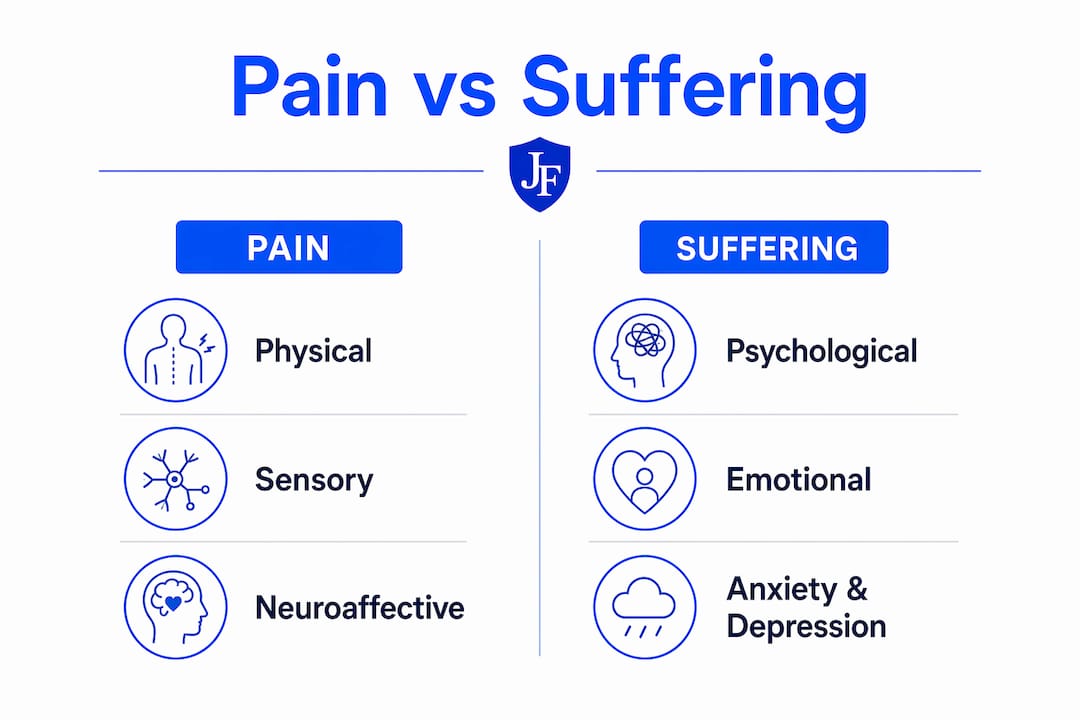
Pain and suffering, the recognized legal term for non-economic damages, describes two connected but separate experiences. Physical pain is the sensory signal your nervous system generates in response to injury or threat. Suffering is the emotional and psychological distress that follows, including fear, grief, anxiety, and loss of identity.
The International Association for the Study of Pain defines pain as an unpleasant sensory and emotional experience. That definition matters because it confirms that pain is never purely physical. The brain constructs the pain experience by weighing sensory input alongside memory, emotion, and context. A broken arm hurts differently depending on whether you are an athlete whose career is at stake or a retiree who was already sedentary.
In a personal injury claim in Georgia, both components count as compensable damages. Jewkes Firm helps clients document and present both dimensions to insurance companies and courts.
What are the types of pain and how does the nervous system create them?
Pain is classified into three mechanistic types, each requiring a different assessment approach:
- Nociceptive pain arises from actual or threatened tissue damage. A broken bone, a torn ligament, or a burn all trigger nociceptive signals. This is the most straightforward type to document medically.
- Neuropathic pain results from damage or disease affecting the nervous system itself. Shooting, burning, or electric sensations after a nerve injury are classic examples. Car accident victims with spinal cord involvement often report neuropathic pain long after the initial injury heals.
- Nociplastic pain occurs when the nervous system becomes sensitized without clear tissue damage or nerve injury. The pain is real, but the source is a hyperactive alarm system rather than an ongoing wound.
That third category is where understanding pain phenomena gets complicated. Chronic pain often persists without ongoing injury because the nervous system has become sensitized, essentially stuck in alarm mode. This explains why accident victims sometimes report severe pain months after their physical injuries appear healed on imaging scans.
Pain is a neuroaffective experience emerging from the ongoing interaction among body, brain, and emotional systems. The NeuroAffective-CBT framework developed by researchers in this field treats pain as a construction, not a transmission. Your brain does not simply receive a pain signal. It builds one from sensory data, past experience, emotional state, and perceived threat level. That is why two people with identical injuries can report vastly different pain levels.
How does suffering relate to pain? Psychological and emotional effects
Suffering is the psychological layer that wraps around physical pain. It includes anxiety, depression, helplessness, social withdrawal, and the loss of the life you had before the accident. These are not side effects of pain. They are part of the injury itself.

Postoperative pain contributes to psychological distress such as anxiety and helplessness in a dose-dependent manner. A study of 6,105 patients across Asia confirmed that higher pain severity directly correlates with greater psychological distress. That means the worse your physical pain, the more likely you are to experience serious emotional suffering alongside it.
The relationship runs in both directions. Chronic pain and mental health issues maintain a bidirectional, self-reinforcing cycle. Disrupted sleep raises pain sensitivity, and higher pain sensitivity makes sleep worse. Social withdrawal removes the support systems that buffer emotional distress, which in turn amplifies the perception of pain. The cycle can become self-sustaining without intervention.
Catastrophizing is one of the most studied psychological effects of pain. Patients who interpret pain as a permanent catastrophe show greater pain intensity and functional impairment than those who do not. Catastrophizing is not a character flaw. It involves measurable changes in brain connectivity and increased HPA axis activity that reduce the body’s natural pain-dampening systems.
The emotional and social impacts of suffering include:
- Disrupted sleep and chronic fatigue
- Withdrawal from family, friends, and community activities
- Loss of professional identity and earning capacity
- Anxiety about future health and financial stability
- Depression and grief over the life lost before the injury
Pro Tip: Keep a daily journal from the day of your accident. Record your pain level, mood, sleep quality, and any activities you could not do. This narrative of suffering becomes powerful evidence in a legal claim.
How is pain and suffering documented for personal injury claims?
Documentation is where the science of pain meets the law. Insurance companies do not take your word for pain. They require objective evidence that your physical and emotional suffering is real, ongoing, and connected to the accident.
Here is a structured approach to building that evidence:
- Obtain complete medical records. Every visit, diagnosis, prescription, and treatment note creates a timeline. Medical reports strengthen your injury claim by establishing a direct link between the accident and your documented symptoms.
- Start a pain diary immediately. Record daily pain levels on a 1–10 scale, emotional state, sleep quality, and specific activities you could not perform. Courts and adjusters respond to concrete, dated narratives.
- Seek psychological evaluation. A licensed psychologist or psychiatrist can formally diagnose anxiety, depression, or PTSD resulting from the accident. This transforms subjective suffering into a documented medical condition.
- Gather witness statements. Family members, coworkers, and friends can describe the changes they have observed in your behavior, mood, and physical capability since the accident.
- Document functional limitations. Non-economic damages require evidence of pain’s effects on quality of life, including sleep, daily activities, and identity. Photographs, videos, and written accounts of things you can no longer do all count.
Structured documentation increases claim strength and credibility with insurance adjusters and juries alike. The more specific and consistent your records, the harder it is for an insurer to dismiss your suffering as exaggerated.
Pro Tip: Never skip a medical appointment after an accident. Gaps in treatment give insurance companies grounds to argue your injuries were not serious or that something else caused your pain.
How do scientific and legal views on pain and suffering compare?
The biomedical model and the legal definition of pain and suffering approach the same experience from very different angles. Understanding both helps you see why proving your claim requires more than a doctor’s note.
| Perspective | Definition of pain and suffering | What counts as evidence |
|---|---|---|
| Biomedical | Physical damage to tissue or nerves producing measurable symptoms | Imaging, lab results, clinical examination findings |
| Neuroaffective | A constructed experience involving body, brain, emotion, and memory | Functional assessments, psychological testing, patient-reported outcomes |
| Legal (Georgia) | Non-economic damages covering physical pain and emotional distress caused by another’s negligence | Medical records, pain diaries, expert testimony, witness accounts |
The biomedical model is what most people picture when they think of injury. It looks for a broken bone or a torn ligament on an MRI. The problem is that pain results from complex central nervous system constructions that can persist independently of tissue damage. A clean scan does not mean no pain.
The neuroaffective model, developed through frameworks like NeuroAffective-CBT, captures what the biomedical model misses. It recognizes that emotional history, stress levels, and cognitive patterns all shape how intensely a person experiences pain. This model aligns more closely with how courts increasingly evaluate suffering in personal injury cases.
Legally, pain and suffering compensation in Georgia covers both physical pain and the emotional distress that accompanies it. Proving it requires connecting your documented symptoms to the accident through a clear, consistent chain of evidence. Expert witnesses, including neurologists and psychologists, often play a critical role in bridging the gap between what science knows about pain and what a jury can understand.
What are the most effective strategies for coping with suffering?
Coping with suffering after an injury is not about pushing through pain. It is about treating the full picture, physical and psychological, at the same time.
Integrated treatment addressing both physical and psychological aspects of pain yields better recovery outcomes than physical treatment alone. Combining cognitive behavioral therapy, mindfulness, and medical care reduces both pain intensity and emotional distress. These are not alternative therapies. They are evidence-based approaches supported by clinical research.
Practical strategies that work include:
- Cognitive Behavioral Therapy (CBT). CBT directly targets catastrophizing by helping you identify and reframe negative pain beliefs. Identifying negative beliefs early prevents maladaptive coping and improves long-term prognosis.
- Mindfulness-based stress reduction. Mindfulness teaches you to observe pain without amplifying it through fear or judgment. Programs like Mindfulness-Based Stress Reduction (MBSR), developed by Jon Kabat-Zinn at the University of Massachusetts, have strong clinical support for chronic pain populations.
- Physical rehabilitation. Guided movement through physical therapy prevents the deconditioning that worsens both pain and depression. Avoiding movement out of fear often makes chronic pain worse, not better.
- Social support and community. Reconnecting with others counters the isolation that feeds the pain-distress cycle. Support groups for chronic pain, available through organizations like the American Chronic Pain Association, provide both practical tools and emotional connection.
- Sleep hygiene interventions. Because disrupted sleep raises pain sensitivity, treating sleep problems directly is a pain management strategy, not just a comfort measure.
The goal is not to eliminate all pain immediately. The goal is to interrupt the cycle that turns acute injury pain into chronic suffering.
Key takeaways
Explaining pain and suffering requires integrating neurological, psychological, and legal perspectives because no single lens captures the full human cost of an injury.
| Point | Details |
|---|---|
| Pain is a brain construction | Pain emerges from body, brain, and emotion together, not from tissue damage alone. |
| Suffering is a medical reality | Psychological distress from injury is measurable, diagnosable, and legally compensable. |
| Documentation is critical | Pain diaries, medical records, and psychological evaluations build the evidence base for your claim. |
| Catastrophizing worsens outcomes | Negative pain beliefs cause measurable brain changes that intensify pain and impair recovery. |
| Integrated treatment works best | Combining CBT, mindfulness, and physical rehabilitation produces better results than any single approach. |
Why I think most people underestimate what pain and suffering really means
After years of working alongside personal injury clients in Georgia, I have seen one pattern repeat itself more than any other. People minimize their own suffering because they cannot see it on a scan. They tell themselves the emotional part does not count, or that they should be stronger than this. That belief costs them in court and in their recovery.
The science is clear. Pain is not a measure of how tough you are. It is a construction your nervous system builds from injury, fear, memory, and context. Two people with the same car accident injuries will have genuinely different pain experiences, and both are real. The person who develops PTSD after a crash is not weaker than the person who does not. Their nervous system responded differently to the same threat.
What I find most important for injury victims to understand is that explaining emotional distress is not about convincing anyone you are suffering. It is about accurately describing a medical reality that affects every part of your life. When you document your pain thoroughly and seek treatment for both the physical and psychological dimensions, you are not exaggerating. You are telling the complete truth about what happened to you.
The legal system in Georgia recognizes this. Your suffering has value. Make sure the people representing you understand both the science and the law well enough to prove it.
How Jewkes Firm helps you document and prove your pain and suffering
If you are dealing with the aftermath of an accident in South Atlanta or the surrounding Georgia counties, Jewkes Firm is ready to help you build the strongest possible claim for your pain and suffering damages.

Jewkes Firm works with medical experts, psychologists, and documentation specialists to capture the full scope of your physical pain and emotional distress. The firm operates on a contingency fee basis, meaning you pay nothing unless they win your case. Every client receives a personalized approach because no two injuries, and no two experiences of suffering, are the same. Contact Jewkes Firm’s personal injury team today for a FREE CONSULTATION and let your voice be heard.
FAQ
What does “pain and suffering” mean in a personal injury claim?
Pain and suffering refers to the non-economic damages covering both physical pain and emotional distress caused by another party’s negligence. In Georgia, these damages are separate from medical bills and lost wages and require documented evidence to prove.
Can you claim pain and suffering without visible physical injuries?
Yes. Because pain results from nervous system constructions that can persist without tissue damage, documented psychological symptoms and functional limitations can support a valid claim even when imaging appears normal.
How do courts measure pain and suffering damages in Georgia?
Georgia courts consider the severity and duration of pain, its impact on daily life and relationships, and expert testimony from medical and psychological professionals. There is no fixed formula, which makes thorough documentation critical.
What is catastrophizing and why does it matter for my claim?
Catastrophizing is a measurable cognitive pattern involving brain connectivity changes that amplify pain intensity and functional impairment. It is a documented medical phenomenon, not a personality trait, and can be supported by psychological evaluation in your claim.
How long should I keep a pain diary after an accident?
Keep a pain diary from the day of the accident through the resolution of your claim. Daily entries recording pain levels, emotional state, sleep quality, and lost activities create a consistent narrative that strengthens your case over time.