

Navigating Georgia’s personal injury lawsuit process overwhelms many accident victims due to confusing rules and strict timelines. Missing critical deadlines like the two-year statute of limitations means losing all your rights to compensation. This guide lays out clear steps to help you file correctly, avoid costly mistakes, and maximize your recovery.
Table of Contents
- Understanding Personal Injury Lawsuits In Georgia
- Prerequisites: What You Need Before Filing
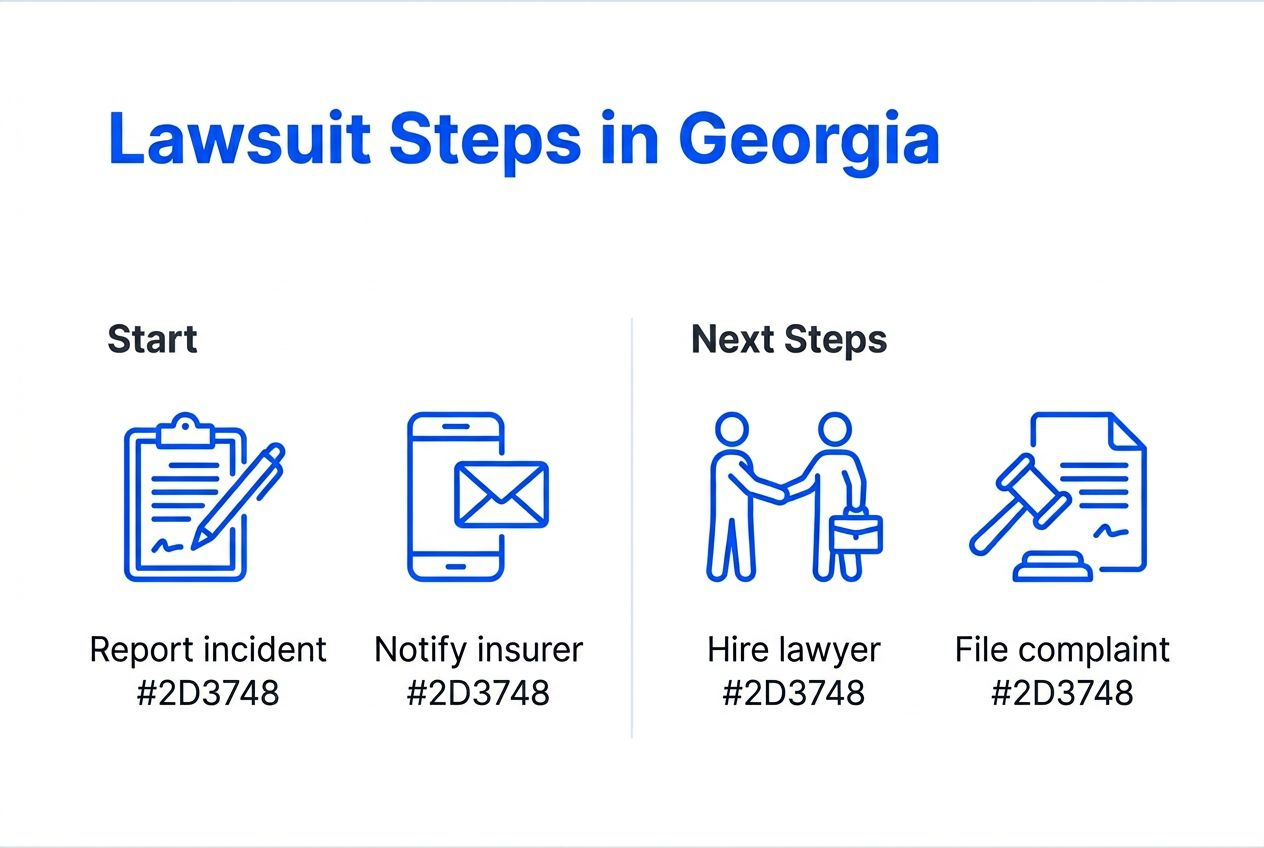
- Step 1: Reporting The Accident And Notifying Insurers
- Step 2: Consulting A Personal Injury Attorney
- Step 3: Filing The Personal Injury Lawsuit
- Step 4: Pre-Trial Procedures And Settlement Negotiations
- Common Mistakes To Avoid When Filing Your Lawsuit
- What To Expect: Timelines, Costs, And Outcomes
- Get Expert Help With Your Georgia Injury Lawsuit
- Frequently Asked Questions
Key takeaways
| Point | Details |
|---|---|
| Filing deadline | Georgia requires personal injury lawsuits within two years of the accident date. |
| Early evidence critical | Immediate documentation and insurer notification prevent claim denials. |
| Attorney advantage | Hiring a personal injury lawyer improves settlement success significantly. |
| Common failures | Late filing, poor documentation, and missed deadlines cause most claim losses. |
| Settlement likelihood | Most cases resolve before trial after discovery and mediation phases. |
Understanding personal injury lawsuits in Georgia
Personal injury lawsuits in Georgia cover a wide range of incidents where someone else’s negligence causes you harm. Common case types include auto accidents, medical negligence, slip and falls, trucking crashes, and wrongful death. Each case requires proving the defendant owed you a duty of care, breached that duty, and caused compensable injuries.
Georgia law imposes strict time limits for filing personal injury claims. You have two years from the injury date to file your lawsuit in court. Miss this deadline and courts will dismiss your case regardless of merit. Exceptions exist for cases involving minors or delayed discovery of harm, but these are rare.
The state follows a modified comparative negligence rule where plaintiffs whose fault is 50% or greater cannot recover damages. If you share less than 50% fault, your compensation reduces proportionally. This rule significantly impacts settlement negotiations and trial strategies.
Georgia recognizes three damage categories:
- Economic damages cover medical bills, lost wages, property damage, and future care costs
- Non-economic damages compensate pain, suffering, emotional distress, and loss of enjoyment
- Punitive damages punish extreme negligence or intentional harm in rare cases
Understanding these foundational elements helps you assess your case’s strength and potential value before investing time and resources in litigation.
Prerequisites: what you need before filing
Before filing any lawsuit, you must gather critical evidence and meet specific legal requirements. Start by acknowledging the two-year deadline. Calculate your filing deadline carefully from the exact accident date, not from when you decided to sue or finished medical treatment.
Seek immediate medical attention even for seemingly minor injuries. Delayed treatment creates gaps insurers exploit to argue your injuries weren’t serious or weren’t caused by the accident. Obtain complete medical records documenting diagnoses, treatments, prescriptions, and prognoses from every healthcare provider.
Collect comprehensive evidence systematically:
- Photograph injuries, accident scenes, property damage, and hazardous conditions from multiple angles
- Obtain official police reports and incident reports from authorities or property owners
- Gather witness contact information and written statements while memories remain fresh
- Preserve insurance information from all parties involved
- Document lost wages with pay stubs, tax returns, and employer letters
Notify all relevant insurance companies within 24 to 72 hours to avoid automatic denials. Report the accident promptly even if you’re uncertain about filing a slip and fall claim or pursuing litigation. Insurance policies often contain strict notification clauses that void coverage for late reporting.
Consider filing a demand letter before initiating a lawsuit. This formal document outlines your injuries, liability arguments, and compensation demands. Filing a demand letter can expedite settlement negotiations and provide leverage if the case proceeds to trial.
Pro Tip: Create a dedicated folder (physical or digital) for all accident-related documents from day one. Organization prevents lost evidence and streamlines the legal process significantly.
Step 1: reporting the accident and notifying insurers
Timely accident reporting and proper insurer notification protect your legal rights from the start. Insurance companies impose strict notification windows, typically 24 to 72 hours after an accident. Late or improper notification causes 25% of claim denials, making this step absolutely critical.
Report your accident through official channels immediately. For auto accidents, call police to the scene and obtain a report number. For slip and falls or premises accidents, notify the property owner or manager in writing and request an incident report. For workplace injuries, follow your employer’s reporting procedures precisely.
When notifying insurers, provide basic facts without speculation:
- Date, time, and location of the accident
- Names and contact information for parties involved
- Brief description of what happened
- Extent of injuries requiring medical attention
Avoid giving recorded statements to insurance adjusters without legal counsel present. Insurers train adjusters to ask leading questions designed to minimize liability or shift fault to you. Statements you make can be used against you later, even innocuous comments taken out of context.
Document every communication with insurance companies meticulously. Save emails, letters, and claim numbers. Note the date, time, and content of phone conversations along with the adjuster’s name. This documentation becomes crucial evidence if disputes arise about what was said or when notifications occurred.
Pro Tip: Send notification letters via certified mail with return receipt requested. This creates indisputable proof of timely notification if insurers later claim they never received your report.
Step 2: consulting a personal injury attorney
Early attorney involvement dramatically improves claim outcomes and simplifies the entire process. Research shows attorney representation increases settlement success by 3.5x compared to self-representation. Lawyers understand Georgia’s complex procedural rules, know how to value claims accurately, and negotiate from positions of strength.

Most personal injury attorneys work on contingency fee arrangements. You pay nothing upfront and owe fees only if you recover compensation. Typical contingency rates range from 33% to 40% of your recovery, with the percentage sometimes increasing if the case goes to trial. This structure aligns your lawyer’s interests with yours and removes financial barriers to quality representation.
Experienced attorneys provide multiple critical services:
- Conduct thorough investigations and preserve evidence before it disappears
- Calculate full claim value including future damages many victims overlook
- Handle all communications with insurers to prevent self-damaging statements
- Navigate complex filing requirements and procedural deadlines
- Negotiate aggressively for maximum settlements
“The difference between representing yourself and hiring a skilled personal injury lawyer often means tens of thousands of dollars in additional compensation. Insurers take represented claimants far more seriously.”
Consult attorneys soon after your accident, ideally within days or weeks. Early involvement allows lawyers to preserve evidence, interview witnesses while memories are fresh, and establish attorney-client privilege protecting your communications. Understanding why to hire legal help can clarify the strategic advantages professional representation provides.
Schedule consultations with multiple attorneys to find the right fit. Most offer free initial consultations where they evaluate your case and explain their approach. Ask about their experience with cases similar to yours, their track record, communication style, and fee structure. Choosing the right injury lawyer requires assessing both competence and compatibility.
Step 3: filing the personal injury lawsuit
Filing the lawsuit initiates formal court proceedings and enforces your legal rights. Your attorney prepares a complaint, the legal document outlining your allegations, damages, and the legal basis for liability. The complaint identifies all defendants, describes the accident and injuries, and specifies the compensation you seek.
File your complaint with the appropriate Georgia court before the statute expires. Jurisdiction depends on case value and location:
- Magistrate Court handles cases under $15,000
- State Court manages cases between $15,000 and $25,000
- Superior Court addresses cases exceeding $25,000 and complex matters
After filing, you must serve the defendant properly to satisfy due process requirements. Service involves delivering copies of the complaint and summons through authorized methods like sheriff’s service, professional process servers, or certified mail depending on the defendant type. Proper service is mandatory to move the case forward.
| Filing Step | Timeline | Key Requirement |
|---|---|---|
| Draft complaint | Before statute expires | Include all defendants and claims |
| File with court | Within 2-year deadline | Pay filing fees, obtain case number |
| Serve defendants | Within 60 days of filing | Use authorized service methods |
| Defendant response | 30 days after service | Answer or motion to dismiss |
Once served, defendants have 30 days to respond by filing an answer or motion to dismiss. Early court hearings may address procedural issues, set discovery schedules, or resolve preliminary motions. Your attorney handles all court appearances and filings while keeping you informed of developments.
Missing the two-year filing deadline typically results in automatic dismissal regardless of your case’s merit. Courts strictly enforce statutes of limitations with few exceptions, making timely filing non-negotiable for preserving your rights.
Step 4: pre-trial procedures and settlement negotiations
After filing, cases enter the discovery phase where both sides exchange evidence and information. Discovery typically lasts six to twelve months but can extend longer in complex cases. This phase includes multiple components designed to uncover facts and prepare for trial or settlement.
Demand letters restart formal settlement talks with more leverage now that litigation has begun. Your attorney sends updated demand letters outlining strengthened evidence, refined damage calculations, and serious intent to proceed to trial if necessary. Demand letters can expedite settlements by demonstrating your case’s strength and your commitment to pursuing full compensation.
Discovery tools include:
- Interrogatories: written questions requiring sworn written answers
- Requests for production: demands for documents, photos, and records
- Depositions: recorded oral testimony under oath before trial
- Requests for admission: statements parties must admit or deny
Mediation offers a less formal, quicker resolution path. A neutral mediator facilitates negotiations between parties to reach voluntary settlements. Courts often require mediation before allowing trials to proceed. Mediation success rates exceed 70% because parties control outcomes rather than risking unpredictable jury verdicts.
| Resolution Method | Timeline | Success Rate | Cost |
|---|---|---|---|
| Direct negotiation | 2-6 months | 50-60% | Low |
| Mediation | 6-12 months | 70-80% | Moderate |
| Trial | 18-36 months | Varies widely | High |
Most cases settle before trial due to the costs, time, and uncertainty juries present. Trials consume substantial resources, take years to conclude, and produce unpredictable outcomes. Defendants face potentially higher jury awards, making reasonable settlements attractive. Plaintiffs avoid litigation stress and receive compensation sooner.
Understanding the settlement process for slip and falls and other injury cases helps set realistic expectations about timelines and outcomes. Your attorney continuously evaluates settlement offers against trial prospects to advise when accepting makes strategic sense.
Common mistakes to avoid when filing your lawsuit
Many accident victims unknowingly sabotage their claims through preventable errors. Understanding these pitfalls helps you navigate the process successfully and maximize your compensation.
Delaying medical treatment ranks among the most damaging mistakes. Insurers argue that gaps in treatment mean injuries weren’t serious or weren’t caused by the accident. Seek immediate care and follow all treatment recommendations consistently. Document every medical visit, even for seemingly minor follow-ups.
Missing the statute of limitations deadline causes automatic dismissal with no exceptions for good excuses. Calculate your deadline carefully and file with plenty of buffer time. Waiting until the last moment risks missing the deadline due to unforeseen complications like difficulty locating defendants or court filing system issues.
Posting about your accident or injuries on social media provides ammunition for defense attorneys:
- Photos showing physical activities contradict disability claims
- Comments about the accident can be twisted to show contributory fault
- Check-ins at locations undermine claims about limitations
- Even innocent posts get taken out of context
Late insurer notification causes 25% of claim denials. Report accidents within 24 to 72 hours regardless of whether you plan to file claims immediately. Notification preserves your rights while you evaluate your options.
Failing to consult an attorney early reduces compensation significantly. Self-represented victims routinely accept lowball settlements, miss valuable damage categories, and make procedural errors that weaken cases. Seeking legal advice after accidents correlates strongly with higher settlement amounts.
Pro Tip: Assume everything you say, write, or post online will be seen by defense attorneys and used against you. When in doubt, stay silent and consult your lawyer first.
What to expect: timelines, costs, and outcomes
Personal injury lawsuits vary dramatically in duration depending on complexity, cooperation levels, and court schedules. Simple cases with clear liability and willing insurers settle within several months. Complex cases involving disputed facts, multiple defendants, or severe injuries can take two to three years or longer to resolve fully.
Contingency fee arrangements eliminate upfront attorney costs and align incentives. You pay nothing until you recover compensation, then your attorney receives an agreed percentage (typically 33% to 40%). If you lose, you owe no attorney fees, though you may remain responsible for case costs like expert witness fees or court filing charges.
Potential compensation in Georgia injury cases includes multiple damage categories:
- Economic damages reimburse quantifiable losses like medical expenses, rehabilitation costs, lost wages, reduced earning capacity, and property damage
- Non-economic damages compensate subjective harms including pain, suffering, emotional distress, loss of enjoyment, and relationship impacts
- Punitive damages punish egregious conduct in rare cases involving intentional harm or gross negligence
Comparative negligence significantly impacts final compensation amounts. If you share any fault under 50%, your recovery reduces proportionally. For example, if you’re awarded $100,000 but found 20% at fault, you receive $80,000. Being 50% or more at fault bars recovery entirely under Georgia law.
Understanding why hiring a personal injury lawyer matters helps set realistic expectations about the investment of time and resources required to maximize your compensation. Quality representation pays for itself many times over through higher settlements and avoided mistakes.
Get expert help with your Georgia injury lawsuit

Navigating Georgia’s personal injury lawsuit process requires experienced legal guidance to maximize your compensation and avoid costly mistakes. The Jewkes Firm specializes in personal injury cases throughout South Atlanta and surrounding Georgia counties, offering the expertise you need to succeed.
Our team works on contingency fee arrangements, meaning you pay nothing until we win your case. We handle everything from evidence gathering and insurer negotiations through lawsuit filing and trial representation. Our personal injury services cover auto accidents, medical negligence, slip and falls, trucking crashes, and wrongful death claims.
Early consultation makes a significant difference in claim outcomes. Understanding the benefits of hiring representation and knowing how to file properly can mean thousands of dollars in additional compensation. Contact the Jewkes Firm today for a free consultation and let us fight for the maximum recovery you deserve.
Frequently asked questions
How long do I have to file a personal injury lawsuit in Georgia?
You generally have two years from the date of your injury to file a personal injury lawsuit in Georgia before your claim is barred by the statute of limitations. Timely filing is essential to preserve your right to compensation. Rare exceptions exist for delayed discovery or minors, but most cases face strict two-year deadlines.
What happens if I miss the insurer notification deadline?
Late insurer notification within 24 to 72 hours may lead to automatic denial of your claim by the insurance company. Prompt notification protects your legal rights and claim validity. Insurance policies contain strict reporting clauses that insurers enforce aggressively to avoid paying legitimate claims.
Do I have to pay attorney fees upfront for my injury case?
Most personal injury lawyers in Georgia work on contingency, meaning you pay no fees unless you win your case. This arrangement reduces financial risk for accident victims pursuing compensation. Typical contingency rates range from 33% to 40% of your final recovery amount.
Can I still recover damages if I was partially at fault for the accident?
Yes, but only if you are less than 50% at fault. Your damages will be reduced in proportion to your fault under Georgia’s modified comparative negligence law. Being 50% or more at fault generally bars recovery altogether regardless of the defendant’s negligence.