

TL;DR:
- Many people mistakenly believe that “pain and suffering” only includes physical injuries, which can reduce compensation amounts.
- In reality, it encompasses emotional distress, loss of life enjoyment, and psychological trauma, all of which require proper documentation to be valued legally.
Most people assume “pain and suffering” just means physical hurt after an accident. That assumption costs injury victims real money. Defining pain and suffering correctly means recognizing it covers far more than a sore back or broken bone. It includes emotional distress, lost enjoyment of life, psychological trauma, and the invisible ways an injury changes who you are. Whether you are weeks out from a car crash or months into a slow recovery, understanding this concept clearly is the first step toward protecting your right to full compensation.
Table of Contents
- Key takeaways
- Defining pain and suffering in personal injury law
- Medical and psychological effects of pain
- Types of pain and suffering in claims
- How pain and suffering damages are calculated
- My perspective on pain and suffering claims
- Get the compensation your suffering deserves
- FAQ
Key takeaways
| Point | Details |
|---|---|
| Pain and suffering are non-economic damages | They cover physical and emotional harm that cannot be tallied with a receipt or medical bill. |
| Multiple types exist in claims | Physical pain, emotional suffering, and loss of enjoyment of life each qualify as separate categories. |
| Valuation has no fixed formula | Multiplier methods and per diem approaches guide estimates, but documentation quality drives the actual outcome. |
| Psychological effects count legally | Anxiety, depression, and PTSD tied to an injury are recognized forms of compensable suffering. |
| State caps limit some awards | About a dozen states restrict non-economic damages to between $250,000 and $1 million. |
Defining pain and suffering in personal injury law
In a legal context, pain and suffering fall under non-economic damages. That means they compensate for losses that have no invoice attached. Medical bills, lost wages, and property damage are economic damages. Non-economic damages cover everything that hurts your quality of life but does not appear on a bank statement.
Pain and suffering damages compensate for physical pain, emotional distress, and loss of enjoyment of life caused by another party’s negligence. This is a broader category than most people expect. It includes the sleepless nights, the anxiety before a follow-up surgery, and the grief of no longer being able to coach your child’s soccer team.
Courts and insurers use two primary methods to put a dollar figure on these losses:
- Multiplier method: Your total economic damages are multiplied by a factor, typically between 1.5 and 5, based on injury severity, permanence, and impact on daily life.
- Per diem method: A daily dollar rate is assigned for each day you live with the injury, from the accident date through maximum medical improvement.
Neither method is written into law as a requirement. No statutory formula governs how insurers or juries calculate these damages. Insurers often use proprietary software, and juries retain broad discretion. That reality makes documentation everything.
Pro Tip: Keep a daily pain journal starting the day after your accident. Record your pain levels, activities you could not do, and emotional low points. This journal becomes one of the most persuasive pieces of evidence in your claim.
One more constraint worth knowing: about a dozen states impose statutory caps on non-economic damages, ranging from $250,000 to $1 million. Georgia has its own rules in specific case types, and those caps directly affect the ceiling on what you can recover.
| Damage Type | Examples | How Valued |
|---|---|---|
| Physical pain | Back injury, nerve damage, fractures | Medical records, expert testimony |
| Emotional distress | Anxiety, PTSD, depression | Therapy records, psychological evaluations |
| Loss of enjoyment | Inability to exercise, socialize, or work | Personal journals, witness statements |
| Loss of consortium | Strain on marriage or family relationships | Spouse testimony, counselor notes |
Medical and psychological effects of pain
Pain is not purely a physical event. The biopsychosocial model of chronic pain treats pain as a complex experience shaped by biology, psychology, and social environment together. Your genetics, your emotional state, your support network, and your history with trauma all influence how pain registers and how much it affects your life.
This matters enormously for injury victims. Two people with the same broken vertebra can experience profoundly different levels of suffering. One returns to work in six weeks. The other spirals into depression, withdraws from family, and cannot sleep without medication. Both are experiencing real, legitimate suffering. The law recognizes this subjectivity.
Chronic pain adds another layer of complexity. About 30% of the global population lives with chronic pain, and the link between chronic pain and depression becomes significantly stronger when multiple pain sites co-occur. An injury that starts in your shoulder can evolve into widespread pain, fatigue, and emotional collapse over months.
The neuroscience behind this is well established:
- Central sensitization occurs when the nervous system becomes hyperexcitable after prolonged pain signals, essentially rewiring the brain to register pain more intensely and more broadly.
- Maladaptive neuroplasticity means the brain physically changes in response to chronic pain, making the condition self-sustaining even after the original injury heals.
- Psychological factors including fear of re-injury, catastrophizing, and poor sleep amplify pain perception well beyond what tissue damage alone would predict.
“Pain is not just a signal from the body. It is an experience created by the brain, shaped by everything from your mood to your memories. Suffering is what happens when that experience consumes your daily life.”
Psychological interventions like cognitive behavioral therapy, mindfulness, and acceptance and commitment therapy have shown meaningful reductions in pain intensity and emotional distress. This means your mental health treatment is both medically necessary and legally relevant. Every therapy appointment is evidence of your suffering.
Types of pain and suffering in claims
Understanding the categories helps you identify what you have actually experienced, and what you deserve compensation for. These are the types recognized in personal injury claims:
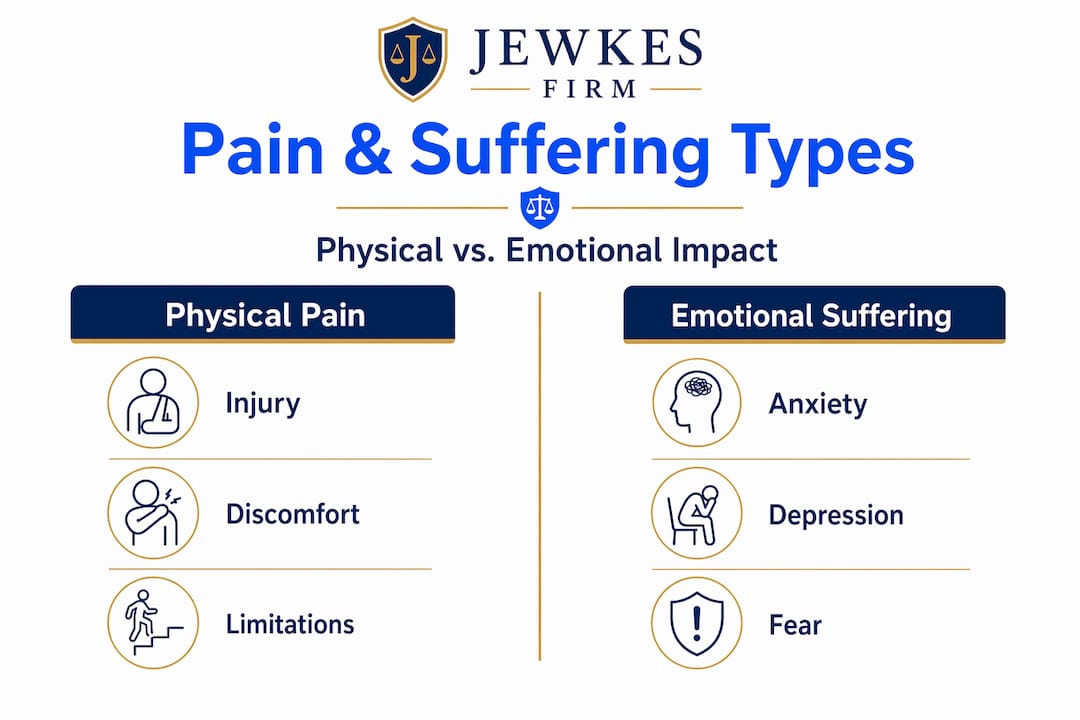
Physical pain and suffering covers the direct bodily experience of injury. This includes acute pain from fractures, burns, or nerve damage, as well as the ongoing discomfort of recovery. It also includes anticipated future pain if your injury is permanent or will require additional procedures.

Emotional and psychological suffering covers the mental health toll of an injury. Anxiety, depression, PTSD, fear, and emotional distress all qualify. An accident victim who develops a phobia of driving after a collision is experiencing real, compensable psychological harm, even if no bone was broken.
Loss of enjoyment of life is often undervalued and underdocumented. It covers the hobbies, activities, and experiences you can no longer participate in because of your injury. A marathon runner who can never run again. A musician who loses hand function. A parent who can no longer carry their child. These losses are real and courts take them seriously.
Loss of consortium addresses the impact on close relationships, typically a spouse or partner. When an injury changes the intimacy, companionship, or support within a marriage, the affected partner may have their own claim.
Common pitfalls when documenting these types:
- Understating pain to appear strong or stoic, which reduces claim value
- Failing to mention emotional symptoms to a doctor, leaving gaps in the medical record
- Not connecting the injury to specific activities you have lost
- Waiting too long to see a mental health professional after trauma
Pro Tip: Tell your doctor everything. If you are grieving the loss of activities you loved, say so explicitly during appointments. That language needs to appear in your medical records, not just your memory.
How pain and suffering damages are calculated
Calculating these damages is more of an art than a science. Here is how attorneys and insurers approach it in practice:
- Establish total economic damages. Start with the hard numbers: all medical costs, lost wages, and future treatment expenses. This figure anchors the multiplier calculation.
- Select a multiplier. Based on injury severity, permanence, and how the injury disrupts your life, a multiplier between 1.5 and 5 is applied. Catastrophic or permanent injuries justify higher multipliers. The Georgia personal injury settlement guide at Jewkesfirm walks through this process in practical detail.
- Alternatively, apply a per diem rate. For injuries with a clear recovery timeline, assigning a daily rate, often tied to your daily wage, across the recovery period can produce a compelling and logical figure.
- Weigh documentation quality. This step is where most claims are won or lost. Medical records, mental health evaluations, physician statements about prognosis, and personal journals all increase the credibility and value of your claim.
- Account for state-specific caps. In Georgia, caps apply to certain medical malpractice cases. Knowing the ceiling in your specific case type prevents unrealistic expectations and shapes settlement strategy from the start.
The uncomfortable truth is that insurance companies use software trained to minimize payouts. They will assign the lowest defensible multiplier and challenge every piece of evidence they can. Understanding pain and suffering compensation before you negotiate changes the dynamic in your favor.
My perspective on pain and suffering claims
I have seen countless injury victims walk into conversations about their claims without fully grasping what they are entitled to. They think in terms of medical bills and missed paychecks. They leave emotional suffering, psychological trauma, and loss of life quality entirely off the table. Not because it did not happen. Because no one told them it counted.
What I have learned is that the legal and emotional definitions of pain and suffering rarely align on their own. The law asks for documentation. Emotions resist being cataloged. That gap is where money is lost. The clients who recover the most are those who connected their lived experience to concrete evidence, whether through therapy records, physician notes, or detailed personal journals.
The philosophy of suffering runs deeper than any courtroom framework can capture. Pain changes people. It alters identity, relationships, and how someone moves through the world. When I work through these cases, I think about what the injury actually took from the person. Not just what it costs. That mindset shift, from transaction to human experience, is what leads to outcomes that genuinely reflect what someone lost.
If you are in pain and wondering whether your experience qualifies, the answer is almost certainly yes. The real question is whether you have the evidence to prove it.
— Ali
Get the compensation your suffering deserves

At Jewkesfirm, we understand that pain and suffering extend far beyond a medical bill. Our team has recovered millions for injury victims across South Atlanta and surrounding Georgia counties, and we know how to build the evidence that makes insurance companies take your claim seriously. Whether your case involves physical trauma, emotional distress, or the loss of something you loved doing, we are prepared to fight for full compensation. We work on a contingency fee basis, which means you pay nothing unless we win. If you are ready to understand exactly what your claim is worth, contact Jewkesfirm today for a FREE consultation and let us put your experience into the language that gets results.
FAQ
What is the legal pain and suffering definition?
Pain and suffering are classified as non-economic damages in personal injury law. They cover physical pain, emotional distress, and loss of enjoyment of life caused by another party’s negligence.
What types of pain and suffering can I claim?
You can claim physical pain, emotional and psychological suffering including anxiety and PTSD, loss of enjoyment of life, and in some cases loss of consortium. Each type requires supporting documentation to strengthen your claim.
How is pain and suffering compensation calculated?
The most common method multiplies your total economic damages by a factor between 1.5 and 5, depending on injury severity and permanence. Some cases use a per diem rate instead, assigning a daily value across the recovery period.
Do psychological effects of pain count in a claim?
Yes. Depression, anxiety, PTSD, and other mental health effects directly tied to an injury are recognized and compensable forms of suffering. Treatment records from a therapist or psychologist serve as key evidence.
Does Georgia cap pain and suffering damages?
Georgia imposes caps on non-economic damages primarily in medical malpractice cases. For most other personal injury claims, no hard cap applies, though state-specific rules can still affect your recovery depending on case type.