
Georgia injury verdict trends are defined by a striking pattern: courts continue to uphold multi-million dollar jury awards even as legislators push to limit them. In 2026, the Georgia Supreme Court blocked the $350,000 statutory cap on noneconomic damages in medical malpractice cases, preserving landmark verdicts totaling $75 million. At the same time, the 2025 tort reform law known as Senate Bill 68 introduced new rules that change how juries weigh fault and evidence. If you were injured in Georgia, understanding these shifts directly affects how you assess your case value and what to expect from the legal process.
What are the major verdict trends in Georgia personal injury cases?
Georgia personal injury verdicts show a clear split: most cases settle quietly, while a small number go to trial and produce headline-grabbing awards. Only about 13% of civil trials in Georgia involve personal injury claims. That figure tells you settlement is the dominant outcome, not the exception.

When cases do reach a jury, the results can be dramatic. Nuclear verdicts, defined as awards of $10 million or more, remain rare but are increasing in frequency. Georgia courts have affirmed several of these awards in recent years, signaling that juries are willing to hold defendants fully accountable when the facts support it.
Recent landmark awards illustrate the scale of what juries can return:
- A DeKalb County jury awarded $70 million in a wrongful death case after the plaintiff rejected a $1 million settlement offer.
- A $42 million medical malpractice verdict included $10 million for pain and suffering and $32 million for wrongful death.
- Both verdicts followed bifurcated or trifurcated trials, where liability and damages phases were heard separately.
The $70 million DeKalb verdict is especially instructive. The jury deliberated on damages for less than an hour before reaching that figure. That speed suggests the evidence was overwhelming, not that the jury was reckless.
Pro Tip: If your case involves serious injury or wrongful death, do not assume a settlement offer reflects your case’s true value. Recent Georgia verdicts show that juries can award amounts far exceeding what insurers initially offer.

How has the 2025 tort reform legislation affected verdicts in Georgia?
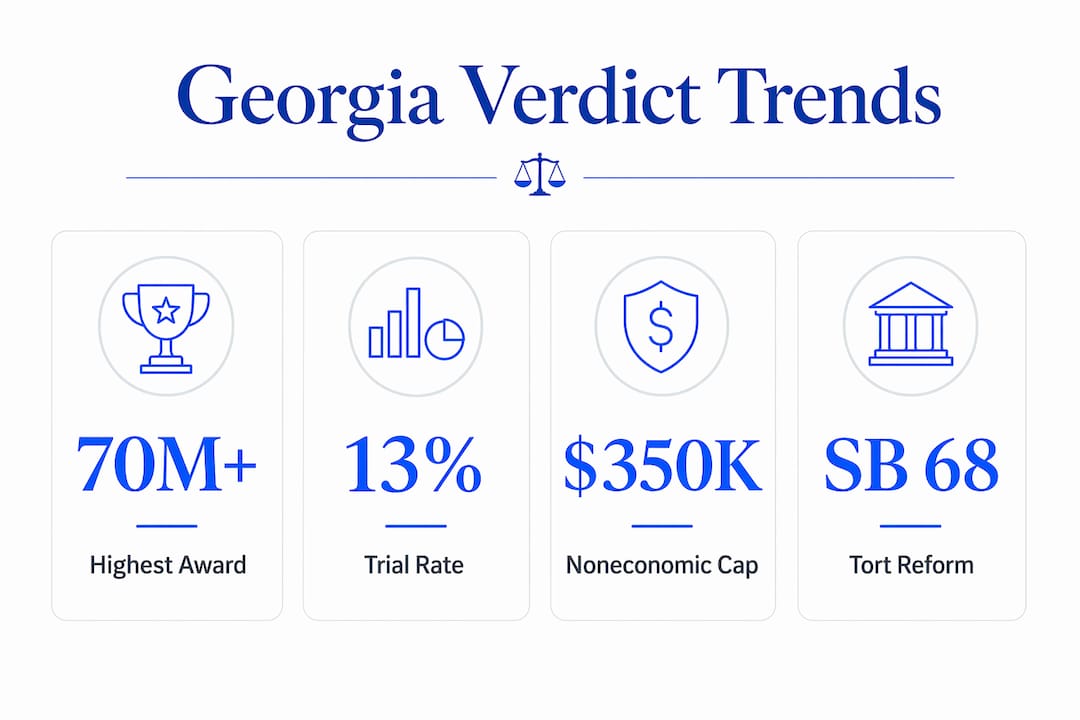
Senate Bill 68 is the most significant change to Georgia personal injury law in years. It reshaped several rules that directly affect how juries evaluate fault and calculate damages.
The key changes under SB 68 include:
- Seatbelt non-use is now admissible evidence. Defense attorneys can present proof that a plaintiff was not wearing a seatbelt. This gives the defense a direct tool to argue the plaintiff contributed to their own injuries, which can reduce the final award under Georgia’s comparative negligence rules.
- Comparative negligence arguments are stronger. If a jury finds a plaintiff more than 50% at fault, that plaintiff recovers nothing. SB 68 gives defense teams more procedural ammunition to push plaintiff fault percentages higher.
- Bifurcation rules have changed. Trial phases are now split more formally, separating liability from damages. This affects how juries process information and how long litigation takes.
- Litigation is longer and more complex. Splitting trials into phases increases the time and cost of going to court, which can pressure plaintiffs to accept lower settlements rather than endure extended proceedings.
These changes do not eliminate large verdicts. They do make it harder to reach them without thorough preparation. Understanding how evidence affects your claim is now more critical than ever, particularly when seatbelt use or comparative fault is in play.
Pro Tip: If SB 68 applies to your case, document everything from the moment of injury. Evidence of your conduct before and during the accident will matter more now than it did under the old rules.
What role do Georgia courts and jury venues play in verdict amounts?
Venue stereotypes are one of the most persistent myths in Georgia personal injury litigation. The assumption that certain counties, particularly urban ones like DeKalb, automatically produce large plaintiff verdicts is not supported by recent outcomes.
Trial outcomes defy venue stereotypes when the evidence does not support the plaintiff’s claim. Defense attorneys have successfully defeated large damage bids in counties traditionally viewed as plaintiff-friendly. The quality of the case presentation, not the zip code of the courthouse, drives jury decisions.
The table below compares common venue assumptions against what Georgia courts actually show:
| Venue assumption | What the evidence shows |
|---|---|
| Urban counties always favor plaintiffs | Defense verdicts occur regularly in DeKalb and Fulton when evidence is weak |
| Rural counties produce smaller awards | Complex cases with strong evidence can yield large awards anywhere |
| Venue selection guarantees outcome | Jury unpredictability makes venue a secondary factor to case quality |
| Liberal venues ignore defense arguments | Juries in all venues respond to credible, well-presented defense narratives |
The practical takeaway is direct: invest in your case preparation, not in venue shopping. A strong narrative, credible expert witnesses, and clear visual evidence matter more than geography. Juries across Georgia respond to facts, not assumptions about where they live.
Pro Tip: Do not choose litigation strategy based on venue reputation alone. Focus on building the strongest possible evidence record, because that is what actually moves juries.
How do recent Supreme Court rulings impact noneconomic damages in Georgia?
The Georgia Supreme Court has drawn a firm line on statutory damage caps. The $350,000 cap on noneconomic damages in medical malpractice cases cannot be applied to jury awards for pain and suffering. The Court’s reasoning is grounded in the constitutional right to a jury trial.
The Georgia Supreme Court blocked the cap and preserved $75 million in combined verdicts across multiple cases. That ruling sends a clear message to defendants and insurers: juries set the number, and courts will protect it.
Two cases anchor this ruling:
| Case | Verdict amount | Key detail |
|---|---|---|
| Baumstark malpractice case | $42 million affirmed | Failure to meet post-cesarean care standards; $10M pain and suffering included |
| DeKalb wrongful death case | $33 million affirmed | Part of the $75M preserved by the Supreme Court ruling |
These rulings matter for every Georgia injury victim, not just medical malpractice claimants. They establish that noneconomic damages like pain and suffering carry constitutional protection. Legislators cannot simply cap what a jury decides you deserve for your suffering.
The practical effect is significant. Defendants and their insurers can no longer rely on a statutory ceiling to limit their exposure after a jury verdict. That shifts negotiating power toward plaintiffs with strong cases, particularly in cases involving severe or permanent injury.
What practical insights should injury victims take from Georgia verdict trends?
Georgia verdict trends offer several concrete lessons for anyone navigating a personal injury claim. Understanding these patterns helps you set realistic expectations and make better decisions at every stage.
- Most cases settle. With only about 13% of civil trials being personal injury cases, the odds are high that your case resolves before a jury ever hears it. Settlement is not a failure. It is the most common outcome.
- Large verdicts are possible but not guaranteed. The $70 million and $42 million awards are real, but they involved severe facts, strong evidence, and skilled legal teams. They are not the average result.
- SB 68 changes your risk profile. If you were not wearing a seatbelt or if the defense can argue you contributed to the accident, your recovery may be reduced. Early legal guidance helps you understand your exposure before the defense builds its case.
- Evidence quality drives outcomes. Across every venue and case type, juries respond to credible, well-organized evidence. Medical records, expert testimony, and clear documentation of your losses are your strongest assets.
- Timing matters. The step-by-step process for filing an injury lawsuit in Georgia has deadlines that can permanently bar your claim if missed.
Pro Tip: Start building your evidence file immediately after an injury. Photographs, medical records, witness contact information, and a written account of what happened are all more reliable when gathered early. Delay weakens every one of these assets.
Understanding how to maximize your compensation in Georgia requires knowing both the legal landscape and the practical realities of how juries decide cases.
Key Takeaways
Georgia injury verdict trends in 2026 are defined by courts protecting large jury awards while new tort reform rules give defendants stronger tools to reduce plaintiff recovery.
| Point | Details |
|---|---|
| Supreme Court caps blocked | Georgia courts struck down the $350,000 noneconomic damages cap, preserving $75M in verdicts. |
| SB 68 changes fault rules | Seatbelt non-use evidence is now admissible, giving defense teams new tools to argue comparative negligence. |
| Most cases settle | Only about 13% of civil trials in Georgia are personal injury cases; settlement is the norm. |
| Venue does not predict outcome | Evidence quality drives jury decisions more reliably than courthouse location. |
| Nuclear verdicts are increasing | Awards of $10M or more remain rare but are being upheld more consistently by Georgia appellate courts. |
What I’ve learned watching Georgia verdicts evolve
Watching Georgia’s injury verdict landscape shift over the past several years, one thing stands out above everything else: the gap between what people expect and what actually happens in a courtroom is enormous.
Clients often come in with a number in their head, usually based on a news story about a $70 million verdict or a friend’s settlement. What they don’t see is the years of preparation, the expert witnesses, the bifurcated trial strategy, and the legal team that refused a $1 million offer because they knew the evidence was worth far more.
SB 68 adds real complexity. The seatbelt evidence rule alone has changed how I think about early case evaluation. A detail that once seemed minor now carries direct financial consequences for a client’s recovery.
The Supreme Court rulings preserving large malpractice awards are genuinely encouraging. They confirm that Georgia’s constitutional commitment to jury trial rights has teeth. But those protections only matter if you get to trial with a case strong enough to earn a large verdict in the first place.
My honest advice: treat your case like the evidence-driven process it is. The law is on your side in more ways than people realize. The challenge is building the record that proves it.
— Ali
Jewkesfirm is ready to help you understand your case
Georgia’s personal injury legal landscape is shifting fast. Between the Supreme Court’s cap rulings and the new SB 68 tort reform provisions, the rules that govern your claim are more complex than they were even two years ago.

Jewkesfirm serves injury victims across South Atlanta and surrounding Georgia counties. The firm’s attorneys stay current on every ruling and legislative change that affects your compensation, from the latest Supreme Court decisions to how seatbelt evidence rules play out in real trials. If you were injured and want to understand what your case is actually worth, contact Jewkesfirm for a free consultation. You pay nothing unless they win.
FAQ
What is Georgia injury verdict trends in simple terms?
Georgia injury verdict trends refer to patterns in how juries award damages in personal injury cases across the state. Recent trends show increasing large verdicts being upheld by courts, even as new legislation attempts to limit recovery.
How does SB 68 affect my personal injury claim in Georgia?
Senate Bill 68 allows seatbelt non-use to be used as evidence against you and strengthens comparative negligence arguments for the defense. These changes can reduce your final award if the defense successfully argues you share fault for the accident.
Can Georgia courts still cap my pain and suffering damages?
The Georgia Supreme Court has blocked the $350,000 statutory cap on noneconomic damages in medical malpractice cases, ruling it violates the constitutional right to a jury trial. Jury awards for pain and suffering now carry full constitutional protection in those cases.
How likely is my injury case to go to trial in Georgia?
Most personal injury cases in Georgia settle before trial. Only about 13% of civil trials in Georgia involve personal injury claims, meaning the vast majority of cases resolve through negotiation rather than a jury verdict.
Does the county where I file my case affect my verdict?
Venue plays a smaller role than most people assume. Georgia courts show that juries in all counties respond primarily to evidence quality and case presentation, not to regional stereotypes about plaintiff or defense favoritism.