
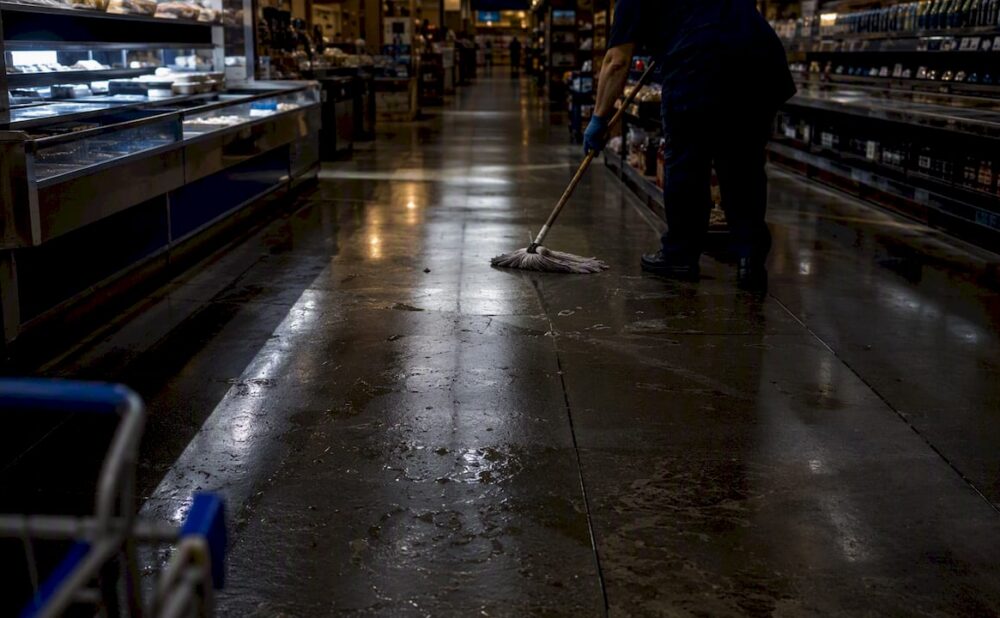
If you were hurt on someone else’s property, the condition that caused your fall or injury may qualify as a compensable hazard under Georgia premises liability law. The most common examples of property hazards that support a claim include:
- Slippery or wet floors without warning signs
- Uneven sidewalks, raised pavement, or cracked steps
- Broken or missing handrails and guardrails
- Poor or failed lighting in stairwells, parking lots, or hallways
- Unsecured rugs, mats, or loose flooring
- Open holes, trenches, or unmarked excavations
- Pooling water from leaks or drainage failures
- Damaged or rotted flooring and decking
- Defective or missing stair nosing
- Unsecured or unfenced pools at rental properties
These hazards can support a claim when the property owner had actual or constructive notice of the condition and you, as the injured person, lacked equal knowledge of the risk. Your first moves matter: photograph everything, get medical care, and contact a Georgia personal injury attorney before evidence disappears.
Key Takeaways
A Georgia premises liability claim turns on whether the property owner had notice of the hazard and whether you lacked equal knowledge of the risk, making early documentation the single most important step you can take.
| Point | Details |
|---|---|
| Notice is the legal hinge | Maintenance logs, prior complaints, and surveillance footage prove the owner knew or should have known about the hazard. |
| Document before anything is cleaned up | Photograph the scene from multiple angles, collect witness contacts, and preserve your clothing and footwear immediately. |
| Entrant status controls your rights | Invitees receive the highest duty of care under O.C.G.A. § 51-3-1; licensees face a higher bar under § 51-3-2. |
| Timing is decisive | Surveillance footage is often overwritten within 24–72 hours; a preservation letter from an attorney stops that clock. |
| Jewkesfirm | Handles Georgia premises liability cases on contingency, with free consultations and immediate preservation steps on new intakes. |
Table of Contents
- Common property hazard examples that cause Georgia injuries
- What to do immediately after an injury on someone else’s property
- Evidence and documentation that strengthen your claim
- How a hazardous condition becomes the basis of a Georgia claim
- When a dangerous condition may not create a viable claim
- What a Georgia personal injury attorney does with your evidence
- Georgia statutes and case law that govern premises liability
- How to formally file a premises liability claim in Georgia
- Georgia agencies that can support your claim
- Hazardous conditions that are especially common in Georgia
- How to choose a Georgia premises liability attorney
- What compensation is available under Georgia premises liability law
- Jewkesfirm is ready to protect your rights after a Georgia property injury
- Sources
Common property hazard examples that cause Georgia injuries
Georgia premises liability claims almost always begin with one of five hazard categories. Matching your incident to the right category helps you preserve the most relevant evidence and describe the condition accurately to counsel.
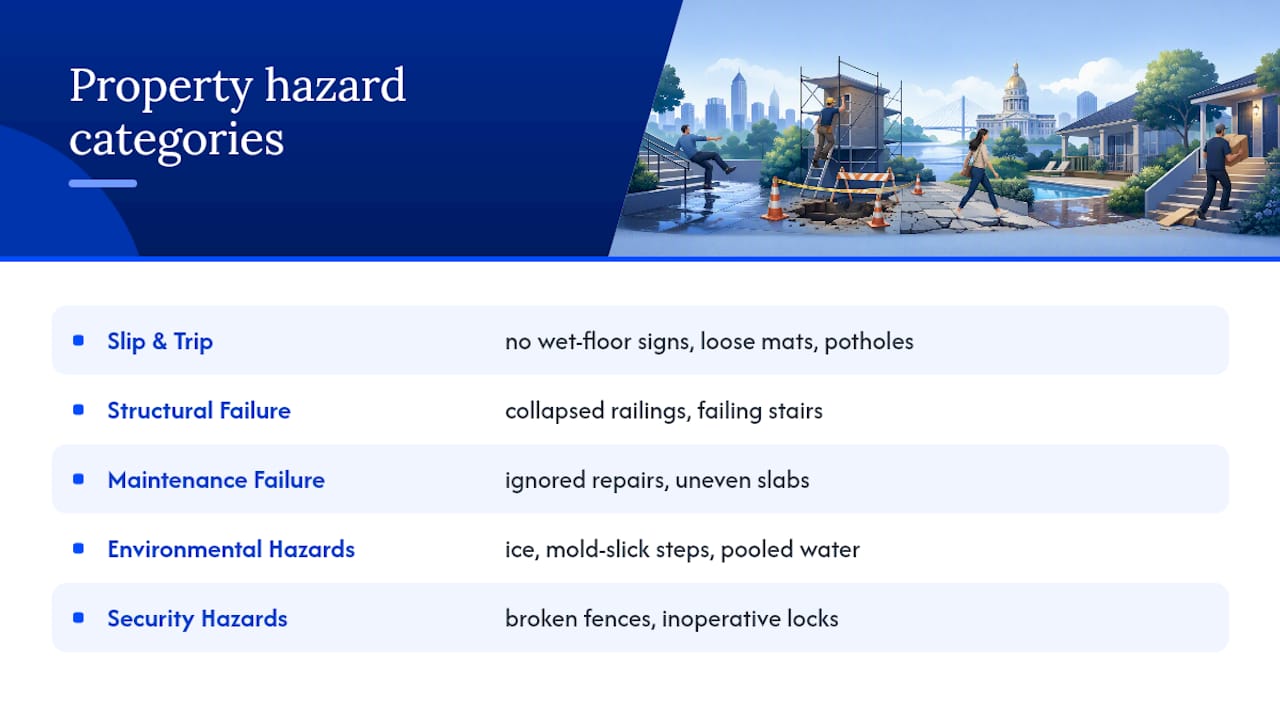
Slip and trip hazards are the most frequent. A grocery store employee mops an aisle and leaves no wet-floor sign. A restaurant mat bunches at the entrance. A parking lot has a pothole large enough to catch a heel. Typical injuries: ankle fractures, knee ligament tears, and head trauma from backward falls.
Structural failures involve components that give way. A deck railing collapses when leaned against. Interior stairs pull away from the wall. A balcony guardrail is corroded through. These failures tend to produce more severe injuries, including spinal fractures and traumatic brain injuries, because the victim has no warning before the structure fails.
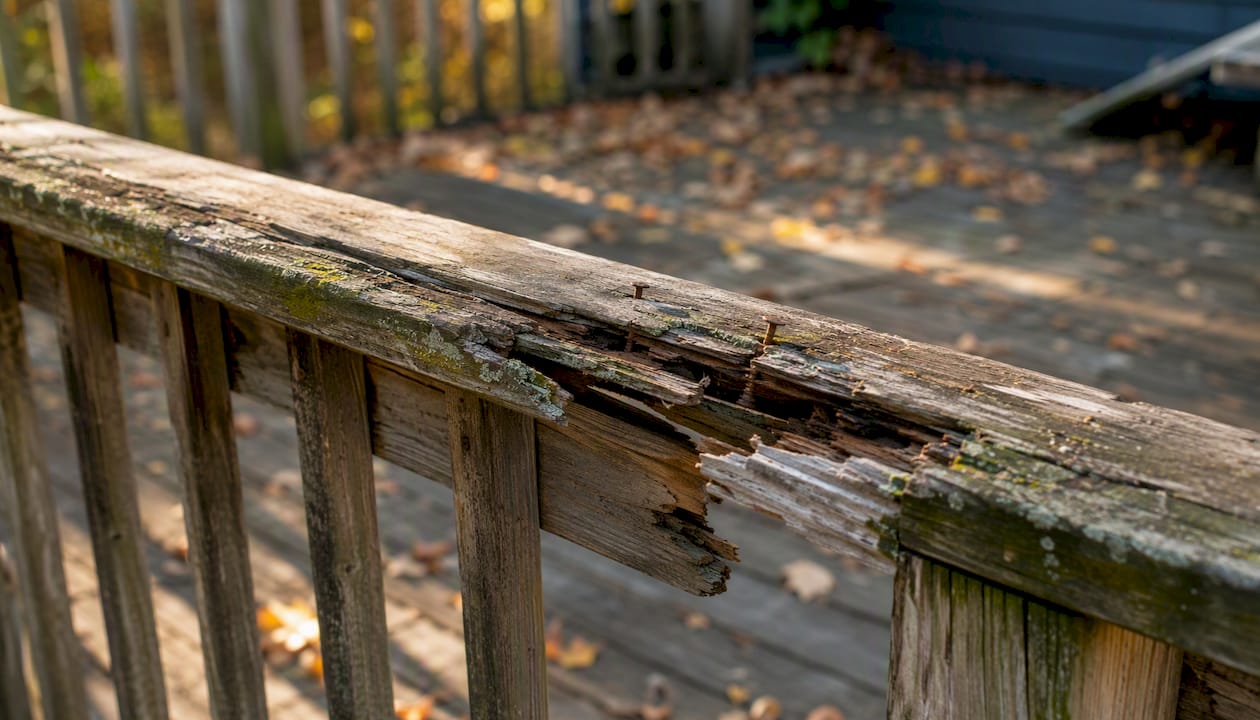
Maintenance failures cover conditions that develop over time and go unaddressed. A landlord ignores a tenant’s repeated complaints about a broken step. A commercial building’s exterior walkway develops a two-inch lip between concrete slabs. A stairwell light burns out and is never replaced. Courts look closely at maintenance logs and prior complaints in these cases, because a pattern of neglect is strong evidence of constructive notice.
Environmental and climate hazards are especially relevant in Georgia. The state’s occasional winter sleet events create icy walkways that property owners often fail to treat or close off. Humidity-driven mold growth on exterior steps makes surfaces slick year-round. Heavy summer rains pool in parking lots where drainage has failed, creating unmarked standing-water hazards.
Security-related hazards include broken perimeter fencing, inoperative gate locks, and inadequate lighting in areas with a known crime history. Georgia’s negligent security duties were further defined by Senate Bill 68 in April 2025, making foreseeability and specific statutory triggers central to these claims.
What to do immediately after an injury on someone else’s property
Acting in the right order protects both your health and your legal rights.
- Get medical care first. Call 911 if needed. Even if you feel you can walk, some injuries, including concussions and internal bleeding, are not immediately apparent. A same-day medical record ties your injury to the incident.
- Photograph and video the scene. Capture the hazard from multiple angles before anyone cleans it up. Include a reference object (a shoe, a wallet) to show scale. Photograph any warning signs that were absent and any that were present.
- Collect witness information. Names and phone numbers from anyone who saw the fall or knew about the condition beforehand are critical. Bystander accounts often make the difference on the notice question.
- Report the incident to the property owner or manager. Ask for a written incident report. Do not admit fault. Keep a copy of everything you sign or receive.
- Preserve your clothing and footwear. Bag them separately. Shoe tread and clothing condition can rebut claims that you were wearing improper footwear.
- Request surveillance footage in writing immediately. Many systems overwrite footage within 24–72 hours. A written request, or better yet, a formal preservation letter from an attorney, creates a record that the footage existed.
Pro Tip: Follow the personal injury checklist Jewkesfirm publishes for Georgia claimants. It covers surveillance overwrite windows, maintenance log retention schedules, and the exact language to use when requesting records from a property manager.
Evidence and documentation that strengthen your claim
Strong premises liability cases are built on paper and pixels, not memory alone. Collect and preserve:
- Photographs and video of the hazard, surrounding area, lighting conditions, and any posted (or absent) warnings
- Time and date stamps on every photo and video file
- Witness names, phone numbers, and written statements taken as soon as possible
- The incident report from the property owner, manager, or employer
- Your medical records from every provider who treated you, starting with the emergency visit
- Repair and maintenance logs from the property, which can show the owner knew about the condition
- Prior complaint records (emails, texts, work orders) showing the hazard was reported before your injury
- Building inspection reports or code-violation citations from local authorities
- Weather reports for the date and time of the incident when climate conditions contributed
To create the strongest contemporaneous record, photograph the hazard from at least four angles, shoot a short video panning the full scene, and note the exact time and lighting conditions in a written memo to yourself that same day. For formal preservation of surveillance and maintenance records, an attorney can send a spoliation preservation notice, a written demand that puts the property owner on legal notice not to destroy evidence. Delays in sending that letter can cost you footage that no longer exists.
How a hazardous condition becomes the basis of a Georgia claim
A property hazard supports a premises liability claim when four elements align:
| Element | What it means in plain English | How your evidence maps to it |
|---|---|---|
| Duty | The owner owed you a legal obligation to keep the property safe | Your status as an invitee, licensee, or trespasser determines the duty owed |
| Breach | The owner failed to meet that obligation | Photos of the hazard, maintenance logs showing neglect, prior complaints |
| Notice | The owner knew or should have known about the condition | Maintenance records, complaint history, how long the condition existed |
| Causation and damages | The breach directly caused your injury and losses | Medical records, witness accounts, lost-wage documentation |
Under O.C.G.A. § 51-3-1, property owners owe invitees ordinary care to keep premises reasonably safe and to inspect for dangerous conditions within their superior knowledge. Invitees, customers, tenants, and members of the public invited onto the property, receive the highest protection.
O.C.G.A. § 51-3-2 narrows that protection for licensees, social guests and similar visitors, limiting recovery to willful or wanton injury. If you were a social guest at a private home when you fell, your path to recovery is harder, though not necessarily closed.
Georgia courts apply a two-prong test in static condition cases: the owner must have had actual or constructive knowledge of the hazard, and the injured person must have lacked that knowledge despite exercising ordinary care. Maintenance logs, prior complaints, and the duration of the condition are the primary tools for proving the owner’s side of that equation.
This section is general legal information, not legal advice. Georgia law turns on specific facts; consult a licensed Georgia attorney about your situation.
When a dangerous condition may not create a viable claim
Not every hazard produces a winning case. Georgia courts recognize several defenses that can defeat or limit recovery:
- Open and obvious: If the hazard was plainly visible and a reasonable person would have seen and avoided it, courts often grant summary judgment for the property owner. However, Georgia precedent shows that poor lighting, camouflage, or a distraction can create a jury question even on conditions that appear obvious in daylight.
- Prior traversal: If you crossed the same hazard multiple times before the fall, courts may find you had equal knowledge of the risk.
- No notice: If the condition arose moments before your injury and the owner had no reasonable opportunity to discover it, the claim is difficult to sustain.
- Trespasser status: Trespassers generally receive only protection against willful or wanton harm, with a narrow exception for child trespassers under the attractive nuisance doctrine (pools, unsecured machinery, accessible construction equipment).
- Independent contractor defense: Owners are not always liable for hazards created by independent contractors working on the property.
- Firefighter’s rule: Emergency responders injured by the very hazard they were called to address face limited recovery, though hidden or unrelated dangers may fall outside this rule.
Timeliness matters. Georgia’s statute of limitations for personal injury claims is generally two years from the date of injury. Delay in reporting, seeking medical care, or contacting an attorney can weaken or bar your claim entirely.
What a Georgia personal injury attorney does with your evidence
An attorney does far more than file paperwork. From the first call, counsel can:
- Send a formal spoliation preservation letter to the property owner within days, before surveillance footage is overwritten
- Subpoena maintenance logs, inspection records, and prior complaint files
- Hire experts in accident reconstruction, lighting analysis, or building code compliance to establish that the condition was unreasonably dangerous
- Interview witnesses while memories are fresh
- Negotiate directly with the property owner’s insurer to pursue maximum compensation
- Prepare for litigation if a fair settlement is not offered
Jewkesfirm handles premises liability cases on a contingency fee basis, meaning you pay nothing unless and until the firm recovers compensation for you. A free consultation lets an attorney evaluate the strength of your notice and causation arguments before you commit to anything.
Pro Tip: Contact an attorney before you speak with the property owner’s insurance adjuster. Adjusters are trained to gather statements that limit the owner’s liability. An attorney levels the playing field from the first conversation.
Georgia statutes and case law that govern premises liability
The statutory foundation is O.C.G.A. Title 51, Chapter 3. Sections 51-3-1 through 51-3-3 set out the duties owed to invitees, licensees, and trespassers. Georgia case law, including Robinson v. Kroger Co., 493 S.E.2d 403 (Ga. 1997), establishes that owners must exercise ordinary care while invitees must also exercise reasonable care for their own safety, a balance courts weigh carefully. Senate Bill 68, signed in April 2025, introduced statutory rules specifically affecting negligent security claims and requires claimants to analyze foreseeability and specific triggers before asserting those claims.
How to formally file a premises liability claim in Georgia
Filing follows a clear sequence. First, preserve evidence and get medical care. Second, notify the property owner or their insurer of your intent to pursue a claim. Third, your attorney sends a demand letter with supporting documentation. If the insurer does not offer a fair settlement, your attorney files a civil complaint in the appropriate Georgia Superior or State Court before the two-year statute of limitations expires. Discovery follows, including depositions, document requests, and expert disclosures. Most cases resolve in settlement; those that do not proceed to trial. See Jewkesfirm’s guide on filing a personal injury claim in Georgia for a step-by-step timeline.
Georgia agencies that can support your claim
Several authorities can generate records useful in premises liability cases:
- Local code enforcement offices (city or county): investigate building code violations and issue citations that document unsafe conditions. Contact your city’s development services or building department directly.
- Georgia Department of Community Affairs: oversees residential building codes statewide and can confirm applicable standards.
- Local health departments: handle complaints about rental property habitability, including mold and sanitation hazards.
- Georgia State Fire Marshal’s Office: investigates fire code violations, including blocked exits and inadequate emergency lighting.
- Local police departments: generate incident reports when 911 is called, which become part of the evidentiary record.
Requesting records from these agencies after an incident can establish that the hazard was known to authorities before your injury.
Hazardous conditions that are especially common in Georgia
Georgia’s climate and construction patterns produce a specific set of recurring hazards. Humidity accelerates wood rot on exterior decks, steps, and boardwalks faster than in drier climates. Occasional winter sleet events, particularly in metro Atlanta, create icy walkways that property owners often fail to treat because ice is infrequent enough to be overlooked. Older commercial buildings throughout South Atlanta and surrounding counties frequently have uneven concrete sidewalks lifted by tree roots, a chronic maintenance failure in neighborhoods with mature tree canopies. Apartment complexes and rental homes with pools are a consistent source of claims when pool gates are broken or missing, a condition Georgia law treats seriously given the attractive nuisance risk to children.
How to choose a Georgia premises liability attorney
Look for an attorney who handles premises liability cases regularly, not just as an occasional add-on to auto accident work. Ask specifically about their experience with notice arguments, spoliation letters, and building code experts. Confirm they practice in the county where your injury occurred, since local court rules and judicial temperament matter. Verify the contingency fee structure in writing before signing anything. Jewkesfirm focuses on slip and fall and premises liability claims across South Atlanta and surrounding Georgia counties, with a contingency model that means no upfront cost to you.
What compensation is available under Georgia premises liability law
Georgia allows injured people to pursue both economic and non-economic damages. Economic damages cover medical bills (past and future), lost wages, reduced earning capacity, and rehabilitation costs. Non-economic damages cover pain and suffering, emotional distress, and loss of enjoyment of life. In cases involving gross negligence or willful misconduct, punitive damages may also be available, though Georgia law caps punitive damages at $250,000 in most cases. Wrongful death claims brought by surviving family members can recover the full value of the deceased’s life under Georgia’s wrongful death statute.
A practitioner’s perspective on what actually changes outcomes
Most people who contact an attorney after a premises injury focus on the hazard itself. What actually determines whether a case succeeds is the notice question: did the owner know, or should they have known, about the condition before you were hurt? That is where the maintenance logs, the prior complaints, and the surveillance footage become decisive. A photograph of a broken step is compelling, but a work order showing the owner was told about that step three weeks earlier is what wins the case.
The other thing people consistently underestimate is timing. Surveillance footage is gone within days in most commercial properties. A preservation letter sent promptly is more impactful than hiring an attorney later. Document first, seek care, then call counsel. That sequence, in that order, gives your claim the strongest possible foundation.
Jewkesfirm is ready to protect your rights after a Georgia property injury
If you were hurt on someone else’s property in South Atlanta or the surrounding Georgia counties, Jewkesfirm offers a free consultation with no obligation and no upfront cost. The firm handles premises liability cases on a contingency fee basis: you pay nothing unless compensation is recovered for you.
From the first call, the firm can send preservation letters for surveillance footage and maintenance records, connect you with the right experts, and begin building the notice and causation arguments your case needs. Georgia’s two-year statute of limitations moves faster than most people expect. Contact Jewkesfirm today to protect your claim before critical evidence disappears.
Sources
The statutes and resources below are the primary references for Georgia premises liability law:
- § 51-3-1. Duty of Owner or Occupier of Land to Invitee – Georgia Code | Trellis Law
- 2024 CODE OF GEORGIA Title 51 – TORTS (§§ 51-1-1 — 51-16-5) Chapter 3 – LIABILITY OF OWNERS AND OCCUPIERS OF LAND (§§ 51-3-1 — 51-3-44) Article 1 – GENERAL PROVISIONS (§§ 51-3-1 — 51-3-3) Section 51-3-2 – Duty of owner of premises to licensee
- Law
This article is general information, not a substitute for advice from a qualified lawyer. Consult a qualified legal professional about your own circumstances before acting on anything here.