
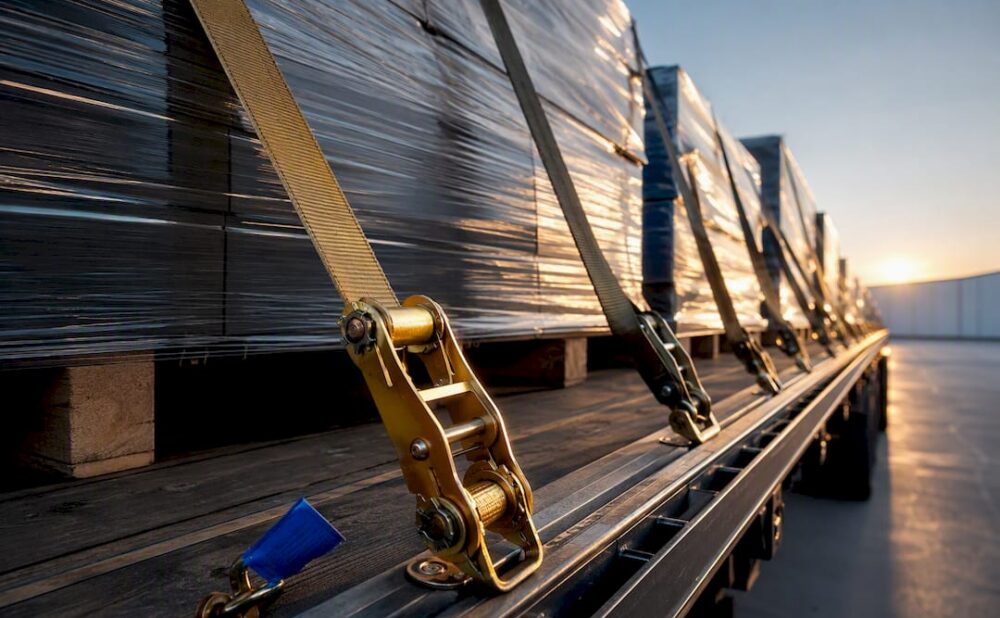
Two legal tests control cargo securement under U.S. federal rules: the tiedown-count rule and the aggregate working load limit (WLL) rule. Under 49 CFR Part 393 Subpart I, commercial motor vehicles must carry enough tiedowns to meet the length-based minimum count AND enough combined strength that the aggregate WLL equals at least half the cargo’s weight. Whichever rule demands more tiedowns wins. Count your straps, add up the WLL numbers stamped on them, and you’ll know within minutes whether a load meets the legal floor.
Key Takeaways
- Meeting the aggregate working load limit rule usually requires two or more straps rated at half the cargo’s weight, especially for heavier loads.
- Using direct tiedowns over indirect ones allows for higher effective capacity, but complex shapes or large loads often necessitate additional or specialized securement methods.
- Cargo categories like logs, coils, and intermodal containers have specific CFR requirements that often exceed general cargo securement rules and must be followed precisely.
- Failing to verify WLL labels, check tiedown condition, or re-tension after initial drive segments frequently results in violations and potential out-of-service orders.
- Documenting the securement setup with photos and replacing worn WLL tags can prevent fines and strengthen liability cases after a load shift or crash.
Table of Contents
- Cargo Securement Rules Checklist Before You Roll
- What Are the Two Rules That Govern Load Securement?
- How Do You Calculate the Required WLL and Strap Count?
- Do Different Cargo Types Have Their Own Securement Rules?
- What Do Inspectors Check, and What Happens if You Fail?
- What Mistakes Do Even Experienced Drivers Still Make?
- The Jewkes Firm’s Perspective on Securement Failures
- How Jewkes Firm Helps Victims of Insecure Load Crashes
- Where to Read the Full Legal Text
- Sources
Cargo Securement Rules Checklist Before You Roll
Before a wheel turns, run through the legal minimums the way an inspector would. Georgia troopers and FMCSA-certified inspectors check the same handful of things every time, and most out-of-service violations trace back to skipping one of these steps.
- Count tiedowns against the length-based minimum for each article or unitized group.
- Add up the WLL stamped on every strap or chain and confirm the total meets or beats 50% of the cargo weight.
- Check each tiedown for cuts, fraying, corrosion, or missing WLL tags. A tiedown with an illegible label doesn’t count toward your aggregate WLL.
- Install edge protectors anywhere webbing crosses a sharp corner.
- Chock or block any item that could roll, and log the pre-trip check with a timestamp.
Pro Tip: Photograph your tiedown setup before departure. If a strap fails or a load shifts later, that photo shows the truck left compliant, which matters far more than your word against an inspector’s report.
What Are the Two Rules That Govern Load Securement?
Section 393.100 sets the performance goal behind every cargo securement rule: freight can’t leak, spill, blow off, fall from, or shift on the vehicle in a way that affects its stability or maneuverability. That standard applies to trucks, truck tractors, semitrailers, full trailers, and pole trailers operating in interstate commerce, and most states, including Georgia, mirror it for intrastate hauls.
Two mechanical tests turn that broad goal into something you can measure on a loading dock.
- The tiedown-count rule. An article five feet or shorter and not exceeding a certain weight threshold needs at least one tiedown. Anything longer than five feet but no more than ten feet needs two. Beyond ten feet, the rule adds one more tiedown for every additional ten feet or fraction thereof.
- The aggregate WLL rule. Section 393.106 requires that the combined working load limit of all tiedowns securing an article equal at least half its weight. Direct tiedowns, meaning straps or chains that run laterally from the cargo to the vehicle, count at 100% of their rated WLL. Indirect tiedowns that run over the top of the load count at only 50% of theirs.
Meeting the count rule alone rarely satisfies the WLL rule. Whichever test produces the higher number is the one that controls your load.
How Do You Calculate the Required WLL and Strap Count?
The math starts with cargo weight, then works backward to figure out how much rated capacity you need on the vehicle. Add up the WLL of every tiedown you plan to use, applying the 100% or 50% rule depending on whether the tiedown runs direct or indirect, and compare that total against half the cargo’s weight.
Typical WLL ratings for common securement hardware look like this:
| Tiedown type | Typical WLL |
|---|---|
| 2-inch polyester winch strap | 3,335 lbs |
| 3-inch polyester winch strap | 5,000 lbs |
| 4-inch polyester winch strap | 3,335 lbs |
| 3/8-inch chain | 5,000 pounds |
| 1/2-inch chain | 5,000 pounds |
Strap angle matters, too. A tiedown running at a steep angle loses vertical holding force, which is why experienced loaders favor tiedowns as close to horizontal as the load geometry allows.
Three examples show how the math plays out:
- A 900-pound pallet, four feet long. The count rule requires one tiedown. A single typical 2-inch polyester strap easily meets the aggregate WLL threshold set at half the cargo’s weight.
- A 10,000-pound piece of equipment. The aggregate WLL rule requires 5,000 pounds of combined direct WLL. Two 3-inch straps rated at 5,000 pounds each, run direct, hit that number exactly, with zero margin. Most fleet safety managers add a third strap here.
- A 20-foot steel beam. The count rule alone requires three tiedowns (two for the first ten feet, one more for the second ten). If the beam weighs 8,000 pounds, the WLL rule demands 4,000 pounds of aggregate capacity, which three 2-inch straps at 3,335 pounds apiece comfortably exceeds.
As a rule of thumb, indirect tiedowns effectively cost you double, since a 5,000-pound-WLL strap thrown over the top only banks 2,500 pounds toward your aggregate. Run tiedowns direct whenever the load shape permits it.
Do Different Cargo Types Have Their Own Securement Rules?
Several commodities carry dedicated CFR sections that add requirements on top of the general rule, because their shape or weight distribution creates hazards the general standard doesn’t fully address. FMCSA’s guidance lists these categories specifically, and the specialized text governs whenever it conflicts with the general rule.
- Logs require bunks, stakes, or bolsters plus a minimum number of wrappers depending on the load’s height and width.
- Dressed lumber and similar packaged products need tight unitization and enough direct tiedowns across the length of the stack.
- Metal coils call for chocks, wedges, or cradles that stop the coil from rolling, with additional tiedowns for coils loaded with their eyes crosswise.
- Paper rolls need blocking or a combination of friction mats and tiedowns depending on orientation.
- Concrete pipe requires cradles or racks and lateral bracing to prevent rolling.
- Intermodal containers must be secured through their corner castings using locking devices rated for the container’s weight.
- Vehicles and heavy equipment need a minimum of four tiedowns, one at each corner, attached to mounting points rated for the securement forces involved.
If your freight falls into one of these categories, read the specific CFR section rather than relying on the general rule alone.
What Do Inspectors Check, and What Happens if You Fail?
Roadside inspectors run a short mental checklist that mirrors the regulation itself. They count tiedowns, verify the aggregate WLL math, check tiedown condition, confirm WLL tags are legible, look for edge protection, and check that anything capable of rolling is chocked or blocked.

Certain violations carry outsized consequences. A shifted load that visibly affects vehicle stability typically results in an out-of-service order on the spot, since it represents an immediate crash risk. An aggregate WLL that falls under the 50% threshold is one of the most commonly cited violations, and missing or illegible WLL tags draw fines even when the tiedown itself is otherwise sound. One industry compliance guide puts total penalty exposure for serious securement violations as high as $18,000 for repeat or aggravated offenses.

To stay ahead of enforcement, keep tiedowns tagged and traceable, replace anything with worn or missing WLL labels before it goes back into rotation, and photograph your setup at departure. A five-minute documentation habit is far cheaper than a roadside fine or a delayed delivery.
What Mistakes Do Even Experienced Drivers Still Make?
Ignoring WLL markings is the most common mistake on the road, usually because a driver eyeballs strap count without checking whether the rated capacity actually adds up to half the cargo weight. Skipping edge protection is a close second, since unprotected webbing can lose a meaningful percentage of its rated strength where it crosses a sharp edge. Running tiedowns at a steep angle instead of closer to horizontal, and failing to re-tension after the first miles of driving, round out the list.
- Re-check tiedown tension within the first 50 miles, then again every 150 miles or three hours, whichever comes first.
- Mark or tag any strap replaced mid-route so the fleet log stays accurate.
- Favor direct tiedowns over indirect ones whenever the cargo shape allows it.
- Keep a spare set of edge protectors in the cab, not buried in a side box.
Pro Tip: Build a two-step habit: full inspection before departure, then a second tension check at your first fuel or rest stop. That second look catches the settling and shifting that happens in the first hour of driving, before it becomes a violation or a hazard.
The Jewkes Firm’s Perspective on Securement Failures
Cargo securement violations rarely stay a paperwork issue when a load shifts on the highway. An inspector’s report documenting an aggregate WLL under the legal threshold, or photos showing missing edge protection, can become central evidence in a negligence claim after a crash. That paper trail is often what separates a strong case from a weak one.
If you were hurt because a load broke loose, preserve everything you can: the police report, any roadside inspection findings, photos of the debris field, and the carrier’s name. Bring those documents to a free consultation, and our team can evaluate whether the rules governing truck accident liability point to the carrier, the shipper, or both.
How The Jewkes Firm Helps Victims of Insecure Load Crashes
It is important to have legal experts review the inspection report, the securement setup, and the carrier’s compliance history to evaluate shifted-load crash cases properly.

If a poorly secured load caused your crash, bring what you have: photos of the wreck, any police or DOT inspection report, medical records, and the trucking company’s information. These details help us evaluate liability quickly and identify every party who may share fault, from the driver to the shipper who loaded the trailer. Our guide to trucking accident claims in Georgia walks through what compensation typically covers, and our breakdown of why hiring a trucking accident lawyer matters explains what a legal team adds that an insurance adjuster won’t tell you. Contact The Jewkes Firm today for a free consultation and find out what your case may be worth.
Where to Read the Full Legal Text
- eCFR § 393.100 covers applicability and the general performance standard for cargo securement.
- 49 CFR § 393.106 sets the aggregate WLL requirement and tiedown attachment rules.
- FMCSA’s cargo securement page explains the rule’s history and commodity-specific sections.
- For vehicle-type questions, this cutaway van and box truck comparison clarifies which vehicles fall under these federal standards.
This article is general information, not a substitute for advice from a qualified lawyer. Consult a qualified legal professional about your own circumstances before acting on anything here.
Sources
- eCFR § 393.100 — Applicability and general requirements of cargo securement standards
- 49 CFR § 393.106 — General requirements for securing articles of cargo (Cornell Law)
- Cargo Securement Rules | FMCSA
- Cargo Securement Rules 2026: Avoid $18K Fines (CompliantDrivers)