
Yes, you can often reduce or resolve injury-related medical bills after a settlement, and the first moves matter. Request itemized bills and explanation of benefits statements, check whether Medicare made conditional payments, and preserve your dispute windows before anything goes to collections. Acting within the first 30 to 120 days protects your leverage and your settlement.
Summary:
- Negotiating medical liens or offsets can significantly reduce your settlement amount, especially if you secure reductions before funds are distributed.
- Medicare conditional payments must be identified and disputed early, as failure to respond can cause the amount owed to increase and complicate settlement disbursement.
- Collecting detailed documentation, such as itemized bills and settlement allocations, strengthens your negotiation position and helps avoid errors or inflated charges.
- Promptly responding to dispute deadlines and keeping written records can prevent losing rights to challenge improper bills or collection efforts.
- Hiring an attorney increases odds of achieving better lien reductions and settlement allocations, particularly when dealing with complex Medicare or insurer claims.
Table of Contents
- Who can claim repayment: liens, subrogation, and Medicare
- Gathering documents and making your first calls
- Negotiating with insurers versus medical providers
- The dispute clocks you cannot afford to miss
- What determines how much your bills can be reduced
- When an attorney’s involvement changes the outcome
- How negotiated bills shape your final settlement amount
- Credit reports, medical debt, and long-term financial standing
- Disputing medical bills on your own, step by step
- What experienced negotiators see go wrong
- How the Jewkes Firm helps with medical bill negotiation
- FAQ
- Sources
Who can claim repayment: liens, subrogation, and Medicare
After a settlement, several parties may have a legal right to part of your recovery. Hospitals and providers can file medical liens directly against settlement proceeds. Health insurers often have subrogation rights, meaning they can recover what they already paid toward your treatment. Medicare’s involvement works differently: when Medicare pays for injury-related care before a settlement closes, those are called conditional payments, and the Medicare recovery process through the Benefits Coordination & Recovery Center governs how they get repaid.
Lien priority shapes how your settlement gets divided, and it rarely follows a simple order. Some states give medical liens priority over attorney fees, others reverse it, and Medicare’s claim typically sits ahead of private liens in liability cases.
- Provider liens attach when a hospital treats you without full payment upfront and files a claim against the settlement.
- Insurer subrogation lets a health plan recoup payments it made for injury-related treatment.
- Medicare conditional payments must be identified and addressed with the BCRC before final allocation.
Notifying the BCRC early keeps the conditional payment amount from ballooning as your case proceeds.
Gathering documents and making your first calls
Before you negotiate anything, build a paper trail. Insurers, providers, and Medicare all respond better to requests backed by documentation than to phone calls alone.
- Pull every itemized bill and explanation of benefits related to the injury, not just the final balance.
- Get a copy of your settlement allocation showing how much was designated for medical expenses versus pain and suffering.
- Collect any good faith estimates you received if you were billed as an uninsured or self-pay patient.
- Request a Conditional Payment Letter from the BCRC if Medicare paid any part of your care, since the Medicare recovery process requires this step before the agency will finalize its demand.
- Contact each provider’s billing office directly, reference your settlement, and ask for a written itemized statement of the current balance.
Every conversation with a billing office, insurer, or collector should be followed by a short written summary, even an email to yourself with the date, the name of the representative, and what was said.
Pro Tip: Send document requests by certified mail or email with read receipts so you have proof of timing if a dispute window later becomes an issue.
Negotiating with insurers versus medical providers
Providers and insurers respond to different pressure points, so the tactics that work on one rarely work on the other.
- With providers, ask for the insured-equivalent rate rather than the inflated chargemaster price, since CFPB guidance notes many hospitals will match negotiated insurance rates for self-pay patients.
- Ask about charity care or financial assistance programs, which hospitals must offer in writing under federal rules, even for people who already have some insurance coverage.
- Request a cash-pay discount or an interest-free payment plan instead of financing through a medical credit card, as it can eliminate your ability to negotiate later.
- With insurers or subrogation claims, propose a reduced lump-sum repayment and present your settlement allocation to show how much is actually earmarked for medical costs versus other damages.
Get every agreed reduction in writing before you send payment. A verbal discount means nothing if the original balance resurfaces in collections six months later.
The dispute clocks you cannot afford to miss
Several federal deadlines run at the same time after a settlement, and missing one can cost you your right to dispute.
You generally have 120 days to dispute a bill that is $400 or more above your good faith estimate. This federal protection applies to uninsured and self-pay patients and triggers the Patient-Provider Dispute Resolution process.
- The PPDR process carries a small filing fee, and CMS guidance requires the independent review entity to request provider documentation promptly and issue a decision within about a month of receiving it.
- If a debt collector contacts you, federal rules require they send validation information within 5 days, and you then have 30 days to dispute the debt in writing, which pauses collection while they verify it, according to CFPB guidance.
- If Medicare made conditional payments, respond to any Conditional Payment Notice promptly, since appeal and waiver requests follow specific CMS timelines described in the Medicare recovery process.
Set calendar reminders the day you receive any of these notices. These windows do not pause for the holidays or for a slow mail carrier.
What determines how much your bills can be reduced
Not every bill shrinks by the same amount, and a few variables drive most of the difference.
- Whether Medicare, Medicaid, or private insurance already paid part of the bill changes your leverage, since conditional payments and subrogation claims follow stricter federal rules than a simple self-pay balance.
- Larger hospital systems often have formal charity care and financial assistance policies, while small practices may negotiate informally but have less room to move.
- How your settlement was allocated matters: funds specifically designated for medical expenses are more exposed to lien claims than funds allocated to pain and suffering or lost wages.
- State lien laws vary widely in how much of a settlement a provider or insurer can claim, and some states cap medical liens at a percentage of the total recovery.
Readers in states with no-fault or personal injury protection insurance face an added layer, since PIP rules can determine which payer has first claim on medical costs before any negotiation begins, as this overview of no-fault PIP coverage explains for one such system.
When an attorney’s involvement changes the outcome
Negotiating liens and conditional payments without legal help is possible, but an attorney brings tools most individuals cannot access alone, including direct negotiation authority with lienholders and the ability to challenge unrelated charges in a Medicare conditional payment demand before it is finalized.
- Attorneys can negotiate provider and insurer liens down as part of finalizing the case, often before the client ever sees a bill.
- They coordinate directly with the BCRC to request interim conditional payment letters and dispute charges unrelated to the injury.
- They advise on how the settlement should be allocated among medical expenses, pain and suffering, and other damages to protect the client’s net recovery.
We work on a contingency fee basis, meaning clients pay nothing upfront and fees come from the settlement only after a successful outcome. Attorney procurement costs and lien negotiations both affect the final amount a client takes home, which is why reviewing the full settlement breakdown with legal counsel before signing anything matters.
How negotiated bills shape your final settlement amount
The size of your medical liens directly affects how much of your settlement you actually keep. A settlement is rarely a single lump sum you pocket in full. Liens, subrogation claims, attorney fees, and case costs are typically paid out of the gross settlement before you see a dime.

If a hospital bill is reduced through negotiation, more of the settlement stays with you rather than going toward repaying that lien. This is why attorneys often negotiate medical liens as one of the final steps before disbursement, not as an afterthought. A reduction of even a few thousand dollars on a hospital lien can meaningfully change the net amount in a client’s pocket, especially in cases where medical expenses made up a large share of the claimed damages.
Settlement allocation also plays a role here. How a settlement is categorized between medical expenses, lost wages, and pain and suffering can affect which liens apply and how aggressively a lienholder can pursue repayment. Providers and insurers generally have stronger claims against funds explicitly allocated to medical costs, which is one reason the allocation conversation often happens alongside lien negotiation rather than after it.
Credit reports, medical debt, and long-term financial standing
Unresolved medical bills do not stay invisible if a settlement takes months to finalize. If a provider sends an unpaid balance to collections while you wait on a settlement, that account can appear on your credit report and affect your ability to get a loan, rent an apartment, or qualify for favorable interest rates.
Negotiating a bill down, or securing a payment plan before it reaches collections, helps you avoid that mark entirely. According to CFPB guidance, acting quickly to resolve or dispute medical bills reduces the chance they escalate to collections and cause lasting credit damage.
Once an account is already in collections, resolving it through negotiation or a financial assistance program can still help, since paid or settled accounts generally look better to future lenders than open collection balances. Avoiding medical credit cards or high-interest financing during this period also protects your long-term finances, since those products convert a negotiable medical bill into a fixed debt obligation with its own interest and repayment terms.
Disputing medical bills on your own, step by step
If you decide not to hire an attorney, you can still work through this process methodically.
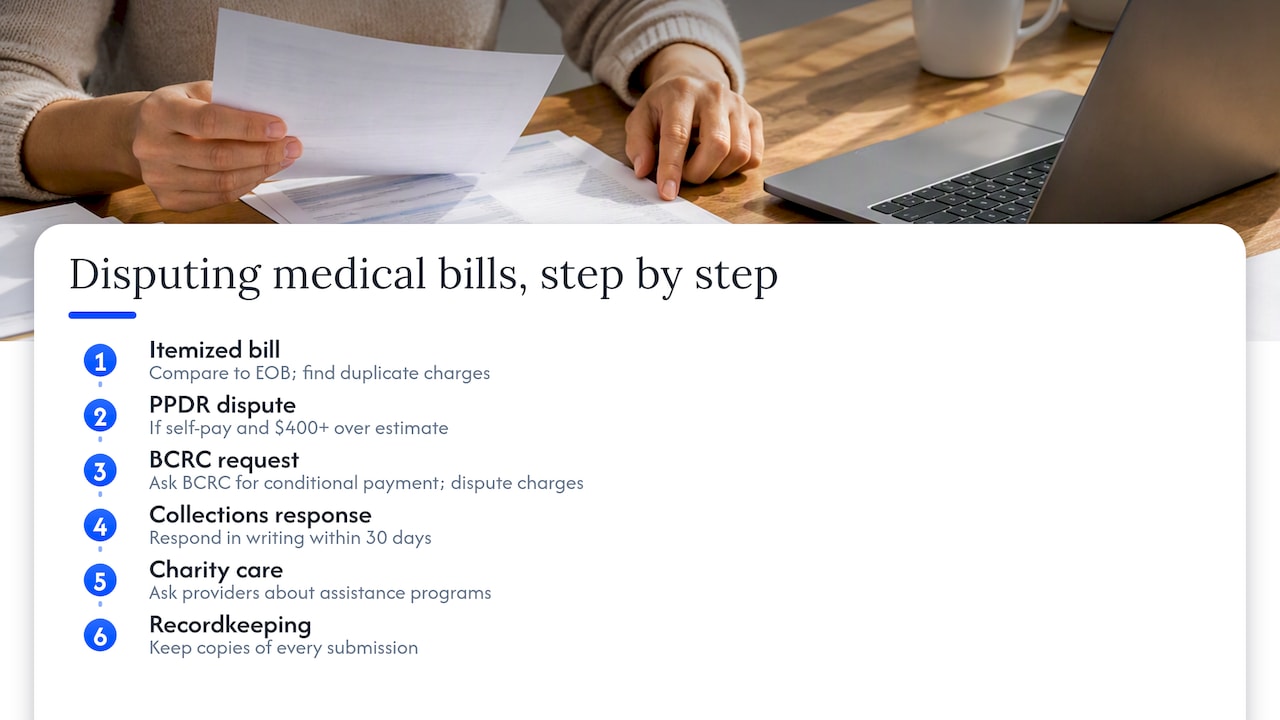
First, request an itemized bill from every provider involved and compare it against your explanation of benefits to catch duplicate charges or services you never received, a step CFPB guidance recommends before any negotiation begins. Second, if you were billed as an uninsured or self-pay patient and the final bill came in $400 or more above your good faith estimate, file a PPDR dispute within the 120-day window using the CMS process. Third, if Medicare paid any part of your care, contact the BCRC directly to request your conditional payment amount and dispute any charges unrelated to your injury before the demand becomes final.
Fourth, if a bill goes to collections, respond to the validation notice in writing within 30 days to pause collection activity while you dispute the debt. Fifth, ask providers directly about charity care or financial assistance programs, since hospitals are required to maintain written policies and some accept applications even after a bill has gone to collections. Keep copies of every letter, email, and form you submit throughout this process.
What experienced negotiators see go wrong
The most costly mistake is paying a collector or provider immediately out of settlement relief, before confirming whether the bill is accurate or negotiable. Once a payment clears, your leverage to dispute that charge is gone. The second most common error is letting dispute windows lapse, often because the notice looked like routine mail rather than a legal deadline. The third is never requesting an itemized bill at all, which means errors and duplicate charges go unchallenged.
- Request itemized bills from every provider before paying anything.
- Send written dispute letters to any collector within 30 days of their validation notice.
- Notify the BCRC immediately if Medicare paid for any part of your treatment.
- Consult an attorney before finalizing your settlement allocation.
Pro Tip: Keep every request and dispute in writing, sent by certified mail or email, so you have dated proof if a provider or collector later claims you missed a deadline.
— Jordan M. Jewkes
How the Jewkes Firm helps with medical bill negotiation
Negotiating liens, coordinating with the BCRC, and protecting your settlement allocation is easier with a legal team that handles this work daily. We focus on personal injury law and offer free consultations with no upfront cost, since fees are only earned if your case succeeds.

Bring your itemized bills, settlement documents, and any explanation of benefits statements to your consultation so the attorney can review your full picture right away. If you are working through medical liens or a Medicare conditional payment demand after a settlement, visit the practice areas page to see how the firm can help with your specific situation.
This article is general information, not a substitute for advice from a qualified lawyer. Consult a qualified legal professional about your own circumstances before acting on anything here.
FAQ
How do you negotiate a medical bill down?
Start by requesting an itemized bill to check for errors, then ask the provider for the insured-equivalent rate, a cash-pay discount, or an interest-free payment plan, as CFPB guidance recommends. Get any agreed reduction in writing before making a payment.
Do you have to pay medical bills from a personal injury settlement?
Medical providers, health insurers, and Medicare can have a legal right to be repaid from your settlement through liens, subrogation claims, or conditional payment demands. The amount owed is often negotiable, which is why many settlements set aside funds specifically for resolving these claims before disbursement.
How much are medical bills reduced after a settlement?
The reduction varies based on who paid the bill, the provider’s policies, and your state’s lien laws, so there is no fixed percentage that applies to every case. Negotiating directly, documenting errors, and involving an attorney for larger liens tend to produce better outcomes than accepting the first balance presented.
How much should I offer to settle medical debt?
There is no universal formula, since the right offer depends on the original bill, your documentation of errors, and whether the account is still with the provider or has moved to collections. Reviewing the itemized bill for inaccuracies first, then proposing a specific reduced amount in writing, tends to work better than a vague request for a discount.