

If an out-of-state driver caused your crash in Georgia, you can usually bring your claim right here under Georgia law, and the at-fault driver’s insurance is typically the primary source of payment. Your immediate priorities are reporting the crash if damage exceeds $500 or anyone was injured, exchanging information with the other driver, documenting the scene, and talking to an attorney before you talk much to any insurer.
TL;DR:
- Cases against out-of-state drivers are filed in Georgia where the crash occurred, and jurisdiction is usually upheld if the incident happened within Georgia borders.
- The at-fault driver’s liability insurance, often under the minimum 25/50/25 coverage, typically covers damages, with your own UM/UIM policies providing backup if limits are insufficient.
- Reporting is mandatory within Georgia for damages over $500 or injuries, and early documentation, including photos and witness info, significantly strengthens your claim.
- The two-year deadline for personal injury claims applies, emphasizing the importance of prompt investigation and record collection to preserve evidence.
- A Georgia attorney can help navigate procedural hurdles, file necessary records, and negotiate with insurers, especially in cases involving out-of-state drivers or complex liability issues.
Table of Contents
- Why Georgia Courts Can Hear a Claim Against an Out-of-State Driver
- Where to File: Venue Rules When the Other Driver Lives Elsewhere
- Which Insurance Pays After an Out-of-State Driver Hits You
- What to Do in the Hours and Days After the Crash
- Deadlines You Cannot Afford to Miss
- Getting Your Crash Report and Related Records
- How Shared Fault Changes What You Recover
- How a Georgia Personal Injury Attorney Supports Your Claim
- Handling Medical Treatment and Billing as an Out-of-State Driver
- When the Out-of-State Driver’s Home State Gets Involved
- Insurance Rates and Claims Handling After a Georgia Accident
- How Georgia Law Shapes Settlement Timing and Negotiations
- What Clients Should Expect Going Through This Process
- Talk to a Georgia Attorney Before You Settle
- Quick Reference: Statutes and Record Request Resources
- Sources
- FAQ
Why Georgia Courts Can Hear a Claim Against an Out-of-State Driver
Georgia’s long-arm statute gives state courts the authority to exercise jurisdiction over a nonresident driver when the crash happened on Georgia roads. Under O.C.G.A. § 9-10-91, a Georgia court may hear a case against someone who lives out of state as long as the injury-causing act occurred inside Georgia’s borders.
In practice, this means you file where the wreck happened, not where the other driver lives. Expect the defense to sometimes raise objections about jurisdiction or ask to move the case, especially when the driver has no other ties to Georgia. Courts routinely reject those arguments when the tort itself happened here. Service of process on a nonresident defendant follows its own rules, and a Georgia attorney handles that step so the case moves forward without procedural delay giving the other side an opening.
Where to File: Venue Rules When the Other Driver Lives Elsewhere
Venue generally sits in the county where the collision occurred. For claims that rely on Georgia’s long-arm statute, venue rules point to the county where a substantial part of the tortious act or resulting injury took place.
When more than one defendant is involved, such as a Georgia resident and an out-of-state driver sharing fault, venue strategy gets more detailed. A resident defendant can sometimes anchor the case in a particular county, which affects where the out-of-state driver must answer the claim. This is one reason scene documentation matters so much: the responding officer’s report, the exact crash location, and witness statements all support where and how the case gets filed and served later.
Which Insurance Pays After an Out-of-State Driver Hits You
Georgia is a tort-based state, meaning the driver who caused the crash is financially responsible for the damage. The state’s minimum insurance requirements set liability coverage at $25,000 per person and $50,000 per accident for bodily injury, plus $25,000 for property damage, often called 25/50/25. These minimums apply to drivers licensed in Georgia, and an out-of-state driver causing a wreck here is typically held to their own policy’s terms when that policy follows them across state lines.
The at-fault driver’s liability policy is your primary source of recovery. When their limits fall short, or the driver has no coverage at all, your own uninsured or underinsured motorist coverage may step in to fill the gap. Haddad and Associates outlines how UM/UIM protection works when the responsible driver cannot cover what you are owed.
Insurers typically ask for:
- A certified copy of the police crash report.
- Photos of the vehicles, scene, and visible injuries.
- Medical bills and records tied directly to the crash.
Pro Tip: Send your insurer written notice of the crash within days, even if the other driver’s carrier already contacted you, so your own policy’s timelines stay protected.
What to Do in the Hours and Days After the Crash
Georgia law requires drivers to report a crash immediately to police or the county sheriff when it causes injury, death, or at least $500 in property damage, under O.C.G.A. § 40-6-273. The responding officer will also expect you to exchange names, addresses, license numbers, and insurance information with the other driver.
- Call police to the scene and confirm a report will be filed.
- Exchange driver and insurance information, and get the other car’s license plate and state.
- Photograph the vehicles, road conditions, skid marks, and any visible injuries.
- Collect contact information from witnesses before they leave.
- Contact your insurer and a personal injury attorney within the first few days.
Avoid saying “I’m sorry” or anything that sounds like an admission of fault at the scene or in a recorded insurer statement. Keep your phone’s photos and any dashcam footage backed up somewhere safe.
Pro Tip: Write down what happened while it’s fresh, including time, weather, and traffic signals, since memory fades faster than most people expect.
Deadlines You Cannot Afford to Miss
Officers typically submit crash reports to the state system within days of the accident, and that report becomes the backbone of your claim. Georgia’s statute of limitations for personal injury claims is generally two years from the date of the crash under O.C.G.A. § 9-3-33, though certain circumstances can shorten or extend that window.
Waiting to investigate costs you real leverage. Witnesses move, skid marks fade, and vehicle damage gets repaired or scrapped long before a claim settles, so early documentation protects evidence the case may later depend on.
Getting Your Crash Report and Related Records
Georgia routes crash reports through the Georgia Electronic Accident Reporting System, known as GEARS, with many local agencies distributing copies through BuyCrash or a GDOT mail-in form.
- Anyone named in the report can request a copy directly, typically for a $5 statutory fee, with certified copies costing more.
- If you are not named in the report, Georgia’s Open Records Act requires a written statement of need under O.C.G.A. § 50-18-72(a)(5) before the agency releases it.
- Attorneys routinely prepare and file that statement of need on a client’s behalf, which speeds up access considerably.
- For 911 audio or bodycam footage, a separate open records request is usually required and may take longer to process.
How Shared Fault Changes What You Recover
Georgia follows a modified comparative negligence rule. Under O.C.G.A. § 51-12-33, your damages are reduced by your own percentage of fault, and multiple at-fault parties each get assigned their own share of responsibility.
Your recovery drops to $80,000 under the apportionment formula. Insurance adjusters representing an out-of-state driver often push hard to shift fault onto you specifically because every percentage point matters to the final number, which is why solid documentation from the scene carries so much weight later.
How a Georgia Personal Injury Attorney Supports Your Claim
A Georgia attorney handles the parts of an out-of-state crash claim that trip up people doing it alone: filing the statement of need for records, preserving evidence before it disappears, arranging service on a nonresident defendant, and negotiating directly with a visiting driver’s insurer. Legal firms often offer free consultations and represent injury victims on a contingency fee basis, meaning clients pay nothing unless compensation is recovered.
Call a lawyer quickly when injuries are serious, when the other driver appears uninsured or underinsured, or when liability involves a commercial vehicle or trucking company rather than a simple passenger-car wreck. These cases often involve multiple insurers, corporate defendants, and tighter evidence-preservation windows, all of which benefit from attorney involvement from the start rather than after talks with an insurer have stalled.
Handling Medical Treatment and Billing as an Out-of-State Driver
If you are the out-of-state driver injured in a Georgia crash, your medical treatment doesn’t have to wait until you get home. Georgia hospitals and urgent care clinics treat out-of-state patients regularly, and prompt treatment matters both for your health and for the paper trail your claim will need later.
Keep every receipt, discharge summary, and billing statement from Georgia providers, even ones you plan to pay out of pocket while a claim is pending. If you return home for follow-up care, ask your Georgia provider for complete records to hand to your home-state doctor, since gaps in treatment history give insurers an easy excuse to argue your injuries weren’t serious or weren’t connected to the crash.
Health insurance from your home state generally still applies to treatment received in Georgia, though you should confirm network coverage before scheduling anything beyond emergency care. Georgia-based medical providers sometimes bill through liens against an eventual settlement rather than demanding immediate payment, an arrangement your attorney can help negotiate so unpaid medical bills don’t follow you home while the claim works its way through the system.
When the Out-of-State Driver’s Home State Gets Involved
A crash in Georgia stays a Georgia legal matter even when the at-fault driver lives elsewhere, but their home state can still play a role. Most states participate in the Driver License Compact or similar reciprocal agreements, which allow Georgia to report certain violations, like reckless driving or DUI, back to the driver’s home state licensing agency.
That reporting can affect the out-of-state driver’s license status and driving record at home, separate from anything that happens in your civil claim. If the driver’s insurance is based out of state, their carrier still has to respond to a Georgia claim and often assigns an adjuster familiar with Georgia law specifically because out-of-state liability claims come up often enough to warrant it.
Your claim itself proceeds under Georgia law regardless of where the other driver’s insurer is headquartered. The practical effect is mostly behind the scenes: expect the claims process to take a bit longer while an out-of-state carrier coordinates between its home office and whatever Georgia-licensed adjuster or local counsel it assigns to the file.
Insurance Rates and Claims Handling After a Georgia Accident
Every state treats at-fault accidents differently when it comes to premium increases, so a driver from one state might see a smaller rate bump than a driver from another state for the same type of claim.
For claims handling, an out-of-state insurer still has to investigate and respond to a Georgia claim the same way a Georgia-based carrier would, following Georgia’s tort rules rather than the rules of its home state. That sometimes means slower initial response times simply because the adjuster has to get familiar with Georgia-specific requirements, like the 25/50/25 minimums and comparative negligence rules, before making a settlement offer.
Victims sometimes assume an out-of-state insurer will drag its feet more than a local one. In practice, delays usually come down to incomplete documentation or a dispute over fault percentages rather than where the insurer is based. Clear records from the scene and from medical providers do more to speed up handling than anything related to the carrier’s home address.
How Georgia Law Shapes Settlement Timing and Negotiations
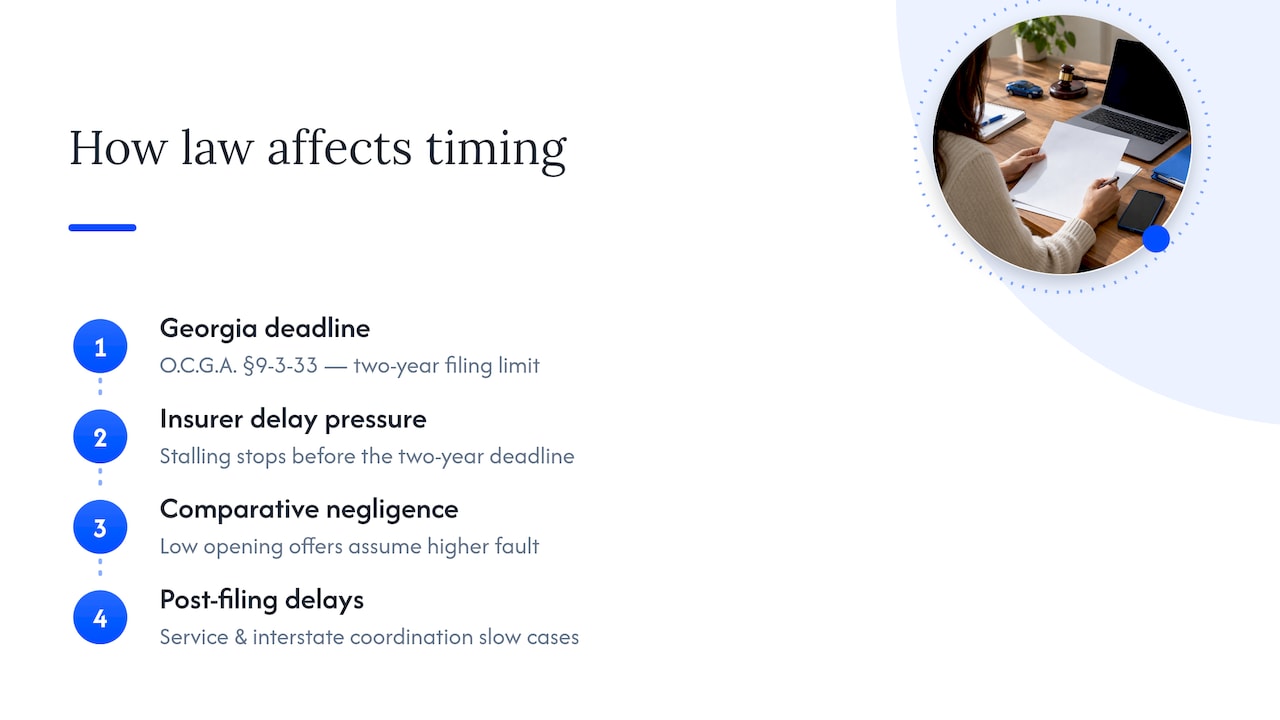
Settlement negotiations in an out-of-state driver crash move on Georgia’s legal timeline, not the other driver’s home state timeline. The two-year statute of limitations under O.C.G.A. § 9-3-33 sets the outer deadline for filing suit, and that date drives how long an insurer can reasonably stall before a claimant’s attorney moves to litigation.
Comparative negligence adds another layer to negotiations. Because your recovery shrinks by your assigned percentage of fault, insurers representing an out-of-state driver often open with a low offer that assumes a higher fault percentage than the evidence supports. Strong documentation, including the certified crash report and witness statements gathered early, gives your attorney leverage to push back on an unfairly low opening number.
Claims involving a nonresident defendant can also take longer to resolve once litigation starts, since service of process and coordination between a Georgia court and an out-of-state insurer’s legal team add extra steps compared to an all-Georgia case. None of that changes your underlying rights, but it does mean patience and early preparation pay off more in these cases than in a routine local fender bender.
What Clients Should Expect Going Through This Process
Insurers often slow-walk out-of-state claims hoping you’ll settle cheap before your injuries fully resolve. Early documentation and a local attorney who knows Georgia’s courts put you back on equal footing, and the contingency fee model means you pay nothing upfront.
— Ali
Talk to a Georgia Attorney Before You Settle
Dealing with an out-of-state driver adds paperwork and waiting that a local Georgia claim usually doesn’t involve, and that’s exactly where having someone in your corner pays off. Legal firms often offer free consultations and represent clients on a contingency fee basis, so clients pay nothing unless there is a recovery.

Before you call, gather what you can: the crash report or the request you’ve filed for it, photos from the scene, medical bills and records, the other driver’s insurance information, and contact details for any witnesses. Visit the practice areas page to see the range of cases commonly handled, from auto accidents to trucking crashes, and consider reaching out for a case review to learn more.
Quick Reference: Statutes and Record Request Resources
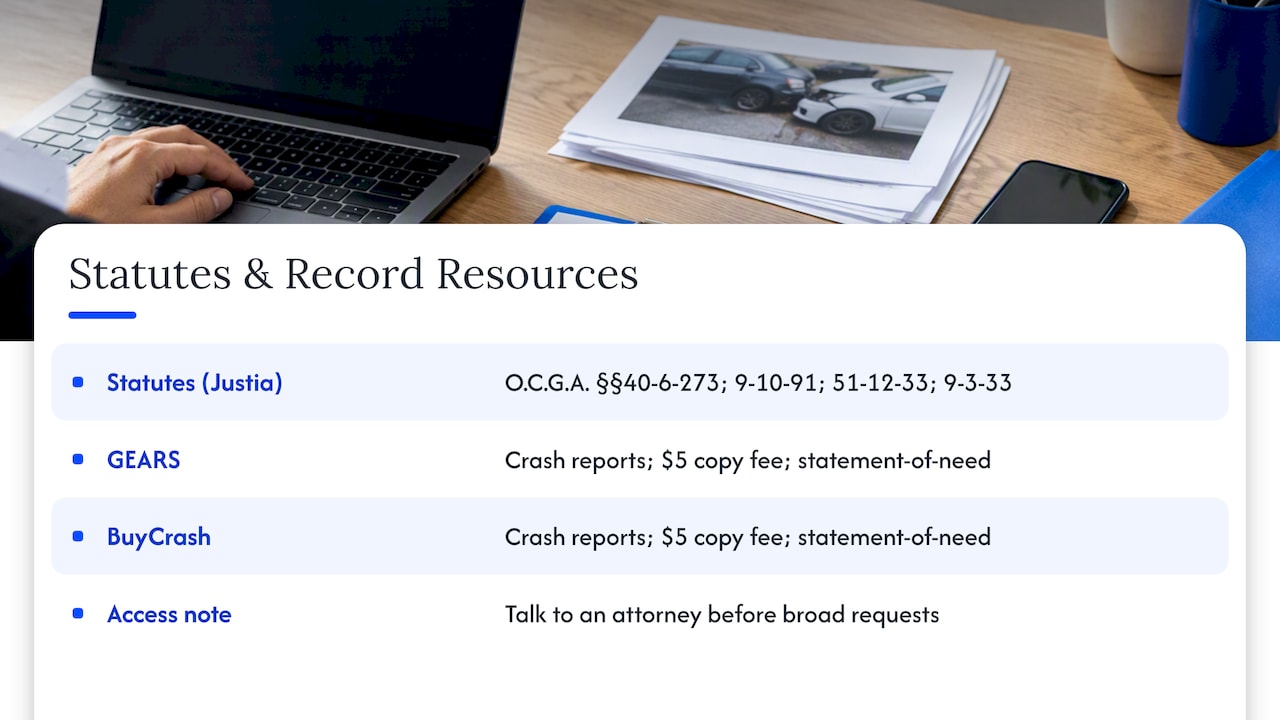
Key statutes cited above include O.C.G.A. §§ 40-6-273, 9-10-91, 51-12-33, and 9-3-33, all available through Justia’s Georgia code library. Crash reports run through GEARS and BuyCrash, with a $5 statutory copy fee and a statement-of-need requirement for anyone not named in the report. Talk to an attorney before filing broad open-records requests, since access rules differ depending on your connection to the crash.
This article is general information, not a substitute for advice from a qualified lawyer. Consult a qualified legal professional about your own circumstances before acting on anything here.
Sources
- Georgia Code § 9-10-91
- Georgia police reports: how to get a crash report or incident report | Recording Law
FAQ
What happens if I get into an accident in a different state?
The laws of the state where the crash occurred, not your home state, generally govern fault, insurance minimums, and filing deadlines. For a Georgia crash, that means Georgia’s tort rules, its 25/50/25 insurance minimums, and its two-year statute of limitations apply even if you live elsewhere.
Who pays for car damage in a no-fault state?
Georgia is not a no-fault state. It’s a tort-based state, meaning the at-fault driver’s liability insurance is responsible for covering the other party’s damage and injuries.
How long does an accident stay on record in Georgia?
Georgia does not publicly specify a single retention period for crash reports, and this detail is not publicly listed by the state’s record-request resources. What’s confirmed is that the report itself becomes available through GEARS and BuyCrash shortly after the crash, and anyone named in it can request a copy for the standard fee.
What should I do first if an out-of-state driver hits me in Georgia?
Report the crash immediately if there’s an injury or at least $500 in damage, exchange information with the other driver, and photograph the scene under O.C.G.A. § 40-6-273. Then contact your insurer and a Georgia attorney before giving a recorded statement to anyone else’s insurance company.
Can I sue an out-of-state driver in a Georgia court?
Yes. Georgia’s long-arm statute, O.C.G.A. § 9-10-91, allows Georgia courts to hear claims against nonresident drivers when the crash happened within the state.