
TL;DR:
- Atlanta construction accident law combines workers’ compensation benefits with third-party civil claims for maximum recovery. Injured workers must report injuries within 30 days and file claims within one year, or risk losing benefits. Multiple parties can be liable, and timely evidence preservation is crucial to success.
Atlanta construction accident law is the body of Georgia statutes and civil rules that govern how injured construction workers can seek compensation after a job site injury. It combines the workers’ compensation system under Georgia Title 34 with the right to file third-party civil claims against negligent contractors, property owners, and equipment manufacturers. Knowing what is Atlanta construction accident law means understanding two parallel legal tracks, not just one. The workers’ compensation track pays medical bills and partial wages. The civil liability track can recover pain and suffering, full lost wages, and punitive damages. Workers who understand both tracks recover far more than those who rely on workers’ comp alone.
What are the legal rights of injured construction workers in Georgia?
Georgia law gives injured construction workers a defined set of protections, but those protections come with strict deadlines. Workers’ compensation benefits pay two-thirds of average weekly wages plus full medical treatment costs. That sounds generous until you realize workers’ comp covers no pain and suffering and no full wage replacement.
The exclusive remedy rule is the most misunderstood part of Georgia construction injury law. It means you generally cannot sue your direct employer in civil court. Workers’ compensation is your only remedy against that employer. The exceptions are narrow: intentional harm by the employer, or an employer operating without required workers’ comp insurance.
The real opportunity lies in third-party claims, which sit completely outside the workers’ comp system. A third-party claim targets anyone other than your direct employer who contributed to the accident. Those claims can reach six or seven figures because they include damages workers’ comp never pays.
Your legal rights also depend on your classification. Subcontractors and independent contractors face a different legal landscape than direct employees. Georgia courts look at the actual working relationship, not just the label on a contract.
Key rights and deadlines every worker must know:
- Report the injury in writing within 30 days under O.C.G.A. § 34-9-80. Verbal notice is legally accepted but far harder to prove in a disputed claim.
- File Form WC-14 with the State Board of Workers’ Compensation to formally open your claim.
- File your workers’ comp claim within one year of the accident or last medical treatment. Late claims are dismissed without exception.
- Choose a panel-approved physician for treatment or risk losing coverage for that visit.
Pro Tip: Written injury notice creates permanent proof. Send it by certified mail so you have a delivery record that no employer can dispute later.
Who can be held liable for construction accident injuries in Atlanta?
Construction accident liability in Atlanta rarely falls on just one party. A single job site involves a general contractor, multiple subcontractors, a property owner, equipment suppliers, and sometimes third-party maintenance firms. Each one carries potential legal responsibility.

OSHA violations and inspection reports are the most powerful objective evidence in establishing negligence. When OSHA cites a contractor for a fall protection failure or an unsafe scaffold, that citation becomes direct proof of a duty-of-care breach. Establishing liability requires proving negligence, a breach of duty of care, and causation. OSHA records make that proof concrete.
Parties who commonly share liability on Atlanta construction sites:
- General contractors carry the broadest safety duty. They control the site and set the safety standards all subcontractors must follow.
- Subcontractors are responsible for the safety of their own crews and the conditions they create in their work zones.
- Property owners can be liable for dangerous site conditions that existed before construction began or that they failed to correct.
- Equipment manufacturers and lessors face product liability claims when defective machinery, scaffolding, or tools cause injury.
- Third-party vendors and maintenance companies share liability when their work or equipment contributes to the accident.
Failing to identify all liable parties directly reduces the total compensation you can recover. A thorough investigation that names every responsible party is not optional. It is the difference between a partial recovery and a full one.
Pro Tip: Request all site safety logs, subcontractor agreements, and equipment maintenance records as soon as possible after the accident. Those documents disappear quickly on active job sites.
How does Georgia’s comparative fault rule affect your claim?
Georgia uses a modified comparative fault standard that directly controls how much money you can recover in a third-party construction accident claim. The rule is straightforward: if you are less than 50% at fault for the accident, you can recover damages. If you are 50% or more at fault, you recover nothing.
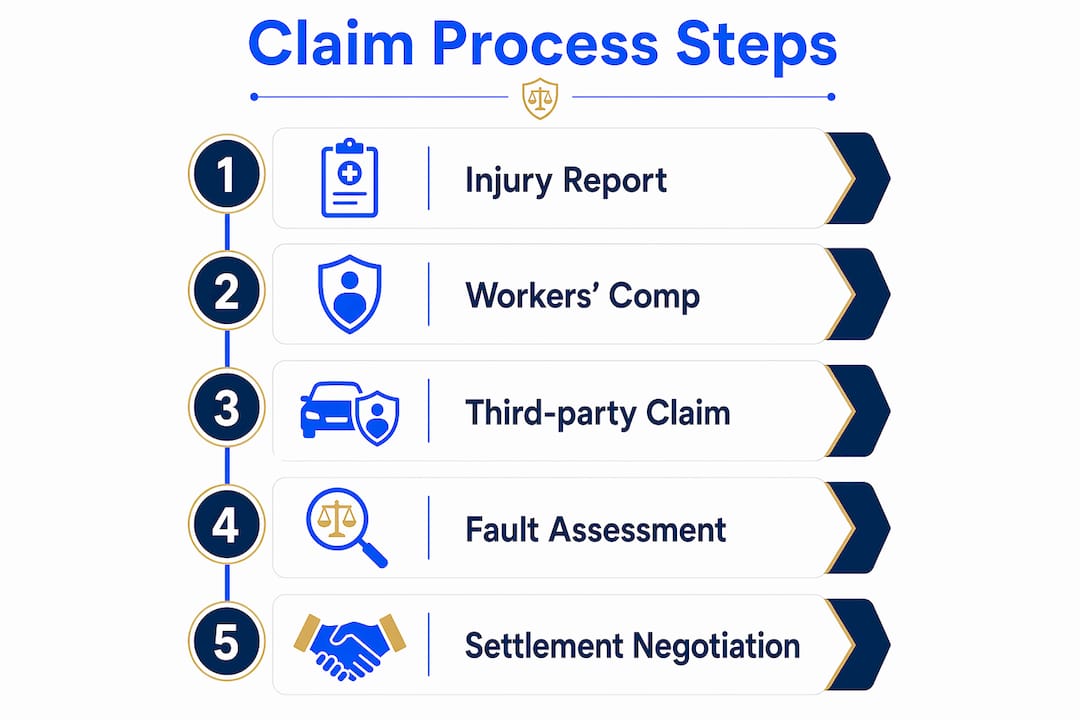
Your recovery is reduced proportionally by your fault percentage. A worker found 20% at fault on a $500,000 claim recovers $400,000. That same worker found 50% at fault recovers zero.
| Fault percentage | Recovery outcome |
|---|---|
| 0% at fault | Full damages recovered |
| 20% at fault | Recovery reduced by 20% |
| 49% at fault | Recovery reduced by 49% |
| 50% or more at fault | No recovery allowed |
This rule applies only to third-party civil claims. Workers’ compensation pays benefits regardless of fault. That distinction matters enormously. A worker who was partially responsible for their own accident still receives workers’ comp benefits, but their third-party civil claim shrinks or disappears depending on the fault percentage assigned.
Insurance adjusters and defense attorneys work aggressively to push your fault percentage above 49%. They do this by pointing to safety rule violations, missing personal protective equipment, or failure to follow site protocols. Understanding how partial fault affects claims before you speak to any adjuster protects your recovery.
Pro Tip: Never give a recorded statement to an insurance adjuster before speaking with a construction accident attorney. Adjusters use those statements to assign you a higher fault percentage.
What steps should you take immediately after a construction accident in Atlanta?
The actions you take in the first 24–72 hours after a construction accident determine the strength of your entire claim. Construction sites change fast. Evidence disappears. Witnesses move on to other jobs. Time is the injured worker’s enemy on rapidly changing sites.
Follow these steps in order:
- Report the injury to your employer in writing the same day. Do not rely on a supervisor’s verbal acknowledgment. Written notice under O.C.G.A. § 34-9-80 is your legal protection.
- Seek medical care immediately. Use a panel-approved provider for workers’ comp coverage. Emergency care is always covered regardless of provider.
- Document the accident scene. Take photos and video of the exact location, the hazard that caused the injury, any missing safety equipment, and the surrounding conditions before anything is moved or cleaned.
- Collect witness contact information. Names and phone numbers of coworkers who saw the accident are critical. Witnesses become harder to locate once a project moves forward.
- File Form WC-14 with the State Board of Workers’ Compensation. This formally opens your workers’ compensation claim and starts the clock on your employer’s response obligations.
- Contact a construction accident attorney before speaking to any insurer. An attorney can send a site preservation letter that legally compels the contractor to maintain site conditions and retain evidence before alterations or cleanup occur.
Documenting accident evidence early is the single most effective thing you can do to protect your claim. Courts and juries rely on physical evidence. When that evidence is gone, your case depends entirely on witness memory and expert reconstruction, both of which are weaker.
Pro Tip: Ask your attorney to send a site-wide evidence preservation letter within 48 hours of the accident. This letter puts every party on legal notice to retain documents, photos, equipment, and site conditions.
Key Takeaways
Atlanta construction accident law gives injured workers two separate legal paths: workers’ compensation for immediate benefits and third-party civil claims for full damages including pain, suffering, and future lost wages.
| Point | Details |
|---|---|
| Report within 30 days | Written notice under O.C.G.A. § 34-9-80 protects your workers’ comp rights and reduces disputes. |
| Two legal tracks exist | Workers’ comp covers wages and medical costs; third-party claims recover pain, suffering, and full lost wages. |
| Multiple parties share liability | General contractors, subcontractors, property owners, and equipment firms can all be held responsible. |
| Comparative fault caps recovery | Being 50% or more at fault bars all recovery in third-party civil claims under Georgia law. |
| Evidence disappears fast | A site preservation letter sent within 48 hours secures critical proof before the site changes. |
What I’ve learned about construction accident cases in Atlanta
Construction workers consistently underestimate what their cases are actually worth. They accept a workers’ comp settlement, sign a release, and walk away from third-party claims worth multiples of what workers’ comp paid. I have seen this pattern repeatedly, and it is entirely preventable.
The biggest mistake is waiting. Workers assume they have time to heal before worrying about legal strategy. Construction sites do not wait. Equipment gets repaired or replaced. Scaffolding gets dismantled. Safety logs get “lost.” By the time an injured worker calls an attorney three months after the accident, the most powerful evidence is often gone.
The second biggest mistake is assuming workers’ comp is the whole story. Workers often mistakenly believe workers’ comp limits their recovery, but a valid third-party claim can exist alongside a workers’ comp claim. These are not competing options. They are parallel strategies that together produce the maximum recovery.
Proving negligence in construction cases is genuinely hard work. You need OSHA records, equipment maintenance logs, subcontractor safety agreements, and witness statements. You need someone who knows which documents to request and how to read them. That is not a job for a general practice attorney. It requires someone who understands how evidence shapes injury claims in Georgia specifically.
My honest advice: call an attorney the same day as the accident if you can. If not, call within 48 hours. The preservation letter alone can be the difference between winning and losing.
— Ali
How Jewkesfirm helps injured construction workers in Atlanta
Construction accident cases in Georgia are complex. They involve multiple liable parties, strict reporting deadlines, and comparative fault rules that insurance companies use aggressively to reduce what they pay you.

Jewkesfirm handles Atlanta construction injury law cases with a thorough, client-first approach. The team investigates every liable party, secures site evidence early, and builds the strongest possible case for maximum compensation. Jewkesfirm works on a contingency fee basis, meaning you pay nothing unless they win. If you or someone you know was injured on a Georgia construction site, get a free case review with Jewkesfirm today. Your rights have deadlines. Do not let them expire.
FAQ
What is Atlanta construction accident law?
Atlanta construction accident law is the set of Georgia statutes and civil rules that govern how injured construction workers seek compensation, combining workers’ compensation benefits with the right to file third-party civil claims against negligent parties.
How long do I have to report a construction injury in Georgia?
Georgia law requires you to report a work-related injury to your employer within 30 days, and you must file a formal workers’ compensation claim within one year of the accident or last medical treatment.
Can I sue someone other than my employer after a construction accident?
Yes. Georgia law allows third-party civil claims against general contractors, subcontractors, property owners, and equipment manufacturers who contributed to the accident, separate from your workers’ compensation claim.
How does fault affect my construction accident claim in Georgia?
Georgia’s modified comparative fault rule reduces your recovery by your fault percentage. If you are 50% or more at fault, you cannot recover any damages in a third-party civil claim.
What does workers’ compensation cover for construction workers in Georgia?
Workers’ compensation covers medical treatment and approximately two-thirds of your average weekly wages. It does not cover pain and suffering, full lost wages, or punitive damages, which is why third-party claims matter.