

Key Takeaways
- Premises liability holds property owners responsible for keeping their premises reasonably safe and compensating visitors harmed by unsafe conditions. Proving a claim requires establishing duty, breach, causation, damages, and owner knowledge of the hazard within the statute of limitations, which is typically two years in Georgia. Owners must act reasonably and document inspections, repairs, and warnings to prevent liability, while injured individuals should promptly report hazards and retain evidence for their case.
Premises liability is defined as the legal responsibility property owners and occupiers have to keep their property reasonably safe and to compensate visitors injured by unsafe conditions caused by their negligence. This doctrine falls under tort law and applies to homeowners, landlords, businesses, and anyone who controls a property. Whether you were hurt on someone else’s property or you own property where someone was injured, understanding premises liability is the first step toward protecting your rights. Jewkes Firm handles these cases regularly across South Atlanta and surrounding Georgia counties, and the legal principles here apply directly to you.
What is premises liability and how does it work?
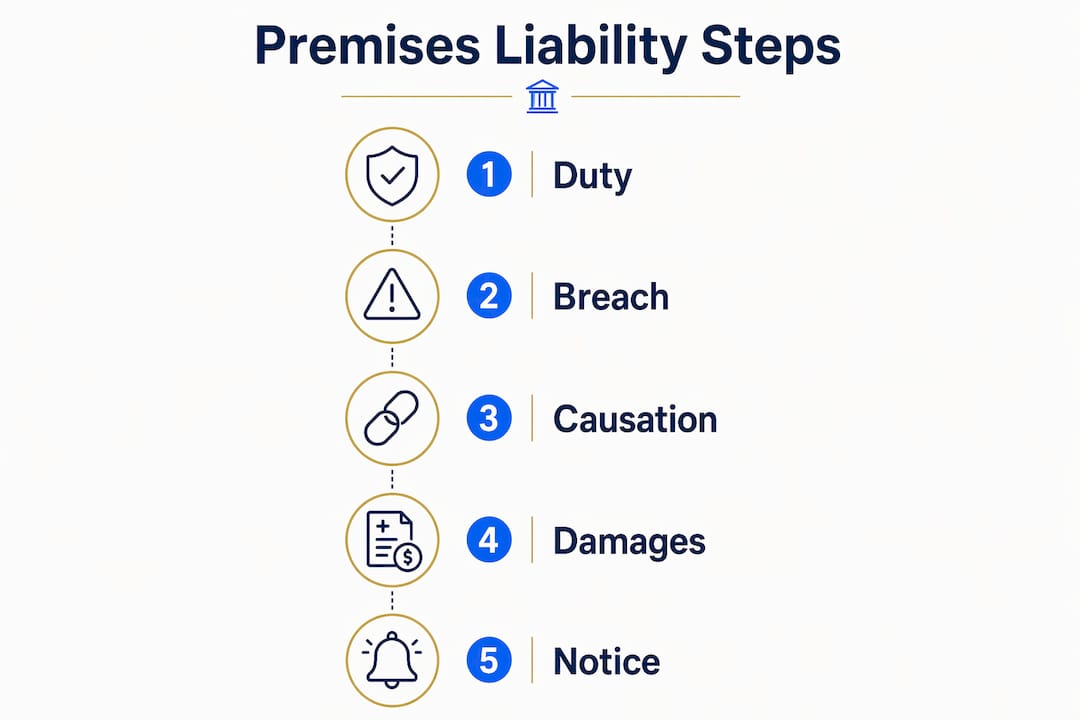
Premises liability is the legal doctrine that holds property owners and occupiers accountable when unsafe conditions on their property cause injury to others. The premises liability definition under tort law requires proving four universal elements: duty of care, breach of that duty, causation, and damages. Each element must be established for a claim to succeed. Missing even one of them typically ends the case.
The duty of care means the property owner had a legal obligation to keep the premises reasonably safe for the person who was injured. Breach means the owner failed to meet that obligation, for example, by ignoring a broken stair or leaving a wet floor unmarked. Causation connects that failure directly to the injury. Damages cover the actual losses suffered, including medical bills, lost wages, and pain and suffering.
One concept that surprises many people is that premises liability is focused on reasonable safety, not perfect safety. A property owner is not expected to prevent every possible accident. The legal standard asks what a sensible, reasonable person in the same position would have done to prevent harm.
What are the essential elements to prove a premises liability claim?
Proving a premises liability claim requires satisfying four legal elements in sequence. Courts apply this framework consistently across premises liability cases, from slip and fall accidents to inadequate security claims.
- Duty of care. The property owner owed a legal duty to the injured person. This duty exists for most lawful visitors, including customers, guests, and tenants.
- Breach of duty. The owner failed to act reasonably. Examples include ignoring a known hazard, skipping routine inspections, or failing to post warning signs near a wet floor.
- Causation. The breach directly caused the injury. A slip on a wet floor that was never marked is a clear causal link. A fall caused by the visitor’s own inattention may break that link.
- Damages. The injured person suffered real, compensable losses. Medical expenses, lost income, and pain and suffering all qualify.
Beyond these four elements, courts also examine the “notice” requirement. A property owner must have had actual or constructive knowledge of the dangerous condition before liability attaches. Actual knowledge means the owner knew about the hazard directly. Constructive knowledge means the hazard existed long enough that the owner should have discovered it through reasonable inspection. Many claims fail because injured persons cannot prove the owner knew or should have known about the danger.
Pro Tip: Document the hazard immediately after an injury. Photograph the scene, note the date and time, and ask for any incident reports. This evidence directly supports the notice element and can make or break your claim.
What common scenarios and hazards cause premises liability claims?
Premises liability examples cover a wide range of property conditions and incidents. Recognizing these scenarios helps both property owners and injured persons understand when liability applies.
- Slip and fall accidents. Wet floors without warning signs, icy walkways, uneven pavement, and broken stairs are the most common causes. These occur in grocery stores, apartment complexes, and private homes alike.
- Inadequate security. A landlord or business that fails to provide adequate lighting, working locks, or security personnel in a high-crime area can be liable if a visitor is assaulted or robbed on the premises.
- Faulty structures. Collapsing railings, rotting decks, and unstable ceilings create serious injury risks. Owners who delay repairs after discovering structural problems face significant exposure.
- Poor lighting. Dim stairwells and unlit parking lots contribute to both falls and criminal incidents. Courts treat inadequate lighting as a foreseeable hazard.
- Debris and maintenance failures. Clutter in walkways, exposed wiring, and unrepaired flooring all qualify as dangerous conditions when they cause injury.
- Landlord liability in common areas. Landlords bear responsibility for shared spaces like hallways, lobbies, and parking lots. Tenants control their own units, but occupiers or tenants who control a dangerous condition can also be held liable, not just the property owner.
One distinction worth understanding: premises liability concerns unsafe property conditions, while personal liability involves individual actions. A business owner who personally shoves a customer faces personal liability. That same owner who ignores a broken step that injures a customer faces premises liability. The two doctrines can overlap, but they are legally distinct.
How do statutes of limitations and insurance affect premises liability claims?
Time limits and insurance coverage are two practical factors that determine whether a premises liability claim can actually be resolved in your favor.
Statutes of limitations for filing premises liability claims vary by state, typically ranging from 1 to 6 years. In Georgia, the window for most personal injury claims is two years from the date of injury. Missing that deadline forfeits your right to compensation, regardless of how strong your case is. The Georgia slip and fall statute of limitations has specific rules worth reviewing before you assume you have time.
| Factor | What it means for your claim |
|---|---|
| Statute of limitations | Filing deadline varies by state; missing it bars all compensation |
| Homeowners insurance | Covers injuries on residential property up to policy limits |
| Commercial general liability | Standard coverage for business premises injuries |
| Occupier vs. owner liability | Tenants controlling a hazard may share or bear full liability |
| Notice to insurer | Delayed reporting to an insurer can reduce or void coverage |
Premises liability claims are most often resolved through insurance coverage, specifically homeowners policies or commercial general liability policies. Insurance pays up to the policy limits when a valid claim is established. Understanding how liability insurance intersects with your claim helps you set realistic expectations for settlement.
Pro Tip: Notify the property owner’s insurer as soon as possible after an injury, even before you have all medical records. Late notification gives insurers grounds to dispute coverage. Your attorney can handle this communication on your behalf.
Insurance companies aggressively defend using statutes of limitations as a primary strategy. They track deadlines carefully and will move to dismiss any claim filed even one day late. Filing promptly is not just good practice. It is a legal requirement that protects your right to be heard.
What responsibilities do property owners have to prevent liability?
Property owners carry an ongoing duty to maintain reasonably safe conditions for lawful visitors. This duty does not require perfection. It requires reasonable care, meaning the kind of attention a sensible person would give to their own property.
Practical owner responsibilities include:
- Regular inspections. Walk the property on a consistent schedule to identify hazards before someone gets hurt. Document each inspection with dates and findings.
- Prompt repairs. Once a hazard is identified, fix it quickly. Delay creates constructive knowledge, which strengthens a claimant’s case.
- Hazard warnings. When a repair cannot happen immediately, post clear warning signs. A “wet floor” cone or a barrier around a broken step demonstrates reasonable care.
- Maintenance records. Keep written logs of all inspections, repairs, and complaints. These records are your primary defense if a claim is filed.
- Visitor-appropriate precautions. The duty of care varies slightly by visitor type. Invitees (customers, guests) receive the highest protection. Licensees (social guests) receive reasonable care. Trespassers generally receive minimal protection, with one major exception.
The shift from visitor status categories toward a reasonable care standard has evolved premises liability law significantly in many jurisdictions. Most states now apply a consistent reasonable care standard to all lawful visitors rather than relying on the old invitee/licensee distinction. The attractive nuisance doctrine is a notable exception: it holds owners liable for injuries to children caused by dangerous features like unfenced pools or abandoned equipment, even when the child was technically trespassing.
Pro Tip: If you own rental property, include a regular inspection clause in your lease and keep copies of all tenant maintenance requests with your responses. This paper trail demonstrates you acted reasonably and can protect you in court.
Key takeaways
Premises liability requires proving duty, breach, causation, and damages, and the notice requirement is the element most likely to determine whether a claim succeeds or fails.
| Point | Details |
|---|---|
| Four required elements | Duty, breach, causation, and damages must all be proven to win a premises liability claim. |
| Notice is the deciding factor | Owners must have actual or constructive knowledge of the hazard before liability attaches. |
| Statutes of limitations | Filing deadlines range from 1 to 6 years by state; missing the deadline bars all compensation. |
| Insurance resolves most claims | Homeowners and commercial general liability policies are the primary source of settlement funds. |
| Reasonable care, not perfection | Owners must act as a sensible person would, not eliminate every conceivable risk. |
The notice requirement is the part most people get wrong
After years of watching premises liability cases unfold, the single most misunderstood element is notice. People assume that if they were hurt on someone’s property, the owner is automatically responsible. That is not how the law works.
The owner must have known about the hazard, or the hazard must have existed long enough that they should have known. A spill that happened two minutes before a fall is very different from a broken step that had been reported three times over six months. Courts draw that line carefully, and so do insurance adjusters.
The second misconception I see constantly is that premises liability and personal liability are the same thing. They are not. Premises liability is about the condition of the property. Personal liability is about individual conduct. A property can be perfectly maintained and still generate a personal liability claim if someone on it acts negligently. Mixing these up leads people to either overestimate or underestimate their exposure.
The reasonable care standard has made liability more consistent across visitor types, which is a genuine improvement over the old classification system. But it has also made it easier for claimants to argue that any lapse in maintenance was a breach of duty. Property owners who think occasional walkthroughs are enough are often surprised by how courts define “reasonable.” Document everything. Fix problems fast. Warn when you cannot fix immediately. That is the standard, and it is applied without much sympathy for owners who treated maintenance as optional.
Jewkes Firm is ready to protect your rights
Premises liability cases move fast, and the evidence that wins them disappears even faster. Whether you were injured on someone else’s property or you are a property owner facing a claim, having experienced legal counsel on your side changes the outcome.

Jewkes Firm represents injured clients across South Atlanta and surrounding Georgia counties, handling slip and fall liability cases and complex premises liability matters with a contingency fee arrangement. You pay nothing unless Jewkes Firm wins your case. The team offers free consultations so you can understand your rights before committing to anything. Contact Jewkes Firm today for your FREE CONSULTATION and get the dedicated advocacy your case deserves.
FAQ
What does premises liability mean in simple terms?
Premises liability is the legal responsibility property owners have to keep their property reasonably safe and to compensate visitors injured by unsafe conditions caused by their negligence.
How do you prove a premises liability claim?
You must prove four elements: the owner owed you a duty of care, they breached that duty, the breach caused your injury, and you suffered real damages. You also need to show the owner knew or should have known about the hazard.
What is the statute of limitations for premises liability in Georgia?
Georgia law gives injured persons two years from the date of injury to file a premises liability claim. Missing this deadline forfeits the right to compensation regardless of the strength of the case.
Can a tenant be held liable for premises liability, not just the property owner?
Yes. Occupiers or tenants who control a dangerous condition on the property can be held liable, even if they do not own it. Liability follows control over the unsafe condition.
What is the difference between premises liability and personal liability?
Premises liability concerns unsafe conditions on the property itself. Personal liability involves the individual actions of a person. A broken staircase is a premises liability issue; a person who intentionally trips someone faces personal liability.