
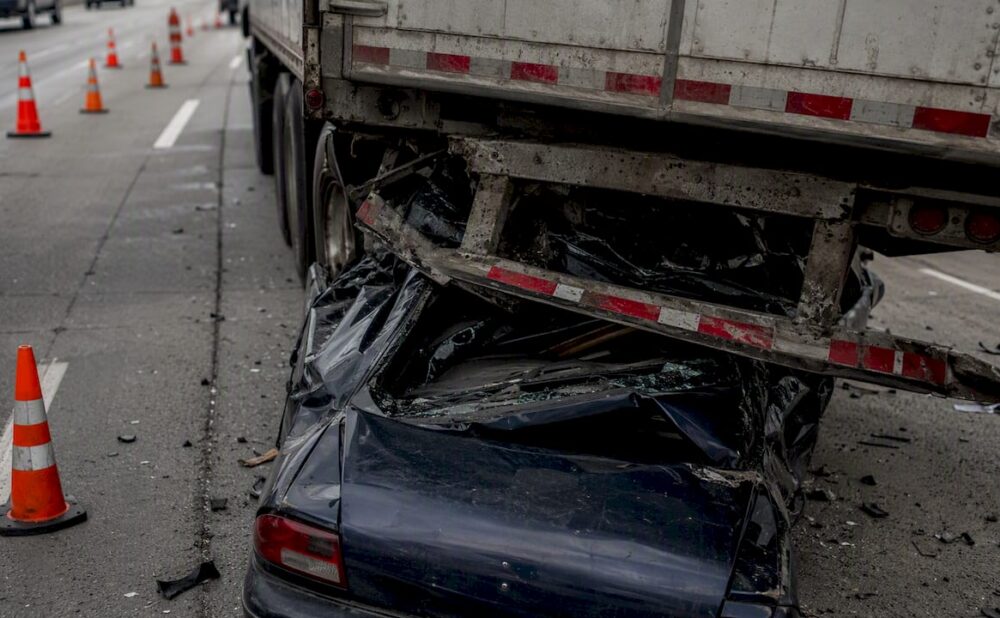
A truck underride accident happens when a smaller passenger vehicle slides beneath the body or trailer of a large truck, causing the truck’s structure to intrude directly into the passenger compartment — and the results are often catastrophic. NHTSA defines these events as among the most structurally destructive collision types on American roads. The GAO documented an average of roughly 219 annual fatalities from underride crashes between 2008 and 2017, and investigators widely agree that number understates reality due to inconsistent state-level reporting.
If you or someone you love was just involved in one of these crashes, the first four steps matter most:
- Call 911 immediately and do not move injured occupants unless there is an immediate fire or safety threat.
- Get a full medical evaluation, even if you feel fine — delayed symptoms are common.
- Photograph the scene, vehicles, road conditions, and any visible injuries before anything is moved.
- Do not give a recorded statement to any insurance adjuster before speaking with an attorney.
Key Takeaways
Truck underride accidents are among the most lethal crash types on American roads because the truck’s structure bypasses all passenger vehicle safety systems and intrudes directly into the occupant space.
| Point | Details |
|---|---|
| Definition and danger | A passenger vehicle slides under a truck or trailer, causing direct structural intrusion into the occupant compartment — bypassing airbags and crumple zones. |
| Annual fatalities | GAO documented roughly 219 average annual underride fatalities (2008–2017), with experts agreeing the true number is higher due to underreporting. |
| Immediate steps | Call 911, accept medical evaluation, photograph the scene, and decline recorded insurance statements before consulting an attorney. |
| Regulatory gaps | FMVSS 223 and 224 cover only rear guards on trailers built after 1996; no federal mandate exists for side or front underride protection. |
| Jewkesfirm | Jewkesfirm represents underride crash victims in South Atlanta and Georgia on a contingency fee basis, with no fees unless compensation is recovered. |
Table of Contents
- What truck underride accidents are and the three types you need to know
- Why the geometry of these crashes makes them so lethal
- How common are underride crashes, and why the data understates the problem
- Injuries from underride collisions and why medical documentation matters
- Federal regulations that govern underride protection — and where they fall short
- Engineering and operational measures that reduce underride risk
- What to do immediately after an underride crash
- Legal options and who can be held liable after an underride crash
- Recent policy and advocacy developments shaping underride safety
- Are underride accidents increasing or decreasing over time?
- Common causes and contributing factors in underride crashes
- Why underride cases demand a different level of legal attention
- Jewkesfirm is ready to fight for underride crash victims in Georgia
- Sources
What truck underride accidents are and the three types you need to know
An underride crash occurs when a passenger vehicle travels under the body of a truck or trailer at a height that bypasses the vehicle’s front bumper, hood, and windshield protection systems. The truck’s undercarriage or trailer floor then contacts the occupant zone directly, rather than the engineered crumple zones designed to absorb impact energy.
Three distinct crash types fall under this category:
Rear underride is the most documented type. A passenger vehicle strikes the back of a stopped or slow-moving trailer and slides beneath it. The trailer’s rear edge can shear off the vehicle’s roof at windshield height, leaving occupants with no overhead protection.
Side underride occurs when a vehicle travels laterally into the side of a trailer, typically at intersections or during lane-change events. Because most trailers have no side guard requirement under federal law, the vehicle slides under the trailer’s full length. Side underrides are particularly deadly because the intrusion zone is directly beside the driver or passenger.

Front underride is less common but documented in cases where a truck rear-ends a smaller vehicle at speed, or where a vehicle crosses into the path of an oncoming truck. The truck’s front bumper and frame override the car’s rear structure.
Partial underride events, where the vehicle slides only partway under the trailer, can still cause severe roof intrusion and head injuries. Full underride, where the vehicle travels completely beneath the trailer, is almost always fatal.
Why the geometry of these crashes makes them so lethal
Modern passenger vehicles are engineered around one core assumption: that a collision will involve contact between bumpers and crumple zones at roughly the same height. Truck trailers sit 48 to 52 inches off the ground. Most passenger car hoods reach about 36 to 40 inches. That gap is where people die.
When a car slides under a trailer, the trailer’s rear cross-member or undercarriage contacts the windshield, A-pillars, and roof — structures that were never designed to absorb frontal crash energy. Airbags typically deploy based on frontal deceleration sensors, but in a rear underride, the car may decelerate gradually as it slides under the trailer rather than stopping abruptly. The airbag may not deploy at all, or may deploy too late to protect the occupant’s head from the descending trailer floor.
Key mechanical failure points in these crashes include:
- Roof shear: The trailer’s rear edge acts like a blade, removing the vehicle’s roof and exposing occupants to direct structural contact.
- Windshield intrusion: Even without full roof removal, the trailer floor can push through the windshield and into the occupant space.
- Seat belt ineffectiveness: Belts restrain the torso but cannot prevent the head from contacting an intruding structure above.
- Crumple zone bypass: The car’s front crumple zone never engages because the collision point is above it.
A NHTSA technical analysis of rear underride crashes found that corner impacts — where the car strikes the trailer at an angle rather than dead center — are especially likely to produce passenger compartment intrusion, even when FMVSS-compliant rear guards are present. That finding matters for both safety engineering and legal claims, because it shows that regulatory compliance does not guarantee occupant protection.
Pro Tip: If you are reconstructing an underride crash for legal purposes, the angle of impact relative to the trailer corner is one of the most critical measurements. Retain a crash reconstruction expert early, before vehicles are repaired or scrapped.

How common are underride crashes, and why the data understates the problem
The GAO’s 2019 report put average annual underride fatalities at roughly 219 per year across the 2008–2017 period. That figure comes with a significant caveat: it reflects only crashes that were coded as underride events in state crash reports. Many states do not have a standardized underride reporting field, and law enforcement officers at the scene may not classify a crash as an underride even when the physical evidence clearly shows it.
The reporting gaps stem from several structural problems:
- No uniform crash coding: States use different data systems, and not all include a specific underride indicator field. An officer may record the crash as a rear-end collision without noting the underride geometry.
- Inspection gaps: FMCSA inspection rules historically did not require annual inspection of trailer rear guards. The GAO specifically recommended that FMCSA revise those regulations to include rear guards in annual inspections — a recommendation that had not been fully implemented as of the GAO’s reporting period.
- Underreporting of non-fatal underrides: Serious injury crashes that do not result in death are even less consistently coded, making it nearly impossible to track injury trends accurately.
- MMUCC revision efforts: The Model Minimum Uniform Crash Criteria (MMUCC) program, which sets voluntary national standards for crash data collection, has been working to add standardized underride data elements. Broader adoption of these elements would improve future counts, but historical data gaps remain.
The practical consequence for victims and attorneys is that official statistics may not reflect the true frequency of these events, and the absence of a crash from official underride counts does not mean it wasn’t one.
Injuries from underride collisions and why medical documentation matters
Underride crashes produce injury patterns that differ sharply from conventional vehicle collisions. The intrusion of the truck’s structure into the passenger compartment means that the head, neck, and upper torso absorb forces that the vehicle’s safety systems were never designed to handle.
Common catastrophic injuries include:
- Traumatic brain injury (TBI): Direct contact between the occupant’s head and the intruding structure, ranging from concussion to severe TBI.
- Decapitation or partial decapitation: In full roof-shear events, this is a documented outcome, particularly in rear underrides.
- Cervical spine fractures: The sudden deceleration and overhead contact frequently fracture the upper cervical vertebrae.
- Thoracic and abdominal crush injuries: When the trailer floor descends into the occupant space, chest and abdominal organs are at risk.
- Facial fractures and eye injuries: Windshield intrusion and structural contact cause severe facial trauma.
- Delayed injuries: Internal bleeding, soft tissue injuries, and psychological trauma (PTSD, anxiety) may not present immediately.
Emergency responders prioritize airway management, cervical spine stabilization, and rapid transport to a trauma center. Standard diagnostic steps include CT imaging of the brain and cervical spine, chest X-ray or CT for internal injuries, and continuous monitoring for internal hemorrhage.
Pro Tip: Request copies of all emergency room records, imaging reports, and EMS run sheets as soon as possible. These documents establish the injury timeline and are critical evidence in any legal claim. A trucking accident injury checklist can help you track what to collect.
Federal regulations that govern underride protection — and where they fall short
Two federal motor vehicle safety standards address rear underride protection for large trailers. Both are codified in federal regulation and apply to trailers with a gross vehicle weight rating (GVWR) of 10,000 pounds or greater manufactured after the applicable compliance dates.
| Standard | Scope | Main Requirement | Year Adopted |
|---|---|---|---|
| FMVSS 223 | Rear impact guard equipment (the guard itself) | Dimensional and strength testing requirements for the guard hardware | 1996 |
| FMVSS 224 | Rear impact protection (installation on trailers) | Requires qualifying trailers to be fitted with a compliant rear guard | 1996 |
Both standards apply only to rear guards. There is no federal mandate for side underride guards or front underride guards on large trucks or trailers. NHTSA’s ongoing research program has studied guard performance, but the agency has not finalized rules requiring side or front protection as of 2026.
Regulatory gaps that affect real-world safety include:
- No side guard requirement: Side underrides, which are frequently fatal at intersections, occur on trailers with no federal protection mandate.
- Older trailers are exempt: Trailers manufactured before the 1996 compliance dates are not required to be retrofitted.
- Inspection gaps: Annual truck inspections under FMCSA rules have not historically included rear guard condition as a required check point, meaning damaged or non-compliant guards can remain in service.
- Strength testing limitations: The federal strength test does not replicate corner-impact scenarios, which NHTSA’s own crash data shows are the most dangerous.
Engineering and operational measures that reduce underride risk
The gap between what federal standards require and what technology can deliver is significant. IIHS has developed more demanding test scenarios — full-width, 50% overlap, and 30% overlap impacts at 35 mph — that go well beyond the federal minimum. Trailer manufacturers who meet these thresholds earn IIHS TOUGHGUARD recognition, and the performance difference between a TOUGHGUARD-rated guard and a minimum-compliant guard in corner-impact scenarios is substantial.
Rear guards are the most mature technology. TOUGHGUARD-rated guards use heavier steel sections and improved mounting geometry to resist corner impacts that defeat standard guards.
Side underride guards are available commercially and are standard equipment in several European markets, but remain voluntary in the United States. Advocacy groups argue that mandating them would prevent a significant share of intersection fatalities.
Front underride protection is the least developed category. Some heavy-duty trucks use front bumper extensions, but no federal standard exists.
Operational and fleet-level measures also reduce risk:
- Conspicuity tape: Federal rules require retroreflective tape on trailer sides and rear. Damaged or missing tape dramatically reduces nighttime visibility.
- Lighting maintenance: Functioning marker lights and brake lights are required and critical for rear-approach warning.
- Speed management: Slower trailer speeds give following vehicles more time to react and reduce impact energy.
- Advanced driver assistance systems (ADAS): Automatic emergency braking (AEB) on trucks can reduce rear-end collision frequency.
Pro Tip: If you drive regularly near large trucks, maintain at least a four-second following distance behind trailers and avoid positioning your vehicle in a truck’s blind spots, particularly alongside the trailer’s rear quarter — the zone most likely to produce a side underride in a lane-change event.
What to do immediately after an underride crash
The actions taken in the first hours after a crash directly affect both your health outcome and the strength of any legal claim. Follow this sequence:
- Ensure immediate safety. If the vehicle is drivable and there is a fire or fuel leak risk, move away from traffic. Otherwise, stay put and wait for emergency services.
- Call 911. Request police and EMS. A police report is a foundational legal document.
- Accept medical evaluation. Even if you feel uninjured, accept transport or go directly to an emergency room. Adrenaline masks pain, and delayed TBI symptoms can be life-threatening.
- Document the scene. Photograph the vehicle positions, the trailer undercarriage, road conditions, skid marks, lighting, and any visible injuries — before vehicles are moved.
- Collect information. Get the truck driver’s name, CDL number, carrier name, DOT number, and insurance information. Photograph the truck’s license plate and DOT markings.
- Gather witness contacts. Names and phone numbers of bystanders can be critical if the driver’s account later conflicts with the physical evidence.
- Request the police report number. Follow up to obtain the full report as soon as it is available.
- Preserve digital evidence. Back up any dashcam footage immediately. Do not delete phone photos or videos.
- Do not give recorded statements. Insurance adjusters may contact you within hours. Politely decline to give any recorded statement until you have spoken with an attorney.
Pro Tip: Do not allow your vehicle to be repaired or released to a salvage yard before an attorney or expert can inspect it. The vehicle itself is physical evidence. Review how to handle insurance after a trucking crash before responding to any adjuster contact.
Legal options and who can be held liable after an underride crash
Underride crashes often involve multiple parties whose negligence or product failures contributed to the outcome. Understanding who can be held responsible is the first step toward meaningful legal recourse.
Potential defendants include:
- The truck driver (distracted driving, fatigue, improper stopping)
- The motor carrier or trucking company (negligent hiring, inadequate training, hours-of-service violations)
- The trailer manufacturer (defective underride guard design or manufacturing defect)
- Guard component manufacturers (defective hardware)
- Maintenance providers (failure to repair or replace damaged guards)
- Loading and securement parties (improperly loaded cargo that contributed to the crash)
Common legal theories in underride cases:
- Driver negligence: Failure to maintain safe speed, improper lane changes, stopping in a travel lane without adequate warning.
- Negligent entrustment or supervision: The carrier knew or should have known the driver was unfit or the trailer was non-compliant.
- Product liability: The underride guard failed to perform as designed or was defectively manufactured.
- Negligent maintenance: The guard was damaged and not repaired; conspicuity tape was missing or degraded.
- Regulatory violations: Failure to comply with FMVSS 223/224, FMCSA hours-of-service rules, or inspection requirements.
Evidence attorneys rely on in these cases:
- Police crash report and any supplemental officer notes
- Electronic logging device (ELD) and GPS telematics data from the truck
- Truck and trailer maintenance logs and inspection records
- Surveillance video and dashcam footage from nearby vehicles or businesses
- Expert crash reconstruction analysis
- Medical records documenting injury causation and severity
- Carrier safety records from FMCSA’s Safety Measurement System (SMS)
Procedural cautions are critical. Georgia’s statute of limitations for personal injury claims is generally two years from the date of injury, but evidence preservation deadlines are far shorter. Trucking companies are required to retain certain records for limited periods, and telematics data can be overwritten within days. An experienced trucking accident attorney should send a preservation letter to the carrier within days of the crash, not weeks.
Recent policy and advocacy developments shaping underride safety
The regulatory picture has been moving, slowly, in the direction of stronger protections. Several developments are worth tracking:
- GAO 2019 recommendations: The GAO called on NHTSA to study side and front underride protection, on FMCSA to add rear guard inspection to annual requirements, and on both agencies to improve crash data collection. Implementation has been partial.
- IIJA directives: The Infrastructure Investment and Jobs Act included provisions that directed DOT activity on underride protections and funded advisory committee reviews, giving NHTSA a legislative push to revisit rulemaking.
- MMUCC revisions: Proposed updates to the Model Minimum Uniform Crash Criteria would add standardized underride data fields to state crash reports, which would improve future fatality counts and strengthen the evidence base for rulemaking.
- STOP Underrides Act: Advocacy group StopUnderrides.org has supported congressional legislation that would require side and front underride guards on large trucks and trailers. The bill has been introduced in multiple congressional sessions without final passage, but advocacy pressure continues.
- IIHS and industry testing: Advocacy data and IIHS testing results have demonstrated that stronger guards are commercially available, which undermines industry arguments that stronger standards are technically infeasible.
- ProPublica investigative reporting has documented long-term agency inaction and industry resistance to stricter underride protections, adding public pressure to the regulatory process.
For victims, these policy shifts matter practically: improved data collection means better expert support in litigation, and new rulemaking activity can establish what the industry knew and when — relevant to negligence and product liability claims.
Are underride accidents increasing or decreasing over time?
The honest answer is that the data is too inconsistent to draw a clean trend line. The GAO’s figure of roughly 219 average annual fatalities covers 2008–2017, but because underride events are systematically undercounted in state crash reports, year-over-year comparisons are unreliable. A drop in reported underride deaths in a given year may reflect improved safety or simply a change in how a large state coded its crashes.
What the broader truck safety data does show is that large truck crash fatalities overall have trended upward in recent years, driven by increased freight volume, more miles traveled, and driver shortage pressures that can affect training and rest compliance. The Federal Motor Carrier Safety Administration tracks large truck crash fatalities annually, and those numbers have risen since the mid-2010s lows. Whether underride crashes track that broader increase proportionally is unknown without better data.
The push for standardized MMUCC underride reporting fields is partly motivated by this problem. Until states adopt uniform coding, researchers and attorneys alike are working with incomplete information, and the true trend remains obscured.
Common causes and contributing factors in underride crashes
Underride crashes rarely have a single cause. They typically result from a combination of driver behavior, vehicle condition, environmental factors, and regulatory gaps.
Driver and operational factors:
- Sudden or unexpected stops: A trailer stopping in a travel lane, on a highway shoulder, or at an intersection without adequate warning is one of the most common setups for a rear underride.
- Inadequate conspicuity: Missing, damaged, or dirty retroreflective tape and non-functioning lights make trailers nearly invisible at night or in low-visibility conditions.
- Truck driver fatigue: Hours-of-service violations contribute to slow reaction times and poor judgment about where to stop.
- Improper lane changes: A truck merging into a lane occupied by a smaller vehicle can create a side underride scenario.
Vehicle and maintenance factors:
- Damaged or missing rear guards: Guards that have been bent, cracked, or improperly repaired in prior incidents may fail in a subsequent crash.
- Non-compliant guard height: Guards that have shifted out of the required height range due to trailer wear or improper installation no longer provide the protection the standard assumes.
- Older trailers without guards: Pre-1996 trailers are not required to have compliant guards and may have no rear protection at all.
Environmental and road factors:
- Low-light conditions: A disproportionate share of underride fatalities occur at night or in poor visibility, when trailer conspicuity is most critical.
- High-speed roadways: Higher approach speeds give the passenger vehicle driver less time to react to a stopped or slow trailer.
- Intersection geometry: Side underrides frequently occur at intersections where a truck is turning and a vehicle approaches from the side, placing the passenger vehicle alongside the trailer’s unprotected midsection.
Understanding these contributing factors is not just academic. In a legal claim, each factor points to a potential defendant and a specific theory of liability.
Why underride cases demand a different level of legal attention
Underride crashes are not standard truck accident cases. The physical evidence degrades fast, the liable parties multiply quickly, and the injuries are severe enough that the stakes of a poorly handled claim are enormous.
At Jewkesfirm, trucking cases involving underride crashes require a coordinated approach from day one: preservation letters to the carrier, early retention of crash reconstruction experts, and careful review of the trailer’s maintenance and inspection history. The medical complexity alone — TBI, spinal injuries, and delayed-onset conditions — means that rushing to settlement before the full injury picture is clear can leave victims significantly undercompensated.
These cases also tend to involve well-resourced defendants. Trucking companies and their insurers move quickly after a crash to protect their interests. Victims deserve representation that moves just as fast. If you or a family member was involved in an underride crash in South Atlanta or the surrounding Georgia counties, a case evaluation with Jewkesfirm costs nothing and carries no obligation.
Jewkesfirm is ready to fight for underride crash victims in Georgia
Surviving an underride crash — or losing someone to one — puts you up against a trucking company, its insurer, and their legal team almost immediately. Jewkesfirm represents underride crash victims and their families across South Atlanta and surrounding Georgia counties on a contingency fee basis: you pay nothing unless the firm recovers compensation for you.

The firm handles every stage of an underride claim: evidence preservation, expert retention, insurer negotiations, and litigation when carriers refuse to offer fair compensation. When you come in for a free consultation, bring any photos from the scene, the police report number, your medical records, and any insurance correspondence you have received. If you have nothing yet, that is fine too — the evaluation starts wherever you are.
To start your free case review, contact Jewkesfirm today. The sooner evidence is preserved, the stronger your claim.
Sources
These primary sources and advocacy organizations provide the most reliable information on underride crash safety, regulation, and policy:
- Underride protection for truck trailers | NHTSA press release
- Truck Underride Guards: Improved Data Collection, Inspections, and Research Needed | U.S. GAO
- Analysis of Rear Underride in Fatal Truck Crashes (NHTSA crash data report)
- eCFR — §571.223 — Rear impact guards; incorporated FMVSS references
- Underrides fact sheet and history (truck safety advocacy PDF)
This article is general information, not a substitute for advice from a qualified lawyer. Consult a qualified legal professional about your own circumstances before acting on anything here.