

You may be able to handle a straightforward property damage claim yourself. But injuries, disputed fault, unclear insurance coverage, or approaching deadlines can make legal advice useful. If you are asking, “Should I get a lawyer for a car accident?” start with what remains unresolved.
Consulting a Georgia Auto Accidents Attorney gives you an opportunity to discuss those questions before deciding whether to hire one. This checklist explains when independent handling may be reasonable, what complications deserve closer review, and which fee questions to ask. A consultation, an agreement to represent you, and a decision to file a lawsuit are separate steps.
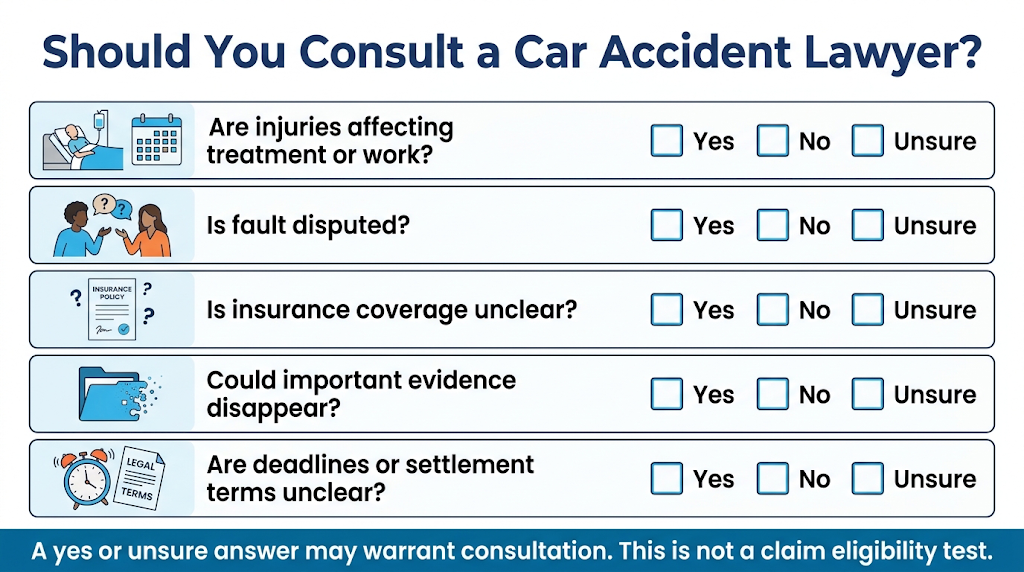
Start Here: A Yes/No Car Accident Lawyer Checklist
Use these questions to identify what remains unresolved after your collision. A “yes” suggests an issue worth discussing with an attorney. An “unsure” answer can also justify consultation. You do not need a certain number of answers to seek advice.
Are Injuries Affecting Your Treatment, Work, or Daily Life?
Consider whether your condition makes it difficult to assess your losses.
| Question | If yes or unsure |
| Are symptoms continuing or treatment needs unclear? | Obtain medical guidance and consider legal advice about documenting the claim. |
| Have you missed work or received work restrictions? | Gather wage records and written restrictions for review. |
| Are future care costs unresolved? | Ask what medical evidence is needed to assess those needs. |
Is Fault or Insurance Coverage Disputed?
Conflicting accounts or unclear coverage can require further investigation.
| Question | If yes or unsure |
| Does another driver or insurer blame you? | Preserve supporting evidence and ask how responsibility is being assessed. |
| Are multiple vehicles, businesses, or policies involved? | Consider consultation about potentially responsible parties and available coverage. |
| Has an insurer denied coverage or questioned payment? | Request the written explanation and have the relevant policy terms reviewed. |
Are Evidence, Deadlines, or Settlement Terms Unclear?
Seek prompt review if important video may disappear, a deadline may be approaching, or you are being asked to accept unfamiliar terms.
If every answer is “no,” independent handling may be reasonable for a straightforward claim. Reassess if circumstances change. This checklist does not establish claim eligibility, value, or the deadline that applies to you.
When You May Be Able to Handle the Claim Yourself
Independent handling may be reasonable when the claim is straightforward, and you can explain both your losses and the proposed payment. Focus on what remains unresolved rather than the collision’s appearance alone.
Responsibility and Documented Losses Are Clear
You may feel comfortable communicating with the adjuster when responsibility is accepted, and the claimed expenses are supported by records. Ask for an itemized explanation of the offer so you can identify excluded amounts or unexplained reductions. Georgia’s insurance regulator recommends this step.
The Claim Involves Straightforward Property Damage
A vehicle repair claim may be manageable when estimates, coverage, and payment terms are clear. Keep photos, estimates, receipts, and correspondence together.
Before accepting, check whether any agreement addresses only property damage or includes other claims. Do not assume the payment’s description explains the full release.
Changes That Should Prompt Another Look
Reassess your approach if:
- New symptoms or treatment needs emerge.
- Additional damage or expenses become disputed.
- The insurer changes its position on responsibility or coverage.
- You receive terms you cannot confidently explain.
A claim that initially seemed simple may require further review before you can make an informed decision.
Signs Legal Advice May Be Useful
Consider a consultation when an unresolved issue makes it difficult to assess your claim or respond confidently to an insurer. The purpose is to understand the problem, the evidence needed, and whether representation would help.
Injuries or Lost Earnings Complicate the Claim
Ongoing symptoms, work restrictions, or uncertain treatment needs can make losses harder to document. Your clinician assesses your condition and appropriate care. An attorney can evaluate how the medical evidence and employment records support the legal claim.
Useful records include:
- Treatment notes and written work restrictions.
- Medical bills and recommended follow-up care.
- Pay statements and employer confirmation of missed work.
Avoid judging an injury solely by visible vehicle damage or assuming every symptom was caused by the collision.
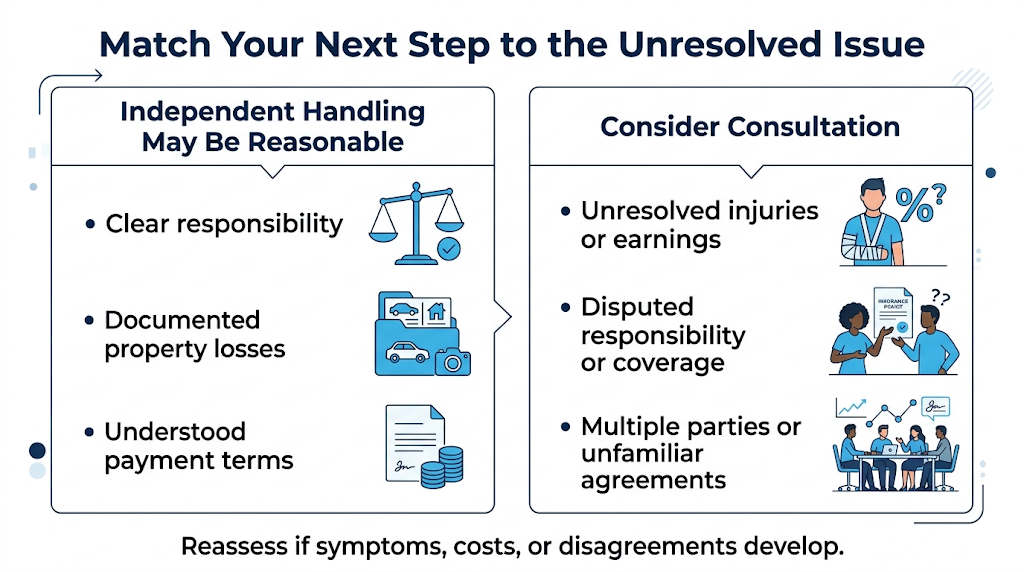
Multiple Drivers, Businesses, or Insurance Policies Are Involved
A collision involving several vehicles, a commercial driver, or work-related travel may raise questions about responsibility and coverage. An attorney can investigate those relationships and review potentially applicable policies.
If an insurer denies coverage, request its written explanation. A denial may require review, but it does not automatically establish misconduct or guarantee that another policy will pay.
Important Evidence May Become Unavailable
Relevant evidence might include nearby surveillance video, dashcam footage, witness accounts, or vehicle data. Availability and retention periods vary.
Consider prompt advice when you know evidence exists but cannot obtain it or are unsure how to preserve it. Keep original files and avoid editing or deleting relevant material.
An Offer or Release Raises Unanswered Questions
Seek clarification if you cannot identify which losses the payment covers, who is being released, or what obligations continue afterward. Georgia’s limited-release statute addresses certain settlements involving multiple insurers, making the wording and circumstances important.
What a Car Accident Attorney Can Do
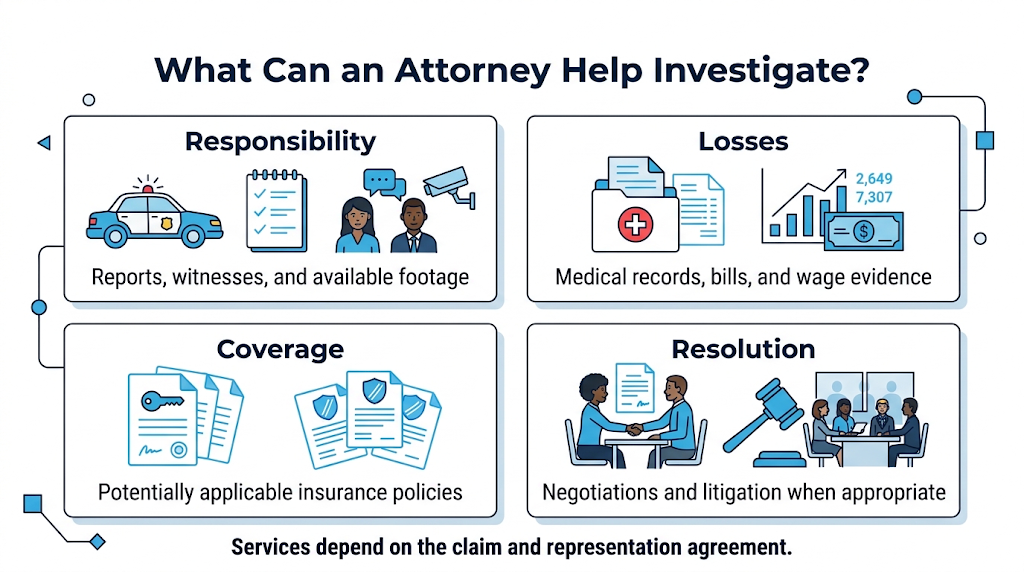
A car accident attorney can investigate unresolved issues, explain your options, and handle agreed parts of the claim. The services provided depend on your circumstances and representation agreement.
Investigate Responsibility and Preserve Evidence
An attorney may obtain accident reports, contact witnesses, request relevant records, and take steps to preserve available evidence. Where appropriate, the investigation may involve qualified specialists.
The goal is to assess competing accounts and identify evidence supporting or challenging them. Hiring an attorney does not guarantee that missing footage or other records can be recovered.
Document Losses and Review Available Coverage
An attorney can organize medical records, bills, wage evidence, and other documentation to assess claimed losses. They may also examine potentially applicable policies and investigate coverage disputes.
Ask whether representation includes vehicle damage, bodily injury, repayment issues, or only specified parts of the claim.
Handle Negotiations and Litigation When Appropriate
An attorney can communicate with insurers, present supporting evidence, and explain proposed settlement terms. If necessary and within the agreed scope, they can file a lawsuit and represent you through litigation.
Ask how you will receive updates, who will handle your questions, and which decisions require your approval.
Georgia Rules That Can Affect Your Decision
Georgia’s fault rules and filing deadlines can make legal advice useful even when you are already communicating with an insurer.
How Shared Fault Can Affect Recovery
Under Georgia’s comparative-fault rule, recoverable damages are generally reduced by your share of responsibility. If you are 50% or more responsible, you cannot recover damages under that rule.
An adjuster’s proposed fault percentage is not a court ruling. If you disagree, ask which evidence supports the assessment and preserve records that may challenge it.
Lawsuit Deadlines and Insurance Requirements Are Different
Georgia’s general filing periods are:
- Personal injury: Two years after the claim accrues, usually the collision date.
- Vehicle property damage: Generally four years after the claim accrues.
Exceptions can change these periods. Claims involving government entities may also require earlier notices. Confirm the requirements for your circumstances rather than relying only on these general timeframes. Your insurance policy may impose separate notice and cooperation duties. Review those terms promptly; a lawsuit deadline does not tell you when your insurer expects notification.
Why Ongoing Negotiations Do Not Automatically Protect Deadlines
An open claim, pending records request, or continuing settlement discussion does not itself file a lawsuit or automatically pause the filing clock.
If a deadline may be approaching, seek individual advice promptly. Confirm whether an attorney has accepted responsibility for taking the required action.
Is Hiring a Lawyer Worth the Cost?
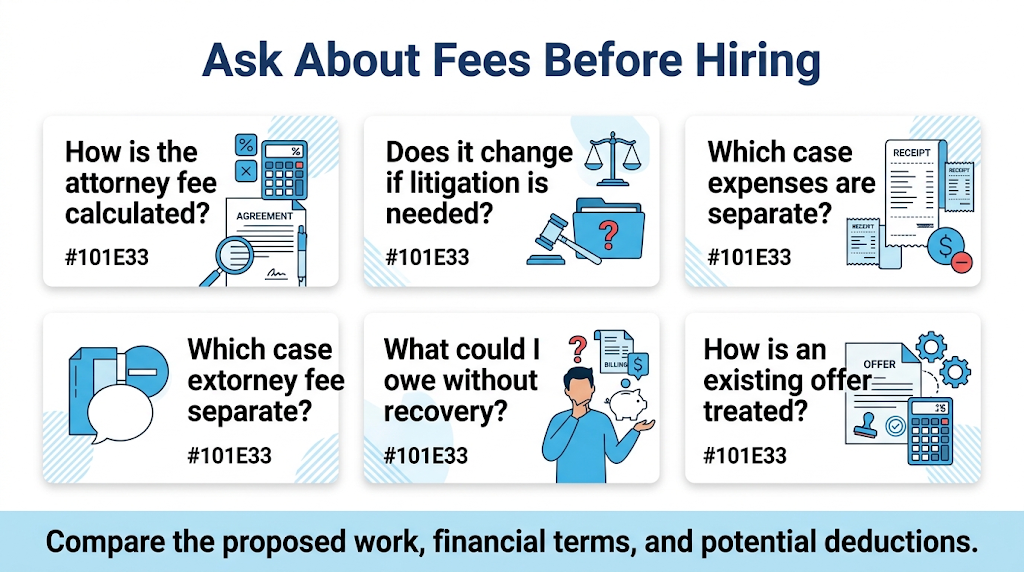
The answer depends on the work your claim needs and the proposed financial terms. Legal help may address disputed evidence, coverage, or losses, but it does not guarantee that you will receive more money after deductions.
Understand Contingency Fees and Case Expenses
Under a contingency arrangement, the attorney’s fee depends on a recovery. Georgia requires a written agreement explaining the fee calculation, applicable percentages, expenses deducted from recovery, and whether expenses come out before or after calculating the fee. Ask whether the percentage changes during litigation and what expenses you could owe without a recovery.
Compare Total Recovery With Your Net Proceeds
The settlement amount is not necessarily what you keep. Attorney fees, case expenses, and valid repayment obligations may reduce your proceeds.
Request a written illustration using the proposed terms. Treat it as an explanation of deductions, not a prediction of your result.
Clarify How an Existing Offer Affects the Fee Agreement
If you already have an offer, disclose it before hiring. Ask whether the fee applies to the entire recovery, how expenses would be handled, and what additional work the attorney proposes.
Evaluate those answers alongside the unresolved issues in your claim.
What to Bring to a Car Accident Consultation
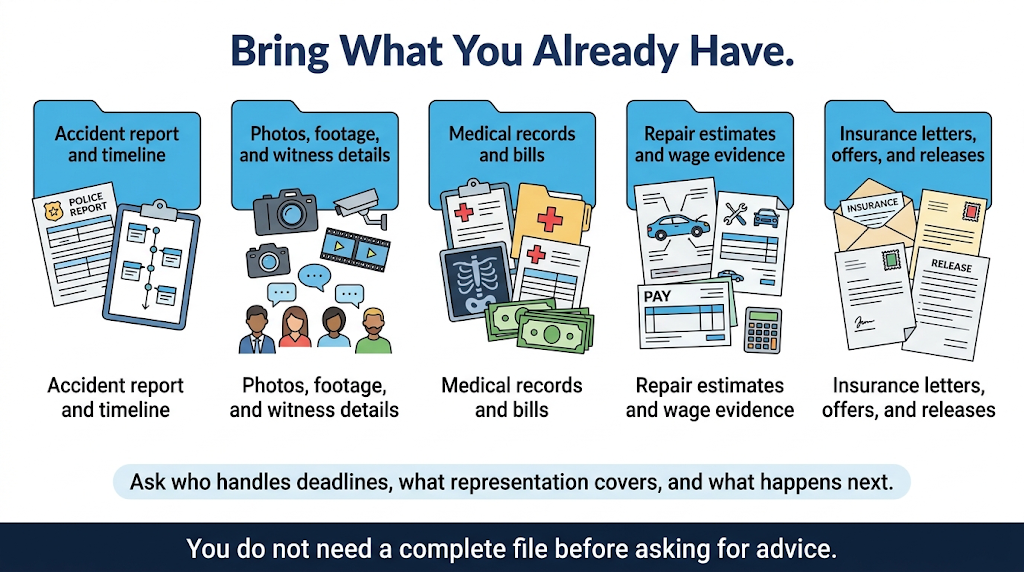
Bring the information you already have. You do not need a complete file before asking about an unresolved claim or approaching a deadline.
Accident Reports, Photos, and Witness Information
Useful items include:
- The accident report or report number.
- Original photos, dashcam recordings, and other available footage.
- Witness names and contact information.
- A short timeline identifying what you remember and what remains uncertain.
Keep original files intact and distinguish your observations from information supplied by others.
Medical Records, Wage Evidence, and Insurance Correspondence
Share available treatment records, bills, work restrictions, and proof of missed earnings. Include insurance information, claim numbers, coverage letters, settlement offers, and proposed releases. Tell the attorney about any terms you have already accepted or documents you have signed. Ask how to submit sensitive records securely.
Questions About Representation, Fees, and Next Steps
Before the consultation ends, clarify:
- Has the firm accepted representation?
- What parts of the claim would it handle?
- How would fees and expenses work?
- Who is responsible for upcoming deadlines?
- What additional information is needed?
Working With The Jewkes Firm in Georgia
The Jewkes Firm handles Georgia auto accident matters and offers free initial consultations. You can discuss the collision, explain unresolved concerns, and ask whether representation fits your circumstances.
Relevant Experience and Scope of Representation
The firm’s website describes experience handling rear-end collisions, side-impact crashes, and other automobile accidents. It also identifies lead attorney Jordan Jewkes’ background in insurance defense, which is relevant when discussing how insurers assess claims
Ask how the firm would investigate disputed responsibility, review available coverage, or document injury-related losses. Confirm whether proposed representation includes bodily injury, vehicle damage, or both. Discuss the work your claim needs alongside the proposed fees and expenses.
Local Consultation Options
The Tyrone office is located at 1155 Senoia Road, Suite 102, Tyrone, GA 30290. The firm also lists offices in Griffin and LaGrange. Business hours are Monday through Friday, 8 a.m. to 5 p.m. Call [(770) 771-5130 (line 7707715130)](tel:7707715130) before visiting to confirm your meeting location and ask about parking, entrance access, or any accommodations you need.
Verified Client Feedback
A Google review reproduced on the firm’s website highlights communication:
“Exceptional service and great communication.” — Noble Asaru
This feedback describes one reviewer’s experience. It does not establish an auto accident case result or predict your outcome.
Frequently Asked Questions
Do I Need a Lawyer If the Other Driver Admits Fault?
Not necessarily. An admission may help clarify what happened, but questions about insurance coverage, injuries, and compensation can remain. Consider consultation if those issues are unresolved or the insurer disputes the driver’s account.
Can I Hire a Lawyer After Starting the Claim Myself?
Yes. You can seek advice after reporting the collision or communicating with an adjuster. Share previous correspondence, offers, signed documents, and upcoming deadlines. Confirm whether the firm accepts representation and what it will handle.
Does Hiring an Attorney Mean Going to Court?
No. An attorney may investigate the claim and negotiate without filing a lawsuit. Litigation may become appropriate if disputes remain or a filing deadline approaches. Ask how the proposed scope and fees would change if a lawsuit becomes necessary.
What If I Am Unsure Whether I Was Injured?
Discuss symptoms and medical concerns with a qualified clinician. An attorney can address legal questions, but cannot replace a medical assessment. Keep accurate records of symptoms, treatment, and any effects on work or daily activities.
Can I Seek Advice Before Accepting an Insurance Offer?
Yes. You can consult an attorney about the offer, supporting evidence, and proposed release before deciding. Ask what remains unresolved and what deductions or obligations could affect your proceeds. Do not assume an accepted agreement can easily be canceled or reopened.
Request a Free Georgia Car Accident Consultation
If the checklist leaves you with unanswered questions, discuss your circumstances with The Jewkes Firm. Explain your injuries, any disputed responsibility, insurance concerns, and approaching deadlines.
Request a free consultation with a Georgia Auto Accidents Attorney. Ask what investigation may be needed, whether representation fits your claim, and how fees and expenses would apply. The firm offers free initial consultations for auto accident inquiries.
The Jewkes Firm
Address: 1155 Senoia Rd #102, Tyrone, GA 30290
Phone: (770) 771-5130