

You may not need a lawyer if your workers’ compensation claim is accepted, authorized treatment is provided, and appropriate benefits arrive without a dispute. A Georgia Workers’ Compensation Lawyer can help assess your options if your claim is denied, treatment is delayed, payments stop, or work restrictions create uncertainty about returning to your job.
For Georgia workers, the decision depends on how the claim is progressing and which questions remain unresolved. Workers’ compensation follows different rules from a personal injury lawsuit, including its own benefit categories, deadlines, and attorney fee limits.
This guide explains when handling a claim yourself may be reasonable and when a consultation could help. Asking for advice does not commit you to hiring an attorney or accepting a settlement.
When You May Be Able to Handle a Claim Yourself
An accepted claim does not automatically require a lawyer. You may be comfortable managing it yourself when treatment is authorized, benefit payments are accurate, and no significant questions remain unresolved.
Your Claim Is Accepted, and Benefits Are Being Provided
Check more than whether someone says the claim is approved. Confirm that you understand which treatment and benefits are being provided, how payments were calculated, and whom to contact about problems.
Keep copies of injury reports, medical documents, payment records, and correspondence. Compare benefit payments with your wage information and ask for an explanation if something appears incorrect.
A cooperative claims process may be manageable without representation, but acceptance does not mean every future treatment request or benefit issue has been resolved.
Your Treatment and Return-to-Work Arrangements Are Clear
You should understand your authorized treatment plan and any medical work restrictions. If you are offered modified duties, compare the actual tasks with those restrictions and raise discrepancies promptly.
Consider seeking advice if:
- Treatment requests remain unresolved.
- Payments stop or change without a clear explanation.
- Proposed duties appear inconsistent with medical restrictions.
- Lasting limitations or settlement discussions create uncertainty.
You can request a consultation at any stage without assuming you must hire counsel.
Signs You May Need a Workers’ Compensation Lawyer
Legal advice may help when a disagreement prevents you from understanding or receiving the benefits you believe are due. A lawyer can review the explanation, identify missing evidence, and assess the available next steps.
Your Claim Is Denied, or Work-Relatedness Is Disputed
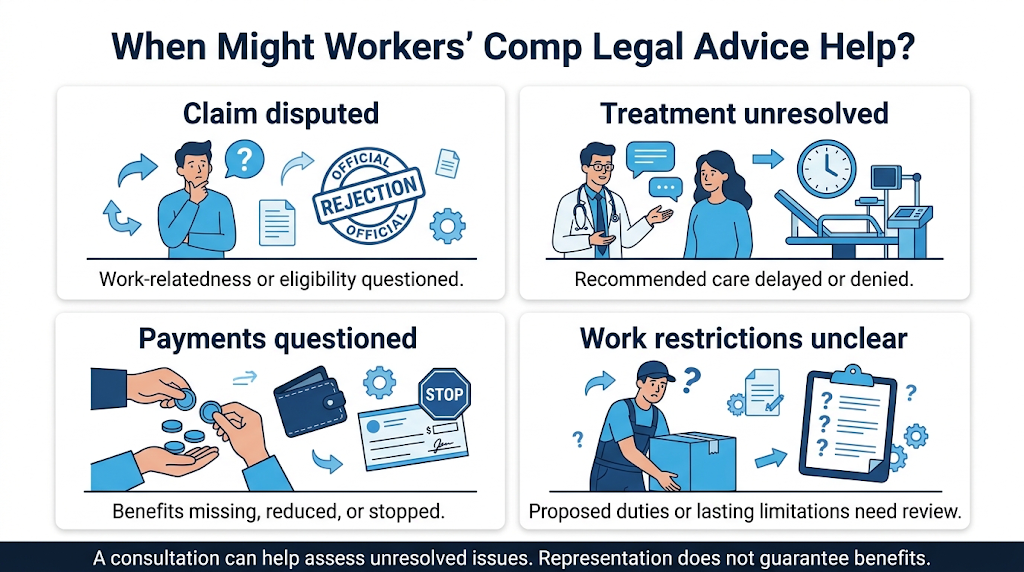
An employer or insurer may dispute whether the injury arose from your work or whether the claim meets other requirements. Ask for the stated reason and preserve relevant notices.
An attorney may review your injury report, job duties, medical history, and witness information. A pre-existing condition can complicate the assessment, but it should not be treated as an automatic answer either way.
Medical Treatment Is Delayed, Denied, or Disputed
Seek advice if you cannot get a clear response about recommended care or there is disagreement over the authorized provider or treatment.
Keep records of requests, responses, and appointments. A delay alone does not establish wrongdoing; the reason, supporting medical information, and applicable rules matter.
Wage Benefits Are Missing, Reduced, or Stopped
Ask how payments were calculated and why any change occurred. Compare the explanation with your wage records, medical restrictions, and work status.
A lawyer can assess whether the dispute concerns eligibility, payment calculations, a return-to-work offer, or another issue. Keep payment records and formal notices rather than relying only on telephone conversations.
Work Restrictions or Lasting Impairment Complicate Your Claim
Advice may be useful when proposed duties conflict with your understanding of medical restrictions, you cannot resume your previous work, or lasting impairment raises questions about additional benefits.
Bring the written restrictions and a description of the actual job tasks. Do not assume that being offered work, or having ongoing symptoms, settles benefit eligibility by itself.
What Benefits Can Georgia Workers’ Compensation Provide?
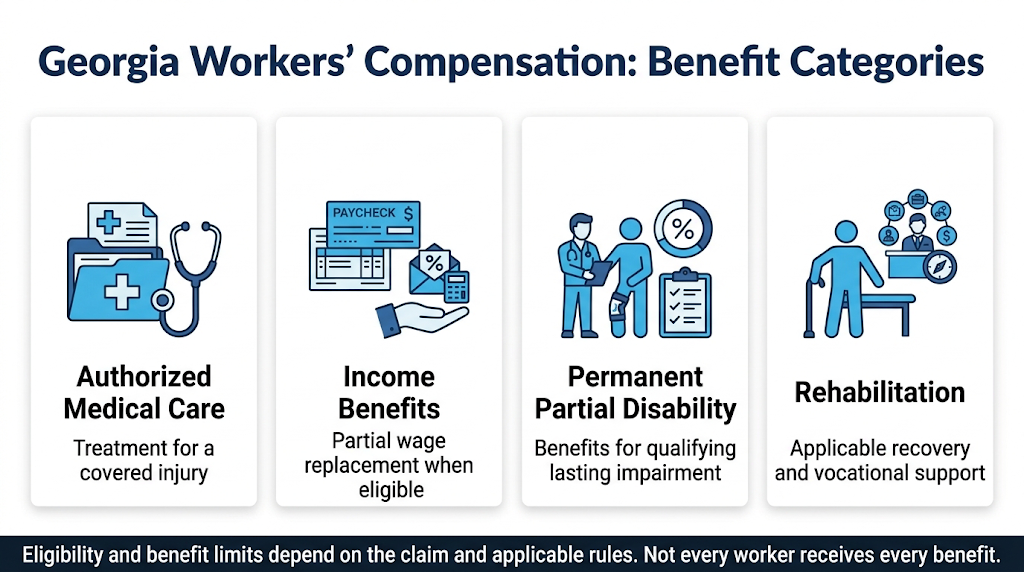
Georgia workers’ compensation may provide medical care, income benefits, and rehabilitation after a covered workplace injury. Eligibility depends on the claim, medical evidence, work status, and applicable rules; not every worker receives every benefit.
Authorized Medical Treatment
Covered care may include authorized doctor visits, hospital treatment, physical therapy, prescriptions, and necessary treatment-related travel. Authorization matters, so confirm the applicable provider arrangements before assuming a visit will be paid.
Income Benefits and Permanent Partial Disability Benefits
Income benefits may replace part of your wages when a covered injury prevents work or reduces earnings. They do not necessarily replace your full paycheck.
Permanent partial disability benefits address qualifying lasting impairment. An authorized treating physician’s impairment assessment helps determine these benefits; ongoing pain alone does not establish the rating or payment amount.
Rehabilitation and Other Applicable Benefits
Medical rehabilitation may support recovery. Vocational rehabilitation can help eligible workers prepare for suitable employment, particularly in qualifying catastrophic-injury cases. Dependents may receive benefits following a covered work-related death.
Workers’ compensation generally does not award pain-and-suffering damages. A potential claim against a responsible third party involves a separate legal assessment.
What a Workers’ Compensation Lawyer Can Do
A Georgia Workers’ Compensation Lawyer can assess disputed issues, explain your options, and represent you through the claims process. The work depends on what remains unresolved; hiring counsel does not guarantee benefits or a settlement.
Review Evidence and Identify Disputed Issues
An attorney may review your injury report, medical records, job duties, wage information, and benefit notices. These documents help clarify whether the disagreement concerns work-relatedness, treatment authorization, payment calculations, or your ability to return to work.
The lawyer can identify missing information and explain what evidence may help address the dispute. Accurate records matter more than trying to describe your claim in legal terms.
Help Address Treatment and Benefit Disputes
Your attorney can communicate with the employer’s insurer, examine the reasons for a decision, and pursue available procedures for resolving disagreements.
For example, a treatment dispute may require supporting medical information, while a wage-benefit dispute may require payroll records. The appropriate response depends on the issue and applicable rules.
Represent You in Mediation, Hearings, and Appeals
Some disputes may be resolved through negotiation or mediation. Others require a hearing before an administrative law judge at the Georgia State Board of Workers’ Compensation.
The judge decides disputed benefits based on the evidence and law. You have the right to represent yourself, although the Board notes that legal assistance may help you present your claim properly.
An attorney can prepare evidence, question witnesses, and assess available appeal options if a decision remains disputed.
Georgia Reporting, Filing, and Medical Treatment Rules
Reporting an injury, filing a claim, and obtaining authorized treatment are separate steps. Understanding each can help you identify when legal advice may be useful.
Reporting an Injury Versus Filing a Claim
Report a workplace accident to your employer immediately or as soon as practicable. Georgia generally requires notice within 30 days, although statutory exceptions may apply. Keep a record of when you reported it and whom you notified.
Notifying your employer does not automatically file a claim with the State Board of Workers’ Compensation. The general filing period is one year after the injury, but employer-furnished treatment or weekly benefit payments can affect that deadline.
Authorized Providers and Requests to Change Doctors
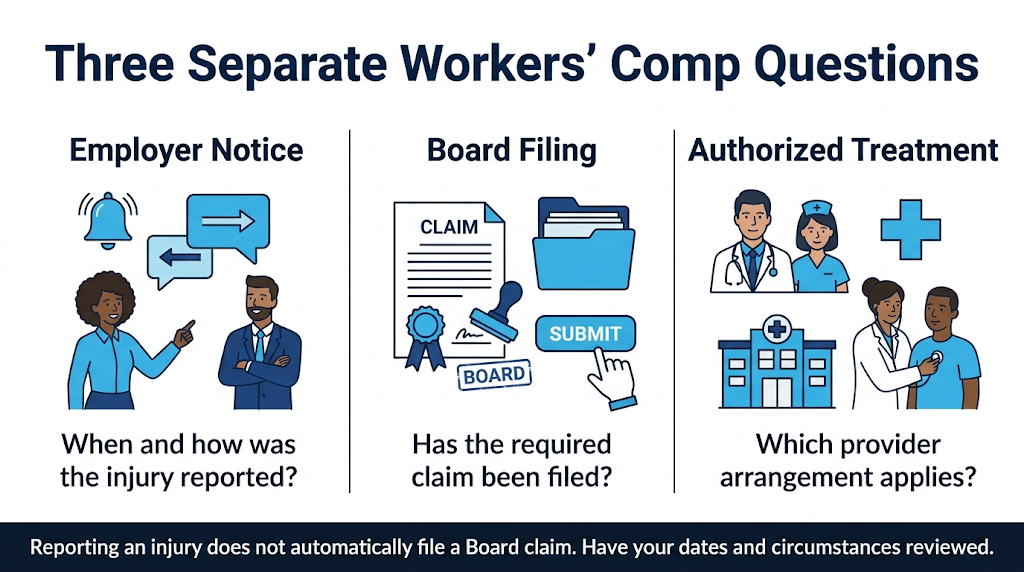
Alt text: Separate requirements for reporting an injury, filing a Board claim, and obtaining authorized treatment.
Georgia generally uses an employer-posted physician panel or a certified managed care arrangement. Under a traditional panel, workers may generally select a listed doctor and make one change to another listed doctor without employer permission. Managed care arrangements have their own eligible-provider process.
If the panel is missing, access is disputed, or you want another change, obtain guidance about the applicable procedure. Emergency care can involve different considerations.
Why Your Specific Dates and Circumstances Matter
Under O.C.G.A. § 34-9-82, qualifying treatment or payments may allow filing within one year after the last employer-furnished remedial treatment or two years after the last weekly benefit payment. Other disputes can involve different timing rules.
Have your actual dates reviewed rather than assuming a general deadline resolves your situation.
How Much Does a Workers’ Compensation Lawyer Cost?
Georgia workers’ compensation attorney fees follow different rules from ordinary personal injury fees. Ask for a written explanation of the proposed fee and expenses before agreeing to representation.
Georgia’s Attorney Fee Limits and Board Approval
The State Board of Workers’ Compensation states that attorney fees are based on the agreement between you and your lawyer, with Board approval required for fees exceeding $100. The Board cannot approve a fee greater than 25% of your award of weekly benefits or settlement.
That limit does not mean every lawyer automatically charges 25%. Confirm the proposed percentage, which benefits it applies to, and when deductions would begin.
Case Expenses and Your Written Agreement
Expenses such as records retrieval, depositions, or expert services are separate from payment for legal work. Ask:
- Which expenses could arise, and who advances them?
- What could you owe if no benefits or settlement are recovered?
- How will expenses be documented and deducted?
- What happens financially if representation ends?
Do not assume that “no upfront attorney fee” answers every expense question. Review the agreement and ask for clarification of anything unclear.
Should You Get Advice Before Accepting a Settlement?
A settlement can resolve disputed benefits, but the payment amount is only part of the decision. Georgia workers’ compensation settlements are voluntary, and stipulated settlements go through Board review and approval.
Understand Future Medical Care and Benefits Being Resolved
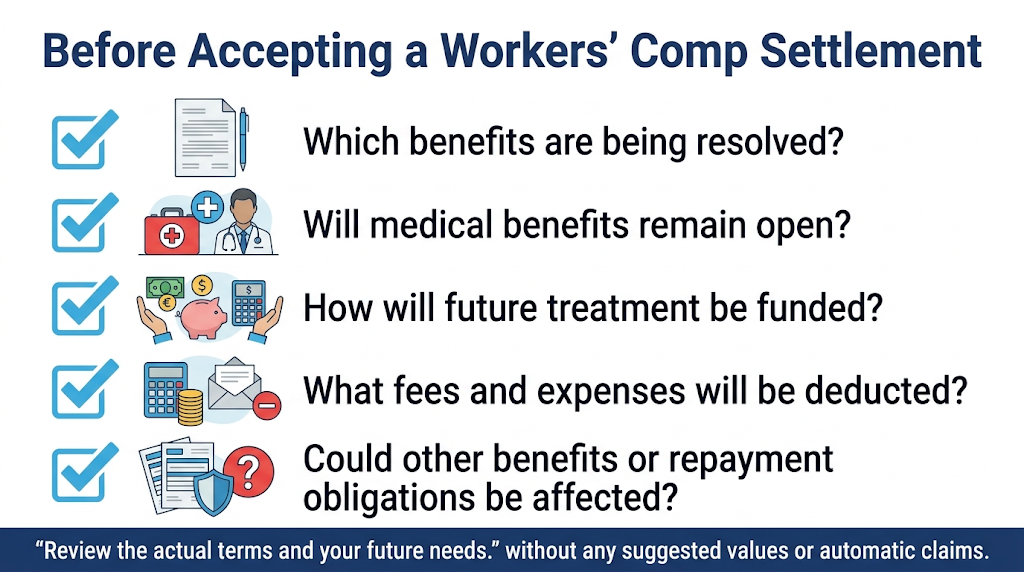
Ask which benefits the agreement closes and which, if any, remain available. Do not assume that future treatment stays covered simply because you still need care.
Review:
- Your expected treatment and medication needs.
- Any unresolved work restrictions or impairment assessment.
- The weekly benefits being resolved.
- How future injury-related medical expenses would be paid.
Some settlements leave medical benefits open, while others address their closure. The actual terms matter.
Review Fees, Repayment Issues, and Other Benefit Interactions
Request an itemized explanation of attorney fees, expenses, and any applicable repayment obligations. Distinguish money available for general use from funds designated for future medical care.
A settlement can also affect Social Security disability benefits, and Medicare’s interests may require consideration where applicable. Do not assume Medicare will automatically cover future work-injury treatment after settlement.
A lawyer can explain these issues and the agreement’s consequences. A larger gross payment does not automatically provide a better outcome once deductions and future needs are considered.
What to Bring to a Consultation
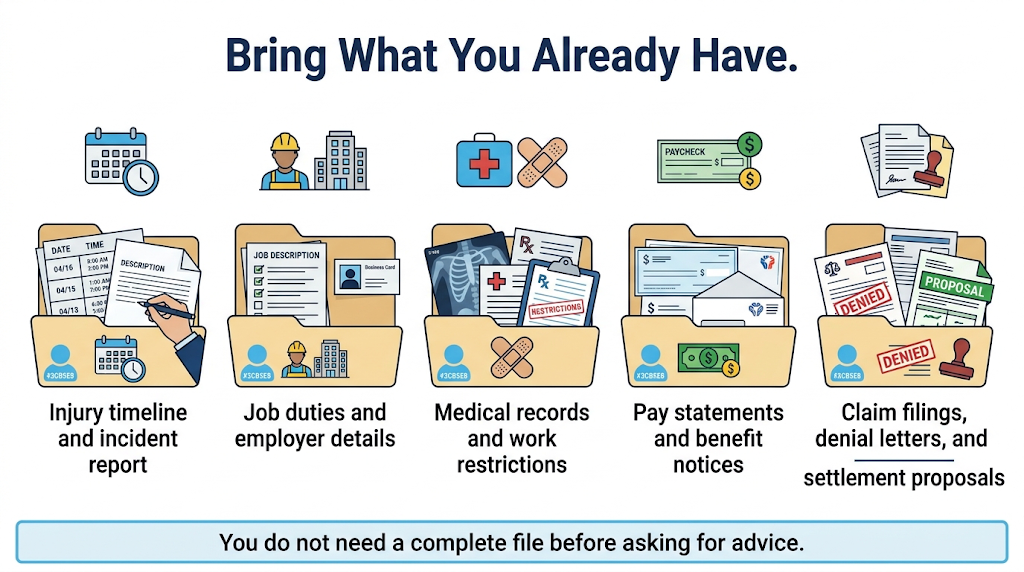
Bring the information you already have. You do not need a complete file before asking a Lawyer about an unresolved issue.
Useful documents include:
- Injury details: The accident date, how it happened, when you reported it, and any incident report.
- Employer information: Your job title, duties, and relevant contact details.
- Medical records: Treatment notes, work restrictions, referrals, and authorization correspondence.
- Wage and payment records: Pay statements, benefit payments, and notices explaining changes.
- Claim documents: Claim numbers, Board filings, denial notices, hearing notices, and settlement proposals.
Prepare a short timeline and identify your main questions. Keep originals intact and ask how to submit sensitive records securely.
Before the consultation ends, confirm whether the firm has accepted representation, what it will handle, and who is responsible for upcoming deadlines.
Working With The Jewkes Firm in Georgia
The Jewkes Firm lists workers’ compensation among its practice areas and offers free consultations. You can discuss your workplace injury, the benefits being provided, and any unresolved treatment or payment questions.
Relevant Experience and Scope of Representation
Ask how the firm would assess your particular dispute, who would handle the matter, and what additional evidence may be needed. Confirm whether representation would include treatment disputes, benefit calculations, settlement negotiations, or Board proceedings.
Local Consultation Options and Verified Client Feedback
The Tyrone office is located at 1155 Senoia Road, Suite 102, Tyrone, GA 30290. Contact the office before visiting to confirm meeting arrangements and access requirements.
A published client review describes the firm’s communication:
“Great experience always helpful. Great communication always kept me up to date on my case.” Ronnie Johnson
This review reflects an individual service experience. It does not establish a workers’ compensation result or predict your outcome.
Frequently Asked Questions
Can I Hire a Lawyer After My Claim Has Already Started?
Yes. You can consult a Georgia Workers’ Compensation Lawyer after reporting your injury, receiving benefits, or encountering a dispute. Bring any claim filings, payment notices, and upcoming hearing dates so the attorney can assess what needs attention.
Do I Need a Lawyer If My Employer Accepts the Injury?
Not necessarily. You may be comfortable handling a claim when authorized treatment and benefits are provided without disputes. Legal advice may become useful if payments change, treatment is denied, or you receive a settlement proposal.
Can I Choose My Own Doctor?
Your choices generally depend on your employer’s valid posted panel of physicians or approved managed care arrangement. Under the traditional panel system, you may generally change once to another listed physician without the employer’s permission. Emergency treatment and problems with the employer’s panel can require a different analysis.
Does Hiring a Lawyer Mean Suing My Employer?
No. A lawyer can help pursue benefits or resolve disputes through Georgia’s State Board of Workers’ Compensation. For covered workplace injuries, workers’ compensation generally replaces an ordinary negligence lawsuit against your employer.
What If Someone Outside My Employer Caused the Injury?
You may have a separate personal injury claim against a responsible third party, such as another driver involved in a work-related crash. Certain parties have legal immunity, and an employer or insurer may assert reimbursement rights against a recovery. Have an attorney evaluate how the claims interact before signing a release.
Request a Georgia Workers’ Compensation Consultation
Unsure whether you need a Georgia Workers’ Compensation Lawyer? A consultation gives you a chance to discuss delayed treatment, disputed benefits, work restrictions, or a proposed settlement. Explain your main concern and share any notices with upcoming deadlines.
Contact The Jewkes Firm for a free consultation. Ask whether the firm can handle your particular claim, what representation would cover, and how fees and expenses would apply. The firm advertises free initial case evaluations.
The Jewkes Firm
Address: 1155 Senoia Rd #102, Tyrone, GA 30290
Phone: (770) 771-5130