
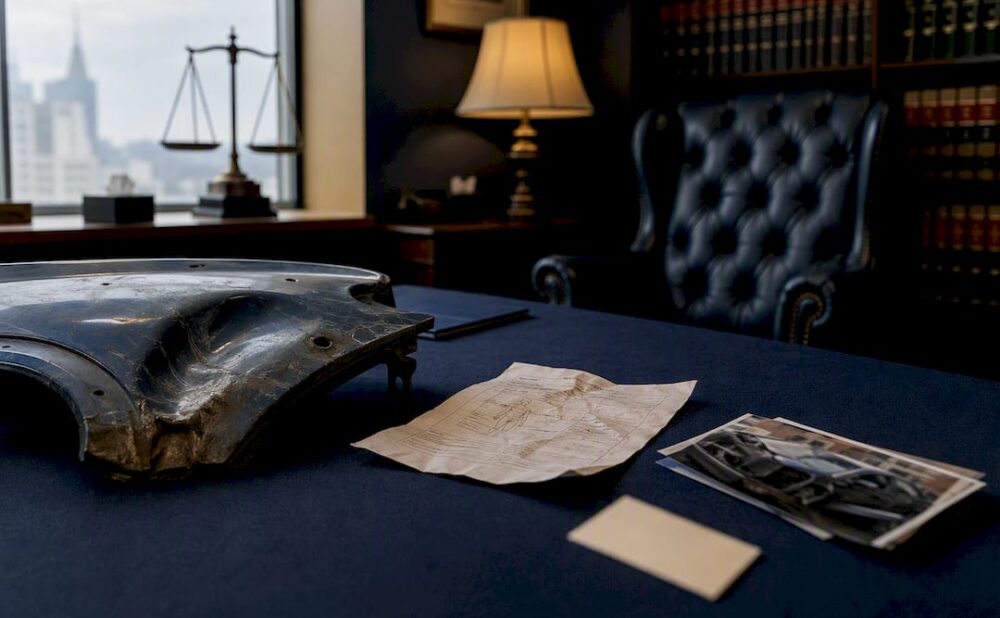
Evidence proves or disproves disputed facts, and that single function controls whether charges stick, whether a defense works, and how likely a conviction or civil judgment becomes. Two standards govern this: criminal cases demand proof beyond a reasonable doubt, while civil cases need only a preponderance of the evidence. Every piece of proof also has to clear the Federal Rules of Evidence before a jury ever sees it.
That gatekeeping function shapes a case long before trial:
- Charging and plea decisions hinge on whether prosecutors believe the evidence will hold up.
- Discovery strategy depends on what each side can preserve, obtain, or challenge.
- Motions to suppress or exclude can remove key proof before a jury ever hears it.
- Settlement leverage often shifts the moment a document, photo, or expert report surfaces.
- Trial weight versus admissibility means some true facts never reach the jury if they were collected or presented improperly.
Key Takeaways
Evidence determines whether a case can be charged, defended, or won, because every legal outcome ultimately rests on what a court allows the jury to consider.
| Point | Details |
|---|---|
| Standards differ by case type | Criminal cases require proof beyond a reasonable doubt; civil cases need only a preponderance of the evidence. |
| Admissibility isn’t automatic | Evidence must pass relevance, hearsay, and authentication rules before a jury ever sees it. |
| Chain of custody can decide outcomes | A single undocumented transfer can get an item excluded, regardless of how damning it looks. |
| Digital evidence needs special handling | Preserve devices and cloud accounts intact, and avoid resets or updates before consulting counsel. |
| Early legal help protects your options | Jewkesfirm sends preservation letters and reviews evidence gaps before they cost you your case. |
This article is general information, not a substitute for advice from a qualified lawyer. Consult a qualified legal professional about your own circumstances before acting on anything here.
Table of Contents
- What Counts as Evidence in a Legal Case
- How Evidence Interacts with the Burden of Proof
- How Admissibility Rules Decide What the Jury Sees
- Why Chain of Custody Can Make or Break Your Case
- Special Rules for Forensic and Digital Evidence
- How Evidence Gets Challenged in Court
- How Evidence Plays Out at Trial
- Protecting Your Evidence Before You Call a Lawyer
- When to Bring in a Lawyer for Evidence Issues
- Sources
What Counts as Evidence in a Legal Case
Courts sort proof into four broad buckets, and recognizing them helps you know what to protect after an accident or dispute. Physical (real) evidence includes tangible items like a weapon, torn clothing, or a damaged bumper. Testimonial evidence comes from people, whether an eyewitness describing a crash or a victim recounting what happened. Documentary evidence covers records such as emails, medical bills, or signed contracts. Digital evidence includes text messages, GPS logs, and metadata buried inside a photo file.
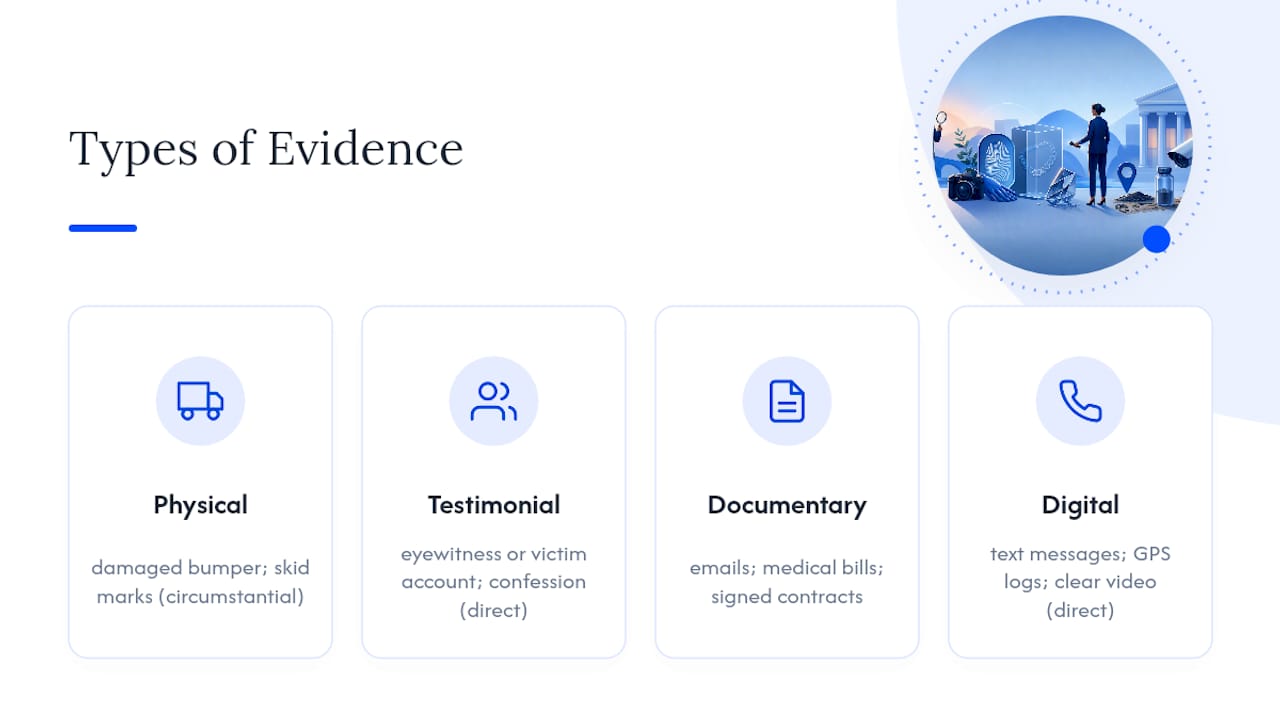
A second distinction matters just as much: direct evidence proves a fact outright (a confession, a clear video of the act), while circumstantial evidence lets a jury infer it (skid marks suggesting speed, a torn seatbelt suggesting force). Courts instruct juries that neither carries automatic priority over the other. A phone photo taken seconds after a collision or a grocery receipt time-stamping your location can carry as much weight in court as a forensic report.
How Evidence Interacts with the Burden of Proof
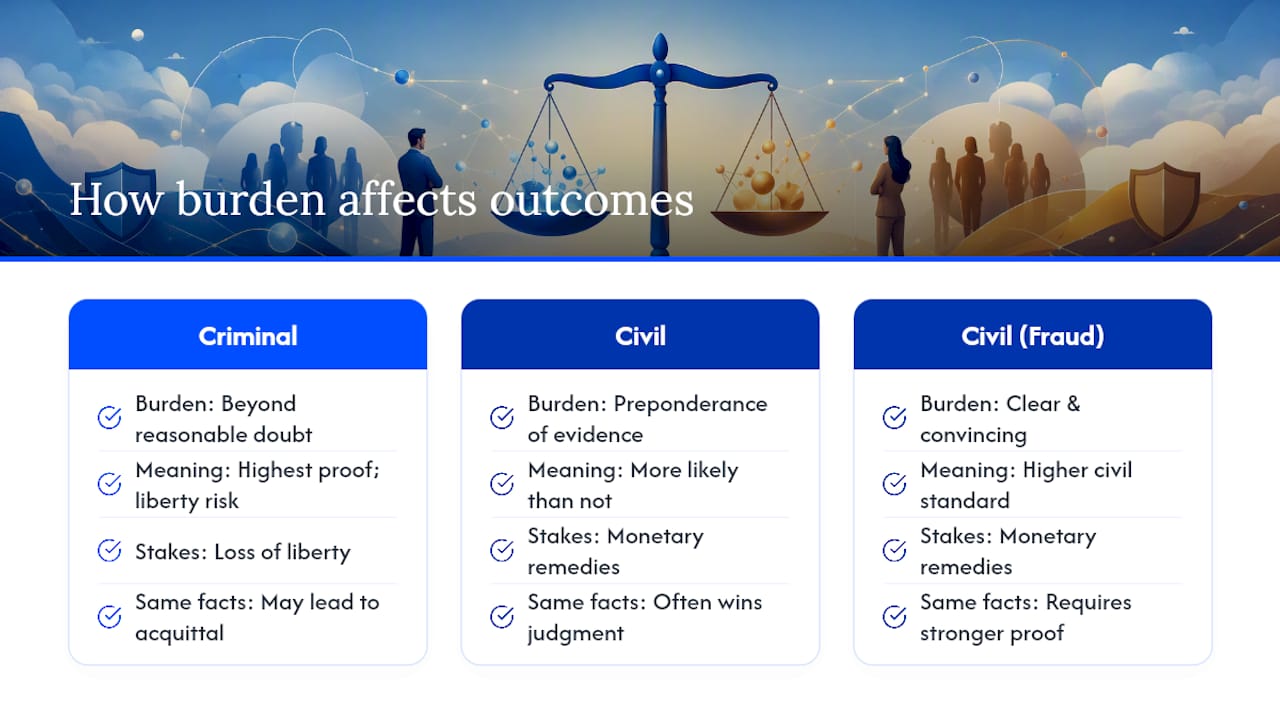
The standard a case must meet decides how much evidence is actually enough. Criminal prosecutors must convince a jury beyond a reasonable doubt, the highest bar in American law because a person’s liberty is on the line. Civil plaintiffs need only show a preponderance of the evidence, meaning it’s more likely than not, though some claims (like fraud) require the tougher clear and convincing standard.
This gap explains why a criminal case can collapse on weak proof while a civil claim built on the same facts still succeeds. A prosecutor who can’t eliminate reasonable doubt walks away; a plaintiff’s attorney with that same file often wins a judgment. It also means admissibility rulings carry heavier stakes in criminal court, since excluding one key exhibit can be the difference between conviction and acquittal.
Pro Tip: Document everything immediately after an incident, preserve texts and photos before your phone auto-deletes them, and avoid giving detailed statements to investigators or insurers until you’ve talked to a lawyer.
How Admissibility Rules Decide What the Jury Sees
Before evidence ever reaches a jury, it has to pass through a series of gates built into the Federal Rules of Evidence. Rule 401 and 402 ask a simple question: does this evidence actually make a disputed fact more or less likely? If not, it’s out. Rule 403 then lets a judge exclude even relevant evidence when its prejudicial impact substantially outweighs its probative value, such as a gruesome photo that inflames a jury more than it informs. Rule 104 governs preliminary questions, like whether a witness is even qualified to testify on a topic.
Hearsay, an out-of-court statement offered to prove the truth of the matter, is generally barred, though common exceptions apply:
- Statements made for medical diagnosis or treatment
- Business records kept in the ordinary course
- Excited utterances made under the stress of an event
- Dying declarations in certain circumstances
Authentication matters too. A text message needs proof it came from the claimed sender; a business record needs a custodian to vouch for it. Without that foundation, even damning evidence never reaches the jury.
Why Chain of Custody Can Make or Break Your Case
Chain of custody is the chronological record of who handled a piece of evidence, from the moment it was collected to the moment it’s shown in court, including where it was stored and who transferred it along the way. A single missing entry, say, a two-day gap in a lab’s log before a blood sample was tested, can give defense counsel enough to file a motion to exclude the entire result.
A typical evidence lifecycle follows this path:
- Collection at the scene, marked and photographed in place
- Packaging in tamper-evident containers with unique identifiers
- Transport logged with time, date, and handler names
- Lab handling documented at every transfer point
- Storage in secure, access-controlled facilities
- Courtroom presentation as a verified exhibit
Robust evidence-management systems and trained personnel are what keep that chain intact across months or years.
Pro Tip: If you’re preserving a phone, laptop, or dashcam footage yourself, don’t alter the device. Screenshot the data, note the date and time you captured it, and hand the original device to your attorney rather than a third party.
Special Rules for Forensic and Digital Evidence
DNA, toxicology, and fingerprint analysis all carry unique vulnerabilities, from contamination during collection to simple lab error, which is why courts scrutinize the methods behind them. Digital evidence has its own failure points: a factory reset, a synced cloud backup that overwrites data, or a lost password can erase proof permanently; following proper digital-preservation techniques is essential to maintain integrity.
A basic digital preservation checklist:
- Power the device down or put it in airplane mode to prevent remote wiping
- Never perform a factory reset or software update before consulting counsel
- Preserve cloud account credentials and share them with your attorney, not investigators
- Keep original files rather than screenshots when possible
Courts also vet expert witnesses under Daubert and Kumho reliability standards, examining whether an expert’s methods, not just their credentials, hold up to scrutiny.
How Evidence Gets Challenged in Court
Defense attorneys have several tools to keep weak or improperly obtained proof out of trial. A motion to suppress targets evidence gathered through an illegal search or seizure. A motion in limine asks a judge to exclude specific evidence before trial even starts. Authentication objections challenge whether an item is what it claims to be, and Daubert challenges attack an expert’s methodology or qualifications.
- Motion to suppress: illegal search, seizure, or interrogation
- Motion in limine: pretrial exclusion request
- Authentication objection: disputes an item’s origin or integrity
- Daubert/Kumho challenge: attacks expert reliability
A suppressed toxicology result, for example, can turn a near-certain conviction into a dismissed charge or a favorable plea deal.
Pro Tip: Never assume an issue with evidence will “come out in the wash.” Preserve your objection through counsel early, since many challenges must be raised at a specific point or they’re waived permanently.
How Evidence Plays Out at Trial
The judge decides what evidence is admissible; the jury decides how much to believe and how much weight it deserves. Attorneys on both sides build a narrative around the same facts, framing circumstantial proof to fit a theory of the case.
- Judge rules on admissibility questions
- Jury evaluates credibility and weight
- Attorneys frame evidence to support their theory
Losing a key forensic test to exclusion often forces a prosecutor back to the negotiating table, and juries relying heavily on circumstantial evidence receive specific instructions confirming that inference-based proof can still meet the burden of proof.
Protecting Your Evidence Before You Call a Lawyer
What you do in the first hours after an incident often decides what evidence survives long enough to matter.
- Photograph and video the scene from multiple angles
- Collect names and contact information for every witness
- Preserve texts, emails, and screenshots without deleting anything
- Get medical treatment and keep every record and bill
- Save receipts, repair estimates, and service records
Call an attorney before giving a detailed statement to police or an insurer, before allowing anyone to search your device, or the moment you suspect evidence has been altered, lost, or seized. A preservation letter sent early can stop the other side from destroying records you’ll need later.
A Perspective on Getting Evidence Right the First Time
Cases are rarely lost because the facts were bad. They’re lost because proof wasn’t preserved, documented, or challenged in time, and that gap is almost always fixable with early legal guidance.
When to Bring in a Lawyer for Evidence Issues
Once evidence has been altered, delayed, or handled by the wrong person, options start closing fast, and that’s precisely where Jewkesfirm steps in for accident victims across South Atlanta and the surrounding Georgia counties.

Jewkesfirm’s attorneys send preservation letters the moment a case comes in, review chain-of-custody records for gaps the other side hopes you’ll miss, and bring in qualified experts to test forensic findings before they ever reach a jury. That early work often determines whether a claim settles fairly or has to go to trial.
- Preservation letters sent to at-fault parties, insurers, and third parties
- Chain-of-custody review for police reports, medical records, and accident data
- Expert engagement for accident reconstruction and medical causation
- Motions practice and trial representation when negotiation stalls
Consultations are free, and Jewkesfirm works on contingency, so you pay nothing unless your case wins. If you’re dealing with a Georgia personal injury claim and worried that key evidence is slipping away, get a free case review today.
Sources
- Burden of proof – Cornell Law School
- Chain of custody | National Institute of Justice
- Federal Rules of Evidence (Dec. 1, 2024) — U.S. Courts
- Physical evidence management and the chain of custody — NIST Special Publication