

Medical records are the primary documentary proof of injury, causation, treatment, and financial loss in a Georgia personal-injury case. Without them, even a serious accident becomes a credibility contest. Under OCGA §24-3-18, a signed narrative medical report is admissible as if the author testified live — but only if the adverse party receives notice at least 60 days before trial and has 15 days to object. That deadline alone can determine whether your strongest medical evidence reaches the jury.
Three things to do right now:
- Get copies of every treatment record, imaging report, and bill from every provider you have seen since the accident.
- Save all billing statements, pharmacy receipts, and explanation-of-benefits documents.
- Contact an attorney before gaps in your records become gaps in your claim. The Jewkes Firm offers free consultations and handles cases on a contingency-fee basis, meaning you pay nothing unless they recover for you.
Key Takeaways
Medical records are the foundation of every Georgia personal-injury claim, and the 60-day notice rule under OCGA §24-3-18 means timing is as important as content.
| Point | Details |
|---|---|
| Request records immediately | Collect ER notes, imaging, billing, and specialist records from every provider after the accident. |
| Narrative beats raw notes | Ask providers for a narrative summary; raw unedited notes can be excluded under Georgia appellate rulings. |
| Know the OCGA deadlines | Narrative reports must be served on the adverse party at least 60 days before trial; the defense has 15 days to object. |
| Preserve bills and films | Keep itemized bills and DICOM imaging files — they prove economic damages and structural injury. |
| Jewkesfirm is your next step | The Jewkes Firm handles record collection, narrative procurement, and litigation for South Atlanta victims on a contingency-fee basis. |
Table of Contents
- What role do medical records play in proving your injury claim?
- Which specific records should you collect, and from whom?
- How does Georgia law govern medical record admissibility?
- How does an attorney use your records to build a case?
- How do you obtain and preserve records in Georgia?
- What common record problems hurt claims, and how does an attorney fix them?
- What should you expect if your case goes to trial?
- What are your rights as a Georgia patient regarding your own records?
- How to store and protect your records so they hold up in court
- How long does it take and what does it cost to collect records?
- Jewkesfirm fights for South Atlanta accident victims
- An editorial perspective on medical records and Georgia injury claims
- Sources
What role do medical records play in proving your injury claim?
Medical records carry several distinct evidentiary functions, and each type of document proves something different.
Proof of injury and severity. ER admission notes, imaging reports, and operative summaries establish that a physical injury exists and how serious it is. An MRI showing a herniated disc at C5-C6 is far harder to dispute than a verbal description of neck pain.

Causation. The timing and content of your first treatment visit links the injury to the accident. A physician who documents “patient presents two hours after motor-vehicle collision with acute cervical pain and limited range of motion” creates a causal chain an insurer cannot easily break.
Necessity and scope of treatment. Specialist consult notes and physical therapy progress records show that every procedure was medically necessary, not elective or unrelated.
Future care and prognosis. A treating physician’s narrative projecting ongoing physical therapy, surgical intervention, or permanent impairment directly supports a claim for future medical expenses.
Billed costs. Itemized bills tied to specific treatment dates connect every dollar of medical expense to the accident.
| Record Type | What It Typically Proves | Common Limitation |
|---|---|---|
| ER/hospital admission notes | Immediate injury, initial diagnosis | May be terse; raw notes may not meet narrative standard |
| Imaging reports and films | Structural damage (fractures, disc injuries) | Requires radiologist narrative to be admissible |
| Operative reports | Surgical necessity, injury extent | Technical language may need expert interpretation |
| Specialist consult notes | Diagnosis confirmation, treatment plan | Sparse notes may undercut causation |
| PT/chiropractic progress notes | Ongoing impairment, treatment response | Inconsistent entries can be exploited by defense |
| Prescriptions and pharmacy records | Pain management, treatment duration | Must be linked to accident-related diagnoses |
| Medical bills | Economic damages | Must correspond to accident-related treatment |
Georgia courts distinguish sharply between raw clinical notes and a narrative medical report. In Lott v. Ridley and Owensby v. Williams, Georgia appellate courts held that a bare recitation of unedited notes does not satisfy the narrative standard. A proper narrative explains findings in plain, lay-understandable prose — and admitting unedited notes in place of one can be reversible error.
Which specific records should you collect, and from whom?
Every provider who touched you after the accident holds records that could matter. Here is the practical checklist:
- Emergency room and hospital: admission notes, discharge summary, nursing notes, and all diagnostic orders.
- Imaging centers: written radiology reports AND the actual films or DICOM files on CD. The written report alone is not enough if the defense retains its own radiologist.
- Surgeons: operative reports and post-operative follow-up notes.
- Specialists: orthopedic, neurological, or pain-management consult notes and treatment plans.
- Physical therapists and chiropractors: initial evaluation, progress notes, and discharge summary.
- Pharmacy: complete prescription history tied to accident-related diagnoses.
- Primary care physician: any visit records referencing the accident, including notes on common accident injuries and their progression.
- Future-care summary: a written projection from a treating provider or life-care planner estimating ongoing costs.
Under OCGA §24-3-18, the professionals who may sign an admissible narrative report include licensed physicians, dentists, podiatrists, and other enumerated healthcare providers. Ask each treating provider specifically for a medical narrative or summary rather than a raw chart printout.
Pro Tip: When requesting records, ask the provider to include: the mechanism of injury as reported, objective findings, diagnosis, treatment rendered, causal relationship to the accident, and prognosis. A narrative that omits causation is far less useful at trial.
Psychiatric and behavioral health records carry special protections under Georgia law. Even when you file a personal-injury claim, those records may retain privilege unless the mental-health treatment is directly placed at issue in the litigation.
How does Georgia law govern medical record admissibility?
Georgia’s rules on medical evidence are specific, and missing a deadline can cost you the evidence entirely.
OCGA §24-3-18 (also codified at §24-8-826) allows a signed, dated narrative medical report to be admitted as if the author testified in person. The Georgia Supreme Court confirmed this in Bell v. Austin (2005), holding that the statute is a valid hearsay exception designed to reduce litigation time and cost while preserving the right to contest the evidence.
The key procedural rules:
- 60-day notice: You must serve the narrative report on the adverse party at least 60 days before trial.
- 15-day objection window: The adverse party has 15 days to object to any portion of the report — but cannot object on hearsay grounds alone.
- Cross-examination right: The adverse party may call the signing professional for cross-examination.
OCGA §24-7-8 handles authentication. When a custodian certifies a reproduction of medical records, that certified copy can be used at trial without the custodian appearing in person to identify it. This significantly reduces the logistical burden of presenting voluminous records.
OCGA §24-12-1 governs when providers must release records. Providers are not required to release records except on written authorization, to public health authorities, or under court order or subpoena. When you file a personal-injury claim, you effectively waive privilege over the medical care and treatment placed at issue. In medical-malpractice actions specifically, OCGA §9-11-9.2 requires a medical authorization to be filed with the complaint, authorizing defense counsel to obtain relevant protected health information.
| Rule | Deadline / Requirement |
|---|---|
| Narrative report notice | Serve on adverse party at least 60 days before trial |
| Objection window | Adverse party has 15 days to object (not on hearsay grounds) |
| Custodian certification | Certified copy usable at trial without in-person identification |
| Privilege waiver | Waived when patient places care/treatment at issue |
How does an attorney use your records to build a case?
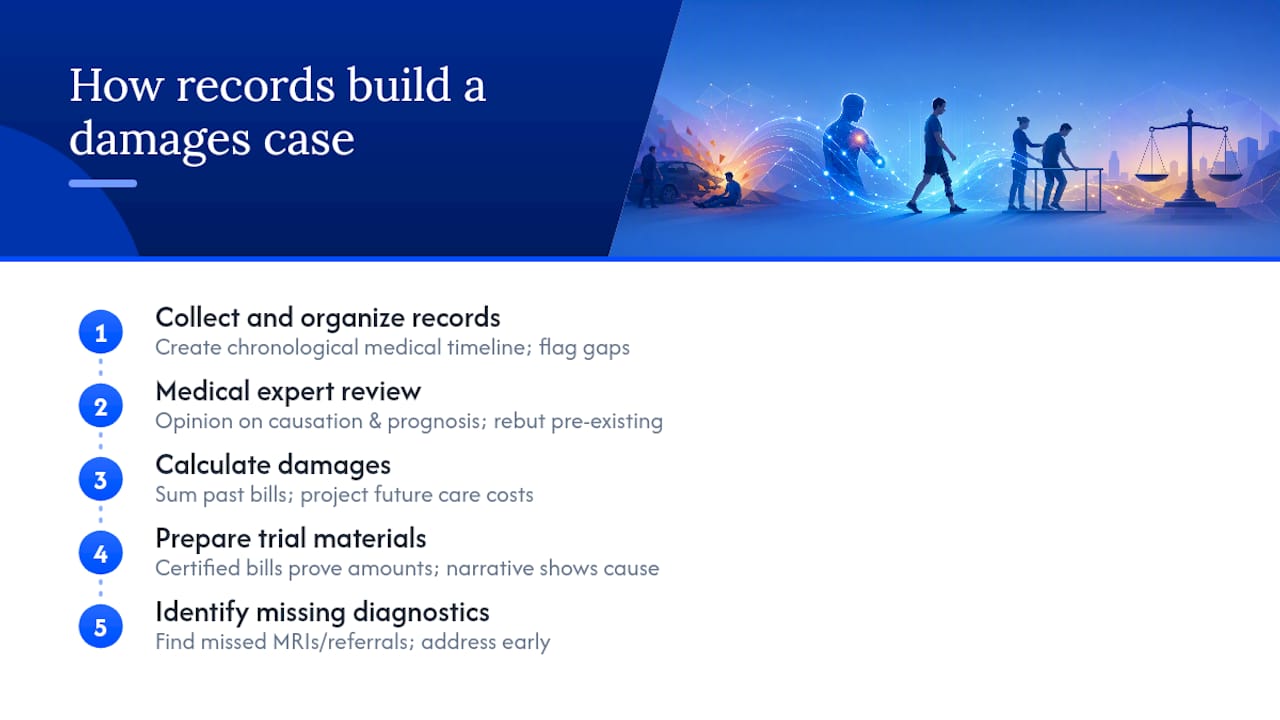
The attorney’s process turns raw documentation into a damages argument. It follows a clear sequence.
First, every record is collected and organized into a chronological medical timeline — a document that maps each treatment event to the accident date and shows the unbroken chain from injury to ongoing care. Gaps in that timeline are identified early, before the defense exploits them.
Second, a medical expert reviews the records and provides an opinion on causation and prognosis. That opinion, combined with the treating physician’s narrative, addresses the most common defense argument: that the injuries were pre-existing or unrelated to the accident. Records showing no prior treatment for the same body part are often the most persuasive rebuttal.
Third, the attorney calculates past medical expenses from itemized bills and projects future costs using life-care planning or expert testimony. Those figures anchor the demand letter and, if necessary, the trial exhibit list.
Pro Tip: Early record review often reveals missing diagnostic tests — an MRI that was recommended but never ordered, or a specialist referral that was not followed up. Identifying those gaps early lets your attorney address them before the defense does.
At trial, certified custodian copies and properly noticed narrative reports work together. The narrative carries the causation story; the certified bills prove the dollar amount. Expert witnesses interpret technical findings for the jury when the records alone are not self-explanatory. See also how medical reports strengthen your injury claim for a deeper look at this process under Georgia law.
How do you obtain and preserve records in Georgia?
Follow these steps immediately after an accident:
- Seek medical care and get written after-visit summaries at every appointment. Do not leave without documentation.
- Sign a HIPAA-compliant medical authorization for each provider. Make sure the form specifies the date range, the types of records requested (notes, imaging, billing), and that it is not limited to a single visit.
- Request certified copies from custodians. Ask specifically for certification under OCGA §24-7-8 so the records are trial-ready.
- Request imaging films and DICOM files on CD or digital download, not just the written report.
- Preserve all billing and pharmacy records, including explanation-of-benefits statements from your insurer.
- Document provider names, addresses, and dates of service in a running log.
- Back up digital copies to a secure cloud storage account and a physical drive kept in a safe location.
Custodian response times vary. Many Georgia hospitals and large health systems respond within 30 days; smaller practices may take longer. Copy fees are set by providers and can vary, so ask for a fee schedule before submitting your request. When a provider refuses to release records without a court order, your attorney can issue a subpoena or seek a court order under OCGA §24-12-1. A complete personal injury checklist can help you track every step.
A complete medical authorization should include:
- Your full legal name and date of birth
- The provider’s name and address
- The specific date range of treatment
- The types of records requested (clinical notes, imaging, operative reports, billing)
- A statement that the authorization covers records related to the accident
- Your signature and the date
What common record problems hurt claims, and how does an attorney fix them?
Gaps and inconsistencies in medical documentation are predictable. Knowing them in advance lets you avoid the worst ones.
- Delayed treatment: Waiting days or weeks to see a doctor gives insurers an opening to argue the injuries were not serious or were caused by something else.
- Sparse or illegible notes: Brief provider entries that do not describe mechanism, severity, or functional limitations leave causation unproven.
- Unconnected bills: A bill from a specialist with no corresponding referral note looks like unrelated treatment.
- Inconsistent histories: Telling one provider the pain started “a few days ago” when the accident was two weeks prior creates a timeline problem.
- Psychiatric record privilege: Mental-health records may remain protected even after a general privilege waiver, requiring careful handling.
Attorneys remedy these problems through custodian affidavits, subpoenaed certified records, commissioned medical narratives, and expert testimony that interprets ambiguous raw notes for the jury. Fixing record gaps is a routine part of personal-injury work. Contact an attorney if providers refuse to release records, if the records contradict your causal timeline, or if the insurer is disputing medical necessity. See how evidence can make or break your claim for more on these dynamics.
What should you expect if your case goes to trial?
Narrative medical reports are presented to the jury through the trial record — they are treated as testimony, not as documentary exhibits that go into the jury room. Under Georgia practice, the report itself does not travel with the jury during deliberations.
Your trial checklist for medical evidence:
- Certified copies of all records, authenticated under OCGA §24-7-8
- Narrative reports served on the defense at least 60 days before trial
- Expert witnesses available to interpret technical findings
- Demonstrative exhibits: a medical chronology, itemized bill summary, and imaging comparisons
- Witness availability confirmed for any provider the defense may cross-examine
Discovery through trial in a Georgia personal-injury case typically spans several months to over a year, depending on case complexity. The step-by-step guide to filing an injury lawsuit in Georgia outlines the procedural timeline in detail.
What are your rights as a Georgia patient regarding your own records?
Under OCGA §24-12-1, you have the right to authorize release of your own medical records. Providers may not release your records to third parties without your written authorization, a court order, or a subpoena — with limited exceptions for public health reporting. When you file a personal-injury claim, you waive privilege over the care and treatment directly at issue, which means the defense can seek those records through the discovery process.
Federal HIPAA rules give you the right to request your records within 30 days of a written request, with one possible 30-day extension. Georgia law does not shorten that window, but providers often respond faster. You also have the right to request corrections to inaccurate entries, though providers are not required to delete clinical observations they believe are accurate.
Psychiatric and substance-abuse treatment records carry heightened protections. Even a general HIPAA authorization may not be sufficient to release those records; a separate, specific authorization is typically required, and in some cases a court order is necessary.
How to store and protect your records so they hold up in court
The integrity of your records matters as much as their content. A document that cannot be authenticated is a document that cannot be used.
Store physical records in a fireproof, waterproof container. Keep digital copies in at least two locations: a password-protected cloud service (such as Google Drive or Microsoft OneDrive with two-factor authentication enabled) and an encrypted external drive stored separately from your home. Never alter, annotate, or highlight original documents. Courts and opposing counsel look for signs of tampering, and even a well-intentioned handwritten note on a medical record can raise authenticity questions.
Organize records chronologically by provider, with a cover sheet listing the provider name, address, date range, and record type. That organization mirrors what your attorney will need to build the medical timeline and makes the custodian certification process faster.
How long does it take and what does it cost to collect records?
Most Georgia hospitals and large health systems respond to record requests within 30 days. Smaller clinics and solo practitioners may take longer, and imaging centers sometimes require a separate request for films versus reports. If a provider does not respond within a reasonable period, a follow-up written request or, when necessary, a subpoena through your attorney will compel production.
Copy fees vary by provider. Georgia law does not cap medical record copy fees for litigation purposes, so costs can range from a nominal per-page charge to a flat administrative fee. Ask each provider for its fee schedule before submitting your request. Your attorney’s office often handles these requests directly and may advance the costs as part of case expenses, to be reimbursed from any recovery.
Jewkesfirm fights for South Atlanta accident victims
When your injuries are serious, the difference between a fair recovery and an inadequate settlement often comes down to how completely your medical evidence is assembled and presented. Jewkesfirm handles every step of that process for accident victims across South Atlanta and the surrounding Georgia counties: collecting records, obtaining custodian certifications, commissioning narrative reports, coordinating medical experts, and building the demand and litigation strategy that puts maximum pressure on the at-fault party.

The firm works on a contingency-fee basis. You pay nothing up front, and no attorney fees are owed unless Jewkesfirm recovers compensation for you. That means you can have experienced legal representation handling your evidence from day one without worrying about hourly bills. To get started, request a free consultation and bring whatever records you have, a list of every provider you have seen, and the dates of your treatment. Jewkesfirm will assess your case and tell you exactly what evidence you need and how to get it.
An editorial perspective on medical records and Georgia injury claims
Most accident victims underestimate how quickly a strong case can weaken. The insurer’s adjuster is reviewing your records within days of the claim. If your early treatment notes are sparse, if you waited two weeks to see a doctor, or if your provider handed you a raw chart printout instead of a narrative summary, the defense already has its argument.
What I have seen repeatedly in Georgia personal-injury work is that the victims who protect their claims best are not the ones with the most severe injuries. They are the ones who sought care immediately, followed up consistently, and involved an attorney before the record gaps became permanent. The 60-day notice deadline under OCGA §24-3-18 is not a technicality — it is a hard cutoff that can leave your best medical evidence out of the jury’s hands entirely if it is missed.
South Atlanta victims deserve to have their voices heard and their injuries fully documented. The path to fair compensation runs directly through your medical records. Capture them early, protect them carefully, and work with counsel who knows how to use them.
Sources
The following primary authorities govern medical records in Georgia personal-injury cases:
- O.C.G.A. § 24-8-826 — Medical reports in narrative form | Georgia Code
- Bell v. Austin, Supreme Court of Georgia, 2005
This article provides general legal information about Georgia personal-injury law and is not a substitute for advice from a licensed attorney. Confirm current rules and deadlines with a qualified Georgia personal-injury lawyer before taking action.