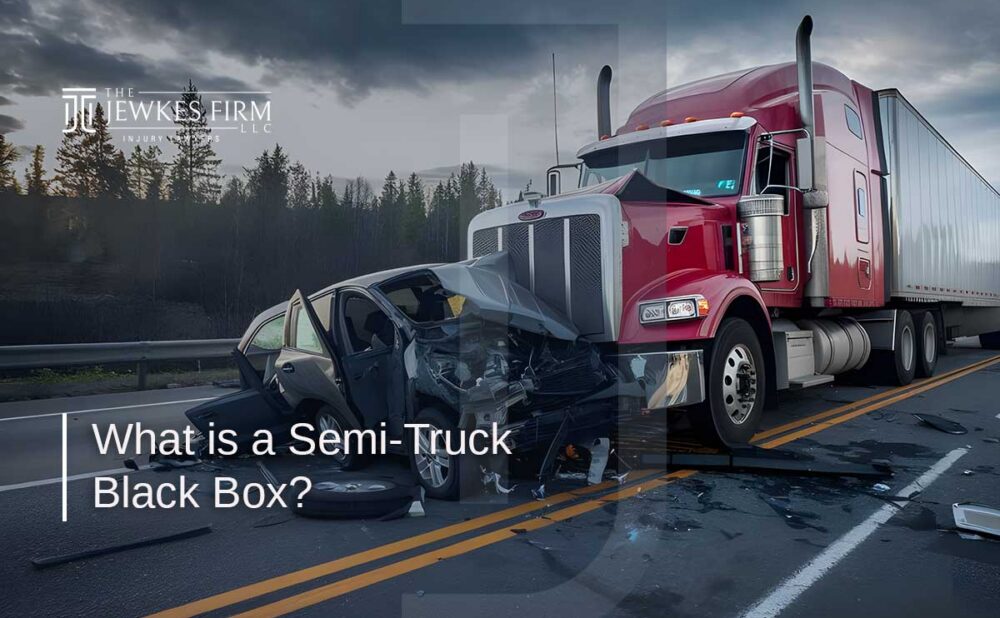
What is a Semi‑Truck Black Box?
When you hear the term “black box,” you might immediately think of airplanes. But semi‑trucks and other commercial vehicles also have similar technology: a data‑recording system that can be critical evidence in understanding how an accident occurred and proving liability in a personal injury claim. At The Jewkes Law Firm, we work with experienced accident reconstruction experts to secure and interpret this data. A semi‑truck black box can make a major difference in your case — especially when parties dispute the events leading up to a crash.
Understanding the Role of a Semi‑Truck Black Box in Truck Accident Cases
A semi-truck “black box” is formally known as an Electronic Logging Device (ELD) or an Event Data Recorder (EDR). Much like the flight recorders in airplanes, these devices continuously monitor and record various data points during a truck’s operation. This information is vital for reconstructing the moments leading up to a crash, which can be crucial in determining fault and liability.
Injured In A Semi-Truck Accident? Contact Us For A Free Consultation
Injured In A Semi-Truck Accident?
What the “Black Box” Really Is
In commercial trucks, the so‑called black box isn’t usually a visible “black box” sitting in the dash. Instead, it refers to digital devices built into the truck’s on‑board computer systems that record information about the vehicle and driver.
Two related systems commonly involved are:
Event Data Recorder (EDR)
- Often what lawyers mean when they say “black box.”
- A device that records a snapshot of data when a significant event — like a crash or hard braking — occurs.
- Installed as part of the truck’s electronic control module (ECM).
Electronic Logging Device (ELD)
- Required by federal law to track hours‑of‑service (how long a driver has been on duty).
- Records engine status, miles traveled, and driver duty status — not crash‑specific data like an EDR.
Though related, an EDR and ELD serve different purposes. For crash reconstruction and legal analysis, the EDR is usually the most valuable source of crash‑related data.
What Data Does a Semi-Truck’s Black Box Record?
A truck’s black box does not record audio or video, but it does log a rich set of objective, timestamped data about how the truck was operating in the moments before, during, and after a collision. Common data points include:
- Vehicle speed
- Brake application and intensity
- Throttle and accelerator position
- Steering inputs
- Cruise control status
- Engine RPM (revolutions per minute) and gear position
- Sudden decelerations or hard impacts
- Seatbelt and other safety systems usage
- Distance traveled
- GPS location and movement history
- Hours of service (to track driver fatigue)
- Fault codes or mechanical issues
This information provides an objective timeline of the truck’s behavior — something that eyewitness testimony often cannot reliably offer.
Need a Free Consultation? Need a Skilled Attorney?
Free Consultation
Call (770) 771-5130
If you’ve been injured, you need to hire the best legal care to assist you with your claim. Get a FREE consultation today!
Why the Black Box Is Important After a Truck Accident
After a collision involving a semi-truck, understanding exactly what happened in the seconds or minutes before the crash is key. Unlike human memory — which can be inconsistent or biased — black box data is factual and time‑stamped. It tells a scientific story of what the truck was doing in the critical seconds before and after impact. The black box can provide objective, factual data that helps answer critical questions such as:
- Was the truck speeding or driving recklessly?
- Did the driver apply the brakes in time?
- Was the truck’s mechanical condition a factor in the accident?
- How long had the driver been on the road before the crash? Were they fatigued?
- Did the trucker comply with federal regulations regarding driving hours?
This data can serve as powerful evidence in personal injury cases. By analyzing the black box records, attorneys can build a strong case to prove negligence or liability, helping injured victims obtain the compensation they deserve. This information helps establish whether the truck driver or trucking company was negligent — a key element in a personal injury claim.
In some cases, trucking companies or their insurers will try to shift blame to other parties or diminish the seriousness of a driver’s actions. Black box data can refute false claims by showing exactly what happened from the truck’s perspective.
Because the data provides factual, unbiased evidence, it often compels insurance companies to take claims more seriously or even offer better settlements. Judges and juries tend to give weight to scientific evidence that reconstructs the crash.
How Long Black Box Data Lasts
Black box data is fragile because many systems overwrite old records with new information. In some trucks, the system may overwrite data in as little as 30 days if you don’t preserve it promptly.
That’s why acting quickly after a truck accident — contacting an attorney immediately — is crucial to secure this evidence before it disappears.
Who Controls the Black Box and Your Legal Rights
The trucking company generally owns the truck and its black box data. They are not automatically obligated to share this data with accident victims. At The Jewkes Firm, LLC, we understand the technical aspects involved in accessing and interpreting black box data. Retrieving this information requires careful legal procedures to preserve evidence integrity. Often, trucking companies or their insurers control the black box data so we may need to act quickly to obtain it through legal channels. If you don’t take action, you might lose the data or it could be deleted before you can use it for your claim.
An experienced truck accident attorney will:
- Send spoliation letters to preserve all relevant evidence,
- Work with forensic techs to download the data correctly, and
- If necessary, seek a court order to compel release of the black box information.
Once obtained, our team works with accident reconstruction experts and forensic analysts to decode the data. This comprehensive approach enables us to paint a detailed picture of the accident, making it easier to negotiate with insurers or present compelling evidence in court.

GEORGIA SEMI-TRUCK ACCIDENT LAWYER NEAR ME
The Black Box Can Be a Case‑Maker — Protecting Your Rights After a Semi-Truck Accident
Truck accident cases can be incredibly complex due to the involvement of multiple parties such as trucking companies, insurance providers, and regulatory agencies. The black box is a vital tool that can tip the scales of justice in your favor, but only if someone knowledgeable advocates on your behalf. Understanding technical evidence like a semi-truck’s black box is just one part of building a strong personal injury case.
If you’ve been hurt in a truck crash, reach out to the trusted team at The Jewkes Firm at (770) 771-5130 to schedule your free consultation. We’re here to fight for your rights and help you navigate the complex legal road ahead.
Frequently Asked Questions
What is a semi-truck’s black box?
A semi-truck’s black box is an Event Data Recorder (EDR) that captures crucial data like speed, braking behavior, and other metrics right before and during a crash. It can help determine the cause of an accident and strengthen your personal injury case.
How does the black box data help in truck accident cases?
Black box data provides objective evidence about the truck’s behavior, which can help establish whether the driver was speeding, braking improperly, or neglecting safety protocols, all of which are essential in determining fault.
How long does the black box data last?
The black box data can be overwritten within 30 days, so it’s important to act quickly after an accident to preserve this valuable evidence.
Can I get the black box data for my truck accident case?
Yes, but trucking companies typically control the data. An experienced semi-truck accident attorney can help preserve and obtain this evidence to ensure it’s used in your case.
How soon can I retrieve the black box data after an accident?
It’s important to act quickly, as trucking companies may erase or alter data. Early retrieval helps preserve critical evidence for your legal case.
Why is black box data crucial in proving negligence?
Since black box data records specific, time-stamped information about the truck’s operation, it can provide irrefutable evidence about whether the driver was acting negligently at the time of the accident.
Can I get compensation if the black box data shows the truck driver was negligent?
Yes, black box data supporting driver negligence strengthens your case, increasing the likelihood of fair compensation for injuries and damages.