

TL;DR:
- Trucking accident claims in Georgia are complex, involving multiple liable parties and federal regulations.
- Immediate action is crucial to preserve evidence like driver logs and ELD data, which can disappear quickly.
- Hiring an experienced truck accident lawyer increases settlement potential and helps navigate strict deadlines.
Trucking accident claims in Georgia are far more complicated than most people expect. Many assume the insurance company will step in quickly, review the facts, and offer fair compensation. The reality is very different. Trucking crashes involve multiple liable parties, federal regulations, and time-sensitive evidence that can disappear within days. If you were hurt in a crash near South Atlanta or the surrounding Georgia counties, understanding how the process works is not just helpful. It is essential to protecting your rights and recovering what you deserve.
Table of Contents
- How trucking accident claims work in Georgia
- Step-by-step process after a trucking accident
- Key deadlines and evidence: Don’t lose your rights
- Insurance negotiations and maximizing your compensation
- What most guides miss about trucking accident claims
- Connect with expert help for your trucking accident claim
- Frequently asked questions
Key Takeaways
| Point | Details |
|---|---|
| Act quickly | Time-sensitive deadlines and evidence make swift action vital for Georgia truck accident claims. |
| Specialized legal help | Hiring a trucking accident lawyer can significantly boost your compensation and protect your rights. |
| Don’t trust first offer | Insurance companies typically lowball initial settlements, so negotiate with expert support before accepting. |
| Local risks matter | South Atlanta’s congested highways raise risk and make professional legal guidance even more important. |
How trucking accident claims work in Georgia
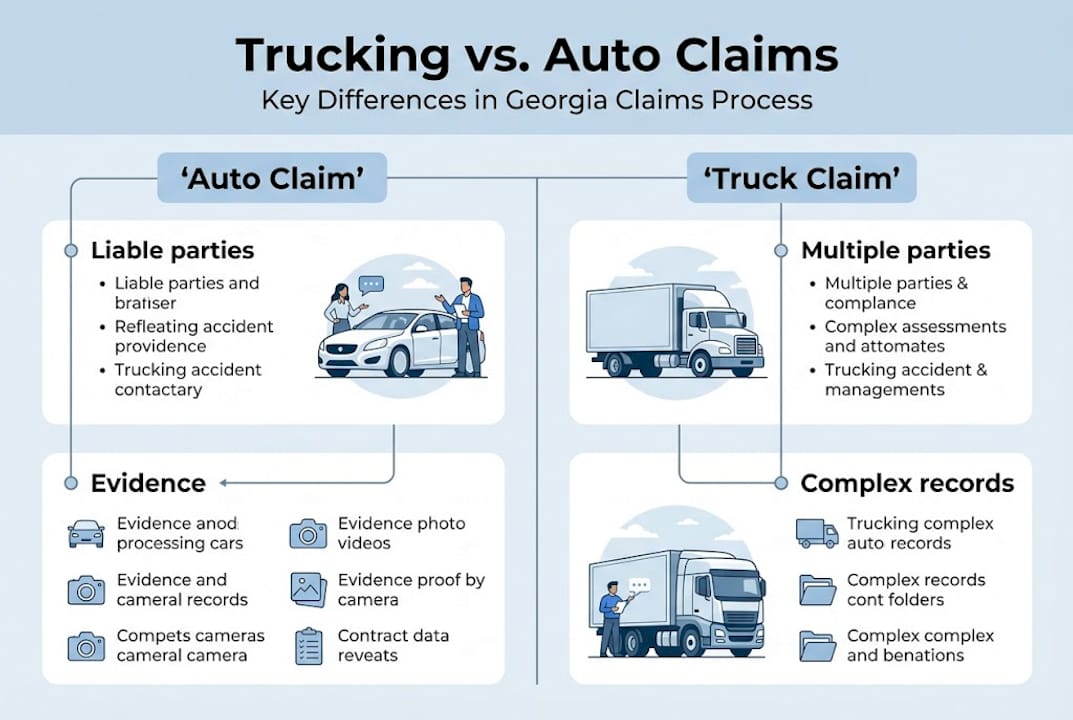
Trucking accident claims are not simply bigger versions of car accident claims. They operate under a different set of rules, involve more parties, and require a level of investigation that standard auto claims rarely demand.
When a commercial truck crashes, the liable parties can include the truck driver, the trucking company, a cargo loader, a vehicle manufacturer, or even a maintenance contractor. Each party may carry separate insurance policies. That alone makes the process significantly more complex than a two-car fender bender.
The truck accident claim process in Georgia follows a defined sequence: seek immediate medical attention, contact a truck accident lawyer, file an insurance claim, conduct a thorough investigation that includes collecting police reports, driver logs, and electronic logging device (ELD) data, send a demand letter, negotiate a settlement, and if necessary, proceed to litigation. Each step builds on the last. Skipping or delaying any one of them can cost you.
South Atlanta sits at the intersection of I-75 and I-285, one of the busiest freight corridors in the Southeast. That volume creates real risk. It also means handling Georgia claims requires local knowledge. Evidence like driver logs and ELD data has a short shelf life. Trucking companies are not required to preserve it indefinitely, and once it is gone, it is gone.
Key differences between trucking and standard auto claims:
- Stakeholders: Multiple defendants including carriers, shippers, and manufacturers
- Evidence: ELD data, black box recordings, driver qualification files, maintenance records
- Regulations: Federal Motor Carrier Safety Administration (FMCSA) rules govern commercial drivers
- Injury severity: Trucking crashes typically cause more serious injuries and higher medical costs
- Insurance complexity: Multiple policies from multiple parties often apply
“South Atlanta is high-risk due to I-75/I-285 congestion. Act fast, because evidence like driver logs expires quickly and may be lost if you wait.”
| Factor | Standard auto claim | Trucking accident claim |
|---|---|---|
| Liable parties | 1-2 | 3 or more |
| Evidence types | Photos, police report | ELD data, logs, black box |
| Governing rules | State traffic law | State law plus federal FMCSA rules |
| Average injury severity | Moderate | Often severe or catastrophic |
Understanding this landscape from the start puts you in a far stronger position.
Step-by-step process after a trucking accident
Knowing what to do immediately after a crash can mean the difference between a strong claim and a dismissed one. Here is the roadmap you need.
- Get to safety and call 911. Move away from traffic if you can do so safely. Request police and emergency medical services immediately.
- Seek medical attention. Even if you feel fine, get evaluated. Some injuries, like internal bleeding or traumatic brain injuries, do not show symptoms right away. A medical record also documents your injuries from day one.
- Document the scene. Take photos of vehicle positions, damage, road conditions, and any visible injuries. Collect the truck driver’s name, license number, company name, and insurance information.
- Gather witness information. Names and phone numbers from bystanders can be invaluable later.
- Notify your insurer. Contact your insurance company within 1 to 3 days. Be brief and factual. Do not speculate about fault.
- Contact a truck accident lawyer. Do this before giving any formal statements. The defined steps from medical care to settlement are easier to navigate with experienced legal guidance.
- Let your attorney manage evidence collection. This includes driver logs, ELD data, black box information, and surveillance footage.
Pro Tip: Never give a recorded statement to an insurance adjuster without your attorney present. Adjusters are trained to ask questions that can minimize your payout. One poorly worded answer can undercut an otherwise strong claim.
Victims who hire specialized attorneys when filing claims in South Atlanta consistently recover more. The numbers back this up. Working with a lawyer focused on maximizing compensation can increase your settlement by up to 40% compared to going it alone.
That is not a small difference. On a $200,000 claim, that gap is $80,000.
Key deadlines and evidence: Don’t lose your rights
Time is not on your side after a trucking accident. Georgia law and insurance policies both impose strict deadlines, and missing either can eliminate your right to recover.

Under O.C.G.A. § 9-3-33, you have two years from the date of the accident to file a personal injury claim. That may sound like plenty of time, but building a strong case takes months. Waiting too long means witnesses forget details, evidence disappears, and attorneys have less to work with.
Insurance notification is even more urgent. Most policies require you to report the accident within 1 to 3 days. Miss that window, and the insurer may deny your claim outright, regardless of how strong your case is. Review your personal injury claim deadlines carefully and act fast.
Evidence in trucking cases is especially fragile. ELD data, which tracks hours of service and driver behavior, may be overwritten within weeks. Black box data from the truck’s event data recorder can also be lost. Surveillance footage from nearby businesses is often deleted on a rolling 30-day cycle.
Critical documentation to gather:
- Police accident report
- Driver’s logbook and ELD data
- Truck’s black box or event data recorder
- Trucking company maintenance records
- Driver qualification and training files
- Photos and video from the scene
- Medical records and bills
- Witness statements
Pro Tip: Act within the first few days to preserve essential records. An attorney can send a legal hold letter to the trucking company, requiring them to preserve all relevant evidence. Without this step, key data may simply vanish.
Understanding settlement timelines in Georgia also helps set realistic expectations. Some cases resolve in months. Others, especially those involving serious injuries or disputed liability, can take longer.
| Deadline type | Standard auto accident | Trucking accident |
|---|---|---|
| Statute of limitations | 2 years | 2 years |
| Insurance notification | 1-3 days | 1-3 days (often stricter) |
| ELD data preservation | Not applicable | Days to weeks before overwrite |
| Black box data | Not always present | Must be secured immediately |
Insurance negotiations and maximizing your compensation
Once you have secured evidence and met your notification deadlines, the focus shifts to negotiation. This is where many victims unknowingly leave significant money behind.
Insurance adjusters work for the insurance company. Their goal is to close claims quickly and at the lowest possible cost. They are skilled at making early offers seem reasonable, even when those offers fall far short of covering your actual losses. Do not accept the first number. It is almost never the best number.
“Insurance companies lowball early. Avoid giving statements without a lawyer. Specialized truck lawyers increase settlements by up to 40%.”
Top negotiation strategies to protect your recovery:
- Involve legal counsel before any negotiation begins. An attorney knows what your claim is actually worth.
- Document every loss. Medical bills, lost wages, future care costs, and pain and suffering all factor into your total damages.
- Avoid open-ended statements. Stick to documented facts. Speculation or casual comments can be used against you.
- Do not rush. Pressure to settle quickly is a tactic. A fair settlement takes time to build.
- Be prepared to litigate. Insurers take claims more seriously when they know you have an attorney willing to go to court.
Understanding the benefits of hiring a lawyer goes beyond just settlement size. An attorney manages communications, handles deadlines, and keeps the process moving so you can focus on recovery. There are also strong reasons to file a claim even when the initial offer seems acceptable. Many victims do not realize the full scope of their damages until months later.
A dedicated truck accident attorney levels the playing field against well-funded insurance teams and keeps your interests fiercely protected throughout every stage of negotiation.
What most guides miss about trucking accident claims
Most articles on trucking accidents cover the basics. What they rarely address is why so many victims still end up under-compensated, even when they follow the steps.
The truth is that trusting an insurance offer without legal review is one of the most costly mistakes an accident victim can make. Insurers know that injured people are under financial stress. They count on that pressure to push quick, low settlements.
Local knowledge also matters more than people realize. South Atlanta’s roads, the specific freight routes along I-75 and I-285, and the patterns of commercial traffic in this region all factor into how South Atlanta claim complexities play out. A lawyer who understands this geography is better equipped to build your case.
Not all lawyers are equal, either. Truck accident cases require knowledge of FMCSA regulations, experience with commercial insurance policies, and the ability to handle multiple defendants. A general practice attorney may not have those tools. If you take one action after reading this, make it this: speak with an experienced truck accident attorney before giving any statement to any insurer.
Connect with expert help for your trucking accident claim
Filing a trucking accident claim without experienced guidance puts you at a real disadvantage. Insurance companies have teams of adjusters and attorneys working to protect their bottom line. You deserve the same level of dedicated support on your side.
The Georgia trucking accident lawyers at The Jewkes Firm offer free consultations with no obligation. We help you secure critical evidence, meet every deadline, and pursue the maximum compensation available for your injuries. You pay nothing unless we win your case. If you or someone you love was hurt in a trucking crash in South Atlanta or the surrounding Georgia counties, reach out today. Your path to recovery starts with a single call. GET A FREE CASE REVIEW now and let us fight for what you deserve.
Frequently asked questions
How long do I have to file a trucking accident claim in Georgia?
You have two years from the accident date to file a personal injury claim related to a trucking accident in Georgia under O.C.G.A. § 9-3-33. Acting well before that deadline gives your attorney the time needed to build the strongest possible case.
What evidence do I need for a truck accident claim?
Collect police reports, driver logs, ELD data, photos, and witness contacts as soon as possible. Time-sensitive records like black box data and surveillance footage must be secured quickly before they are overwritten or deleted.
Is it necessary to hire a lawyer for a trucking accident claim?
Hiring a specialized truck accident lawyer can increase your settlement by up to 40% and protects you from common insurance traps. Truck accident cases involve federal regulations and multiple defendants that require specific legal expertise.
What happens if I miss the insurance claim notification deadline?
Missing the 1-3 day notification window can result in your claim being denied outright by the insurance company. Report the accident to your insurer as soon as possible after receiving medical attention.