

Key Takeaways
- Georgia law provides tools to maximize personal injury compensation through proper documentation and legal knowledge.
- Deadlines like the two-year statute of limitations and government claim notices are critical to preserve your case.
- Working with an experienced attorney ensures thorough investigation, proper fault assessment, and fair settlement negotiations.
Most accident victims in Georgia walk away with far less money than they deserve. Insurance companies count on that. They make quick, low offers before you fully understand your injuries, your rights, or the true value of your case. The result? Thousands of dollars left on the table. Georgia law gives you real tools to fight back, but only if you follow the right steps. This guide covers everything from the types of damages you can claim to the deadlines you cannot miss, the fault rules that affect your payout, and how a skilled attorney can protect your recovery from start to finish.
Table of Contents
- Understand what you can claim: Types of damages in Georgia
- Take immediate action: Documentation and deadlines
- Navigate fault and negotiate wisely: Georgia’s comparative negligence rules
- Work with a lawyer for maximum results
- Why waiting for full recovery before settling is your best strategy
- Get expert help with your Georgia accident claim
- Frequently asked questions
Key Takeaways
| Point | Details |
|---|---|
| Document all damages | Carefully track both financial losses and emotional impacts to support your claim. |
| Meet Georgia deadlines | Filing within strict time limits is necessary to protect your right to compensation. |
| Know the fault rules | Your share of fault can dramatically lower or even eliminate your recovery. |
| Consult a lawyer early | Professional help often results in higher settlements and fewer mistakes. |
| Wait to settle if needed | Don’t settle until you know the full extent of your injuries and damages. |
Understand what you can claim: Types of damages in Georgia
Before you negotiate a single dollar, you need to know what compensation is actually available to you. Georgia personal injury law recognizes two main categories of damages, and understanding both is the foundation of a strong claim.
Economic damages are the measurable financial losses tied directly to your accident. These include medical bills, future medical expenses, lost wages, reduced earning capacity, and property damage. Every dollar here can be documented with receipts, pay stubs, and medical records.
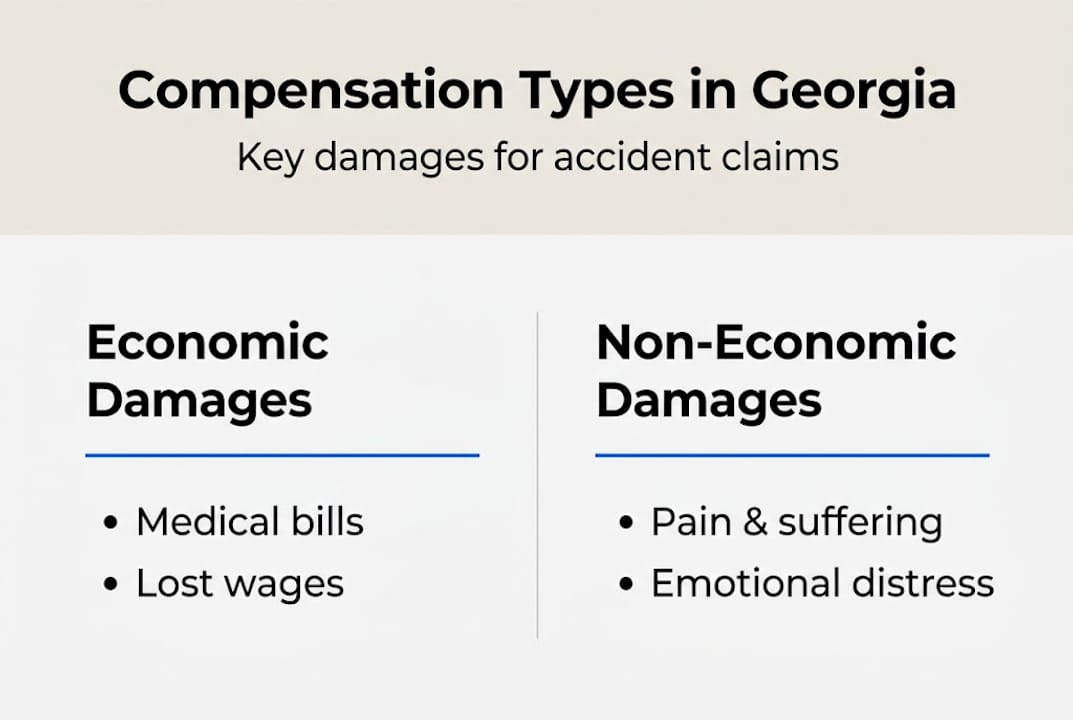
Non-economic damages cover the human cost of your injuries. Pain and suffering, emotional distress, loss of enjoyment of life, and loss of consortium all fall into this category. These are harder to quantify, but they are just as real.
Insurance adjusters often use what is called the multiplier method to estimate non-economic damages. They take your total economic damages (called “specials”) and multiply them by a number between 1.5 and 5, depending on the severity of your injuries. A $20,000 medical bill with a multiplier of 3 produces a $60,000 non-economic estimate. Knowing this formula helps you understand why complete documentation of your economic losses directly raises the value of your entire claim.
Here is a quick comparison of the two damage types:
| Damage type | Examples | How it is proven |
|---|---|---|
| Economic | Medical bills, lost wages, property repair | Receipts, pay stubs, invoices |
| Non-economic | Pain, suffering, emotional distress | Journals, testimony, medical notes |
Key items to document from day one:
- All medical bills and treatment records
- Prescription costs and therapy expenses
- Proof of missed work and lost income
- Out-of-pocket costs related to the accident
- Ongoing symptoms and how they affect daily life
As outlined in Georgia compensation categories, you should document all damages carefully, including medical bills, lost wages, and pain and suffering journals, to build the strongest possible claim. Reviewing the personal injury settlement steps can also help you understand what comes next.
Pro Tip: Start a pain journal the day after your accident. Write a short entry every day describing your pain level, what activities you could not do, and how your injuries affected your mood and sleep. This journal becomes powerful evidence for non-economic damages.
Take immediate action: Documentation and deadlines
Knowing what counts as compensable damages, it is critical to gather proof and act within Georgia’s legal time frames. Waiting too long is one of the most common and costly mistakes accident victims make.
“Miss a deadline, lose your claim. Strict compliance is required under Georgia law.”
Georgia’s statute of limitations gives most personal injury victims two years from the date of the accident to file a lawsuit, as established under O.C.G.A. § 9-3-33. But if your claim involves a government entity, such as a city bus or a poorly maintained public road, you may have as little as 6 to 12 months to file a formal notice. Missing that window can permanently bar your claim. You can review the Georgia limitations period for more detail on how these rules apply to specific case types.
Here is a step-by-step documentation process to follow immediately after an accident:
- Call 911 and get an official police report filed at the scene.
- Photograph everything: vehicle damage, road conditions, injuries, and the surrounding area.
- Collect contact information from all witnesses.
- Seek medical attention within 24 to 48 hours, even if you feel fine.
- Request copies of all medical records and treatment notes.
- Keep every receipt tied to your accident, including transportation to appointments.
- Notify your employer in writing about missed work days.
Timeline reference for Georgia accident claims:
| Claim type | Filing deadline | Early action needed |
|---|---|---|
| Standard personal injury | 2 years | Medical records, photos |
| Government entity claim | 6 to 12 months | Ante litem notice |
| Wrongful death | 2 years from death | Estate documentation |
| Minor injury claims | Tolled until age 18 | Preserve all evidence |
Pro Tip: If a government entity is involved in your accident, send an ante litem notice (a formal written notice of your intent to sue) as early as possible. This notice is legally required before you can sue a government body in Georgia, and missing it kills your claim entirely. Review the accident claim steps to make sure you follow the right process.
Navigate fault and negotiate wisely: Georgia’s comparative negligence rules
Once your documentation is ready, you need to understand how Georgia’s unique rules on fault impact your financial recovery. This is where many victims unknowingly give up money.

Georgia follows a modified comparative negligence system. Under Georgia personal injury law, if you are found to be less than 50% at fault for the accident, you can still recover compensation. However, your award is reduced by your percentage of fault. If you are 50% or more at fault, you recover nothing.
Here is how the math works in practice:
| Your fault % | Total award | What you actually receive |
|---|---|---|
| 0% | $100,000 | $100,000 |
| 25% | $100,000 | $75,000 |
| 40% | $100,000 | $60,000 |
| 50% or more | $100,000 | $0 |
Insurance adjusters know this rule well. They will often try to assign you more fault than you actually carry to reduce their payout. A disputed liability case can cost you tens of thousands of dollars if you are not careful. The Georgia 50% fault rule explains exactly how this plays out in real cases.
Negotiation tips to protect your recovery:
- Never admit fault at the scene or in conversations with adjusters.
- Do not accept the first settlement offer. It is almost always too low.
- Gather independent evidence, such as traffic camera footage or expert accident reconstruction.
- Keep all communication with insurance companies in writing.
- Review fault example scenarios to understand how adjusters assign liability.
Insurance companies are skilled negotiators. You should be too. Knowing your rights under Georgia’s comparative negligence rules is one of the most powerful tools you have.
Work with a lawyer for maximum results
Understanding the complexities of fault and damage calculation, the final piece is leveraging expert help to protect your interests. An experienced Georgia personal injury attorney does not just handle paperwork. They change the outcome of your case.
Here is what a skilled attorney does that most victims cannot do alone:
- Investigates thoroughly. Attorneys gather evidence quickly, including surveillance footage, black box data from vehicles, and expert witness statements.
- Handles all insurance communication. Every word you say to an adjuster can be used against you. Your lawyer shields you from that risk.
- Calculates the full value of your claim. Attorneys identify damages that victims often miss, including future medical costs and loss of earning capacity.
- Manages liens and subrogation. If your health insurer paid your medical bills, they may have a right to be repaid from your settlement. An attorney negotiates those liens down.
- Litigates if needed. When insurers refuse to offer fair value, your attorney takes the case to court.
“Hiring an attorney early, before you speak to any insurer, is the single most effective step you can take to protect your compensation.”
As noted in guidance on compensation types, hiring an experienced Georgia personal injury attorney early is essential for negotiating effectively, managing liens, and stacking UM/UIM (uninsured/underinsured motorist) coverage when available. Learn more about the benefits of hiring a personal injury lawyer and how to maximize your claim with the right legal support.
Common mistakes attorneys prevent:
- Accepting a lowball early offer before treatment is complete
- Failing to claim future medical expenses
- Ignoring subrogation rights that could reduce your net recovery
- Missing deadlines for government claims
Pro Tip: Choose a lawyer with Georgia-specific personal injury experience. Georgia’s laws on comparative fault, ante litem notices, and insurance coverage stacking are unique. A lawyer who knows these rules inside and out can make a significant difference in your final settlement. You can also review the steps to file an injury lawsuit if your case goes to court.
Why waiting for full recovery before settling is your best strategy
With the legal and practical steps covered, there is one more strategy most victims overlook. It is arguably the most important of all.
Insurance companies push for fast settlements. They contact you while you are still in pain, still confused, and still unsure how serious your injuries really are. That urgency is not accidental. It is a tactic designed to close your claim before the full picture emerges.
The truth is, the real value of your case is not known until your treatment is complete. A back injury that seems minor in week two may require surgery by month four. Nerve damage may not fully present itself for months. Settling before you reach maximum medical improvement (MMI), the point at which your condition has stabilized, can leave you personally responsible for future medical bills that should have been covered.
“Accepting an early settlement may leave you paying future medical bills out of your own pocket.”
Patience, combined with thorough documentation of ongoing care, can add thousands of dollars to your final award. As detailed in the full damages explanation, completing treatment before settling ensures that future care costs are captured and that early settlements do not undervalue your claim. Do not let pressure from an insurer push you into a decision you will regret.
Get expert help with your Georgia accident claim
Navigating a Georgia personal injury claim on your own is risky. Small errors, like missing a deadline, admitting partial fault, or accepting a low first offer, can cost you thousands of dollars you are rightfully owed.

Jewkes Firm’s Georgia personal injury lawyers are dedicated to fighting for maximum compensation on your behalf. We work on a contingency fee basis, meaning you pay nothing unless we win your case. Our team handles everything from evidence gathering and insurance negotiations to litigation, so you can focus on healing. Contact us today for a FREE CONSULTATION and let us review your case at no cost to you.
Frequently asked questions
How long do I have to file a personal injury claim in Georgia?
You generally have two years from the date of your accident to file, but claims against government entities may have deadlines as short as six months, so acting quickly is essential.
What if I was partly at fault for my accident?
Georgia’s modified comparative negligence law allows you to recover compensation as long as you were less than 50% at fault, though your award will be reduced by your share of the blame.
What evidence increases my accident compensation?
Complete medical records, lost wage documentation, accident photos, and a daily pain journal all strengthen your claim, as thorough damage records directly support both economic and non-economic damages.
Should I accept the insurance company’s first settlement offer?
No. First offers are almost always below the true value of your claim. Consult an attorney before agreeing to any settlement, especially before your medical treatment is complete, as early settlement acceptance can permanently waive your right to future compensation.
Recommended
- How to handle accident claims in Georgia: step-by-step
- Understanding compensation types in Georgia injury cases
- File Personal Injury Claim in Georgia: 3.5x Higher Success
- Examples of accident claims and how to file in South Atlanta