

TL;DR:
- The Georgia litigation process follows a structured sequence from filing a complaint to possible appeals, with strict deadlines controlling each step. Missing deadlines such as the 30-day answer period can result in default judgments, making timely action crucial. Discovery phases and pretrial motions significantly influence case outcomes, emphasizing thorough preparation early in the process.
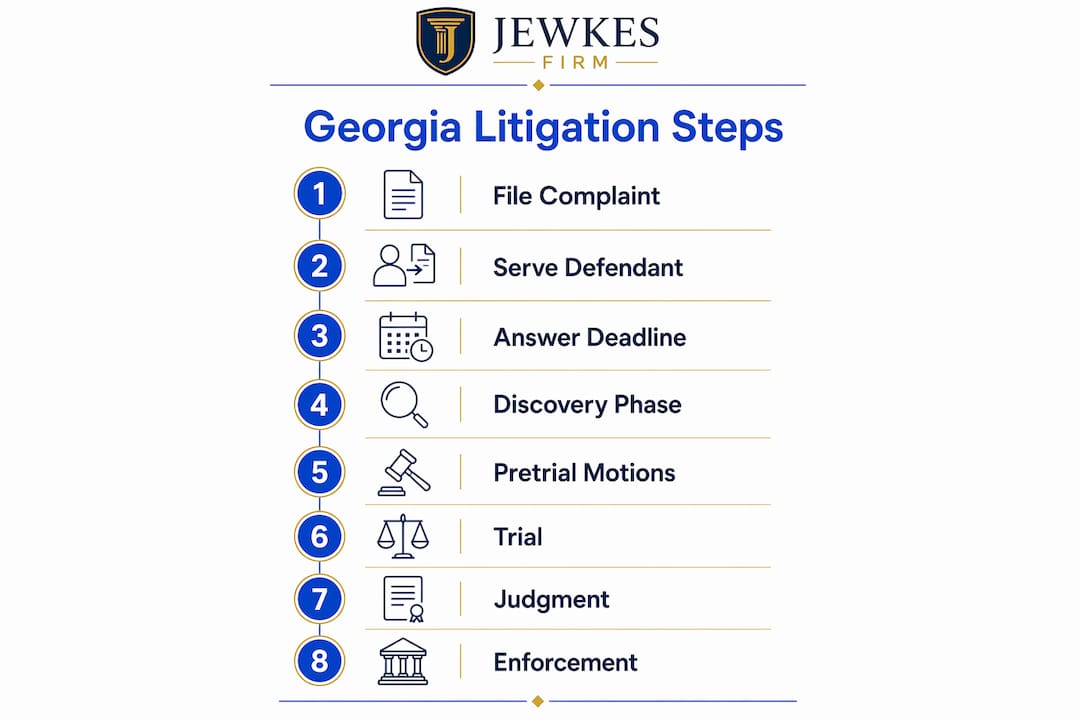
The Georgia litigation process is the formal, statutory sequence governing civil lawsuits in the state: filing a complaint, serving the defendant, exchanging pleadings, conducting discovery, arguing pretrial motions, proceeding to trial, and, if necessary, pursuing an appeal. Two deadlines control your rights from day one. Under O.C.G.A. § 9-11-12, a defendant has a statutory period from service to file a written answer or face default judgment. Discovery is bounded by O.C.G.A. § 9-11-33, which limits interrogatories to a set number of questions per party absent a court order or written agreement.
If you were served today: preserve every piece of evidence, mark the 30-day calendar deadline in red, and consult an attorney before that clock expires.
Table of Contents
- What Are the Stages of a Georgia Civil Lawsuit?
- Key Deadlines and Timelines That Control Your Georgia Case
- How Does Discovery Work in Georgia?
- Common Pretrial Motions and How They Change Your Case
- How Do Georgia Cases Typically Resolve?
- What Does Georgia Litigation Actually Cost?
- What Should You Do in the First 30 Days?
- Key Takeaways
- Why Preparation Separates Winning Cases from Losing Ones
- Ready to Talk to a Georgia Injury Attorney? Jewkesfirm Can Help
- Authoritative Sources and Further Reading
What Are the Stages of a Georgia Civil Lawsuit?
Georgia civil litigation steps follow a structured path governed by the Georgia Civil Practice Act (O.C.G.A. Title 9) and supplemented by Uniform Superior Court Rules and local county rules.
- Pre-suit investigation and demand letter. Before filing, gather contracts, medical records, photos, and witness statements. A demand letter often prompts early settlement and can avoid court entirely.
- Filing the complaint. The plaintiff files a formal complaint in the appropriate court. Missing Georgia’s statute of limitations permanently bars recovery, so filing on time is non-negotiable.
- Service of process. The defendant must be properly served by the sheriff’s office or an authorized process server. The 30-day answer clock starts on the date of service.
- Defendant’s answer or motion. The defendant admits or denies each allegation, raises defenses, and may file a motion to dismiss or counterclaim.
- Discovery. Both sides exchange evidence through interrogatories, depositions, document requests, and admissions. This is typically the longest phase.
- Pretrial motions and conferences. Either party may move for summary judgment. Courts often schedule a pretrial conference to set trial dates and discuss settlement.
- Trial. If no resolution is reached, the case proceeds to a bench or jury trial. Both sides present evidence and examine witnesses.
- Post-trial motions. The losing party may file motions for a new trial or to alter the judgment.
- Appeal. A notice of appeal must be filed within the statutory deadline after final judgment to the Georgia Court of Appeals or, in certain cases, the Supreme Court of Georgia.
Jurisdiction and venue: which court do you file in?
Georgia has three primary trial courts for civil matters. Magistrate Court handles small claims and minor civil disputes with simplified procedures. State Court covers mid-range civil cases and misdemeanor offenses. Superior Court has general jurisdiction over all civil matters, including personal injury claims, contract disputes, and property cases. Filing in the wrong court wastes time and money, so matching your claim type and dollar amount to the right venue matters from the start.

How a car-accident claim typically flows
A driver injured in a rear-end collision files a complaint in Superior Court, serves the at-fault driver, and receives an answer within the permitted response period. Discovery runs roughly six months: the plaintiff deposes the defendant and the defendant’s insurer requests medical records. Settlement talks intensify after depositions. Most injury cases settle before trial, often during or shortly after the discovery phase.
Key Deadlines and Timelines That Control Your Georgia Case
Missing a deadline can forfeit your rights entirely. The table below maps the core timing rules every Georgia litigant must track.
| Deadline / Phase | Timeframe | Consequence of Missing |
|---|---|---|
| Statute of limitations | Varies by claim type (consult counsel for your specific claim) | Claim permanently barred |
| Service of process after filing | Typically within a few days to several weeks | Case may be dismissed for lack of service |
| Defendant’s answer after service | 30 days (O.C.G.A. § 9-11-12) | Default judgment entered against defendant |
| Discovery period | Commonly 3–12 months depending on complexity | Missed evidence; weakened trial position |
| Notice of appeal after final judgment | 30 days | Right to appeal waived |
What is a default judgment and why does the 30-day rule matter?
If a defendant fails to answer within 30 days, the plaintiff can move for a default judgment, meaning the court rules in the plaintiff’s favor without a trial. Georgia does allow a defendant to reopen a default, but only within a narrow window and only by showing a meritorious defense and a reasonable excuse. Waiting even a few extra days after the deadline dramatically reduces the chance of reopening. The personal injury case timeline for most Georgia injury matters spans several months to well over a year, with discovery alone often running six to ten months in contested cases.
How Does Discovery Work in Georgia?
Discovery is where cases are won or lost before anyone sets foot in a courtroom. Georgia’s Civil Practice Act provides five principal tools.
- Interrogatories (O.C.G.A. § 9-11-33): Written questions one party sends to the other, limited to 50 questions per party unless the court orders otherwise or the parties agree in writing. Prioritize your questions carefully.
- Requests for production: Formal demands for documents, emails, contracts, photos, or other tangible evidence.
- Depositions: Sworn, out-of-court testimony transcribed by a court reporter. Depositions are the most powerful discovery tool for locking in witness accounts.
- Requests for admission: Statements one side asks the other to admit or deny, narrowing the disputed issues before trial.
- Physical or mental examinations: Available when a party’s physical or mental condition is directly at issue.
Discovery disputes are resolved by a motion to compel under O.C.G.A. § 9-11-37. Sanctions for non-compliance can include dismissal, default, or contempt, so timely and complete responses are not optional.
Pro Tip: Prepare every discovery response as if a jury will read it. Cutting corners on interrogatory answers or document production almost always surfaces as a weakness during cross-examination at trial.
Common Pretrial Motions and How They Change Your Case
Motions are formal requests asking the judge to rule before trial. Three are especially consequential in Georgia civil litigation.
Motion to dismiss challenges the court’s jurisdiction, improper venue, or the plaintiff’s failure to state a legally valid claim. A successful motion to dismiss can end the case before discovery even begins, saving the defendant significant time and expense.
Motion for summary judgment (O.C.G.A. § 9-11-56) argues that the undisputed facts entitle one party to win as a matter of law, without a trial. Courts grant summary judgment only when no genuine issue of material fact remains. The quality of your discovery record directly determines whether summary judgment is a realistic option or a long shot.
Motions in limine ask the judge to exclude specific evidence before trial, such as prior bad acts or unreliable expert testimony. Georgia courts apply standards similar to the federal Daubert framework when evaluating expert witnesses, so retaining qualified experts early and preparing them thoroughly is critical.
A well-prepared pretrial motion can eliminate entire claims or defenses before the jury hears a word. Conversely, a poorly supported motion signals weakness to both the judge and opposing counsel.
How Do Georgia Cases Typically Resolve?
Most civil cases never reach a jury. Understanding the resolution paths helps you evaluate your options realistically.
- Settlement: Parties negotiate a dollar amount and release claims. Settlement can happen at any stage, from pre-suit demand through the morning of trial. To maximize your accident compensation, understanding your case’s full value before negotiating is essential.
- Dismissal: The plaintiff voluntarily dismisses, or the court dismisses for procedural failures or a successful motion.
- Default judgment: The defendant fails to answer within 30 days and the court enters judgment for the plaintiff.
- Bench or jury trial: A judge decides alone (bench trial) or a jury decides the facts. Jury trials are more common in personal injury and contract disputes.
- Appeal: The losing party challenges legal errors to the Georgia Court of Appeals within 30 days of the final judgment. An appeal reviews the record for legal error; it is not a second trial.
After winning a judgment, collection is a separate step. Enforcement tools include filing a writ of fieri facias (fi. fa.), garnishment, and post-judgment discovery to locate assets. A fi. fa. remains valid for seven years and can be renewed.
Pro Tip: Cases with weak factual disputes and high litigation costs tend to settle. Cases involving disputed credibility, precedent-setting issues, or large damages gaps tend to go to trial. Honest case assessment early on saves money and stress later.
What Does Georgia Litigation Actually Cost?
Litigation costs vary significantly by court, county, and case complexity.
| Cost Category | Typical Range | Notes |
|---|---|---|
| Superior / State Court filing fees | Low hundreds of dollars | Varies by county |
| Magistrate Court filing fees | Lower than Superior/State | Simplified procedures |
| Service of process | Varies by method | Sheriff or process server fees apply |
| Deposition costs | Varies by length and reporter | Transcript fees add up in complex cases |
| Expert witnesses | Varies widely | Often the largest single litigation expense |
For personal injury matters, most plaintiffs retain counsel on a contingency fee basis: the attorney earns a percentage of the recovery only if the case succeeds. You pay nothing out of pocket unless your lawyer wins. Hourly billing applies in most other civil cases, where costs accumulate regardless of outcome.
A short example: if a personal injury case settles for $100,000 and the contingency fee is one-third, the attorney receives approximately $33,333 and the client nets the remainder after costs. That structure aligns the attorney’s incentive directly with the client’s recovery. Jewkesfirm offers free consultations and contingency arrangements for qualifying injury clients, so there is no financial barrier to getting an honest case evaluation.
What Should You Do in the First 30 Days?
Whether you are filing or defending, the first 30 days set the trajectory of the entire case.
- Preserve all physical evidence immediately: photographs, damaged property, clothing, and any objects relevant to the incident.
- Save every communication: texts, emails, voicemails, and written correspondence related to the dispute.
- Do not delete social media posts or device data. Courts treat spoliation of evidence seriously, and sanctions can be severe.
- Note all key dates: date of incident, date of service, and any deadlines referenced in the summons.
- Calendar the 30-day answer deadline if you were served. Missing it risks a default judgment.
- Consult an attorney before the deadline. Extensions are available only in narrow circumstances, and a default judgment is very difficult to undo.
- Gather documents for your initial consultation: the complaint or summons, any contracts or agreements, insurance policies, medical records, and a written timeline of events.
Pro Tip: Bring a written chronology to your first attorney meeting. Your lawyer’s first questions will be: What happened, when, and what evidence exists? A clear timeline cuts consultation time in half and lets counsel focus on strategy immediately.
For a detailed walkthrough of filing an injury lawsuit in Georgia, Jewkesfirm publishes step-by-step resources to help you understand every stage before you walk into a courtroom.
Key Takeaways
Georgia litigation is a staged, deadline-driven process where preparation at each phase directly determines what is possible at the next.
| Point | Details |
|---|---|
| 30-day answer deadline | A defendant must respond within 30 days of service or risk a default judgment under O.C.G.A. § 9-11-12. |
| 50-question interrogatory limit | Georgia caps interrogatories at 50 per party; prioritize questions carefully to stay within the limit. |
| Discovery drives outcomes | Cases won or lost in discovery; poor preparation surfaces as weakness at trial or on cross-examination. |
| Appeal window is strict | A notice of appeal must be filed within 30 days of the final judgment or the right is waived. |
| Jewkesfirm | Offers free consultations and contingency-fee representation for qualifying Georgia injury clients. |
Why Preparation Separates Winning Cases from Losing Ones
What separates clients who recover maximum compensation from those who don’t is rarely the strength of the underlying facts. It is preparation. Cases where evidence is preserved from day one, discovery is thorough, and motions are strategically deployed give attorneys the tools to negotiate from strength or win at trial. Cases where corners were cut in discovery consistently show up as weaknesses under cross-examination, and those weaknesses are very difficult to repair once the trial has begun.
Jewkesfirm handles Georgia personal injury matters across auto accidents, trucking crashes, medical malpractice, slip-and-fall injuries, and wrongful death claims. The firm’s approach prioritizes building the strongest possible record at every stage, because the outcome at trial is almost always decided long before the jury is seated.
Ready to Talk to a Georgia Injury Attorney? Jewkesfirm Can Help
Jewkesfirm gives injured Georgians a concrete advantage: a free case evaluation with no obligation, and contingency-fee representation for qualifying personal injury matters so you pay nothing unless the firm wins.

The firm handles the full litigation cycle: case evaluation, negotiation, mediation, trial, and appeals. Practice areas include auto accidents, trucking crashes, medical malpractice, slip-and-fall injuries, workers’ compensation, and wrongful death. If you were served with a complaint or suffered an injury due to someone else’s negligence, the 30-day clock may already be running. Contact Jewkesfirm for a free consultation and bring your timeline, your documents, and your questions. The firm’s attorneys will tell you exactly where you stand.
Authoritative Sources and Further Reading
- O.C.G.A. § 9-11-12 (30-day answer deadline) — Justia
- O.C.G.A. § 9-11-33 (interrogatory limits) — Justia
- Georgia Legal Aid: civil lawsuits overview
- Georgia Legal Services Authority: civil procedure basics
- First Counsel: Georgia personal injury litigation stages
| Source | Best Used For |
|---|---|
| O.C.G.A. § 9-11-12 | Confirming the 30-day answer deadline and default judgment rules |
| O.C.G.A. § 9-11-33 | Verifying the 50-interrogatory limit per party |
| Georgia Legal Aid | Pleadings, service of process, and post-filing basics |
| Georgia Legal Services Authority | Statutory framework and discovery sanctions |
| First Counsel | Timeline expectations and discovery strategy |