

TL;DR:
- Strong evidence is essential in Georgia personal injury claims to prove fault and damages.
- Types of key evidence include medical records, police reports, photos, witness statements, and expert opinions.
- Promptly gathering and preserving evidence significantly increases chances of a successful case.
Many accident victims in Georgia believe that being clearly hurt and having an obvious at-fault driver is enough to win a personal injury case. It is not. Courts do not operate on assumptions or sympathy. They operate on proof. Without strong, well-organized evidence, even the most legitimate injury claims can fall apart before they ever reach a fair resolution. This guide walks you through exactly what evidence matters, how Georgia courts evaluate it, and what steps you can take right now to protect your claim and your future.
Table of Contents
- What is evidence in a personal injury claim?
- Key types of evidence that strengthen your case
- How courts evaluate and allow evidence in Georgia
- Steps to gather and preserve the strongest evidence
- Why most victims underestimate evidence (and what to do differently)
- Need help building your case? We can help
- Frequently asked questions
Key Takeaways
| Point | Details |
|---|---|
| Evidence is essential | No matter how clear the injury, strong evidence is necessary to win a Georgia personal injury case. |
| Use multiple evidence types | Combining photos, records, witness statements, and expert opinions gives you the best chance of success. |
| Act quickly | Gather evidence right after an accident to avoid losing details or proof. |
| Courts are selective | Georgia judges strictly review evidence, especially expert opinions, so professional help can be crucial. |
What is evidence in a personal injury claim?
Evidence is any material or information that helps establish the facts of your case. In a personal injury claim, that means proving two things: that someone else was at fault, and that their actions caused your injuries and losses. Personal injury claims depend on physical, testimonial, and documentary evidence to prove both liability and damages.
Georgia courts are strict about what they allow. Evidence must be relevant, meaning it must actually relate to the facts in dispute. It must also be reliable, meaning it comes from a credible source and was gathered properly. Anything that falls outside those standards can be excluded, no matter how convincing it seems to you.
Here are the main categories of evidence used in Georgia personal injury claim examples:
- Medical records: Documentation of your diagnosis, treatment, and prognosis directly connects your injuries to the accident.
- Accident reports: Police reports and incident reports create an official record of what happened and who was involved.
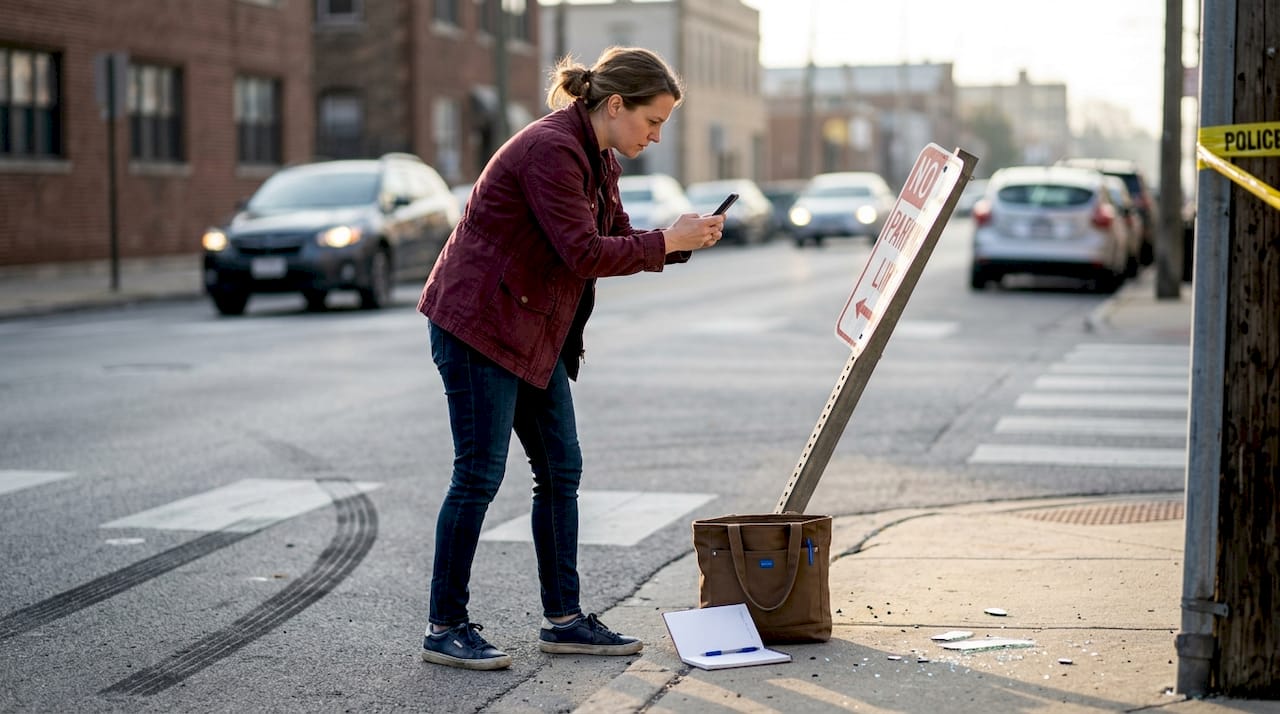
- Photographs and videos: Visual evidence captures the scene, vehicle damage, hazardous conditions, and visible injuries.
- Witness statements: Eyewitness accounts from people who saw the accident provide independent support for your version of events.
- Expert opinions: Medical experts, accident reconstructionists, and other specialists can explain complex facts to a jury in plain terms.
Each category plays a different role. Together, they build a picture that a judge or jury can trust.
Pro Tip: Start collecting evidence immediately after an accident. Memories fade, surveillance footage gets overwritten, and physical conditions change. The sooner you act, the stronger your file will be.
Key types of evidence that strengthen your case
Now that you know what counts as evidence, here are the types that actually sway Georgia courts.
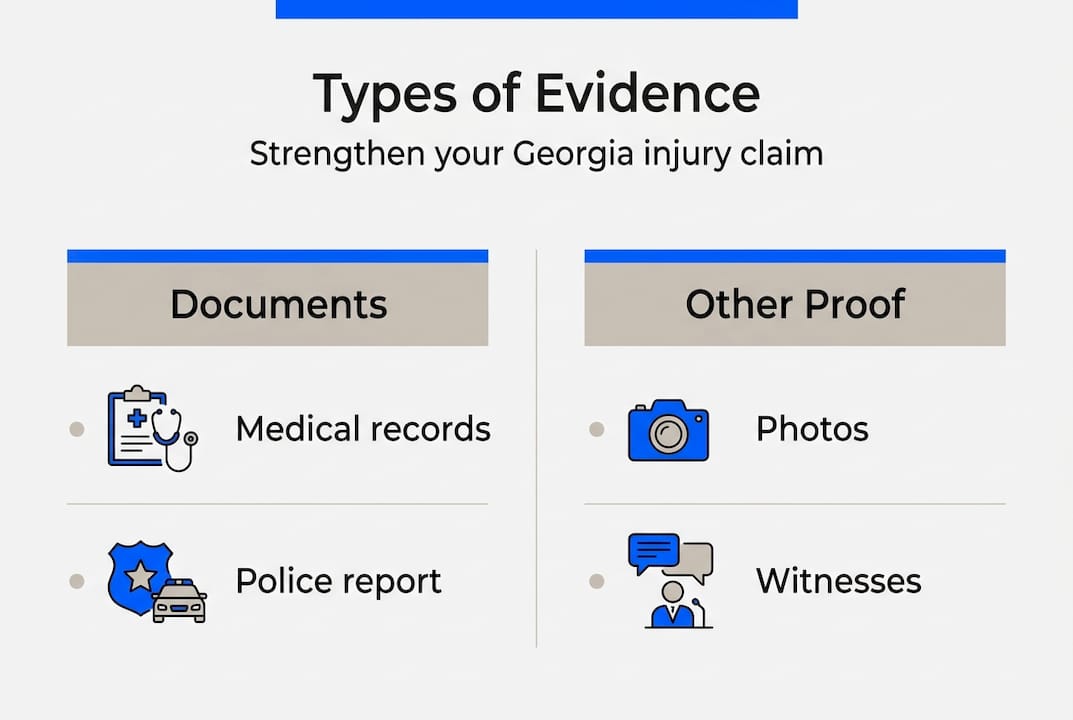
Medical records, police reports, and eyewitness statements often make or break a claim. Claims backed by complete evidence are 3.5 times more likely to succeed than those with gaps or inconsistencies. That number alone should tell you how seriously you need to take this.
Here is how each type of evidence contributes to your case:
- Medical documentation: This is your most powerful tool. It proves you were injured, shows the severity, and establishes a timeline connecting the accident to your condition.
- Accident reports: A police report carries official weight. It records the responding officer’s observations, statements from those involved, and often an initial determination of fault.
- Photographs and video: Visual proof is hard to argue with. Photos of skid marks, broken equipment, or a wet floor can establish conditions that words alone cannot.
- Witness testimony: An independent witness with no stake in the outcome is extremely credible to a jury. Their account can confirm your story and challenge the other side’s version.
- Expert opinions: Experts translate technical or medical information into language the court can act on. A biomechanical expert, for example, can explain exactly how a collision caused your spinal injury.
| Evidence type | Primary role | Impact level |
|---|---|---|
| Medical records | Proves injury and damages | Very high |
| Police/accident report | Establishes facts and fault | High |
| Photos and video | Visual confirmation of conditions | High |
| Witness statements | Independent corroboration | Medium to high |
| Expert opinions | Explains complex causation | High (if qualified) |
For specific case types, the evidence requirements shift slightly. Reviewing evidence for slip and fall cases, for instance, shows how property maintenance records become just as important as medical files. Exploring real-world evidence examples from South Atlanta cases can also help you understand what a complete file looks like in practice.
How courts evaluate and allow evidence in Georgia
But not all evidence is equal. Here is how Georgia courts decide what gets in and what stays out.
Georgia follows strict rules for admissibility. Evidence must be relevant to the facts at issue and must be presented through proper legal channels. Hearsay, meaning statements made outside of court that are offered to prove the truth of a claim, is generally not allowed unless a specific exception applies. Speculation is never allowed.
Courts in Georgia rigorously filter out speculative or unqualified expert opinions and require strong methodological support. This is especially important for expert witnesses. A doctor who simply says “this injury was caused by the accident” without explaining their reasoning may be disqualified. The court wants to know how they reached that conclusion, not just what it is.
“Georgia courts apply a gatekeeping standard to expert testimony. The methodology matters more than the conclusion. If an expert cannot explain their process in a way that meets scientific or professional standards, their testimony will not be heard.”
Here are the most common reasons evidence gets excluded in Georgia personal injury cases:
| Reason for exclusion | Example |
|---|---|
| Hearsay | A friend’s account of what someone else told them |
| Lack of expert qualification | A general practitioner testifying on neurosurgery |
| Improper foundation | Photos with no documented chain of custody |
| Speculation | An expert guessing at cause without testing |
| Irrelevance | Evidence unrelated to the specific facts in dispute |
Understanding these standards is one reason why working with a qualified injury attorney matters so much. An experienced attorney knows how to present evidence in a way that meets Georgia’s admissibility requirements.
Steps to gather and preserve the strongest evidence
Knowing what counts and how courts review evidence, let’s turn to action. Here is how to gather what you need.
Taking early action to gather evidence protects your rights and increases your chance of success. Every hour that passes after an accident is an opportunity for evidence to disappear.
Follow these steps as soon as it is safe to do so:
- Seek medical care immediately. Even if you feel fine, get evaluated. Delayed treatment creates gaps in your medical record that the other side will use against you.
- Report the accident officially. Call the police for car accidents. Report the incident to a property manager for slip and falls. Get a copy of every official report.
- Document everything visually. Take photos and videos of the scene, your injuries, vehicle damage, road conditions, and any contributing hazards. Take more than you think you need.
- Collect witness information. Get names, phone numbers, and email addresses from anyone who saw what happened. Do not rely on memory.
- Keep a pain journal. Write down your symptoms, limitations, and emotional state every day. This documentation supports claims for pain and suffering.
- Preserve physical evidence. Keep damaged clothing, broken equipment, or any physical object involved in the accident. Store it somewhere safe and do not repair or discard it.
- Back up all digital files. Store photos, videos, and communications in multiple places, including cloud storage.
For a broader look at the injury claim process steps, including what happens after evidence is gathered, reviewing a full injury lawsuit guide for Georgia can prepare you for every stage ahead.
Pro Tip: Ask your attorney what evidence they plan to gather on your behalf. A good attorney will subpoena surveillance footage, obtain black box data from vehicles, and hire qualified experts. Do not assume they will handle it without being asked.
Why most victims underestimate evidence (and what to do differently)
The steps are clear, but here is where most people go wrong.
Many victims trust that the truth will come out on its own. It will not. Courts are not in the business of finding truth. They are in the business of evaluating proof. An obvious injury without documentation is just an allegation. A minor detail you dismissed, like a small crack in a sidewalk or a faint bruise on day one, can become the turning point in your case.
We have seen victims lose strong claims because they did not write down the names of bystanders, or because they waited three days to see a doctor. Those gaps become the other side’s best arguments.
Write down everything. Take more photos than feels necessary. Document your pain daily, even when it seems repetitive. And do not assume your attorney is automatically building a thorough evidence file. Ask them directly about their strategy. Understanding the value of injury lawyers who prioritize evidence from day one can be the difference between a strong settlement and a dismissed case. Not every attorney approaches evidence with the same rigor. Find one who does.
Need help building your case? We can help
If building your own evidence file seems overwhelming, you are not alone. Most accident victims are dealing with pain, stress, and financial pressure at the same time. Gathering and preserving the right evidence while managing all of that is a real challenge.

The Jewkes Firm legal team knows what Georgia courts require and how to build a file that holds up. From obtaining accident reports and medical records to working with qualified experts, we handle the evidence so you can focus on healing. As a trusted injury lawyer in South Atlanta, we work on a contingency fee basis, meaning you pay nothing unless we win. Contact us today for a FREE CONSULTATION and let us fight for the maximum compensation you deserve.
Frequently asked questions
What are the most important types of evidence for a Georgia personal injury claim?
Medical records, police reports, and eyewitness statements are usually the most critical, as they directly prove both fault and the extent of your injuries.
Can expert witnesses always testify in Georgia personal injury cases?
No. Georgia courts only allow expert testimony if the expert is properly qualified and uses a reliable, well-supported methodology.
How soon should I collect evidence after an accident?
You should collect evidence as soon as possible after the accident. Taking early action prevents critical details from being lost and strengthens your position from the start.
What happens if I don’t have enough evidence in my case?
Without sufficient evidence, your claim is far less likely to succeed or secure fair compensation, since personal injury claims depend on a combination of physical, testimonial, and documentary proof to establish liability and damages.