

The cost of suing a dentist depends on the attorney’s fee arrangement, the evidence needed, and how far the case proceeds. With contingency representation, attorney fees depend on a recovery, but you must separately clarify who pays expenses such as dental expert reviews, court filings, and depositions.
A Georgia Dental Malpractice Attorney can explain what you must pay upfront, who advances case expenses, and what you could owe if the claim is unsuccessful. Your written agreement should explain those obligations.
This guide breaks down the main cost categories, explains how deductions affect settlement proceeds, and identifies questions to ask before hiring an attorney.
What Might You Pay Upfront?
Your initial payment depends on the firm’s terms and the arrangement offered for your claim. Before authorizing work, ask for a clear explanation of what is due now and what may become payable later.
Consultation Fees, Retainers, and Expense Deposits
These charges serve different purposes:
- Consultation fee: Payment for an initial discussion or assessment, if charged.
- Advance attorney fee deposit: Money paid toward legal services under the agreed arrangement.
- Expense deposit: Funds set aside for items such as records retrieval or expert review.
A free consultation does not automatically mean that investigation or litigation expenses are waived. Ask whether reviewing your records or obtaining an initial dental expert opinion would require a separate payment.
How Contingency Representation Affects Initial Payments
Under a contingency arrangement, the attorney’s fee depends on a recovery. However, case expenses require separate clarification. A firm may advance certain expenses, but advancement does not necessarily eliminate your obligation to reimburse them. Georgia’s rules permit expense advances with repayment potentially contingent on the outcome. Request written confirmation of any upfront payment and reimbursement terms before proceeding.
How Dental Malpractice Attorney Fees Work
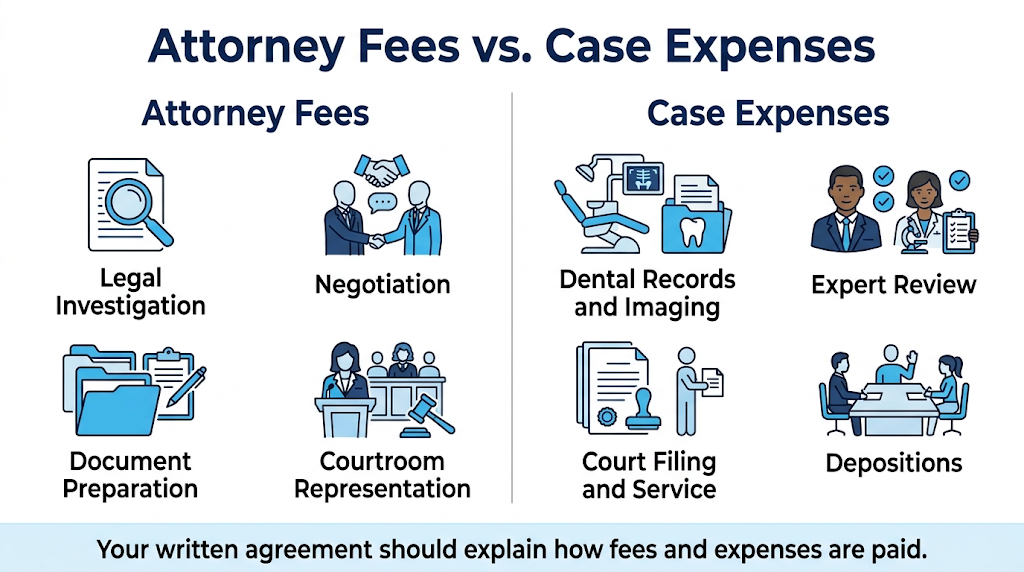
Attorney fees pay for legal services, including investigating your claim, negotiating, preparing filings, and representing you in court. Under a contingency arrangement, the attorney’s fee depends on a recovery. Your written agreement establishes the percentage and calculation method.
Understand the Percentage and Any Stage-Based Changes
Ask whether the percentage changes when a lawsuit is filed, the case reaches trial, or an appeal becomes necessary. Also confirm whether expenses are deducted before or after the attorney’s percentage is calculated. Georgia requires these calculation details to appear in the written contingency agreement.
The Jewkes Firm’s general personal injury guidance discusses percentages around 33%–40%, with possible differences depending on the case and stage of resolution. Those published examples do not establish the specific rate for your dental malpractice claim. Request the proposed terms and an example of the calculation before signing.
Separate Attorney Fees From Case Expenses
Dental expert reviews, records retrieval, court filings, and depositions generate expenses separate from attorney fees.
The Jewkes Firm states that it advances case expenses in its personal injury matters and deducts them from a recovery. Its guidance qualifies responsibility for unsuccessful-case expenses, so confirm the terms applicable to your claim in writing.
Before signing, clarify:
- Which expenses will the firm advance?
- What could you owe without a recovery?
- In what order are fees and expenses deducted?
- Do different terms apply if representation ends?
Which Expenses Can a Dental Malpractice Case Involve?
Case expenses cover the evidence and services needed to investigate and pursue your claim. Some arise before a lawsuit is filed; others develop during discovery or trial preparation. Not every case requires every expense listed below.
Dental Records, Imaging, and Expert Review
Your attorney may obtain dental charts, X-rays, scans, procedure notes, and records of corrective treatment. Retrieval or copying charges may apply.
A qualified dental expert may then review those materials to assess the treatment and its connection to your injury. The amount of material, complexity of the procedure, and questions requiring analysis can affect the expense.
Expert Affidavit Preparation and Testimony
Georgia generally requires an expert affidavit with a professional malpractice complaint, subject to limited exceptions. Preparing it may involve paid expert review and drafting work.
Later expert services can generate separate charges, including deposition preparation, testimony, and trial attendance. An initial review payment should not be assumed to cover all future expert work.
Filing, Service, Depositions, and Trial Preparation
| Expense | What it may cover | What affects the amount |
| Court filing | Submitting the lawsuit | Court and applicable charges |
| Service of process | Formally delivering lawsuit documents | Defendants and service arrangements |
| Depositions | Recording testimony under oath | Number, duration, transcripts, and video |
| Expert testimony | Preparation and participation | Specialty, time, and attendance |
| Trial materials | Exhibits and evidence presentation | Complexity and preparation needs |
Court reporters, transcripts, travel, and additional specialists may also add costs. The Jewkes Firm’s published guidance identifies these types of expenses separately from attorney fees.
Ask for an initial estimate by category, an explanation of what it includes, and updates when the expected spending changes. An estimate helps planning but is not necessarily a fixed price.
Why Costs Differ Between Cases
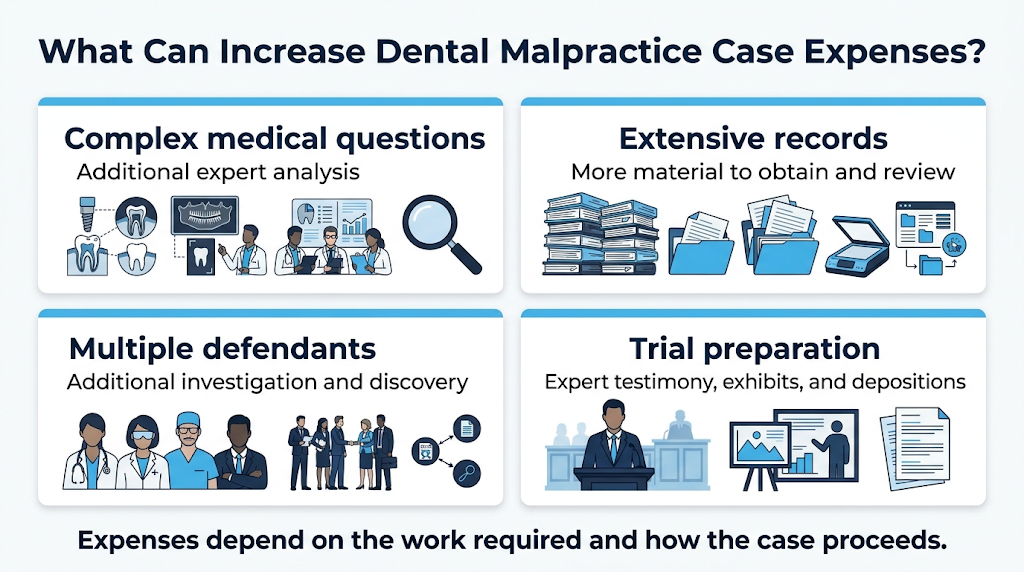
Two dental malpractice claims involving similar injuries can require different amounts of work. Costs depend on what must be investigated, which issues are disputed, and how the case develops.
Case Complexity, Providers, and Expert Requirements
A claim involving one procedure and a clear treatment history may require fewer records and expert hours than one involving several providers or years of care.
Disputed causation can add expense. An expert may need to distinguish harm caused by the alleged negligence from an existing condition or another treatment. Some claims also require specialists to assess future care needs or lost earning capacity.
The severity of an injury matters, but it is not the only factor determining litigation costs.
Early Resolution Versus Extended Litigation
A case resolved before extensive discovery may avoid some deposition, testimony, and trial preparation expenses. If important facts remain disputed, additional evidence gathering can increase spending.
However, a longer case does not generate costs at a constant rate. Ask your attorney which upcoming steps are likely to require significant expenditure and when the estimate should be updated.
Who Pays Expenses, and What Happens If There Is No Recovery?
Who pays a bill initially and who ultimately bears the expense can be different. Your representation agreement should explain both, including what happens if the claim does not produce compensation.
Expense Advances, Deposits, and Reimbursement
A firm may advance expenses, request an expense deposit, or require you to pay certain providers directly. An advance is not automatically a waiver: reimbursement may come from a recovery or become payable under other agreed terms.
The Jewkes Firm’s published personal injury guidance says it advances case expenses and deducts them from a recovery. Confirm how that policy applies to your dental malpractice claim.
If Investigation Ends or the Claim Is Unsuccessful
Ask separately about a claim that ends during investigation and a lawsuit that proceeds but produces no recovery. Do not assume both situations carry identical obligations.
The firm’s guidance states that clients typically do not repay advanced costs in unsuccessful cases, while emphasizing that the agreement should state the policy. Read the applicable terms before authorizing work.
If Representation Changes or an Appeal Is Considered
Ending representation, changing lawyers, or pursuing an appeal may raise additional fee and expense questions. Ask:
- Could previously advanced expenses become payable?
- How would fees between successive attorneys be handled?
- Does an appeal require a separate agreement or expense budget?
Request a written explanation of any financial obligations that could continue after representation ends.
How Fees and Expenses Affect Your Settlement Proceeds
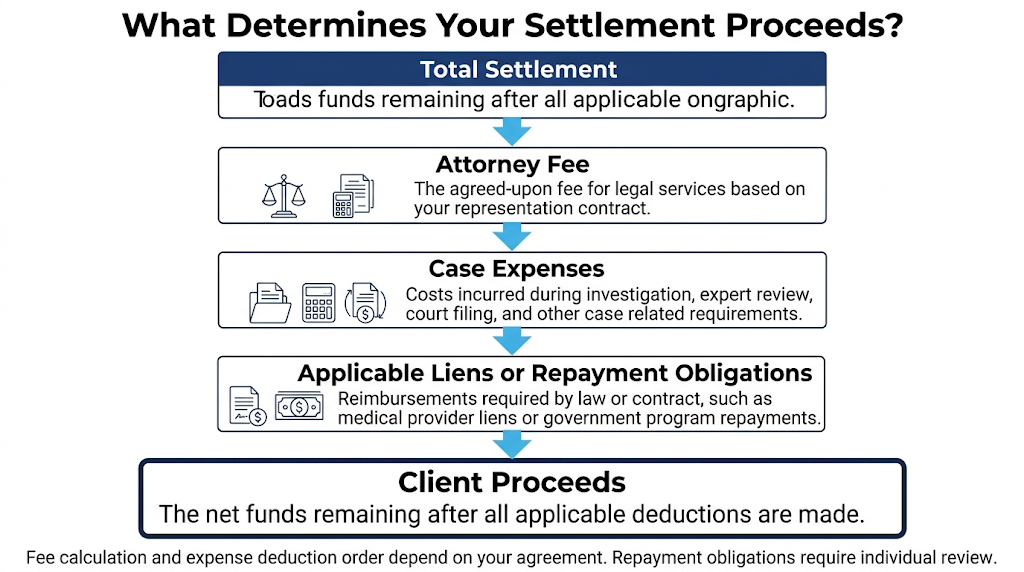
The settlement amount is not necessarily the amount you receive. Attorney fees, reimbursable case expenses, and applicable liens or repayment obligations can reduce the final distribution.
Gross Recovery Versus the Amount You Receive
Gross recovery means the total settlement or award before deductions. Ask your attorney for an itemized explanation showing the fee calculation, expenses, other applicable obligations, and the balance payable to you.
Keep these categories separate. For example, repayment of a qualifying medical lien is different from reimbursement for an expert hired to evaluate your claim.
A Hypothetical Example of Expense Deduction Order
Assume a $100,000 recovery, a 30% attorney fee, and $20,000 in case expenses. These figures illustrate arithmetic only; they are not standard rates, predicted results, or The Jewkes Firm’s terms.
| Calculation method | Attorney fee | Case expenses | Remainder before other obligations |
| Fee calculated on the full recovery | $30,000 | $20,000 | $50,000 |
| Expenses deducted before calculating the fee | $24,000 | $20,000 | $56,000 |
Georgia requires the contingency agreement to specify whether expenses are deducted before or after calculating the fee. Confirm the method in your agreement rather than assuming either example applies.
Is Pursuing the Claim Financially Practical?
An attorney weighs the evidence supporting negligence, the losses that can be documented, and the projected expense of pursuing recovery. A serious injury may justify careful investigation, but it does not guarantee a viable claim or a particular settlement.
Ask the lawyer to explain:
- Which liability or causation questions remain unresolved.
- What expert work is needed and its estimated cost.
- Which losses have supporting documentation.
- How further litigation could affect expenses and potential client proceeds.
There is no universal minimum claim value that makes every dental malpractice lawsuit worthwhile. Firms differ in resources, experience, and willingness to accept uncertainty.
Also distinguish potential compensation from the cost of pursuing it. Published settlement figures do not tell you what your claim would cost or what you would receive after deductions. Request a case-specific assessment, with estimates updated as the evidence develops.
Questions to Ask Before Signing a Fee Agreement
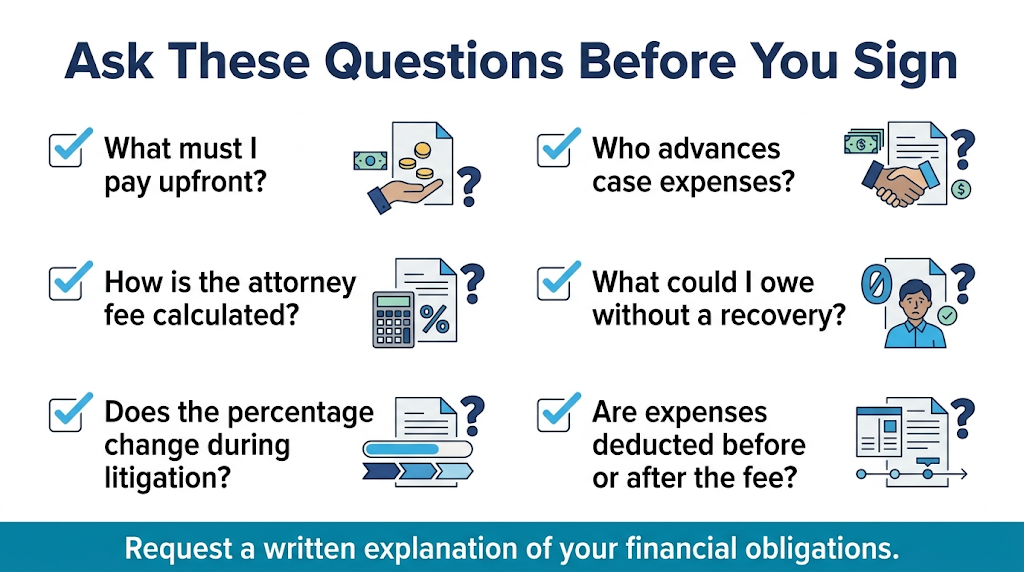
Before authorizing work, ask the attorney to explain the proposed financial terms in plain language. Request a worked example so you can see how the agreement would apply to a hypothetical recovery.
Questions include:
- What must I pay upfront? Clarify consultation charges, deposits, and initial expert review.
- How is your fee calculated? Confirm the percentage, deduction order, and any changes at filing, trial, or appeal.
- Who advances case expenses? Ask which costs are covered and when reimbursement becomes due.
- What could I owe without a recovery? Address investigation ending, an unsuccessful lawsuit, and representation ending early.
- How will I receive spending updates? Ask whether significant expenses require approval and whether estimates will be revised.
- What will the final accounting show? Request separate entries for fees, expenses, applicable repayment obligations, and your proceeds.
If an answer differs from the written agreement or remains unclear, ask for clarification before signing.
Discussing Dental Malpractice Costs With The Jewkes Firm
The Jewkes Firm offers free consultations and publishes information about its contingency fee arrangements. Use that conversation to discuss both your dental injury concerns and the financial terms proposed for your claim.
Confirm the Proposed Fee and Expense Arrangement
Ask the firm to explain the applicable percentage, expense deduction order, and responsibility for costs if the claim is unsuccessful. Its published guidance describes advancing personal injury case expenses, but your agreement should confirm the terms governing your representation.
Local Consultation Options and Verified Client Feedback
The Tyrone office is located at 1155 Senoia Road, Suite 102, Tyrone, GA 30290. Contact the office before visiting to confirm meeting arrangements and any access requirements. Located near the intersection of Senoia Road (Highway 74) and Peachtree Parkway in the heart of Tyrone, the office is situated in a commercial complex offering accessible ground-floor entry and ample free surface parking directly in front of the building.
A published client review describes the firm’s communication:
“Great experience always helpful. Great communication always kept me up to date on my case.” — Ronnie Johnson
This feedback concerns an individual service experience; it does not verify fee terms or predict a dental malpractice result.
Frequently Asked Questions
Does a Free Consultation Mean the Lawsuit Is Free?
No. A free consultation covers the initial discussion offered by the firm. Attorney fees and case expenses are separate matters. Ask what payments may be required, who advances expenses, and what you could owe under the proposed agreement.
Do I Have to Pay the Dental Expert Myself?
It depends on your arrangement. The firm may advance expert expenses, request a deposit, or require direct payment. Confirm whether an initial review includes affidavit preparation or whether later testimony generates additional charges. Advancement does not automatically mean reimbursement is waived.
Can I Save Money by Suing Without a Lawyer?
Self-representation may avoid an attorney’s fee, but it does not remove expert expenses or legal requirements. Georgia generally requires an expert affidavit when filing a professional malpractice complaint, subject to limited exceptions. A billing dispute and a malpractice claim also raise different issues.
Is a Settlement the Same as My Take-Home Amount?
No. The gross settlement may be reduced by attorney fees, reimbursable expenses, and applicable liens or repayment obligations. Ask for an itemized accounting showing each deduction and the amount payable to you. The fee agreement should explain how fees and expenses are calculated.
Request a Consultation About Your Claim and Costs
If you are concerned about the cost of pursuing a dental malpractice claim, ask The Jewkes Firm for a clear explanation of the proposed fees and expenses.
Request a free malpractice consultation to discuss your treatment, resulting harm, and available records. Before authorizing work, confirm the financial terms in writing. A consultation does not guarantee representation or compensation.
The Jewkes Firm
Address: 1155 Senoia Rd #102, Tyrone, GA 30290
Phone: (770) 771-5130