

To get a malpractice attorney to take your case, start by presenting an honest account of your treatment, the suspected medical error, and the harm that followed. Gather the records you already have, write down key dates, and contact a lawyer who handles medical malpractice. Preparation helps an attorney evaluate your situation, but it cannot guarantee acceptance.
An attorney will need to assess whether the evidence supports negligence, whether that negligence caused your injury, and what losses resulted. The firm’s experience, resources, and availability also influence its decision.
This guide explains what to prepare, how to approach a consultation, and what to do if a firm declines your claim. It focuses on medical malpractice in Georgia; claims involving a former lawyer require a separate legal malpractice evaluation.
What Makes a Medical Malpractice Case Worth Taking?
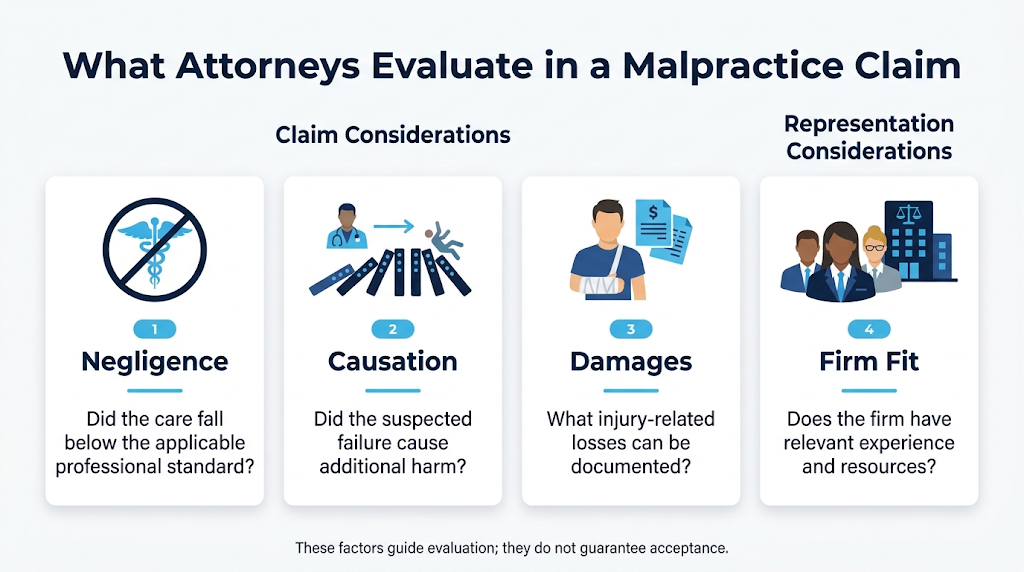
A malpractice attorney evaluates whether the evidence supports a legal claim and whether the firm has the resources to pursue it. A serious injury deserves careful review, but the outcome alone does not establish that a healthcare provider acted negligently.
Evidence of Negligence and a Breach of the Standard of Care
An attorney first needs to understand the provider’s responsibility for your treatment and whether the care fell below the applicable standard. Medical records and qualified expert review help assess what the provider should have done under the circumstances. Georgia law recognizes liability for injuries resulting from a medical professional’s failure to exercise the required care and skill.
For example, a missed diagnosis may warrant investigation. The question is whether the provider failed to take appropriate steps based on the symptoms and information available at the time. A diagnosis that later proves incorrect does not, by itself, answer that question.
A Connection Between the Medical Error and Your Injury
The attorney must also assess causation: whether the suspected negligence caused your injury or made your condition worse. Showing that a medical mistake happened is only part of the evaluation.
Suppose a test result was overlooked and treatment was delayed. Expert analysis may be needed to determine whether acting on that result sooner would probably have prevented additional harm. Georgia courts require more than speculation that the alleged negligence caused the injury.
Documented Damages and the Resources Needed to Pursue a Claim
Attorneys also examine how the injury affected your health, finances, and daily life. Useful information includes:
- Additional medical treatment and rehabilitation.
- Lost income or reduced ability to work.
- Ongoing care needs and physical limitations.
- Pain and changes to everyday activities.
Medical malpractice litigation can require substantial spending on experts, records, and case preparation. A firm considering contingency representation weighs those demands alongside the potential recovery, its relevant experience, staffing, and availability.
There is no universal dollar threshold that makes every case worth accepting. One firm’s decision may reflect its resources or case focus as well as its assessment of the evidence.
Prepare These Records Before Your Consultation
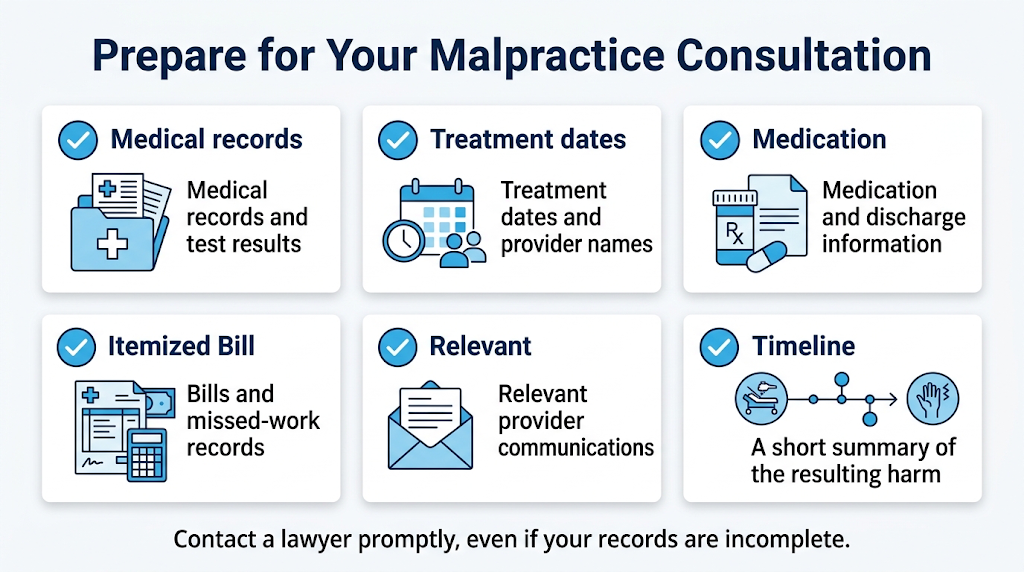
Organized records help a malpractice attorney understand what happened and identify questions that need further investigation. Start with documents you already have, but do not delay contacting a lawyer while waiting for a complete medical file.
Collect Available Medical Records and Financial Documents
Gather information about the treatment you believe caused harm and any care you received afterward. Useful documents include:
- Medical records: Visit summaries, treatment notes, discharge instructions, and surgical reports.
- Test information: Laboratory results, imaging reports, and available scan images.
- Medication details: Prescriptions, dosage instructions, and records of medication changes.
- Financial records: Medical bills, receipts for additional care, and documentation of missed work.
- Provider communications: Patient portal messages, letters, and relevant emails.
Include information about related conditions and earlier treatment, even if you think it may weaken your claim. An accurate medical history helps the attorney assess other possible explanations for your injury.
Keep originals intact. Avoid writing on records or editing screenshots, and ask the firm how to submit sensitive medical information securely.
Create a Clear Treatment and Injury Timeline
Write a short timeline that connects the records to your experience. For each important event, note:
- The date and the provider or facility involved.
- Your symptoms and the treatment you received.
- What you were told about your condition or follow-up care.
- When you noticed complications and what happened next.
Mark uncertain dates as approximate and separate what you remember from what the records confirm. Include ongoing symptoms, additional expenses, and changes to your ability to work or manage daily activities.
You do not need to diagnose the mistake yourself. Your goal is to give the attorney a clear starting point for evaluating your concerns.
How to Explain Your Case to a Malpractice Attorney
Start with a brief summary of the treatment, the suspected mistake, and the harm that followed. You do not need legal terminology or a polished presentation. Clear, accurate information gives the attorney a useful starting point.
Describe What Happened, When It Happened, and What Changed
Use your timeline to explain four things:
- The treatment: Why you sought care and which providers were involved.
- Your concern: What action, delay, or omission you believe needs investigation.
- The harm: What additional injuries, treatment, expenses, or limitations followed.
- The dates: When the treatment occurred and when you noticed problems.
For example, a hypothetical summary might be: “I visited the hospital with abdominal pain on March 4 and was discharged. Two days later, another hospital diagnosed appendicitis and performed emergency surgery. I want to understand whether the earlier care contributed to my complications.”
That summary identifies a concern without claiming that negligence has already been proven.
Separate Known Facts From Questions and Assumptions
Explain what you personally observed, what a provider told you, and what appears in your medical records. If you do not know why something happened, say so.
Disclose related health conditions, missed appointments, treatment gaps, and previous attorney reviews. These details help the lawyer assess the claim and identify information that needs clarification.
Before ending the consultation, ask which documents or answers would help the evaluation move forward. Keep a list of requested items so you can respond accurately.
Understand Georgia’s Filing Deadlines and Expert Requirements
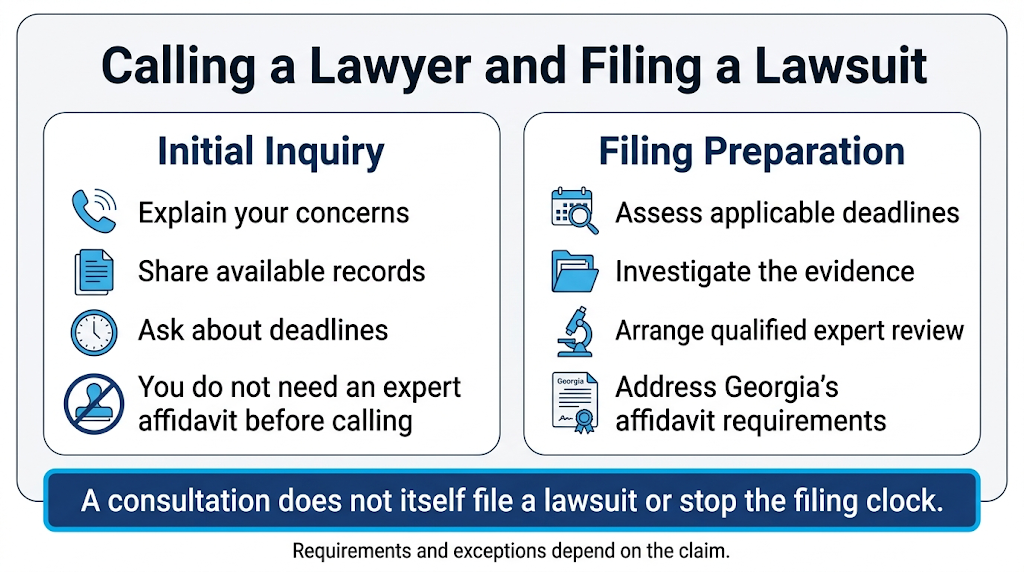
Timing affects whether an attorney can investigate and pursue your claim. Reviewing records, identifying responsible providers, and consulting medical experts takes time, so contact a lawyer promptly even if you are still gathering information.
Why You Should Ask an Attorney to Assess Your Deadline
Under O.C.G.A. § 9-3-71, Georgia generally requires a medical malpractice lawsuit to be filed within two years after the injury or death resulting from the alleged negligence. A separate five-year statute of repose generally runs from the negligent act or omission. These periods have different starting points; the five-year rule does not give everyone five years to sue.
Do not assume your deadline begins when you discover a possible medical mistake. Special rules can affect particular claims, including claims involving young children, so an attorney should assess the dates and circumstances.
Calling a firm, requesting records, or attending a consultation does not itself file your lawsuit or stop the filing clock. Ask whether the firm has agreed to represent you and who is responsible for taking action before the deadline.
How Expert Review and Affidavit Requirements Affect a Claim
Georgia generally requires an expert affidavit to accompany a complaint alleging medical professional negligence. Under O.C.G.A. § 9-11-9.1, the affidavit must identify at least one alleged negligent act or omission and its factual basis. Limited exceptions apply to the filing requirement.
You do not need to obtain this affidavit before calling a lawyer. The attorney can assess the applicable requirements and whether qualified expert review supports moving forward.
Why Malpractice Lawyers Decline Cases, and What to Do Next
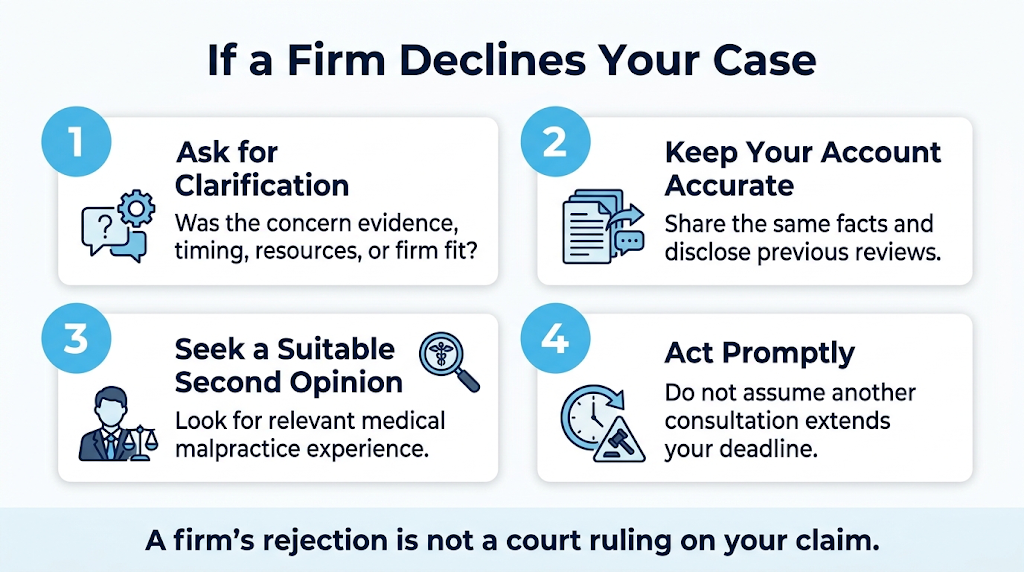
A rejection can feel discouraging, especially when you are dealing with ongoing health problems or mounting bills. However, a firm declining representation is not a court ruling on your claim. Understanding the reason can help you decide what to do next.
Evidence, Causation, Costs, and Firm Capacity
An attorney may decline because the available information does not sufficiently support negligence or connect the suspected error to your injury. Missing records or an unfavorable expert assessment can also affect the decision.
Other reasons concern the practical demands of representation:
- Litigation costs: The expected expenses may be difficult to justify against the potential recovery.
- Relevant experience: The medical issue may fall outside the firm’s usual case focus.
- Capacity: The firm may lack the staff or time needed to investigate.
- Conflicts: An existing professional relationship may prevent representation.
Ask whether the decision relates to the evidence, missing information, or the firm’s availability. The attorney may not provide a detailed explanation, but any clarification can help you approach another firm more effectively.
When to Seek a Second Opinion
Another attorney may assess the evidence differently or have resources better suited to the claim. When requesting a second opinion, disclose previous reviews honestly and provide any explanation you received.
Share your treatment timeline and available records rather than changing your account to make it sound more persuasive. Ask whether additional information could resolve unanswered questions.
Act promptly. Do not assume that another consultation gives you more time to file. Tell each firm the key treatment dates and ask whether it can evaluate your inquiry soon enough to address any applicable deadline.
Choosing a Georgia Medical Malpractice Attorney
Finding suitable representation involves asking how a firm would investigate your claim, communicate with you, and handle the financial terms. Use the consultation to assess those practical details before agreeing to representation.
Ask About Relevant Experience and Case Handling
Ask whether the attorney has handled claims involving similar treatment or injuries. Experience with the medical issues in your case can help the firm identify relevant records and appropriate experts.
Useful questions include:
- Who would handle my case and provide updates?
- What further investigation is needed before you decide whether to accept it?
- How would you obtain qualified medical expert review?
- If litigation becomes necessary, who would prepare and try the case?
Understand Contingency Fees and Litigation Expenses
A contingency fee agreement ties the attorney’s fee to a recovery. Georgia’s professional conduct rules require the agreement to be in writing and explain how the fee is calculated, including how expenses are deducted.
Ask who advances expert fees and other litigation costs, whether expenses come out before or after the attorney’s percentage, and what you could owe if nothing is recovered. Review the actual agreement rather than relying on a general description of “no upfront fees.”
Frequently Asked Questions
Can I Contact a Lawyer Without All My Medical Records?
Yes. Start with the provider names, treatment dates, a brief account of what happened, and any records you already have. Ask which additional documents the firm needs and whether it can help obtain them with your authorization. Do not postpone an inquiry while waiting for a complete file.
Can Another Attorney Accept My Case After a Rejection?
Possibly. Firms differ in experience, resources, and case selection. Another attorney may reach a different assessment, but acceptance is never guaranteed. Disclose previous reviews honestly and seek another opinion promptly because filing deadlines continue to apply.
Do I Need an Expert Affidavit Before Calling a Lawyer?
No. Georgia’s general expert affidavit requirement concerns filing a professional malpractice complaint, rather than making an initial inquiry. An attorney can assess whether the requirement applies and how to obtain appropriate expert review.
Does a Consultation Mean the Firm Has Accepted My Case?
Do not assume so. Ask the attorney to confirm whether the firm has agreed to represent you, what work it will undertake, and who is responsible for upcoming deadlines. Request clear written confirmation of the arrangement.
Request a Georgia Medical Malpractice Case Review
If you believe medical negligence caused you or a loved one harm, contact The Jewkes Firm to discuss your concerns. A consultation is an opportunity to share your treatment timeline, explain how the injury affected you, and ask about possible next steps.
Speak with a Georgia Medical Malpractice Attorney or call (770) 771-5130 to request a free case review. You can make an initial inquiry even if you are still gathering records. The Jewkes Firm, LLC
The Jewkes Firm
Address: 1155 Senoia Rd #102, Tyrone, GA 30290
Phone: (770) 771-5130