

If you are asking, “Should I sue my dentist?”, start by considering whether improper care caused an injury and resulting losses. Persistent numbness, additional treatment, or worsening symptoms may warrant investigation, but none proves negligence on its own.
A dental malpractice attorney can help assess whether the treatment fell below the applicable professional standard and whether that failure caused harm. You do not need to establish those answers yourself before requesting a consultation.
This guide explains which concerns deserve closer review, what evidence matters, and how Georgia’s legal requirements affect your options. It also considers when a request for an explanation, a refund discussion, or a Dental Board complaint may address a different concern.
When Is Suing a Dentist Worth Considering?
Seeking legal advice may be worthwhile when you suspect improper dental care caused additional harm, treatment costs, or lasting limitations. The first step is an evaluation, not an immediate commitment to file a lawsuit.
Questionable Care and Resulting Harm
Consider what concerns you about the treatment and what changed afterward. Relevant questions include:
- Was a reported problem left unaddressed?
- Did another provider identify an issue requiring corrective treatment?
- Has the injury affected eating, speaking, working, or daily activities?
These facts can guide an investigation, but they do not establish negligence by themselves. An attorney must examine whether the care fell below the applicable professional standard and whether that failure caused your losses.
Why an Attorney’s Evaluation Matters
A lawyer can identify missing evidence and assess whether qualified dental expert review is appropriate. You do not need complete records or a proven case before making an inquiry.
An injury does not have to be permanent to warrant assessment. However, its extent, supporting evidence, and the resources needed to pursue the claim can influence a firm’s decision.
Signs Your Dental Injury May Warrant Investigation
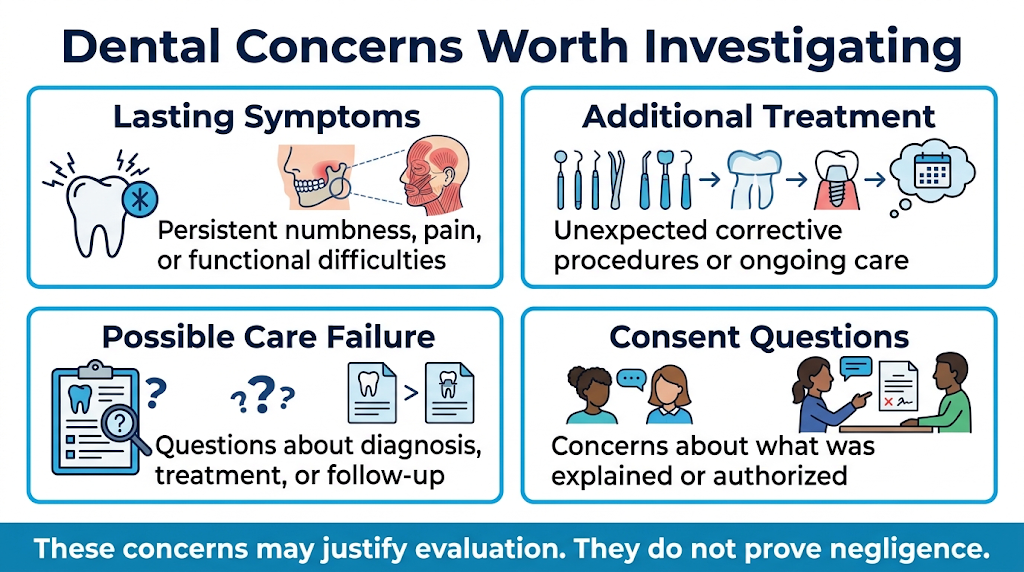
Certain problems deserve closer review, especially when the explanation for an injury remains unclear. These concerns are starting points for investigation, not proof that your dentist was negligent.
Lasting Harm or Unexpected Corrective Treatment
Persistent numbness, difficulty chewing, significant pain, or additional treatment may justify asking questions about the original care. An attorney may examine the procedure records, earlier imaging, and findings from subsequent providers.
For example, nerve damage after an extraction requires more than confirmation that an injury occurred. A qualified expert may need to assess the treatment planning, technique, and follow-up before determining whether care fell below the applicable standard.
Likewise, needing corrective treatment does not automatically establish malpractice. The reason for that treatment and its connection to the suspected error matter.
A Possible Diagnostic, Treatment, or Follow-Up Failure
A concern may warrant investigation when available information suggests that a finding was overlooked, treatment was performed incorrectly, or reported complications were not appropriately assessed.
Relevant questions include:
- What symptoms or imaging findings were available to the dentist?
- What treatment or referral was recommended?
- When did you report the problem, and how did the office respond?
- Did any delay contribute to additional harm?
A later diagnosis or a different dentist’s recommendation does not, by itself, prove that earlier care was negligent. The assessment must consider what was reasonably required at the time.
Questions About Consent or the Procedure Performed
Tell an attorney if you believe the procedure differed from what you authorized or important information was missing from the discussion.
The lawyer may review consent forms, treatment plans, and your account of the conversation. Signing a form and receiving appropriate care are separate issues; neither the form nor your recollection alone resolves every legal question.
What Must the Evidence Show?
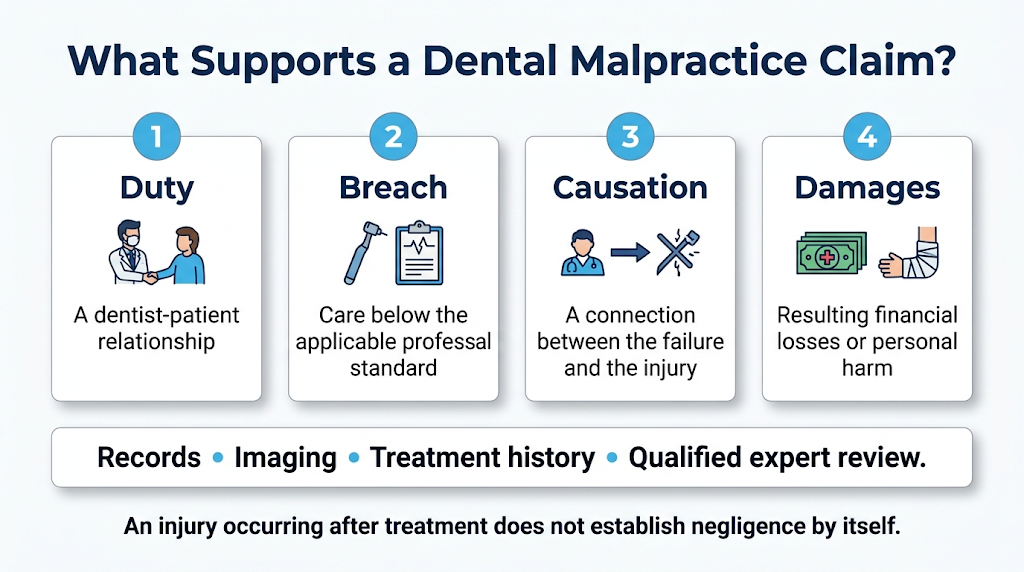
A dental malpractice claim needs evidence connecting substandard care to an injury and resulting losses. Your account provides a starting point, but records and qualified expert review help determine whether the facts support that connection.
Duty, Breach, Causation, and Damages
| Legal element | What the evidence needs to establish |
| Duty | A dentist-patient relationship created a professional responsibility for your care. |
| Breach | The treatment fell below the applicable standard of care. |
| Causation | That failure caused an injury or worsened your condition. |
| Damages | You experienced resulting losses, such as additional treatment costs, lost income, or pain. |
An injury occurring after treatment does not establish causation by itself. The investigation must consider other explanations, including an existing condition or a complication that occurred despite appropriate care.
How Dental Records and Expert Review Help
Dental charts, X-rays, procedure notes, and follow-up records help reconstruct what happened. A qualified dental expert can assess the treatment and whether a suspected failure contributed to additional harm.
Missing or conflicting information may require further investigation. Preserve what you have, identify unanswered questions, and separate what you observed from what you believe caused the problem.
When a Bad Dental Experience May Not Support a Malpractice Claim
A frustrating or painful experience deserves attention, but a malpractice claim requires more than dissatisfaction. The question is whether the dentist provided substandard care that caused injury and resulting losses.
Complications Despite Appropriate Care
Some complications occur even when treatment meets professional standards. An unsuccessful procedure, additional treatment, or discomfort does not establish negligence on its own.
The evaluation should consider the care before, during, and after the procedure. A complication may have been unavoidable, while the response to it may still require investigation. Similarly, listing a risk on a consent form does not settle whether the treatment was performed appropriately.
Billing Disputes, Dissatisfaction, and Communication Problems
An unexpected bill, an unpleasant interaction, or disappointment with appearance may raise concerns without establishing malpractice. Depending on the issue, requesting an explanation, reviewing the treatment agreement, or discussing corrective options may be useful.
However, communication problems can become relevant when they involve clinical information, for example, whether a reported symptom was passed to the treating dentist. Describe the specific events rather than assuming that poor service either proves or rules out negligence.
Is Pursuing a Claim Practical for Your Situation?
A claim’s legal merits and the practical demands of pursuing it are related but separate questions. An attorney considers the evidence, the extent of your losses, and the resources needed to investigate and litigate. There is no universal dollar threshold that determines whether every dental injury claim is worth pursuing.
Document Financial Losses and Personal Harm
Keep records that show how the injury affected you, including:
- Bills and estimates for corrective treatment.
- Medication expenses and other related costs.
- Employment records showing missed work.
- Medical assessments of ongoing treatment needs.
Also describe effects that do not appear on a receipt, such as difficulty eating, speaking, sleeping, or managing daily activities. Specific examples help an attorney understand your losses without relying on a guessed settlement value.
Understand Expert Costs, Fees, and Uncertainty
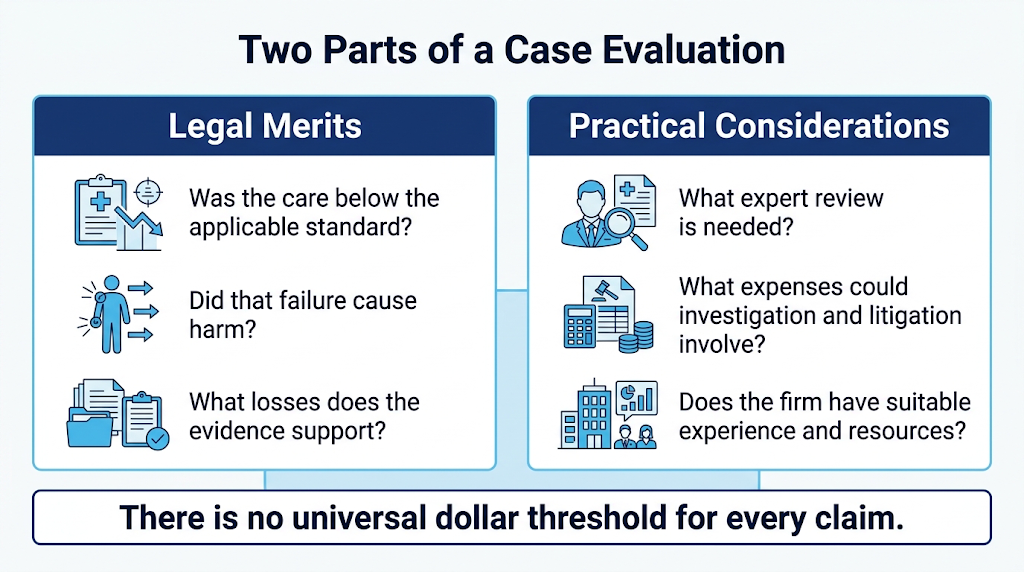
Dental malpractice cases may require paid expert review, depositions, and other litigation expenses. Ask who advances those costs, how they are deducted from a recovery, and what you could owe if the claim is unsuccessful.
Attorney fees are separate from case expenses. Review the written agreement carefully rather than assuming that contingency representation makes every expense conditional on winning.
A firm may decline because of evidence concerns, anticipated costs, limited capacity, or lack of relevant experience. That decision is not a court ruling. A prompt second opinion may help clarify your options, although another firm’s acceptance is never guaranteed.
What Should You Do Before Deciding?
You do not have to decide whether to file a lawsuit before asking for legal advice. Focus first on your care, preserving available information, and getting answers to the questions that affect your options.
Obtain Appropriate Care and Preserve Available Evidence
Seek appropriate assessment and treatment for ongoing problems. An independent dentist or specialist can document your condition and recommend care, although a different treatment opinion does not automatically establish negligence.
Prepare a short file containing:
- Available dental records, X-rays, and treatment instructions.
- A timeline of procedures, symptoms, and follow-up visits.
- Messages exchanged with the dental office.
- Bills, corrective treatment estimates, and missed-work records.
Keep original documents intact and mark uncertain dates as approximate.
Arrange a Consultation Without Waiting for Complete Records
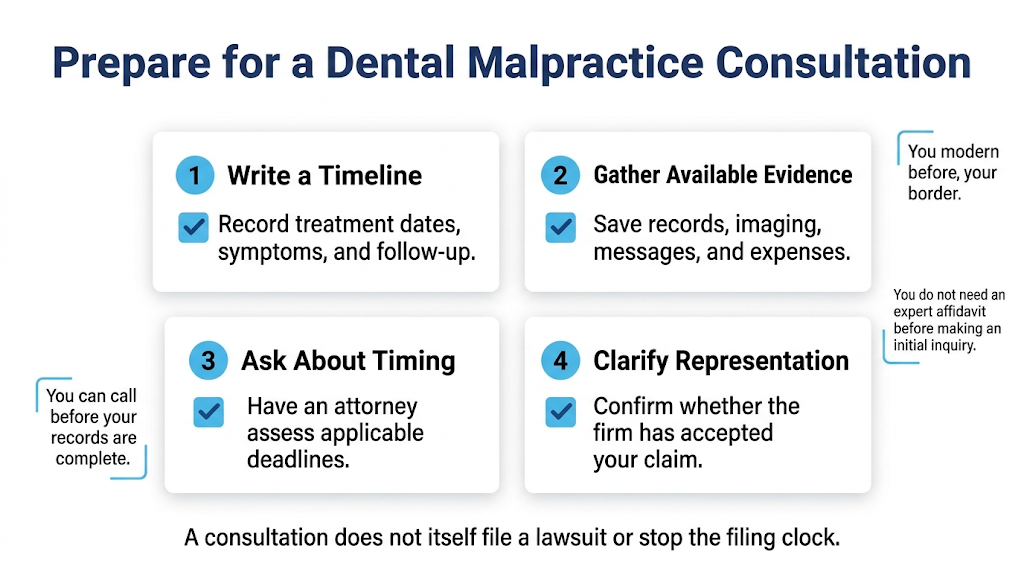
Contact an attorney while gathering documents rather than postponing an inquiry until everything arrives. Explain what you have, what is missing, and the key treatment dates.
Ask what further investigation may be needed and whether the firm has accepted representation. Clarify who is responsible for any approaching deadline; do not assume that sending records means the firm has agreed to handle your claim.
How Georgia’s Deadlines and Expert Rules Affect Your Options
Georgia’s filing requirements affect whether a dental malpractice claim can proceed. An attorney should assess them promptly while reviewing the treatment and injury.
Assess the Applicable Filing Deadlines
Georgia generally requires a malpractice lawsuit within two years after the injury or death resulting from the alleged negligence. A separate five-year statute of repose generally runs from the negligent act or omission. These periods have different starting points; the five-year rule does not give everyone five years to sue. Special rules and exceptions require individual assessment. Do not assume discovering a possible mistake starts a new period, or that a consultation, records request, or Board complaint pauses the deadline.
Understand the General Expert Affidavit Requirement
Georgia generally requires an expert affidavit with a complaint alleging professional malpractice. The expert must identify at least one alleged negligent act or omission and its factual basis. Limited exceptions apply.
You do not need an affidavit before calling a lawyer. Counsel can assess the requirement and arrange appropriate expert review.
Could a Refund Request or Dental Board Complaint Address Your Concern?
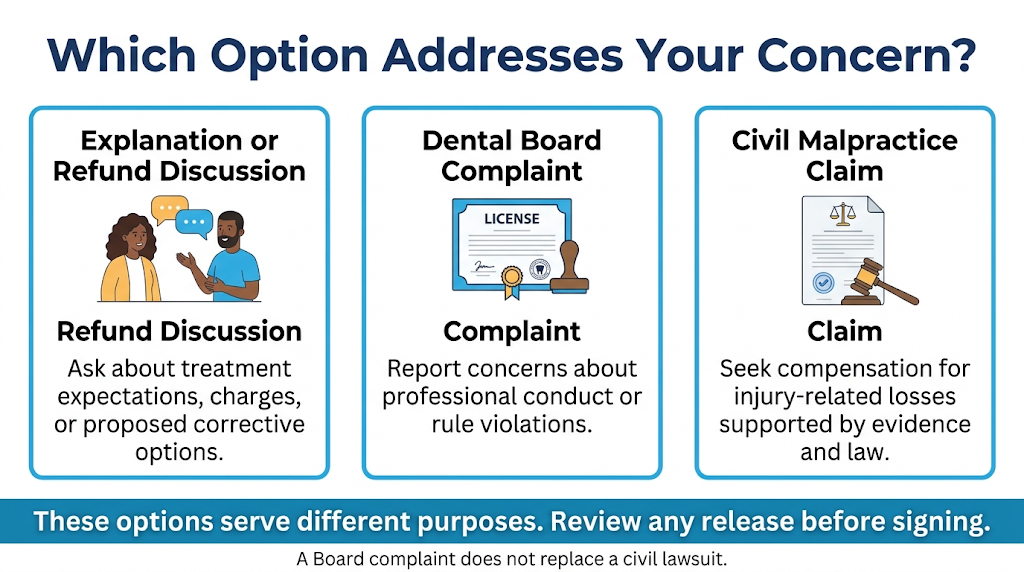
The appropriate next step depends on what you want resolved. An explanation, a billing adjustment, professional oversight, and compensation for an injury serve different purposes.
Requests for Explanations or Refunds
For questions about charges or treatment expectations, you can request an itemized bill, copies of the treatment agreement, and a written explanation.
A refund offer does not automatically admit negligence or address every injury-related loss. Before signing a release or settlement agreement, ask an attorney to explain which rights it may affect, especially if you need further treatment or your recovery remains uncertain.
Professional Discipline Versus Civil Compensation
The Georgia Board of Dentistry investigates alleged violations of the Dental Practice Act and Board rules. It expressly states that it does not settle fee disputes or personality conflicts.
Use the official Board complaint page for regulatory concerns. A civil malpractice claim instead seeks compensation for injury-related losses. Do not wait for a Board investigation before obtaining advice about civil filing deadlines.
Working With The Jewkes Firm in Georgia
The Jewkes Firm offers free consultations for people concerned about injuries caused by negligent care. An initial discussion lets you explain your dental treatment, describe the harm, and ask whether further investigation may be appropriate.
Relevant Experience and Local Consultation Options
Ask how the firm would evaluate the procedure involved, obtain missing records, and coordinate qualified dental expert review. Confirm who would handle your inquiry and whether representation has been accepted. The Tyrone office is located at 1155 Senoia Road, Suite 102, Tyrone, GA 30290. Contact the office before visiting to arrange a consultation and discuss access requirements.
Verified Client Feedback
In a published review, Ronnie Johnson described the firm’s communication:
“Great experience always helpful. Great communication always kept me up to date on my case.” Ronnie Johnson
This review concerns an individual service experience. It does not establish a dental malpractice result or predict another client’s outcome.
Frequently Asked Questions
Can I Sue My Dentist for Pain and Suffering?
Potentially, if evidence establishes that negligent dental care caused your injury and resulting suffering, pain after a procedure does not prove malpractice by itself. The assessment considers the treatment provided, the cause of the pain, and its effect on your life.
Can I Sue My Dentist for Emotional Distress?
Emotional harm may be considered, but recovery depends on the facts and applicable Georgia law. Emotional distress accompanying a physical injury and a standalone claim raise different legal questions. Describe the symptoms and their effects to your attorney rather than assuming anxiety or dissatisfaction alone establishes a claim.
Does Signing a Consent Form Prevent a Lawsuit?
Not automatically. Acknowledging a procedure’s risks is different from agreeing to negligent care. An attorney may review the form, what was discussed, the treatment performed, and whether a failure to meet professional standards caused harm.
What If One Attorney Declines My Case?
Ask whether the decision concerns evidence, costs, deadlines, or the firm’s resources. Another attorney may assess the matter differently, although acceptance is never guaranteed. Seek any second opinion promptly, disclose previous reviews honestly, and do not assume the first consultation paused your filing deadline.
Discuss Your Concerns With a Georgia Dental Malpractice Attorney
If you are unsure whether to sue your dentist, start with an informed assessment. Share your treatment timeline, available records, and how the injury has affected you.
Contact The Jewkes Firm to request a free consultation with a Georgia Dental Malpractice Attorney. You can ask about possible next steps while still gathering documents. A consultation does not guarantee representation or compensation.
The Jewkes Firm
Address: 1155 Senoia Rd #102, Tyrone, GA 30290
Phone: (770) 771-5130