

The step by step truck crash legal process is a structured, multi-phase approach that moves accident victims from the moment of impact through investigation, claim filing, negotiation, and trial to secure rightful compensation. Formally called a personal injury claim or trucking liability lawsuit, this process is more complex than a standard car accident claim. Federal regulations under the Federal Motor Carrier Safety Administration govern commercial trucking, and multiple parties, including the driver, trucking company, cargo loaders, and vehicle manufacturers, can share liability. Knowing each phase and its timing gives you a real advantage before insurers and defense attorneys gain the upper hand.
What immediate actions protect your legal rights after a truck crash?
Initial scene actions and immediate legal steps dramatically influence case strength and compensation outcomes. The first 48 hours after a collision are the most critical window you have. What you do, and what you avoid, shapes every phase that follows.

Your first priority is physical safety and medical care. Seek treatment even when injuries feel minor. Delayed symptoms like traumatic brain injury or internal bleeding are common after high-impact truck collisions, and a gap in medical records gives insurers grounds to dispute your injuries.
Scene documentation is your second priority. Photographing vehicle positions and tire marks creates evidence that insurers scrutinize heavily. Collect the following at the scene:
- Photos of all vehicles, road conditions, skid marks, and traffic signals
- Names and contact information for all witnesses
- The truck driver’s commercial license number, carrier name, and DOT number
- A copy of the police report or the report number
Notify your own insurance carrier promptly. Do not give a recorded statement to the at-fault party’s insurer without legal counsel present. That single mistake can cost you thousands of dollars in recoverable damages.
Pro Tip: Contact a truck accident attorney within 24 hours of the crash. Your attorney can send a spoliation letter to the trucking company, legally demanding preservation of the truck’s black box, electronic logging device data, and driver records before they are destroyed.
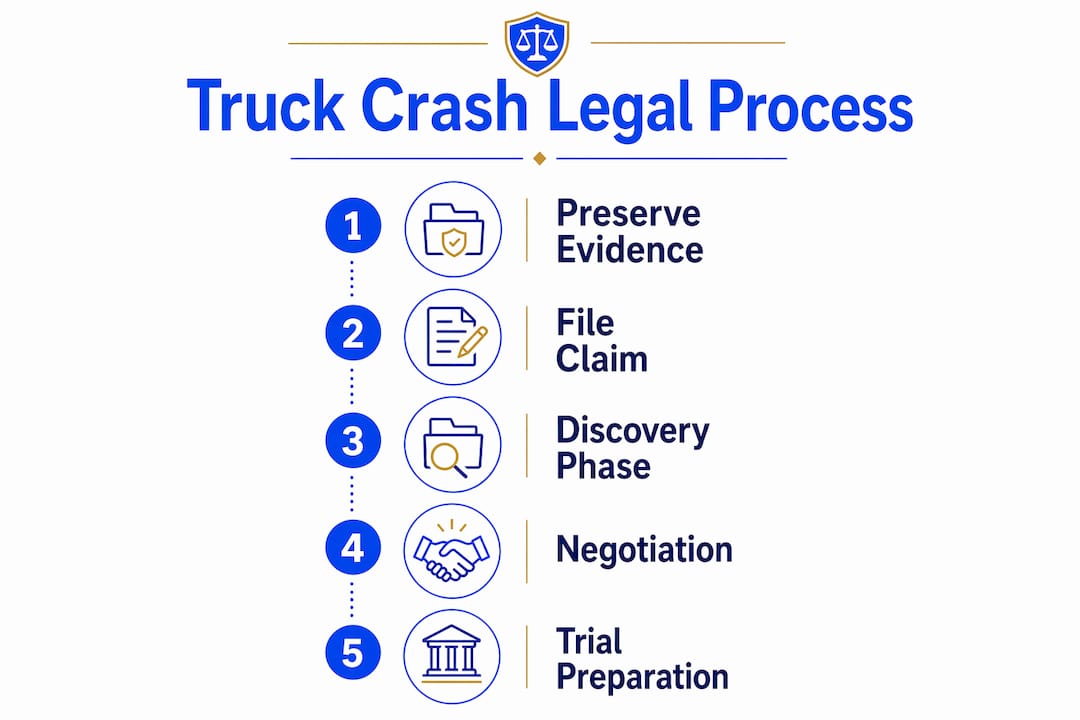
How do you file a truck accident claim and send a demand letter?
Filing a truck accident claim formally begins the compensation process. The truck accident claim process involves two parallel tracks: notifying your own insurer and filing a third-party claim against the at-fault party’s carrier. Both require prompt action, typically within days of the crash.
Here is the sequence your attorney will follow:
- Open a claim with your insurer. Provide factual details only. Your attorney handles all written and verbal communications from this point forward.
- File a third-party claim. Your attorney submits a formal claim to the trucking company’s insurer, identifying the liable parties and the nature of your injuries.
- Gather medical records and bills. Your attorney compiles all treatment records from the date of the crash through maximum medical improvement, the point at which your condition stabilizes.
- Draft and send the demand letter. This formal document outlines liability, details your damages (medical costs, lost wages, pain and suffering), and states the compensation amount you are seeking.
- Wait for the insurer’s response. Insurers typically respond within 30 days, either accepting, rejecting, or countering the demand.
Legal counsel’s exclusive handling of insurer communications shields you from “third-party capture” tactics, where adjusters use recorded statements or early lowball offers to minimize your payout. Never negotiate directly with an adjuster.
Pro Tip: Do not accept any settlement offer before reaching maximum medical improvement. Settling early locks in a number that may not cover future surgeries, therapy, or lost earning capacity.
What happens during discovery, and how does it affect your case?
Discovery is the formal evidence exchange phase, and it is often the longest stage in the entire litigation timeline. After a lawsuit is filed, defendants have 20 to 30 days to file an answer, which triggers discovery. The discovery phase typically lasts 6 to 12 months, involving depositions, interrogatories, and expert analysis.
Key evidence gathered during discovery
| Evidence Type | Purpose |
|---|---|
| Electronic logging device (ELD) data | Proves hours of service violations and driver fatigue |
| Black box data | Records speed, braking, and steering inputs before impact |
| Driver qualification files | Reveals prior violations, training gaps, or disqualifications |
| Cargo loading records | Establishes whether improper loading caused the crash |
| Eyewitness depositions | Corroborates your account of the collision |
| Medical expert reports | Quantifies injury severity and long-term prognosis |
Successful negotiation outcomes frequently depend on effective mapping of all responsible parties, which may include trucking companies, drivers, cargo loaders, and vehicle manufacturers. Each additional liable party represents additional insurance coverage your attorney can pursue.
After discovery closes, both sides typically enter mediation. A neutral mediator facilitates structured settlement talks. Most cases resolve here. Only about 5% of truck accident cases reach a jury trial. Cases that settle during negotiations typically resolve within 6 to 18 months. Litigated cases can last 18 to 36 months.
Pro Tip: Review the Georgia truck accident settlement timeline to understand how local court schedules and Georgia-specific rules affect your case duration.
What should you expect if your case goes to trial?
Trial is the final stage when settlement negotiations fail. Trial proceedings usually last 3 to 10 days, but reaching that point takes far longer. Court backlogs in urban venues can delay trial dates by 24 to 36 months after the lawsuit is filed. That timeline is not a failure. It reflects the depth of preparation required to win.
During trial, your attorney presents evidence, examines witnesses, and argues liability and damages before a jury. The defense does the same. Jury deliberations can last hours or days depending on case complexity.
“Most victims are surprised by the extended duration of truck accident cases due to required investigation of multiple parties and federal regulations. The structured multi-phase process prioritizes evidence over quick settlements.”
Post-trial possibilities include:
- Appeals by the defense. If the jury rules in your favor, the defense may appeal, extending resolution by an additional 6 to 18 months.
- Post-trial motions. Either side can file motions challenging the verdict or the damages awarded.
- Enforcement of judgment. If the defendant refuses to pay, your attorney pursues enforcement through the court.
Patience through this phase pays off. Jury verdicts in truck accident cases often exceed pre-trial settlement offers significantly, particularly when liability is clear and injuries are severe.
Common pitfalls in the truck crash legal process and how to avoid them
Mistakes in the truck crash lawsuit steps are costly and often irreversible. The most damaging errors happen early, before victims realize the full scope of what they face.
Avoid these critical mistakes:
- Talking to the trucking company’s insurer without counsel. Adjusters use “third-party capture” tactics to minimize or deny claims. Every word you say becomes part of the record.
- Delaying the spoliation letter. Federal regulations under 49 CFR require evidence retention, but trucking companies can destroy ELD and black box data after short retention windows unless preservation is legally demanded within 24 to 48 hours.
- Ignoring the liability web. Truck crashes involve multiple corporate entities. Failing to identify all liable parties means leaving compensation on the table.
- Stopping medical treatment too soon. Gaps in treatment give insurers grounds to argue your injuries healed or were not serious. Document every appointment through maximum medical improvement.
- Missing Georgia’s statute of limitations. Georgia law gives you a limited window to file a personal injury lawsuit. Missing that deadline eliminates your right to recover.
Pro Tip: Use the trucking accident injury checklist to track every medical visit, expense, and communication from day one. Organized records give your attorney the strongest possible foundation.
Key Takeaways
The step by step truck crash legal process requires immediate evidence preservation, careful claim filing, thorough discovery, and patient negotiation to secure maximum compensation.
| Point | Details |
|---|---|
| Act within 24–48 hours | Send a spoliation letter immediately to preserve ELD and black box data before destruction. |
| Never talk to adjusters alone | All insurer communications must go through your attorney to prevent claim-damaging statements. |
| Discovery drives case value | ELD data, driver files, and expert reports built during the 6–12 month discovery phase determine your payout. |
| Most cases settle before trial | Only about 5% of truck accident cases reach a jury; mediation resolves the majority within 6–18 months. |
| Map every liable party | Identifying all responsible parties, from the driver to cargo loaders, maximizes your total recovery. |
Why victims consistently underestimate what this process demands
I have seen it happen repeatedly. A victim comes in weeks after the crash, convinced the case is straightforward because the truck driver was clearly at fault. What they do not realize is that “clearly at fault” means nothing without evidence to prove it, and that evidence has a shelf life measured in days, not months.
The biggest misconception I encounter is that truck accident cases work like standard car accident claims. They do not. Federal Motor Carrier Safety Administration regulations, mandatory logbook requirements, and multi-party corporate liability structures make these cases fundamentally different. The trucking company’s legal team is already working the moment the crash happens. Victims who wait weeks to consult an attorney are fighting uphill from the start.
Understanding layered liability among multiple corporate entities is what separates adequate settlements from full recoveries. I have watched cases where the driver was just one of four liable parties. The cargo loader, the maintenance contractor, and the trucking company all carried separate insurance policies. Identifying all four meant the client recovered far more than any single policy would have covered.
My honest advice: treat the legal process as a long-term project, not a quick transaction. Prepare for 12 to 36 months. Stay consistent with medical treatment. Trust your attorney to handle insurer communications. The victims who follow this process with discipline are the ones who walk away with compensation that actually reflects what they lost.
— Ali
Jewkesfirm is ready to fight for your full recovery
Truck accident claims are not cases you should handle alone. Jewkesfirm represents truck accident victims across South Atlanta and surrounding Georgia counties, guiding clients through every phase from the first 24 hours after a crash through trial or settlement.

Jewkesfirm’s attorneys act fast to preserve critical evidence, identify every liable party, and handle all insurer communications so you never have to face an adjuster alone. The firm works on a contingency fee basis, meaning you pay nothing unless they win your case. If you were injured in a truck collision, contact Jewkesfirm today for a free case assessment and get the dedicated legal support your recovery demands.
FAQ
How long does a truck accident lawsuit take to resolve?
Truck accident cases that settle during negotiations typically resolve within 6 to 18 months. Litigated cases can last 18 to 36 months, depending on court backlogs and case complexity.
What is a spoliation letter and why does it matter?
A spoliation letter is a formal legal demand sent to the trucking company requiring preservation of evidence like ELD data and black box records. Federal regulations under 49 CFR allow destruction of this data after short retention windows, so the letter must go out within 24 to 48 hours of the crash.
Should I talk to the trucking company’s insurance adjuster?
No. Adjusters use “third-party capture” tactics to record statements that minimize or deny your claim. All communications with the at-fault party’s insurer should go through your attorney.
Who can be held liable in a truck accident case?
Liability in truck accident cases can extend to the driver, the trucking company, cargo loaders, and vehicle manufacturers. Identifying all responsible parties is critical to accessing the full insurance coverage available and maximizing your compensation.
What happens if my truck accident case goes to trial?
Trial proceedings typically last 3 to 10 days, but court backlogs in urban venues can delay the trial date by 24 to 36 months after filing. Post-trial appeals can extend the timeline by an additional 6 to 18 months.