
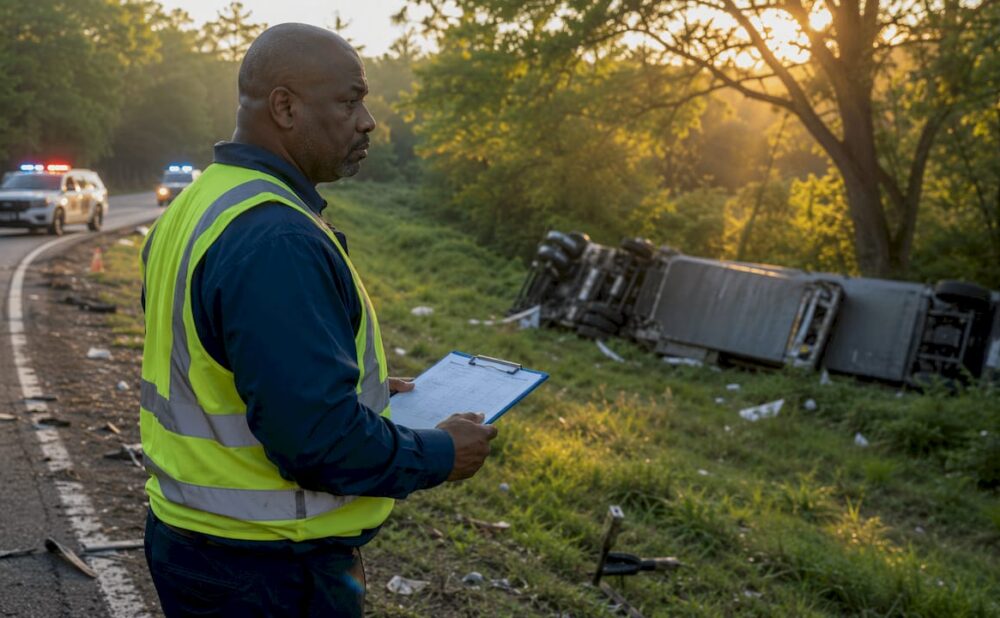
Trucking accidents are not a single event. They are a family of distinct crash types, each with its own mechanics, causes, and injury patterns. The most common types of trucking accidents include jackknife crashes, tire blowouts, rollovers, underride collisions, rear-end impacts, wide turn accidents, T-bone collisions, blind spot crashes, head-on collisions, lost load incidents, sideswipe accidents, fatigue-related crashes, brake failure events, intersection collisions, and pedestrian or bicyclist accidents. According to NHTSA’s 2024 data, 5,340 people were killed in crashes involving large trucks that year, with 70% of those fatalities being occupants of other vehicles. Understanding what each crash type looks like, and why it happens, is the first step toward protecting yourself on the road and knowing your rights if you are ever hurt.
- Jackknife: The trailer swings outward, forming an acute angle with the cab.
- Tire blowout: A sudden tire failure causes loss of directional control.
- Wide turn: The truck swings left before turning right, trapping vehicles in its path.
- Rollover: The truck tips onto its side or roof, often from speed or cargo shift.
- Rear-end collision: The truck or another vehicle strikes from behind.
- Underride: A smaller vehicle slides beneath the trailer.
- Improper cargo securement: Shifting loads cause loss of control or debris.
- T-bone (side-impact): A truck strikes a vehicle perpendicularly at an intersection.
- Blind spot crash: A vehicle lingers in a truck’s “no-zone” and gets struck.
- Head-on collision: Two vehicles collide front-to-front, often with fatal results.
- Lost load: Cargo falls from the truck and creates road hazards.
- Sideswipe: Two vehicles traveling in the same or opposite directions make side contact.
- Fatigue-related: Driver drowsiness impairs reaction time and judgment.
- Brake failure: Mechanical brake defects cause the truck to be unable to stop.
- Intersection collision: Trucks fail to yield or misjudge clearance at intersections.
- Pedestrian/bicyclist accident: Vulnerable road users are struck by large trucks.
Table of Contents
- 1. What makes jackknife accidents so dangerous?
- 2. How tire blowouts cause truck crashes
- 3. Why wide turns by large trucks catch other drivers off guard
- 4. Truck rollover accidents and what causes them
- 5. Rear-end collisions involving commercial trucks
- 6. Underride accidents: why they are uniquely deadly
- 7. Improper cargo securement and the crashes it causes
- 8. T-bone collisions at intersections involving trucks
- 9. Blind spot accidents and the truck “no-zones”
- 10. Head-on collisions with large trucks
- 11. Lost load accidents and road debris hazards
- 12. Sideswipe accidents involving large trucks
- 13. Understanding the causes and risk factors of trucking accidents
- 14. How driver fatigue leads to serious truck crashes
- 15. Brake failure accidents and why trucks are especially vulnerable
- 16. Intersection collisions involving large trucks
- 17. Pedestrian and bicyclist accidents involving trucks
- Key Takeaways
1. What makes jackknife accidents so dangerous?
A jackknife happens when a tractor-trailer’s cab and trailer fold toward each other at the hitch point, creating a sharp angle that looks like a folding pocketknife. The trailer swings outward, often sweeping across multiple lanes simultaneously. Hard braking on slippery pavement, sudden evasive maneuvers, or brake imbalance between the cab and trailer are the most common triggers.
The danger is not just the initial crash. A jackknifed truck can block an entire highway, turning a single incident into a multi-vehicle pileup. Drivers behind the truck have almost no time to react when 70 feet of steel swings across their lane. Anti-lock braking systems and electronic stability control reduce the risk, but neither eliminates it when a driver brakes too aggressively.
2. How tire blowouts cause truck crashes
A blowout on a commercial truck is a different animal than a flat tire on a passenger car. The sheer weight of a loaded tractor-trailer, often 80,000 pounds at maximum, means a sudden tire failure can send the vehicle lurching violently across lanes before the driver regains control. Underinflation, worn tread, overloading, and road debris are the leading causes.

When a rear trailer tire blows, the truck may sway or fishtail. A front steer tire blowout is worse: the driver must fight the wheel to keep the truck from veering directly into adjacent traffic. Pre-trip tire inspections and proper inflation are the most reliable prevention tools, yet they are frequently skipped under schedule pressure.
3. Why wide turns by large trucks catch other drivers off guard
Large trucks need far more road space to complete a right turn than most drivers expect. A standard 18-wheeler may need to swing left into the adjacent lane before turning right, a maneuver that creates a lethal pinch point between the truck’s trailer and the curb. Passenger vehicles that pull alongside the truck during this swing can be crushed or dragged.

The risk is highest on urban streets and narrow intersections where there is little margin for error. Truck drivers are trained to check mirrors and signal early, but other drivers often misread the leftward swing as an invitation to pass on the right. Staying well back from a turning truck and never passing on its right side are the two most effective habits for other drivers.
4. Truck rollover accidents and what causes them
Rollovers account for roughly 8.9% of large truck crashes in the FMCSA’s Large Truck Crash Causation Study, and they are among the most destructive. A truck rolls when lateral forces exceed the vehicle’s stability threshold, which happens most often during sharp curves taken at excessive speed, sudden lane changes, or when cargo shifts to one side mid-trip.
High-profile loads like dry bulk tankers and flatbeds carrying stacked materials are especially vulnerable. When a truck rolls on a highway, it can crush adjacent vehicles, scatter cargo across multiple lanes, and block traffic for hours. Proper cargo distribution, speed management on curves, and electronic stability systems all reduce rollover risk, but driver judgment remains the critical variable.
5. Rear-end collisions involving commercial trucks
Rear-end crashes are the single most common crash type in the FMCSA’s causation data, representing 23% of large truck crash involvements. A fully loaded truck traveling at highway speed carries enormous kinetic energy. When a truck rear-ends a passenger car, the size disparity often means catastrophic injury to the car’s occupants even at moderate speeds.
The causes run in both directions. Truck drivers who follow too closely or fail to anticipate traffic slowdowns are a major factor. But passenger vehicle drivers who cut in front of trucks and brake suddenly also contribute. A loaded truck at 65 mph needs roughly the length of two football fields to stop. That physics does not change regardless of who is at fault.
6. Underride accidents: why they are uniquely deadly
An underride accident occurs when a smaller vehicle slides beneath a truck’s trailer after a collision, with the trailer overriding the car’s roof structure and often the passenger compartment. These crashes are particularly lethal because standard vehicle safety systems, including airbags and crumple zones, are designed for front-to-front or front-to-rear impacts, not for a trailer rail cutting through the windshield.
Underride guards are required on the rear of trailers under federal regulations, but side underride guards remain inconsistently mandated. Rear underrides typically happen when a car strikes a stopped or slow-moving trailer in low visibility. Side underrides occur when a truck turns across a car’s path. Both scenarios are survivable with proper guards in place.
7. Improper cargo securement and the crashes it causes
Cargo that is not properly secured shifts during transit, and that shift can be enough to destabilize an 80,000-pound vehicle. A load that slides to one side during a curve raises the rollover risk dramatically. Cargo that breaks free of its restraints entirely becomes a road hazard for every vehicle behind the truck.
Federal Motor Carrier Safety Regulations set specific requirements for tie-downs, blocking, bracing, and load distribution. Violations are common and are frequently cited in post-crash investigations. Trucking companies that pressure drivers to load quickly and move fast create conditions where securement shortcuts become routine. When a crash results from an unsecured load, both the driver and the carrier can face liability.
8. T-bone collisions at intersections involving trucks
A T-bone, or side-impact collision, happens when the front of one vehicle strikes the side of another at roughly a 90-degree angle. When a commercial truck is the striking vehicle, the force delivered to the side of a passenger car is often fatal. The side of a car offers far less structural protection than the front or rear, and a truck’s bumper height frequently aligns with the car’s door panels rather than its frame.
These crashes most often occur at intersections where a truck runs a red light, fails to yield, or misjudges the gap in cross traffic. Blind spots compound the problem: a truck driver who cannot see a vehicle approaching from the side may enter an intersection believing it is clear. Intersection design, signal timing, and driver attentiveness all play roles in prevention.
9. Blind spot accidents and the truck “no-zones”
Every large truck has four significant blind spots: directly in front of the cab, directly behind the trailer, and along both sides extending back from the cab mirrors. The Federal Motor Carrier Safety Administration refers to these as “no-zones.” A passenger vehicle that lingers in any of these areas is effectively invisible to the truck driver.
Blind spot collisions are a major contributor to multi-vehicle truck crashes. They happen most often during lane changes, merges, and turns when the truck driver checks mirrors but cannot see a vehicle that has drifted into the no-zone. The practical rule for other drivers is simple: if you cannot see the truck driver’s face in their mirror, they cannot see you.
10. Head-on collisions with large trucks
Head-on crashes between trucks and passenger vehicles are statistically rare, representing about 3% of large truck crash types, but they are disproportionately fatal. The combined closing speed of two vehicles traveling toward each other multiplies the force of impact, and a passenger car absorbing a head-on strike from a fully loaded semi has almost no structural margin.
Wrong-way driving, drifting across the center line due to fatigue or distraction, and failed passing maneuvers on two-lane roads are the primary causes. Divided highways and cable median barriers reduce the frequency of these crashes significantly, which is why rural two-lane roads, where 56% of fatal large truck crashes occur, remain the most dangerous environment.
11. Lost load accidents and road debris hazards
A lost load accident begins when cargo falls from a truck and lands in the path of following traffic. Drivers face an instant choice between braking hard, swerving, or striking the debris, and none of those options is safe at highway speed. Debris can puncture tires, shatter windshields, or trigger chain-reaction crashes involving multiple vehicles.
Federal regulations require that all cargo be secured against movement in any direction, with specific tie-down requirements based on load weight and type. When a lost load causes a crash, liability typically falls on the carrier, the driver, or the loading company, depending on who was responsible for securement. Documentation of the load at departure is one of the most important pieces of evidence in these cases.
12. Sideswipe accidents involving large trucks
A sideswipe occurs when two vehicles traveling in the same or opposite directions make side contact without a full angular collision. With trucks, sideswipes often happen during lane changes when the driver fails to check blind spots, or when a truck drifts out of its lane on a curve. The FMCSA data shows sideswipes in the same direction account for roughly 10.3% of large truck crash involvements.
While sideswipes can seem minor, a truck sideswiping a passenger car at highway speed can push the smaller vehicle off the road entirely. The truck’s sheer mass means even a glancing blow transfers significant force. Drivers who notice a truck beginning to drift toward them should slow down and move away rather than accelerating to escape.
13. Understanding the causes and risk factors of trucking accidents
Truck crashes rarely have a single cause. The FMCSA’s Large Truck Crash Causation Study makes clear that most serious crashes result from a chain of factors: driver behavior, vehicle condition, road environment, and traffic flow all interact. Brake problems appear in nearly 30% of large truck crashes, a rate far exceeding the 5% seen in passenger vehicles, making mechanical maintenance one of the highest-leverage prevention points.
Key figure: 80% of large trucks in fatal crashes were involved in multivehicle collisions, compared to 63% for passenger vehicles, underscoring how often truck crashes pull in other road users.
The LTCCS identified three dominant critical events: running out of the travel lane (32% of trucks), loss of vehicle control (29%), and rear-end collisions (22%). Traffic flow interruptions, including congestion and prior crashes, contributed to roughly 25% of two-vehicle truck crashes. Driver recognition failures and poor decision-making accounted for the majority of critical reasons assigned to truck drivers, while vehicle factors like brake defects and cargo shift were statistically linked to crash assignment far more often for trucks than for passenger cars.
Pro Tip: When evaluating a truck crash for legal purposes, never stop at the driver’s actions. Investigate the truck’s maintenance records, the carrier’s loading protocols, and the road conditions at the time. Multi-factor causation means multi-party liability is often in play.
14. How driver fatigue leads to serious truck crashes
Fatigue dulls reaction time, narrows attention, and impairs judgment in ways that closely mirror alcohol intoxication. For truck drivers covering hundreds of miles on overnight schedules, fatigue is a persistent occupational hazard. The FMCSA’s Hours of Service regulations set maximum driving windows and mandatory rest periods specifically to address this risk.
What makes fatigue crashes particularly dangerous is that a fatigued driver often does not recognize their own impairment. Microsleeps, brief involuntary sleep episodes lasting just a few seconds, can occur without the driver’s awareness. At 65 mph, a two-second microsleep means the truck travels nearly 200 feet with no one at the wheel.
15. Brake failure accidents and why trucks are especially vulnerable
Brake failure is not an equal-opportunity problem. Trucks are eight times more likely than passenger vehicles to have brake problems cited as a crash factor. The air brake systems on large trucks require regular inspection, adjustment, and maintenance. Worn brake pads, air leaks, out-of-adjustment slack adjusters, and overheated brakes on long descents are all documented failure modes.
Pre-trip brake inspections are federally mandated, but they are only effective when performed thoroughly and honestly. Carriers that push drivers to skip or rush inspections create direct crash risk. When brake failure causes a crash, the maintenance records, inspection logs, and carrier safety ratings become central evidence in any legal claim.
16. Intersection collisions involving large trucks
Intersections concentrate risk for large trucks in ways that open highway driving does not. Trucks need longer distances to stop, wider arcs to turn, and more time to clear an intersection than passenger vehicles. When signal timing is tight or visibility is limited, the margin for error disappears quickly.
Failure to yield, running red lights, and misjudging the speed of cross traffic are the most common driver errors at intersections. The FMCSA data shows that turning across or into a vehicle’s path accounts for roughly 8% of large truck crash involvements. Intersection design improvements, including longer signal phases for trucks and better sight-line clearance, reduce these crashes, but driver attentiveness remains the primary defense.
17. Pedestrian and bicyclist accidents involving trucks
Pedestrians and bicyclists are among the most vulnerable road users in any truck crash scenario. They appear in the NHTSA data as the 13% of 2024 truck crash fatalities classified as nonoccupants. Trucks pose unique risks to these groups because of their large blind spots, wide turning arcs, and the height differential between the truck’s bumper and a person on foot or on a bicycle.
Right-turn squeeze accidents, where a truck’s trailer swings over a bike lane during a right turn, are a documented and preventable hazard in urban environments. Pedestrians crossing in front of a stopped truck can be invisible to the driver until the truck begins to move. Awareness campaigns, protected bike infrastructure, and truck driver training on urban maneuvering all contribute to reducing these crashes, but the responsibility to check carefully before moving falls squarely on the truck operator.
Key Takeaways
Trucking accidents span at least 16 distinct crash types, each driven by a specific combination of driver behavior, vehicle condition, and road environment, making multi-factor investigation the only reliable path to understanding liability.
| Point | Details |
|---|---|
| Fatalities skew toward other vehicles | 70% of the 5,340 people killed in 2024 truck crashes were occupants of other vehicles, not the truck. |
| Brake problems are disproportionate | Brake defects appear in nearly 30% of truck crashes, compared to 5% for passenger vehicles. |
| Rear-end crashes lead by volume | Rear-end collisions represent 23% of large truck crash involvements per FMCSA causation data. |
| Most fatal truck crashes are multivehicle | 80% of large trucks in fatal crashes were in multivehicle collisions, versus 63% for passenger cars. |
| Underride and rollover carry highest severity | These two crash types cause catastrophic injury due to structural override and cargo dynamics. |
If you or someone you love was hurt in a truck crash in South Atlanta or the surrounding Georgia counties, Jewkesfirm is ready to fight for the compensation you deserve. The firm handles complex trucking accident claims on a contingency basis, meaning you pay nothing unless they win. Understanding why you need a trucking accident lawyer in Georgia starts with a free consultation.

GET A FREE CASE REVIEW — Call Jewkesfirm today. Your voice will be heard, and your rights will be fiercely protected.