

Key Takeaways
- Negligent hiring holds employers liable when they fail to conduct reasonable background checks that would have revealed employee unfitness.
- Proper screening processes that are well-documented and tailored to job risks help prevent negligent hiring claims and legal exposure.
Negligent hiring is the legal doctrine that holds employers directly liable when they fail to exercise reasonable care before placing an employee, and that employee causes foreseeable harm to others. Unlike vicarious liability, this doctrine targets the employer’s own failure during the screening process. Courts across the United States recognize negligent hiring as a common law tort, meaning injured parties can sue employers directly. Understanding what constitutes negligent hiring is critical for HR professionals, business owners, and legal practitioners who want to protect their organizations and the people they serve.
What is negligent hiring under U.S. law?
Negligent hiring is defined as an employer’s failure to conduct a reasonable pre-employment investigation that would have revealed an employee’s unfitness for a role, where that unfitness leads to foreseeable harm. The negligent hiring definition focuses on the employer’s conduct before the hire, not the employee’s conduct on the job. Negligent hiring liability can extend beyond the workplace. An employer may be held liable for harm an employee causes off duty if that harm was foreseeable given what a proper background check would have uncovered.

Courts do not require employers to predict future misconduct. Instead, they ask whether a reasonable pre-hire investigation would have uncovered red flags that made the harm foreseeable. That distinction matters. It shifts the focus from the employee’s behavior to the employer’s process. If you skipped a background check or ran a superficial one, the adequacy of your process is what goes on trial.
What are the legal elements required to prove negligent hiring?
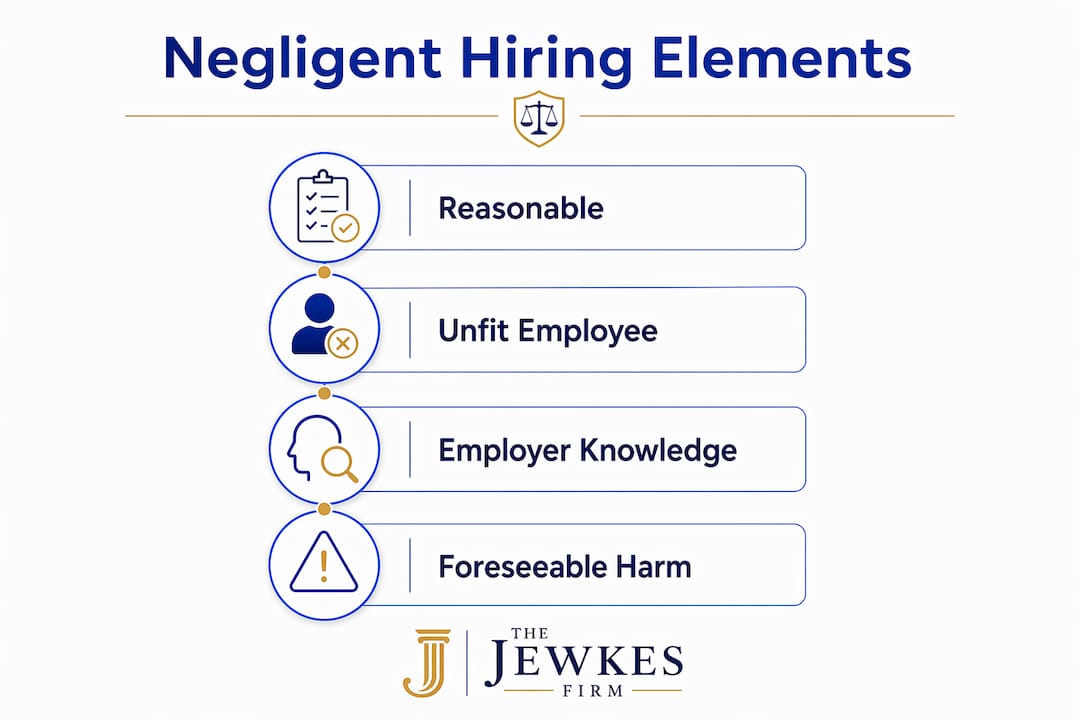
To succeed on a negligent hiring claim, a plaintiff must establish four core elements. California’s CACI No. 426 jury instruction provides one of the clearest codifications of these elements, and courts in many states apply the same framework.
- The employee was unfit or incompetent for the position. The plaintiff must show the employee lacked the qualifications, temperament, or background required for the job. A driver with multiple DUI convictions hired to transport children is a clear example of unfitness.
- The employer knew or should have known of the unfitness. This is the heart of the four core legal elements for liability. If a basic background check would have revealed a violent criminal history, the employer is treated as if they knew. Actual knowledge is not required.
- The unfitness created a particular risk to others. The risk must be specific and connected to the job duties. A warehouse worker with a theft conviction poses a different risk than a home health aide with the same record. Courts weigh the nature of the job against the nature of the known risk.
- The employer’s negligence was a substantial factor in causing the harm. The plaintiff must connect the employer’s failure to investigate with the actual injury. If the employer had run a thorough check and the harm still would have occurred, causation fails.
Foreseeability runs through all four elements. An employer who hires a caregiver without checking references or verifying credentials faces a much higher foreseeability argument than one who hires a back-office data entry clerk with the same gaps. The duty of care scales with the job’s risk level and the foreseeability of harm to third parties.
How does negligent hiring differ from respondeat superior?
Respondeat superior is vicarious liability. Under that doctrine, an employer is liable for an employee’s wrongful acts committed within the scope of employment, even if the employer did nothing wrong. Negligent hiring is different. It requires the employer’s own negligence in the hiring process, not just the employee’s bad act.
The practical difference is significant:
- Respondeat superior applies when an employee causes harm while doing their job. The employer is liable because the employee was acting on the employer’s behalf.
- Negligent hiring applies when the employer’s failure to screen properly created the conditions for harm. The employer is liable for their own conduct, regardless of whether the harm happened on or off the clock.
- Scope of employment limits respondeat superior. If an employee goes off-script and commits a crime unrelated to their duties, respondeat superior may not apply. Negligent hiring can still apply if the harm was foreseeable from the employee’s background.
- Off-duty conduct is a key battleground. Negligent hiring reaches conduct that respondeat superior cannot, because foreseeability, not job scope, controls the analysis.
Pro Tip: If a plaintiff’s attorney cannot establish that the employee was acting within the scope of employment, they will often pivot to a negligent hiring theory. Employers who assume respondeat superior is their only exposure are leaving themselves vulnerable.
Understanding negligence in Georgia personal injury law helps clarify how these doctrines interact in practice, particularly when claims arise from workplace-related incidents.
What are negligent hiring examples that show real employer liability?
Real-world negligent hiring scenarios share a common thread: an employer skipped a step that would have revealed a red flag, and someone got hurt as a result.
- Failure to check criminal history. A property management company hires a maintenance worker without running a background check. The worker has prior convictions for residential burglary. He uses his access to steal from tenants. The company faces a negligent hiring claim because the criminal history was discoverable and the risk was foreseeable given the job’s access to private residences.
- Failure to verify credentials. A medical clinic hires a nurse practitioner without confirming their license status. The practitioner’s license had been revoked for patient abuse. A patient is harmed. Failure to verify credentials is a recognized basis for negligent hiring liability, separate from criminal history.
- Ignoring employment gaps. A trucking company hires a driver with a two-year unexplained gap in their employment history. That gap concealed a period of substance abuse treatment and a license suspension. After an accident, the company’s failure to investigate the gap becomes central evidence of negligent hiring.
- Superficial background checks. A staffing agency runs a single-county criminal search on a candidate who has lived in five states. The search misses prior assault convictions. Limited geographic checks are a documented failure mode that courts have used to find employer liability.
Courts do not expect employers to be perfect. They expect employers to be reasonable. The question is always whether a competent HR professional, given the job’s risk level, would have done more.
Staffing agencies face a compounded version of this problem. They carry double negligent hiring exposure as both the employer of record and the intermediary placing workers at client sites. Multilayered screening is not optional for agencies. It is a legal necessity.
How can employers avoid negligent hiring claims?
Avoiding negligent hiring liability requires a structured, documented, and consistent screening process. The depth of that process must match the risk level of the job.
- Calibrate your investigation to the job’s risk. A public-facing caregiver role demands a deeper investigation than a back-office position with no client contact. The threshold of reasonable care is dynamic and tied to foreseeability of harm. Document why you chose the screening level you did for each role.
- Run multi-jurisdictional background checks. A single-county or single-state search is not enough for candidates who have lived or worked in multiple locations. Use a screening provider that covers all relevant jurisdictions. Inadequate screening methods undermine your legal defense even when you ran a check.
- Verify credentials independently. Do not rely on documents candidates provide. Contact licensing boards, educational institutions, and prior employers directly. Credential fraud is a recognized basis for negligent hiring claims.
- Investigate employment gaps. Ask candidates to explain gaps. Document their answers. Follow up with prior employers where possible. An unexplained gap that conceals relevant misconduct is a foreseeable red flag courts will scrutinize.
- Apply your screening policy consistently. Inconsistent application of background check policies creates legal exposure on two fronts: negligent hiring liability and potential discrimination claims. Document every hiring decision and the screening steps taken.
- Stay current on Ban-the-Box laws. Many states and municipalities restrict when employers can ask about criminal history. Georgia employers must balance their duty to screen against these legal compliance requirements. Consult legal counsel to build a policy that satisfies both obligations.
Pro Tip: Research shows that states clarifying negligent hiring laws increased employment of individuals with criminal records by 3–5 percentage points and reduced reincarceration rates by 2 percentage points. A well-designed screening policy protects your organization and supports fair hiring at the same time.
Reviewing effective background check practices can help HR teams build a defensible, thorough screening process that holds up under legal scrutiny.
Key takeaways
Negligent hiring holds employers directly liable for their own failure to screen, not just for what their employees do on the job.
| Point | Details |
|---|---|
| Core legal definition | Negligent hiring requires employer failure to investigate, resulting in foreseeable harm from an unfit employee. |
| Four-element proof standard | Plaintiffs must show unfitness, employer knowledge, created risk, and causation to establish liability. |
| Distinct from respondeat superior | Negligent hiring targets the employer’s own conduct; respondeat superior targets the employee’s act within job scope. |
| Screening depth scales with job risk | Public-facing and high-access roles require deeper investigation than low-risk back-office positions. |
| Documentation is your defense | Consistent, documented screening policies are the strongest protection against negligent hiring claims. |
Why negligent hiring law is more nuanced than most employers realize
Working with negligent hiring claims over the years has shown me one consistent pattern: employers are surprised by how far liability can reach. Most assume that if an employee commits a harmful act off the clock or outside their job duties, the company is insulated. That assumption is wrong, and it costs organizations dearly.
Courts focus on what the employer knew or should have known at the time of hire. I have seen cases where a single missed reference check or an unverified license became the centerpiece of a multi-million dollar claim. The employee’s conduct was bad, but the employer’s process was the legal issue.
What I find genuinely underappreciated is the social dimension of this doctrine. Research shows that legal clarity around negligent hiring actually increases employment opportunities for people with criminal records while reducing reincarceration. That is a meaningful outcome. A well-designed screening policy is not a barrier to inclusive hiring. It is a framework that lets employers make informed decisions rather than blanket exclusions.
My advice to HR professionals and legal practitioners is this: treat your screening process as a legal document. Every step you take, or skip, will be examined if a claim arises. Build a process you can defend, calibrate it to the actual risk of each role, and review it annually as laws evolve.
Jewkes Firm is ready to help with employer liability concerns
Negligent hiring claims can arise from a single gap in your screening process, and the legal consequences are serious.
Jewkes Firm has extensive experience handling complex liability cases across South Atlanta and surrounding Georgia counties. If you are an employer, HR professional, or legal practitioner facing a negligent hiring claim or looking to assess your current exposure, Jewkes Firm offers free consultations with no obligation. The firm works on a contingency basis, meaning you pay nothing unless they win. Contact Jewkes Firm today for a free case review and get the dedicated legal guidance your situation demands.
FAQ
What is the negligent hiring definition in simple terms?
Negligent hiring occurs when an employer fails to conduct a reasonable background investigation before hiring, and that failure allows an unfit employee to cause foreseeable harm to others.
What constitutes negligent hiring under the law?
A negligent hiring claim requires proof that the employee was unfit, the employer knew or should have known of that unfitness, the unfitness created a specific risk, and the employer’s failure caused the harm.
Can an employer be liable for an employee’s off-duty conduct?
Yes. Negligent hiring liability can extend to off-duty conduct if the harm was foreseeable based on what a proper pre-hire investigation would have revealed about the employee’s background.
How does negligent hiring differ from respondeat superior?
Respondeat superior holds employers vicariously liable for employee acts within the scope of employment. Negligent hiring holds employers liable for their own failure to screen, regardless of when or where the harm occurs.
How can employers avoid negligent hiring claims?
Employers should run multi-jurisdictional background checks, verify credentials independently, investigate employment gaps, and document every screening decision. The depth of investigation must match the risk level of the specific job role.