
TL;DR:
- Documenting the accident scene immediately is vital to preserve evidence like photos, witness statements, and environmental conditions that degrade quickly. This thorough documentation strengthens your insurance claim, counters disputes, and provides essential evidence for legal protection. Acting within hours by capturing accurate, detailed photos, videos, witness contacts, and medical records is crucial for a successful recovery process.
Documenting the accident scene is the single most effective step you can take to preserve evidence that validates your claim and protects your legal rights after a collision. Known formally as accident scene documentation, this practice covers everything from photographing vehicle damage and road conditions to recording witness statements and seeking prompt medical evaluation. What you capture in the minutes and hours after a crash becomes the factual foundation of your insurance claim or personal injury case. Without it, you are left relying on memory, police reports, and the other driver’s version of events.
Why document accident scene evidence immediately
Accident scene evidence deteriorates faster than most people expect. Surveillance footage overwrites itself within 24 to 72 hours at most commercial and residential properties, meaning the video that captured the crash may be gone before you even file a claim. Skid marks fade with rain and traffic. Debris gets cleared. Witnesses leave and become difficult to locate. Every hour you wait, the objective record of what happened shrinks.
The importance of documenting accidents goes beyond simply having photos on your phone. Insurance adjusters are trained to identify gaps in evidence and use those gaps to dispute liability or reduce your payout. A well-documented scene shifts the negotiating advantage to you. It gives your attorney concrete, dated material to work with rather than a story that opposing counsel can attack as subjective or inconsistent.
Environmental conditions at the time of the crash, including road surface quality, lighting, traffic signs, and weather, directly affect how fault is assigned. A pothole that contributed to the collision may be repaired within days. A missing stop sign may be replaced. If you did not photograph those conditions at the scene, proving their role in the accident becomes far harder. This is why the reasons to document accidents extend well beyond vehicle damage alone.
What types of evidence to collect at the scene
Strong accident documentation covers several distinct categories of evidence. Each one serves a different purpose in your claim.
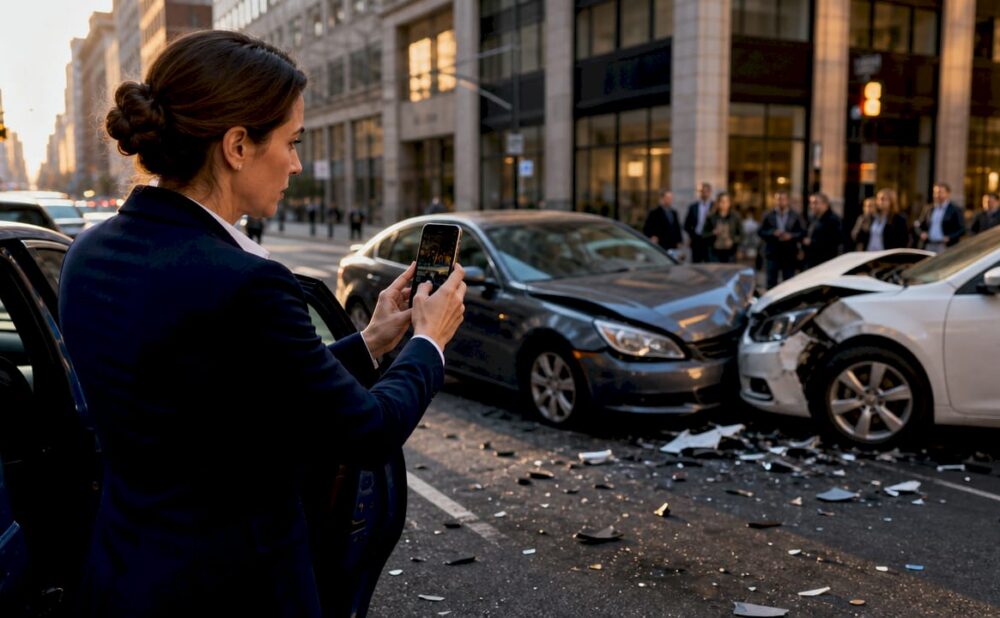
Vehicle and scene photographs form the backbone of your record. Wide-angle shots from about 50 feet establish the overall scene context, showing vehicle positions, lane markings, and surrounding environment. Close-up shots capture specific damage, license plates, deployed airbags, and broken glass. Both are necessary. Wide shots without close-ups leave gaps in detail; close-ups without wide shots lack context.
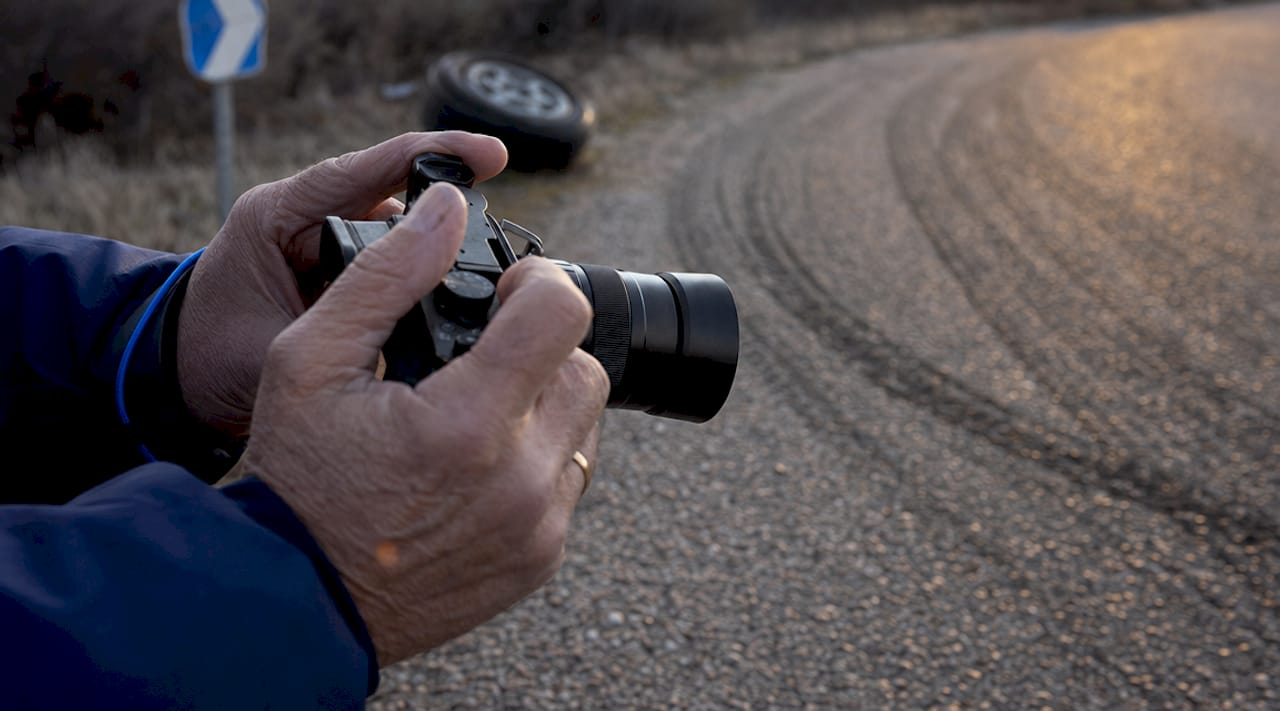
Environmental documentation covers road conditions, weather, visibility, traffic controls, and any hazards that may have contributed to the crash. Photograph every relevant sign, signal, and road marking within the immediate area. If the sun was in a driver’s line of sight or the road was wet, capture that too.
Witness information is among the most time-sensitive evidence you can collect. Independent witnesses leave quickly, and their memories degrade just like yours. Get full names, phone numbers, and email addresses from anyone who saw the crash. Ask if they are willing to give a brief recorded statement on your phone. Even a 60-second audio clip describing what they saw carries real weight.
Physical evidence such as skid marks, debris fields, and fluid spills tells the story of vehicle speed, braking, and impact direction. These details are critical for accident reconstruction and often disappear within hours.
Injury documentation requires both visual and medical records. Photograph visible injuries at the scene and again in the days that follow as bruising and swelling develop. Prompt medical records tie your health problems directly to the accident, which counters insurer arguments about pre-existing conditions. Delaying a doctor’s visit gives insurers room to argue your injuries were caused by something else entirely.
Pro Tip: Record a 30-second narrated walk-around video of the entire scene. A narrated video captures scene geometry, ambient audio, and dynamic context that still photos simply cannot replicate.
How and when to document the accident scene effectively
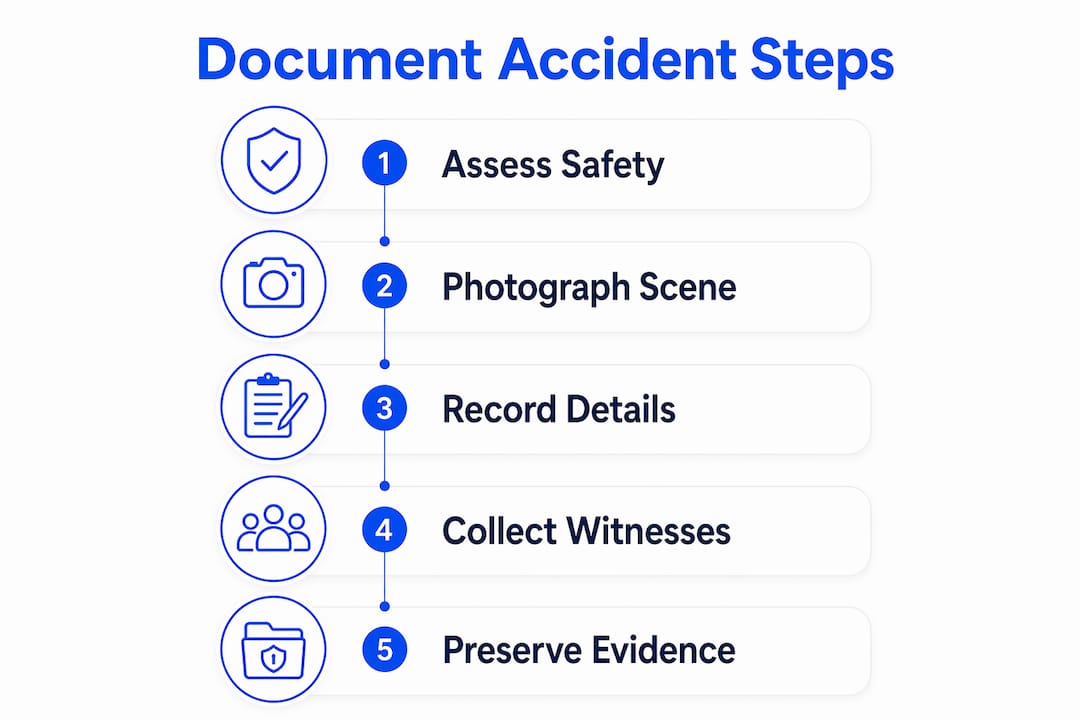
Timing is everything. Here is a step-by-step approach to collecting evidence before it disappears.
-
Confirm safety first. Move to a safe location if the scene is a traffic hazard. Call 911 before anything else. Do not attempt to document the scene while standing in active traffic lanes.
-
Start photographing immediately. Once you are safe, begin with wide-angle shots of the full scene, then work inward to close-up damage, license plates, and road markings. Capture all four sides of every vehicle involved.
-
Record a walk-around video. Narrate what you see as you film. Describe the positions of vehicles, visible damage, road conditions, and any relevant environmental factors. This 30-second video adds context that photos alone cannot provide.
-
Collect witness information. Approach witnesses calmly and politely. Ask for their name, contact number, and a brief description of what they saw. Do not pressure anyone, but do ask directly.
-
Request surveillance footage quickly. Identify nearby businesses, traffic cameras, or residential properties with cameras that may have captured the crash. Contact those businesses or property owners within 24 hours and send a formal preservation request. Digital evidence is vulnerable to overwriting within days, and this step often requires legal support to execute properly.
-
Write your statement within 24 to 48 hours. Written statements are most credible when drafted quickly, written in chronological order, and limited to factual observations. Avoid opinions, blame, or speculation. Stick to what you saw, heard, and felt.
-
Seek medical evaluation the same day. Even if you feel fine, get checked. Some injuries, including whiplash and traumatic brain injuries, do not present symptoms immediately.
Pro Tip: Use your smartphone’s timestamp and location features when taking photos. Dated, geotagged images are harder to dispute and carry more evidentiary weight in both insurance negotiations and court.
Common mistakes that weaken your documentation
Many accident victims make documentation errors that cost them significantly later. Knowing what to avoid is as important as knowing what to do.
-
Waiting too long to document. The most common and costly mistake is assuming you can return to the scene later or gather evidence after the fact. Evidence fades within hours, and surveillance footage may already be overwritten by the time you act.
-
Taking too few photos or poor angles. A handful of photos taken from one angle rarely tells the full story. Adjusters and attorneys need multiple perspectives to reconstruct what happened. Photograph everything, even details that seem minor.
-
Skipping witness contact information. Many victims focus on the other driver and forget about bystanders entirely. Witness accounts from neutral third parties carry significant weight, especially when the two drivers tell conflicting stories.
-
Neglecting medical documentation. Failing to see a doctor promptly gives insurers grounds to argue your injuries are unrelated to the crash. Medical documentation is the direct link between the accident and your physical harm. Without it, proving causation becomes an uphill battle.
-
Writing an inconsistent or opinionated statement. Statements that include guesses, blame, or contradictions between what you told the police and what you later tell your insurer create credibility problems. Factual, chronological statements drafted quickly are far more defensible under legal scrutiny.
-
Relying solely on the police report. Police reports are valuable, but they are not complete. Officers document what they observe at the scene, which may not include everything relevant to your claim. Your own documentation fills those gaps.
How thorough documentation supports your claim and legal protection
Objective evidence does one thing above all else: it reduces disputes. When you have dated photographs, a narrated video, witness contact details, and prompt medical records, the other side has far less room to manufacture an alternative version of events.
“Legal disputes often arise from conflicting recollections. Objective, dated photos and statements collected immediately give your attorney the anchor needed to advocate for you effectively.” — Maus Law Firm
The benefits of accident scene documentation extend directly into insurance negotiations. Insurance adjusters exploit gaps in evidence and memory to reduce payouts. A complete evidence package shifts that dynamic. Your attorney can present a clear, corroborated narrative rather than asking an adjuster to take your word for it.
Thorough documentation also supports professional accident reconstruction. Attorneys and investigators use scene photographs, skid mark measurements, and vehicle damage patterns to calculate speed, braking distance, and point of impact. This analysis can be the deciding factor in cases where liability is disputed.
| Point | Details |
|---|---|
| Evidence deterioration | Surveillance footage and skid marks disappear within 24 to 72 hours of the crash. |
| Photo strategy | Start with wide-angle shots, then move to close-ups of damage, plates, and road markings. |
| Witness urgency | Collect names and contact details immediately; witnesses leave quickly and memories fade fast. |
| Medical records | Same-day medical evaluation ties injuries directly to the accident and counters insurer disputes. |
| Written statements | Draft a factual, chronological account within 24 to 48 hours while memory is still reliable. |
Key takeaways
Thorough accident scene documentation, completed within hours of the crash, is the most reliable way to protect your claim, counter insurer disputes, and give your attorney the evidence needed to advocate effectively.
| Point | Details |
|---|---|
| Act within hours | Evidence like surveillance footage and skid marks disappears within 24 to 72 hours. |
| Cover all evidence types | Photograph vehicles, road conditions, injuries, and collect witness contact information. |
| Write your statement fast | Draft a factual, chronological account within 24 to 48 hours for maximum credibility. |
| Get medical care immediately | Prompt medical records directly link your injuries to the accident and prevent insurer disputes. |
| Avoid common errors | Never rely solely on the police report or skip witness documentation. |
What I’ve learned about documenting accident scenes
After years of working with accident victims across South Atlanta and surrounding Georgia counties, one pattern stands out clearly: the cases that settle well are almost always the ones where the client documented everything in the first hour. Not the first day. The first hour.
Most people are shaken after a crash. That is completely understandable. But the instinct to sit down, call family, and wait for the police to handle everything is exactly what insurance companies count on. By the time you feel ready to gather evidence, the surveillance footage is gone, the witnesses have driven away, and the skid marks have been washed off by rain.
What I tell every client is this: your smartphone is your most powerful tool at the scene. You do not need special equipment or legal training to take a wide-angle photo or record a 60-second video. You just need to act before the scene changes. The steps to take after an accident are not complicated, but they are time-sensitive.
The other thing I have seen hurt clients repeatedly is the written statement. People write things down days later, include opinions about who was at fault, and contradict what they told the officer at the scene. That inconsistency becomes ammunition for the opposing side. Write your statement within 24 hours. Keep it factual. Keep it chronological. Let your attorney handle the interpretation.
Technology helps, but it does not replace professional legal support when it comes to preserving digital evidence. Requesting surveillance footage from a business requires a formal preservation letter. Most individuals do not know how to do that, and most businesses will not hold footage indefinitely without one. That is where having an attorney in your corner early makes a real difference.
— Ali
How Jewkesfirm can protect your rights after an accident

If you have been in an accident in South Atlanta or the surrounding Georgia counties, Jewkesfirm is ready to help you preserve the evidence that protects your claim. Our team knows exactly what insurance companies look for and how to build a documented case that holds up. We can send preservation letters for surveillance footage, guide you through documenting auto accident evidence, and handle the legal details so you can focus on recovering. Jewkesfirm works on a contingency fee basis, meaning you pay nothing unless we win. Contact us today for a FREE CONSULTATION and let us put our experience to work for you.
FAQ
Why is documenting the accident scene so important?
Accident scene documentation preserves objective evidence before it deteriorates, including surveillance footage that overwrites within 24 to 72 hours. Without this evidence, insurance adjusters can dispute liability and reduce your payout based on gaps in the record.
When should you start documenting after an accident?
Start documenting as soon as you are safely out of traffic, ideally within minutes of the crash. Skid marks, debris, and witness availability all decrease rapidly, and surveillance footage may be gone within a day.
What should you photograph at an accident scene?
Photograph the full scene from about 50 feet away first, then take close-ups of vehicle damage, license plates, road markings, traffic signs, and any visible injuries. A narrated walk-around video adds context that still photos cannot capture.
Does a police report replace your own documentation?
No. Police reports record what officers observe at the scene, but they do not capture every detail relevant to your claim. Your own photographs, witness contacts, and written statement fill critical gaps that the report leaves out.
How does injury documentation affect your claim?
Prompt medical records directly tie your injuries to the accident, which counters insurer arguments about pre-existing conditions. Delaying medical care gives insurers grounds to argue your injuries were caused by something unrelated to the crash.