
TL;DR:
- Documenting auto accident evidence immediately is crucial as delays can cause vital proof to be lost or overwritten.
- Organizing all evidence into a comprehensive folder enhances credibility and helps legal and insurance processes.
A car accident is disorienting. In the minutes that follow, most people focus on shock, pain, and safety. What they rarely think about is evidence. That gap costs accident victims real money. Poor documentation is one of the top reasons insurance adjusters deny or undervalue claims, and it can cripple an otherwise strong legal case. This guide to documenting auto accident evidence walks you through exactly what to collect, how to collect it, and how to keep it organized so you walk into any negotiation or courtroom with proof that cannot be dismissed.
Table of Contents
- Key takeaways
- What to gather before and right after a crash
- Steps for accident documentation at the scene
- Documenting injuries and medical evidence
- Preserving digital and third-party evidence
- Organizing your evidence after the accident
- What I have learned from watching evidence make or break real cases
- Your documented evidence deserves strong legal backing
- FAQ
Key takeaways
| Point | Details |
|---|---|
| Start documenting immediately | Begin capturing photos, videos, and notes at the scene as soon as you are safe. |
| Injuries need ongoing documentation | Time-stamped photos and symptom journals over days and weeks carry more weight than a single ER photo. |
| Digital evidence expires fast | Surveillance footage is often overwritten within 24 to 72 hours. Request it immediately. |
| Organization wins claims | A single, complete folder of all evidence signals credibility to adjusters and attorneys alike. |
| Legal help multiplies evidence value | An attorney knows which evidence to prioritize and how to preserve it before it disappears. |
What to gather before and right after a crash
Being prepared before an accident ever happens puts you in a far stronger position. The best auto accident evidence tips begin before you ever need them.
Keep these items in your vehicle at all times:
- A smartphone with a charged battery and a reliable camera app
- A small notepad and pen for written observations
- Copies of your insurance card, driver’s license, and vehicle registration
- A list of emergency contacts
- An audio recorder app pre-installed on your phone
The moment a crash occurs, your first obligation is safety. Move out of traffic if possible, check for injuries, and call 911. Georgia law requires you to report accidents that involve injury, death, or significant property damage. Do not skip this step. Police reports provide neutral, timestamped, official records that form the foundation of both insurance claims and legal proceedings. Get the responding officer’s name, badge number, and report number before you leave.
Pro Tip: Set your phone to keep location and timestamp data embedded in every photo. This metadata becomes part of the evidence and confirms exactly when and where each image was captured.
Once you are safe and police have been called, evidence collection begins. The key steps after a car accident that protect your rights are time-sensitive. Every minute that passes changes the scene.
Steps for accident documentation at the scene
This is where most people either build a strong case or lose it entirely. Follow these steps for accident documentation in order, without rushing past any of them.
-
Photograph the entire scene first. Take wide-angle shots from multiple directions showing vehicle positions, lane markings, traffic signals, and any road hazards. These establishing shots prove where everyone was and how the crash occurred.
-
Move to close-up shots. Capture damage to every vehicle from multiple angles. Photograph license plates, bumpers, doors, tires, and interiors if relevant. Do not overlook damage to your own car.
-
Document road and environmental conditions. Photograph skid marks, debris, broken glass, potholes, missing signage, wet pavement, or anything that contributed to the crash. Weather and lighting conditions matter too.
-
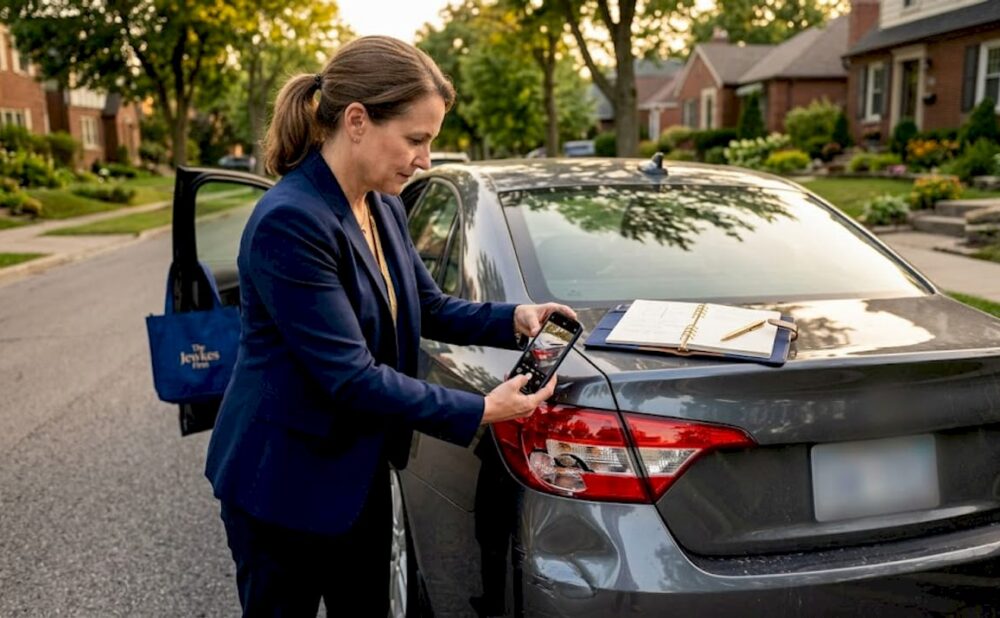
Record a narrated walk-around video. Walk around the entire scene while speaking clearly into your phone camera. Describe what you see: vehicle positions, damage, road conditions, and any observations about the other driver. Multi-angle videos with metadata preserve vital context that photos alone cannot capture.
-
Exchange information without admitting fault. Collect the other driver’s name, license number, insurance company, policy number, and contact details. Avoid apologizing or speculating about who caused the accident. Even casual statements can be used against you in a claim.
-
Collect witness information. If bystanders or other drivers saw the crash, ask for their names and phone numbers. A brief recorded statement with their permission is even better.
-
Write down your own observations immediately. Do not rely on memory. Your account of events is part of the evidence. Include the time, direction you were traveling, speed, what the other driver did, and anything unusual you noticed.
Here are the critical details to capture in written form at the scene:
- Full names and contact info for all parties involved
- Insurance details for all drivers
- Vehicle make, model, color, and year for every car
- Exact location including street name, intersection, and direction of travel
- Time of day and weather conditions
- Names and badge numbers of responding officers
Pro Tip: If you are too shaken to write, use your phone’s voice memo app to record your observations out loud. You can transcribe later. What matters is capturing your account while it is still fresh.
Documenting injuries and medical evidence
Physical injuries are central to most auto accident compensation claims. Yet this is where many victims fall short because they stop documenting once they leave the hospital.
Start by photographing any visible injuries immediately at the scene. Cuts, bruising, swelling, and abrasions should all be captured. Then photograph those same injuries every day for the next several weeks. Bruising often worsens in the days after a crash, and showing that progression tells a far more convincing story than a single photo. You can find detailed guidance on documenting accident injuries for your legal case on the Jewkesfirm blog.
Equally important is a symptom journal. Write daily entries that include:
- Your pain level on a scale from 1 to 10
- Specific symptoms such as headaches, stiffness, dizziness, or numbness
- Activities you cannot perform because of your injuries
- How your injuries affect your sleep, work, and daily life
Injury documentation that pairs time-stamped photos with functional narratives resonates far more convincingly with adjusters and juries than vague descriptions of pain. Saying you could not lift your child for three weeks is far more powerful than saying your shoulder hurt.
Seek medical evaluation promptly, even if you feel fine. Adrenaline masks injury symptoms, and conditions like whiplash or internal bruising may not appear for 24 to 48 hours. Gaps in medical treatment are one of the first things insurance adjusters scrutinize to dispute injury claims.
Save every piece of medical paperwork:
- Emergency room and hospital records
- Physician and specialist visit summaries
- Prescription receipts and pharmacy records
- Physical therapy notes and attendance records
- All bills and insurance correspondence related to treatment
If your injuries caused you to miss work, get written documentation from your employer confirming the dates you were absent and any reduced duties you performed upon return.
Pro Tip: Do not post about your injuries or recovery on social media. Insurance adjusters routinely monitor claimants’ social media accounts, and a photo of you at a family barbecue can be used to argue your injuries are not serious.

Preserving digital and third-party evidence
Physical evidence at the scene is only part of the picture. Digital evidence can be decisive, but it disappears fast if you do not act quickly.
Here is what to prioritize:
- Dashcam footage: Download your dashcam video immediately after the crash and back it up in at least two locations. Do not let the device overwrite it.
- Phone recordings: Any videos or photos taken on your phone should be backed up to cloud storage within hours.
- Third-party surveillance: Nearby businesses, traffic cameras, and parking structures may have recorded the crash. Surveillance footage is often overwritten every 24 to 72 hours. Send a written preservation request to property owners immediately.
- Event data recorders (EDRs): Modern vehicles contain black boxes that record speed, braking, and steering data in the seconds before impact. An attorney can help you obtain and preserve this data before the vehicle is repaired or totaled.
When it comes to protecting the files you already have, preserve original digital evidence files intact and only work with copies for review or sharing. Altering or accidentally overwriting an original file can undermine its legal authenticity.
| Evidence type | Retention risk | Action required |
|---|---|---|
| Dashcam video | Overwrites continuously | Download and back up immediately |
| Business surveillance | 24 to 72 hours | Send written request same day |
| Traffic camera footage | Varies by municipality | Contact city or police within 48 hours |
| EDR/black box data | Lost if vehicle is repaired | Notify attorney to issue preservation letter |
| Social media posts | Permanent but can be deleted | Screenshot and save any relevant posts |
If there is any delay in accessing third-party footage, your attorney can send a legal preservation letter demanding that the footage be retained. That letter creates a legal obligation and a paper trail if evidence later goes missing.
Organizing your evidence after the accident
Collecting evidence is only half the job. Disorganized evidence is almost as damaging as missing evidence, because it creates confusion and delays when you need to move quickly on a claim.
Organize all evidence into a single folder, both physical and digital, that contains everything related to your accident. That folder should include:
- Police report and report number
- All photos and videos from the scene
- Witness names and contact information
- Medical records, bills, and treatment summaries
- Symptom journal entries
- Employer documentation for lost wages
- All insurance correspondence and claim numbers
- A dated log of every phone call you make related to the crash
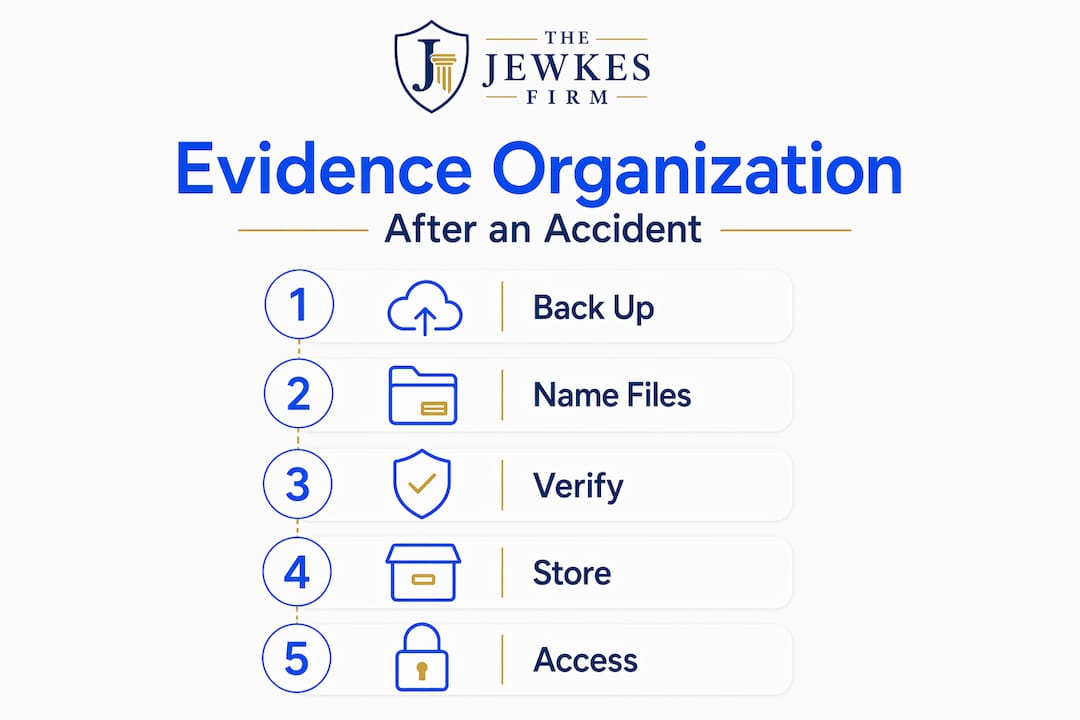
Back up your digital files to at least two locations, such as a cloud service and an external drive. Verify that nothing is missing by cross-referencing your files against the comprehensive personal injury checklist recommended by attorneys.
Pro Tip: Create a simple naming convention for your files, such as “2026-01-15_damage_front_bumper.jpg,” so you can locate any piece of evidence instantly without sorting through hundreds of unnamed photos.
What I have learned from watching evidence make or break real cases
I have seen cases that looked airtight on paper fall apart because the client could not produce the evidence that would prove their account. And I have watched cases that seemed difficult turn in the client’s favor because of one piece of footage or a detailed symptom journal nobody expected.
The most common mistake I see is waiting. People are shaken after a crash, which is understandable. But evidence degrades fast. Memories fade. Surveillance footage disappears. Skid marks wash away. The clients who document everything at the scene, even imperfectly, are in a far better position than those who waited until they “felt ready.”
The second mistake is treating injury documentation as a one-time task. A single ER photo does not tell the story of a painful six-week recovery. Daily entries and photos do. Adjusters are trained to minimize your injuries. Consistent, dated documentation makes that much harder to do.
Evidence organized well also changes how attorneys can build your case. When I see a client with a complete, clearly labeled folder, I can get to work immediately rather than spending weeks chasing down records. That speed matters when statutes of limitations and claim deadlines are involved.
Take the time to document everything, even when it feels overwhelming. That investment pays.
— Ali
Your documented evidence deserves strong legal backing

You have done the hard work of collecting and preserving your evidence. Now the question is how to use it effectively. At Jewkesfirm, we help auto accident victims in South Atlanta and throughout Georgia turn documented evidence into real compensation. Our attorneys know exactly which evidence carries the most weight with insurers and in court, and we know how to present it for maximum impact. We work on a contingency basis, meaning you pay nothing until we win your case. Contact Jewkesfirm today for a FREE CONSULTATION and let us put your evidence to work for you. Learn how evidence affects your claim and why timing matters every step of the way.
FAQ
What photos should I take at an auto accident scene?
Photograph wide shots of the entire scene, close-ups of all vehicle damage, license plates, skid marks, road conditions, traffic signals, and any visible injuries. Capture images from multiple angles to give insurers and attorneys a complete picture of what happened.
How soon should I seek medical attention after a crash?
Seek medical evaluation within 24 hours even if you feel fine. Adrenaline can mask symptoms, and delayed treatment creates gaps that insurance adjusters use to dispute or minimize injury claims.
How long does surveillance footage last before it is deleted?
Most business and traffic surveillance systems overwrite footage every 24 to 72 hours. Send a written preservation request to any nearby property owners on the same day as the accident to prevent that footage from being lost.
What should I include in an accident evidence folder?
Your folder should contain the police report, all photos and videos, witness contact information, medical records, bills, your symptom journal, employer documentation for lost wages, and a log of all insurance-related communications.
Should I post about my accident on social media?
No. Avoid posting anything about the crash, your injuries, or your recovery on social media. Insurance companies regularly monitor claimants’ accounts and can use photos or comments to argue your injuries are less serious than claimed.