

Key Takeaways
- A train accident claim is a legal request for compensation that relies heavily on proper documentation and proof of lawful travel. Failure to meet strict deadlines, provide clear evidence, or avoid emotional language can result in claim denial, even with severe injuries. Seeking early legal assistance and maintaining organized records greatly improve the chances of successful compensation.
If you were hurt in a train accident, you probably have more questions than answers right now. Train collision claims explained simply means understanding who is liable, what compensation you can pursue, and how to file a claim without making costly mistakes. Most people either wait too long or submit incomplete claims and walk away with nothing. This guide cuts through the confusion and gives you a clear picture of the process, your legal rights, and what actually determines whether your claim succeeds or fails.
Table of Contents
- Key takeaways
- Train collision claims explained: the legal foundation
- How to file train claims step by step
- Common pitfalls that can sink your claim
- Compensation frameworks and amounts in 2026
- My take after years of handling these cases
- Get the legal support your claim deserves
- FAQ
Key takeaways
| Point | Details |
|---|---|
| Proof of travel is non-negotiable | Courts have dismissed claims despite severe injury when valid travel documentation was absent. |
| Deadlines are strict | Many jurisdictions require written claims within months of the incident, making early action critical. |
| Documentation drives outcomes | Itemized records, photos, and medical reports submitted upfront prevent drawn-out back-and-forth. |
| Compensation varies by jurisdiction | Award amounts range from hundreds to millions depending on local law and injury severity. |
| Emotional letters hurt claims | Claim letters must be factual and specific; anything else gives adjusters a reason to reject. |
Train collision claims explained: the legal foundation
A train collision claim is a formal legal request for compensation after you are injured or lose a family member in a train accident. These claims can arise from passenger train crashes, collisions at railroad crossings, freight train derailments, or falls caused by unsafe conditions on trains or platforms. Understanding the legal basis for your claim matters because the laws governing train accident liability differ depending on where the incident occurred and who operates the train.
The categories of damages you can typically pursue include:
- Medical expenses: Emergency treatment, surgery, rehabilitation, and ongoing care costs
- Lost income: Wages lost during recovery and future earning capacity if you are permanently disabled
- Pain and suffering: Physical pain and psychological distress caused by the accident
- Wrongful death benefits: Funeral costs, loss of financial support, and grief-related damages for surviving family members
- Property damage: Personal belongings damaged or destroyed in the collision
In the United States, train crash liability laws are shaped by a combination of federal and state statutes. The Federal Railroad Safety Act sets baseline safety requirements for railroad operators. When a railroad violates those standards and that violation causes your injury, it strengthens your negligence claim considerably. For freight-related losses, the Carmack Amendment requires written claims within 9 months and lawsuits filed within 2 years of a denial. Jurisdiction matters enormously. Filing in Georgia under state tort law gives you different leverage than filing a federal claim, which is why speaking with a local attorney before you act is so valuable.
How to file train claims step by step
The train wreck claims process rewards people who move quickly and document everything. Here is what that looks like in practice:
- Get medical attention immediately. Even if you feel fine, see a doctor the same day. Many soft tissue injuries and neurological symptoms appear hours or days later. A same-day medical record also creates a direct link between the accident and your injuries, which is critical for your claim.
- Preserve evidence at the scene. Take photos of the train, the collision point, your injuries, and any visible property damage. Collect contact information from witnesses. If you have a ticket, boarding pass, or any travel documentation, protect it carefully.
- Report the accident formally. Notify the railroad operator or transit authority in writing. Verbal reports disappear. Written reports create a paper trail the railroad cannot deny.
- Build your documentation file. Your claim package should include medical records, itemized bills, photos, your travel proof, a copy of your incident report, and any witness statements. Railroad claims adjusters demand itemized documents like photographic evidence and repair estimates, and incomplete submissions are rejected outright.
- Write a clear, factual claim letter. State what happened, when it happened, what injuries you sustained, and what compensation you are requesting. Keep emotion out of it. Stick to facts and specific dollar amounts supported by your documentation.
- Submit via certified mail or official portal. Always get proof of delivery. Online portals should generate a confirmation number. Keep copies of everything you send.
- Request a joint inspection if applicable. Railroads are required to cooperate in joint inspections within a reasonable timeframe, giving both parties the opportunity to document damage together. This reduces disputes later.
- Follow up in writing. If you do not receive a response within the stated timeframe, send a written follow-up and document the date. This protects you if the claim moves to litigation.
Pro Tip: If your claim is denied, request the specific reason in writing. Denials based on technicalities, like a missing document, are often fixable. A denial is not the end of the road.
Common pitfalls that can sink your claim
Even valid claims fail. Knowing why helps you avoid the same traps.
The single most dangerous mistake is failing to prove you were lawfully traveling at the time of the accident. The Delhi High Court dismissed a claim despite both hands being amputated in a train accident because the claimant could not prove they were a valid, ticketed passenger. That outcome shocks most people. It illustrates exactly how courts treat documentation: it is not a formality. It is the foundation of your entire case.
Other common pitfalls include:
- Writing emotionally charged claim letters. Claims must be factual and contain all necessary documentation. Adjusters treat emotional language as a red flag and use it to justify rejection.
- Missing filing deadlines. Statutes of limitations vary by state and claim type. Missing a deadline by even one day can permanently bar your right to compensation.
- Inconsistent accounts of the accident. If your claim letter, medical records, and witness statements tell slightly different stories, adjusters and defense attorneys will exploit those gaps.
- Waiting to hire legal help. The earlier an attorney gets involved, the better your evidence preservation and the less likely you are to make procedural errors that cannot be undone.
- Ignoring denied claims. Many people accept a denial as final. It rarely is. Judicial delays from misapplied liability rules have caused some claims to drag on for over a decade before higher courts intervened and corrected the outcome.
Remember: A denied claim is a starting point for an appeal, not a verdict. Railroads and their insurers count on claimants giving up. Persistence, paired with strong documentation, is what separates successful claimants from those who walk away empty-handed.
The role of train collision insurance also comes into play here. Railroad operators carry liability coverage that is specifically designed to settle claims before they escalate. Understanding what that coverage includes and how to engage with it properly is something most unrepresented claimants get wrong on their first attempt.
Compensation frameworks and amounts in 2026

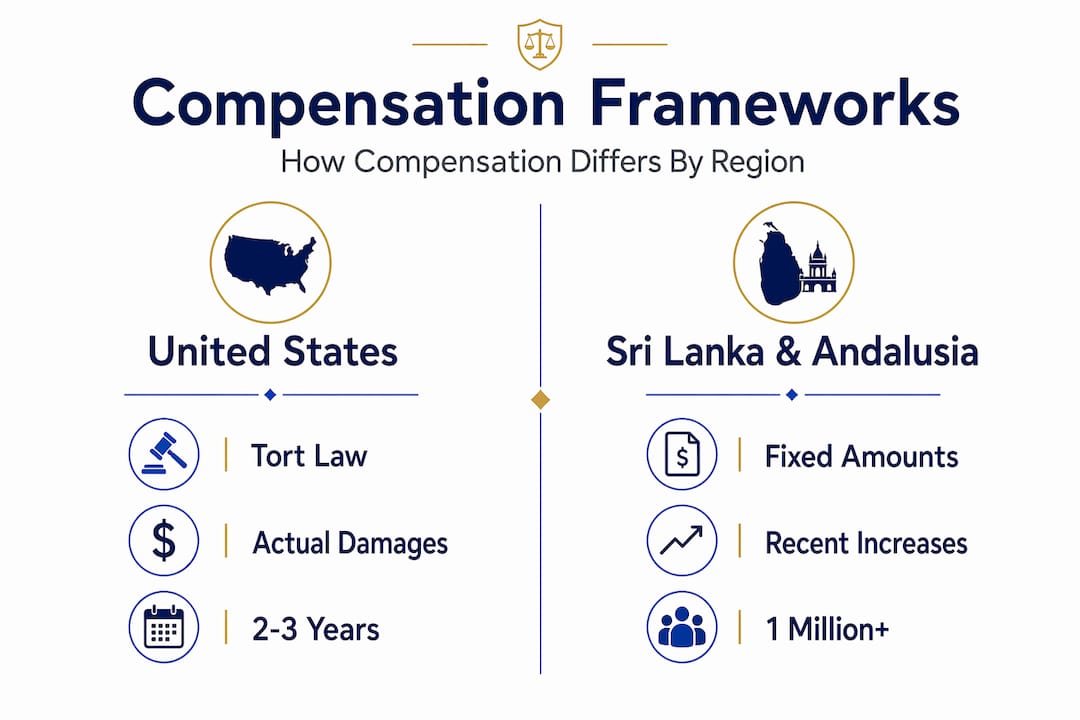
Compensation for train injuries is not a flat number. It depends on where you are, who operates the train, the severity of your injuries, and the applicable laws. Here is a current snapshot of how different jurisdictions structure their compensation frameworks:
| Jurisdiction | Compensation range | Injury levels | Claims deadline |
|---|---|---|---|
| United States (federal) | Varies widely by case | Negligence-based | State-dependent (often 2 years) |
| Sri Lanka Railways | Up to Rs 1 million | Death or permanent disability | Per railway authority guidelines |
| Andalusia, Spain | 481 to 16,828 euros | 14 defined severity levels | Per regional aid law |
| India (rail tribunal) | Varies; court-supervised | Death and injury claims | 1 year from incident |
Sri Lanka Railways raised death and permanent disability compensation to Rs 1 million as of May 2026. Andalusia recently passed an aid law that defines 14 levels of injury severity with corresponding payouts between 481 and 16,828 euros. These international examples matter even if you are filing in Georgia because they reveal a universal truth: the more precisely an injury is documented and classified, the higher the potential award.
In the U.S., train accident compensation is largely driven by tort law. That means your payout reflects actual proven damages plus any pain and suffering multiplier your attorney negotiates or a jury awards. There is no standardized cap in most states, which is why the quality of your legal representation directly affects the final number.
Pro Tip: Ask your attorney whether your jurisdiction allows prejudgment interest on compensation awards. In some states, delays caused by the railroad’s refusal to settle can actually increase what you are owed.
Tax treatment of awards also varies. In the U.S., compensation for physical injuries is generally not taxable, but lost wages components of a settlement may be. Ask your attorney about structuring your settlement in a way that maximizes your take-home recovery.
My take after years of handling these cases
I have worked through enough personal injury cases to know that train collision claims are genuinely among the most documentation-intensive claims in personal injury law. The clients who do best are never the ones with the most dramatic injuries. They are the ones who kept their ticket, took photos, saw a doctor that same day, and called an attorney before talking to the railroad’s claims team.
The bona fide travel issue catches people off guard every time. They assume their injury speaks for itself. It does not. Courts want to know you had the legal right to be on that train at that moment. Without that proof, even catastrophic harm may go uncompensated. I have seen it happen and it is devastating.
What I have also learned is that emotionally written claim letters, while completely understandable given what people are going through, genuinely hurt outcomes. An adjuster reading a letter full of frustration and anguish is not moved. They are looking for a reason to say no. A clean, factual letter with organized documentation gives them no opening.
If there is one thing I would tell anyone starting this process, it is this: do not try to handle the railroad alone. Their legal team has processed thousands of claims. You are doing this for the first and hopefully only time in your life. That imbalance matters, and it affects outcomes. Get expert guidance early. The difference between a dismissed claim and a fully compensated one often comes down to how quickly someone with experience got involved.
Get the legal support your claim deserves
Train collision claims are not the kind of legal matter where a DIY approach protects your interests. Railroads and their insurers have experienced legal teams ready to minimize what they pay you. The Jewkes Firm levels the playing field.

The attorneys at The Jewkes Firm have helped injury victims across South Atlanta and surrounding Georgia counties recover the compensation they deserve after serious accidents. From gathering evidence and meeting critical deadlines to negotiating maximum compensation, the firm handles every step so you can focus on recovery. The Jewkes Firm works on a contingency fee basis. You pay nothing unless they win your case. If you or a family member has been injured in a train collision, call The Jewkes Firm today for a FREE CONSULTATION and find out exactly where you stand.
FAQ
What does proof of bona fide travel mean in train claims?
Proof of bona fide travel means documentation showing you were a lawful passenger at the time of the accident, such as a valid ticket or boarding pass. Courts have dismissed claims despite severe injuries when this proof was absent.
How long do you have to file a train collision claim?
Deadlines vary by jurisdiction and claim type. In the U.S., many personal injury statutes of limitations are two years, while federal freight claims under the Carmack Amendment require written notice within 9 months of the incident.
What compensation can you recover after a train accident?
You can pursue medical expenses, lost wages, pain and suffering, and wrongful death benefits depending on your case. The amount depends on injury severity, applicable state or federal law, and the quality of your documentation.
Can a denied train accident claim be appealed?
Yes. A denial is not final. You can appeal through the railroad’s internal process, file a complaint with a regulatory body, or pursue litigation. An experienced attorney can identify the specific reason for denial and correct it.
Do you need a lawyer to file a train collision claim?
You are not legally required to hire a lawyer, but railroad companies carry experienced legal teams dedicated to minimizing payouts. Working with a personal injury attorney significantly improves your chances of recovering full compensation, especially in complex or denied claims.