

TL;DR:
- Rideshare accident claims are more complex than standard car crashes, involving layered insurance policies and driver status. Many parties, including passengers, pedestrians, and other drivers, can file for compensation, which varies based on the trip phase and coverage. Early documentation and legal assistance are crucial to maximize recovery and navigate disputed coverage.
If you were hurt in an Uber or Lyft accident, you are dealing with something far more complicated than a typical car crash. Understanding what is a rideshare accident claim is the first step toward protecting your rights and recovering what you deserve. Unlike standard auto accidents, these claims involve layered insurance policies, driver status at the time of the crash, and multiple parties who may share liability. This guide breaks down exactly how these claims work, who can file, what compensation you may be owed, and how to take the right steps from day one.
Table of Contents
- Key takeaways
- What is a rideshare accident claim?
- How rideshare insurance coverage actually works
- Steps for filing a rideshare accident claim
- Types of compensation you can recover
- My take on what most victims get wrong
- Get the legal support your case deserves
- FAQ
Key takeaways
| Point | Details |
|---|---|
| Rideshare claims are uniquely complex | Multiple insurance layers and driver status at the time of the crash determine who pays. |
| Anyone involved can file a claim | Passengers, other drivers, pedestrians, and cyclists all have the right to pursue compensation. |
| Insurance coverage shifts by phase | Coverage ranges from no rideshare protection to up to $1 million depending on the trip status. |
| Documentation starts at the scene | Photos, police reports, and app records are critical to building a strong claim. |
| Legal help changes outcomes | Engaging an attorney early prevents costly mistakes and protects your claim’s full value. |
What is a rideshare accident claim?
A rideshare accident claim is a personal injury claim filed after a collision involving a rideshare vehicle such as an Uber or Lyft. It is the legal process by which an injured party seeks financial compensation from the at-fault driver, the rideshare company’s insurer, or both. The key difference from a standard car accident claim is that liability and coverage depend heavily on the specific facts of the crash, including when it happened within the driver’s app cycle.
Who can file? The list is broader than most people realize.
- Passengers riding in the rideshare vehicle at the time of the crash
- Occupants of other vehicles hit by the rideshare driver
- Pedestrians and cyclists struck by the rideshare vehicle
- The rideshare driver if another party caused the accident
Claims may be based on several legal theories. Straightforward negligence applies when a driver causes harm through careless driving. Negligent hiring applies when a rideshare company fails to screen drivers properly. Vicarious liability may apply in situations where the company is considered a co-employer. Each theory opens a different door to compensation, and the right approach depends on the details of your case.
| Claim Type | Who Is Targeted | When It Applies |
|---|---|---|
| Driver negligence | At-fault driver personally | Driver caused the crash through careless behavior |
| Rideshare commercial insurance | Rideshare company’s insurer | Driver was active on the app at time of crash |
| Negligent hiring | Rideshare company directly | Company failed to vet the driver appropriately |
| Third-party driver claim | Another driver’s insurer | A third party caused the crash, not the rideshare driver |
How rideshare insurance coverage actually works
This is where many victims lose money. Rideshare claims are more complex than standard auto claims specifically because coverage depends on the driver’s status at the exact moment of the accident.

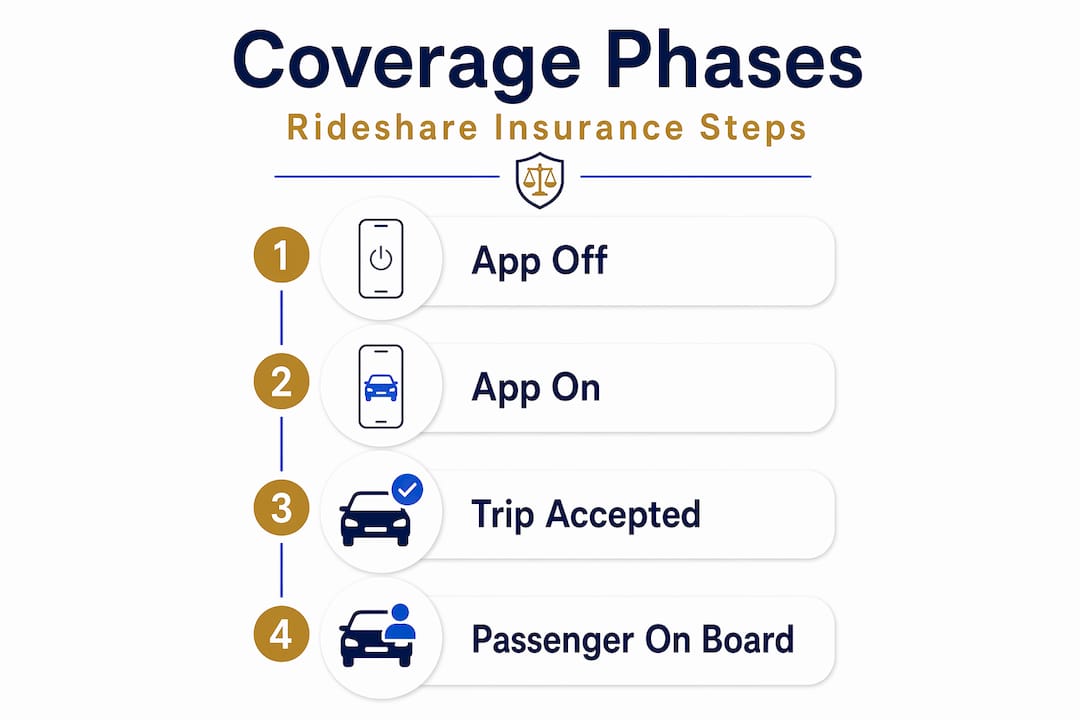
There are three distinct phases, and each carries different insurance implications.
Phase 1: App off. The driver is not logged into any rideshare platform. Only the driver’s personal auto insurance applies. The rideshare company has zero obligation to cover you.
Phase 2: App on, waiting for a ride. The driver is logged in but has not yet accepted a trip. Limited secondary coverage applies, typically around $50,000 per person and $100,000 per accident in liability coverage. Personal insurance may still be the primary policy.
Phase 3: En route or passenger on board. The driver has accepted a trip or is actively transporting a passenger. This is when full commercial coverage kicks in, with up to $1 million in liability protection available through Uber or Lyft.
Coverage gaps are real and can be costly. If the driver was between phases, or if an unauthorized person was driving the vehicle, determining which policy responds becomes a legal dispute. Unauthorized driver situations can result in the rideshare company’s insurer denying coverage entirely, leaving victims to pursue the driver’s personal policy alone.
Pro Tip: Screenshot the ride receipt from the rideshare app immediately after any accident. That record establishes the trip phase at the time of the crash and can be critical evidence when insurers dispute coverage.
Steps for filing a rideshare accident claim
The decisions you make in the first 24 to 72 hours after a rideshare crash have an outsized impact on your claim. Early action and thorough documentation are the foundation of any strong case.
Here are the steps to follow:
-
Call 911 and stay at the scene. A police report is critical evidence that establishes the official account of liability. Never skip this step, even for seemingly minor crashes.
-
Seek medical attention immediately. Even if you feel fine, go to a doctor. Delayed-onset injuries like whiplash and soft tissue damage are common. Medical records from the day of the accident are among the most powerful tools in building your claim.
-
Document everything at the scene. Photograph vehicle damage, road conditions, traffic signs, and any visible injuries. Note weather, time of day, and any witnesses. Collect names and insurance details from all involved parties. Follow the key steps after a car accident to make sure nothing is missed.
-
Preserve your app data. Keep the ride receipt, the driver’s name and rating, and the trip route. This data links you to the active trip phase and establishes the rideshare company’s involvement.
-
Report the accident to the rideshare company. Uber and Lyft both have in-app accident reporting functions. Use them. But be careful about what you say, particularly to their claims representatives. Their process is designed to gather information that benefits the platform, not you.
-
Notify your own insurance company. Even as a passenger or pedestrian, your own uninsured or underinsured motorist coverage may apply depending on how the accident unfolded.
-
Consult a personal injury attorney before accepting any settlement. Insurance companies move fast. They may offer a quick settlement before the full scope of your injuries is known. Learn how to handle accident claims in Georgia and what timelines apply to your case.
Pro Tip: Never give a recorded statement to any insurer, including your own, without first speaking with an attorney. Anything you say can be used to minimize your payout.
Types of compensation you can recover
Rideshare accident compensation covers more than just your medical bills. Understanding the full scope of damages is what separates a fair settlement from one that leaves you short.
Economic damages are the concrete financial losses tied directly to your accident:
- Past and future medical expenses, including emergency care, surgeries, physical therapy, and prescriptions
- Lost wages for time missed from work during recovery
- Loss of earning capacity if injuries affect your ability to work long term
- Rehabilitation and assistive device costs
- Transportation costs to and from medical appointments
- Property damage to your vehicle or personal belongings
Non-economic damages are equally real but harder to calculate:
- Pain and suffering from the physical injury itself
- Emotional distress, anxiety, and post-traumatic stress following the crash
- Loss of enjoyment of life if your injuries limit daily activities
- Loss of consortium if injuries impact your relationship with a spouse
Rideshare claims generally carry no statutory cap on non-economic damages, unlike some medical malpractice cases. That matters because pain and suffering can represent a significant portion of total compensation. Settlement amounts vary widely, from under $15,000 for minor injuries to well over $50,000 when serious injuries are involved. Accurate documentation and skilled legal representation are what drive those numbers higher.
The quality of your accident evidence documentation directly determines how convincingly your attorney can present economic losses to the insurer or a jury.
My take on what most victims get wrong
I have seen what happens when people approach rideshare accident claims the same way they would handle a fender bender. They assume the rideshare company’s insurer will be reasonable. They take the first settlement offer because they just want it to be over. And they end up with a fraction of what they were actually entitled to.
The burden of proof rests entirely on you as the injured party. That means every gap in your documentation is a gift to the insurance company. I have watched strong cases get undervalued because the victim waited too long to see a doctor, or because they gave a recorded statement before understanding what their injuries actually were.
What most people do not realize is that the layered insurance structure in rideshare claims is not just a complication. It is also an opportunity. When a full commercial policy with $1 million in coverage is active, the ceiling on what you can recover is significantly higher than in a typical two-car accident. But you will not reach that ceiling without knowing which policy applies and how to push for it.
My honest advice: get legal counsel before you talk to anyone from the rideshare company’s claims department. Not after. Before. The phone call you make to an attorney in the first 48 hours can be worth more than any other step in this process.
— Ali
Get the legal support your case deserves
Rideshare accident claims involve multiple insurers, shifting liability rules, and insurance companies with dedicated legal teams working against you from day one. You should not navigate that alone.

At Jewkesfirm, we represent accident victims across South Atlanta and surrounding Georgia counties. We handle every layer of the rideshare claim process, from identifying which insurance policy applies to fighting for maximum compensation on your behalf. There are no upfront costs. You pay nothing unless we win. If you were hurt in a rideshare accident, contact Jewkesfirm today for a FREE case review and find out exactly what your claim may be worth. Your recovery starts with one call.
FAQ
What is a rideshare accident claim exactly?
A rideshare accident claim is a personal injury claim filed after a crash involving an Uber, Lyft, or similar rideshare vehicle. It seeks compensation from the at-fault driver, the rideshare company’s insurer, or both, depending on the driver’s app status at the time of the accident.
Who can file a rideshare accident claim?
Passengers, occupants of other vehicles, pedestrians, and cyclists who are injured in a rideshare accident all have the right to file a claim. The rideshare driver may also file if another party caused the crash.
How much compensation can I get from a rideshare accident?
Settlement amounts depend on injury severity, medical costs, lost wages, and pain and suffering. Minor injury claims may settle under $15,000, while serious injury claims can exceed $50,000 or more when full commercial coverage applies.
How long do I have to file a rideshare accident claim in Georgia?
Georgia generally allows two years from the date of the accident to file a personal injury claim. Acting quickly protects your evidence and preserves your legal rights before deadlines pass.
Do I need a lawyer to file a rideshare accident claim?
You are not required to hire an attorney, but rideshare claims involve multiple insurers and complex liability rules that are difficult to navigate without legal experience. An attorney can identify which policies apply and fight for the full value of your injuries.