

TL;DR:
- Getting hurt in a rideshare accident can be overwhelming due to complex liability and insurance issues. The applicable coverage depends on the trip phase, driver status, and potential liability of the driver, company, or third parties. Prompt evidence preservation, legal guidance, and understanding insurance layers are crucial for recovering fair compensation.
Getting hurt in a rideshare accident feels overwhelming enough. Then you discover that figuring out who owes you compensation is a puzzle most people have never faced before. Your rideshare accident legal rights are not the same as your rights after a regular car crash. Multiple insurance policies, a driver whose employment status is legally ambiguous, and a claims team trained to minimize payouts all stand between you and fair recovery. This guide cuts through that complexity, explaining who is liable, how insurance layers work, and exactly what steps protect your rights from the moment the crash happens.
Table of Contents
- Key takeaways
- Understanding who is liable in rideshare accidents
- Insurance coverage tiers and how they affect claims
- What to do after a rideshare crash
- Special cases: unauthorized and backup drivers
- My take on why timing and counsel make or break these claims
- How Jewkesfirm can protect your rights after a rideshare accident
- FAQ
Key takeaways
| Point | Details |
|---|---|
| Driver status determines coverage | The phase of the trip at impact controls which insurance policy applies and how much coverage is available. |
| Companies can be held liable | Independent contractor status does not automatically shield rideshare platforms from responsibility in every case. |
| Evidence disappears fast | In-app ride records can be altered or deleted, so screenshot and preserve them immediately after any crash. |
| Never talk to claims reps alone | Rideshare claims teams protect company interests; consult an attorney before any communication. |
| Unauthorized drivers complicate claims | Insurance may be denied entirely when an unauthorized backup driver was behind the wheel. |
Understanding who is liable in rideshare accidents
Liability in a rideshare crash is rarely simple. At minimum, three parties could share responsibility: the rideshare driver, the rideshare company itself, and any third-party driver involved in the collision. Identifying the right target for your claim depends on facts that must be documented quickly.
The driver’s status at the moment of impact matters more than most victims realize. Rideshare drivers are classified as independent contractors, which companies have historically used to argue they bear no employer liability. However, courts have increasingly challenged that shield, especially in high-profile litigation where juries found platforms liable despite the contractor model. Multidistrict litigation is ongoing, and the legal interpretation is shifting in favor of victims.
A third-party driver who caused the accident can also be named in your claim. If that driver is uninsured or underinsured, you may need to look to the rideshare company’s policy to cover the gap. That layered structure is one of the defining features that separates these claims from ordinary auto accidents. As multiple insurance layers and app-based driver statuses create complex claims processes, victims without legal guidance often pursue the wrong party entirely.
Proving negligence still falls on you. The burden of proof rests with the victim, which means gathering evidence, establishing the driver’s duty of care, and showing a clear causal link between the driver’s actions and your injuries. That burden does not disappear because you were a passenger.
Pro Tip: Screenshot your trip receipt and the driver’s profile in the app before leaving the accident scene. That data alone can establish the driver’s status and confirm the trip was active, both of which determine which insurance policy applies.
Insurance coverage tiers and how they affect claims
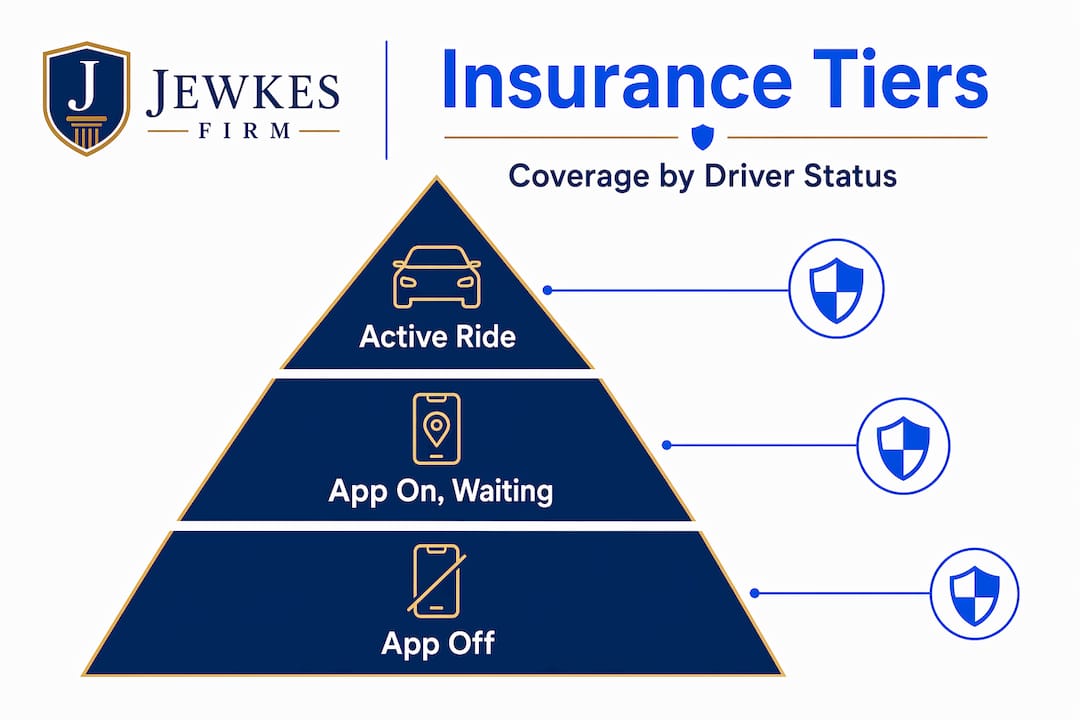
The single biggest source of confusion for rideshare accident victims is insurance coverage. Unlike a standard car crash where one policy typically controls, rideshare accidents involve tiered coverage that changes depending on what the driver was doing when the crash occurred.
Here is how the three periods break down:
| Coverage Period | Driver Status | Coverage Type |
|---|---|---|
| Period 0 | App off, driving personally | Driver’s personal auto insurance only |
| Period 1 | App on, waiting for a ride request | Limited rideshare liability coverage ($50,000–$100,000 typical) |
| Period 2/3 | Matched with a rider or trip in progress | Full commercial policy ($1 million typical) |
Full commercial coverage only applies during an active ride. If the driver had the app on but was still waiting for a request when the crash happened, you are working with a significantly reduced policy. If the app was off entirely, you are dealing only with the driver’s personal insurance, which may not cover commercial-use accidents at all.
These coverage gaps are not accidental. California’s Senate Bill 371 reduced Uber’s liability coverage for underinsured drivers from $1 million down to $300,000, saving the company hundreds of millions of dollars. Legislative influence on coverage limits is real, and it means you cannot assume the policy that applies to your case is the one you expect.
Pro Tip: Your ride confirmation email or in-app receipt timestamps the trip start and end. Save that documentation immediately. In-app digital records are often the only way to confirm driver status at the moment of impact, and they can be altered or deleted later.
What to do after a rideshare crash
The actions you take in the first hours after a rideshare accident directly shape the strength of your claim. Mistakes made here are difficult, sometimes impossible, to fix later. Here is a concrete sequence to follow.
-
Call 911 immediately. Get law enforcement and emergency services on the scene. A police report is an independent record of the facts and is difficult for insurance companies to dispute.
-
Document everything at the scene. Photograph vehicle damage, road conditions, traffic signals, skid marks, and your visible injuries. Take wide shots and close-ups. Photograph the driver’s license, vehicle registration, and insurance card.
-
Preserve your ride data. Screenshot your trip details in the app before you close it. Note the driver’s name, rating, vehicle make and model, and the trip timestamps. Evidence preservation including app screenshots is critical to establishing driver status and the applicable insurance period.
-
Seek medical attention the same day. Even if you feel fine, adrenaline masks injury. A same-day medical record establishes a direct connection between the crash and your injuries. Gaps in medical care give insurers an argument to reduce or deny your claim. Learn more about documenting accident injuries effectively for your legal case.
-
Do not give recorded statements to insurance adjusters. Rideshare claims teams protect company liability limits, not your interests. Anything you say can be used to reduce your payout. Decline to give recorded statements until you have spoken with an attorney.
-
Do not accept early settlement offers. The first offer almost never reflects the full value of your claim. Before the full extent of your injuries is known, accepting a settlement typically waives your right to seek further compensation.
-
Contact a personal injury attorney. The benefits of legal counsel after an accident are well documented. An attorney experienced in rideshare cases can identify all liable parties, determine which insurance policies apply, and protect you from the tactics adjusters use to minimize your recovery.
Special cases: unauthorized and backup drivers
One of the most legally treacherous situations in rideshare claims involves an unauthorized or backup driver. This occurs when someone other than the registered account holder was operating the vehicle during your trip.
You might not know this happened until after the accident. Consider these specific risks:
- Insurance denial is likely. Claims may be denied entirely when an unauthorized driver was behind the wheel, because the policy is issued to the registered account holder, not the substitute driver.
- The backup driver may be uninsured. Without the rideshare platform’s policy, you may be pursuing an individual with no meaningful insurance or assets, turning your claim into a lengthy and costly lawsuit with uncertain recovery.
- The account holder faces liability too. The person who lent their account to an unauthorized driver may face both civil liability and consequences from the rideshare platform, including account termination.
- Criminal charges are possible. In serious accidents involving injury or death, unauthorized drivers can face criminal charges. Knowing this matters because criminal proceedings and civil claims run on different timelines, and the outcome of one can affect the other.
- Your claim is not necessarily lost. An experienced attorney can build a strong case even in complicated unauthorized-driver scenarios, including pursuing the account holder directly and exploring any coverage that may still apply.
If you suspect an unauthorized driver was involved in your accident, do not assume the claim is hopeless. It is more complex, but the right legal team can work through the coverage questions and identify every available path to compensation.
My take on why timing and counsel make or break these claims
I’ve worked through enough rideshare accident claims to say this plainly: most victims who receive inadequate settlements didn’t lose because their case was weak. They lost because they waited too long, talked to the wrong people, or accepted the first offer.
What I’ve seen consistently is that victims treat rideshare accidents like simple fender-benders. They assume the app company will handle it fairly. The reality is that rideshare companies have dedicated claims departments, legal teams, and years of litigation experience on their side. You are not starting on equal footing.
The misleading nature of rideshare insurance coverage catches victims off guard. They assume a $1 million commercial policy is automatic. Then they discover the driver’s app was in “waiting” status at the moment of impact, which drops the coverage dramatically. That one detail can mean a difference of hundreds of thousands of dollars in available compensation.
What litigation trends show me is encouraging, though. Juries are increasingly willing to hold companies accountable in ways the independent contractor defense was supposed to prevent. That shift matters for victims, but only if their claims are built properly from the start. And importantly, rideshare accident claims carry no statutory cap on non-economic damages, which means the potential recovery in a serious injury case is genuinely significant.
My strongest advice: act decisively, document everything, and get qualified legal counsel on your side before you say anything to an insurance representative. The early steps either build your case or quietly undermine it.
— Ali
How Jewkesfirm can protect your rights after a rideshare accident
Rideshare accident claims demand a legal team that understands both the insurance mechanics and the litigation trends specific to these cases. Jewkesfirm works with accident victims across South Atlanta and the surrounding Georgia counties, providing dedicated legal representation on a contingency basis. You pay nothing unless your case is won.

From the first call, Jewkesfirm helps you preserve critical evidence, identify every available insurance policy, and build a claim that reflects the true value of your injuries. The firm handles all communications with rideshare claims representatives and insurance adjusters, so your words are never used against you. If you were hurt in a rideshare accident and need trusted legal representation for your claim, contact Jewkesfirm today for a FREE CONSULTATION. Your path to fair compensation starts with one phone call.
FAQ
What are my legal rights as a rideshare passenger after an accident?
As a rideshare passenger, you have the right to seek compensation from the at-fault driver, the rideshare company’s insurance policy, or both, depending on the driver’s status at the time of the crash. Your rights extend to economic damages like medical bills and lost wages, as well as non-economic damages with no statutory cap.
How does rideshare insurance coverage work after a crash?
Coverage depends on which trip phase was active at the moment of impact. Full commercial coverage up to $1 million typically applies only when the driver has an active passenger or is en route to pick one up. If the driver was waiting for a ride request, a much lower liability limit applies.
Can I sue the rideshare company directly for my injuries?
Yes, in some circumstances. Courts have increasingly found rideshare platforms liable despite the independent contractor classification of their drivers, particularly in cases involving serious injury. A qualified attorney can assess whether the company’s actions or policies contributed to your harm.
What should I never say to a rideshare claims representative?
Avoid giving recorded statements, speculating about fault, or describing your injuries as minor before a full medical evaluation. Rideshare claims teams work to protect the company’s interests. Speaking without legal counsel can limit the compensation you are entitled to recover.
How long do I have to file a rideshare accident lawsuit in Georgia?
Georgia’s statute of limitations for personal injury claims is generally two years from the date of the accident. Missing that deadline typically bars your claim entirely, which is why consulting an attorney as quickly as possible after a rideshare crash is so important.