
On a Saturday afternoon in May 2016, 19-year-old Shane Malloy fell overboard on Lake Lanier, north Georgia’s sprawling 38,000-acre reservoir. Within seconds, the boat’s own spinning propeller struck him. When rescuers reached him, they found that the propeller had severed his foot and lacerated his other foot. Emergency personnel airlifted him to the hospital while witnesses described a scene of chaos on the water. The Hall County Sheriff’s Office soon arrested the 19-year-old operator of the boat, alleging that he had operated it while intoxicated.
Malloy’s injury shocks on its own. But it also offers a window into something larger: Lake Lanier’s long-documented, well-earned reputation as Georgia’s most dangerous body of water. According to a 2024 TIME magazine report, Lake Lanier recorded 13 deaths in 2023 alone — more than any other lake in Georgia, with the next-highest lake (Allatoona) recording only three deaths. The lake also reported the highest number of boating incidents and injuries of any lake in the state. Roughly 12 million people visit it every year.
For every tragedy that makes headlines, survivors like Shane Malloy face catastrophic, life-altering injuries and difficult questions about who holds responsibility and what legal options exist.
SUMMARY
Lake Lanier ranks as Georgia’s deadliest lake for boating accidents, with numerous severe injuries caused by boat propeller strikes. This article explores the legal realities faced by victims of propeller injuries, including negligent operation, boating under the influence (BUI), and product liability claims. Learn how victims and families can pursue accountability and compensation under Georgia law, and why immediate legal action is crucial to preserve evidence. If you or a loved one has suffered a boating injury on Lake Lanier, contact experienced Georgia boating accident attorneys for a free consultation.
According to WSB-TV, the incident occurred around 4:30 p.m. on Saturday, May 21, 2016. Malloy fell overboard while out on the lake. Before the operator could bring the boat to a stop, the vessel’s propeller struck him. He suffered a severed foot and significant lacerations to his other foot. Emergency crews airlifted him to the hospital. Witnesses on the scene wrapped him and kept him warm as rescuers worked to stabilize him.
The Hall County Sheriff’s Office arrested the boat’s operator, 19-year-old William Craven, on suspicion of operating the vessel while intoxicated — commonly known as Boating Under the Influence (BUI). Craven’s attorney publicly disputed the allegation, stating that his client had not been drinking and that he had acted quickly to prevent the situation from worsening. As happens commonly in the immediate aftermath of a traumatic accident, public reporting on the case did not confirm how authorities ultimately resolved the criminal charge.
Malloy’s case is far from isolated on Lake Lanier. In August 2012, Fox News reported that a 17-year-old girl was thrown from the front of a boat on the lake after a wave struck the vessel while it towed a tube rider. The wave threw her under the boat and into the spinning propeller, which caused lacerations that ran “from her shoulder to her hamstring.” Medical personnel rushed her to Gwinnett Medical Center, where doctors expected her to recover. These accidents do not happen as freak, one-off events; they form part of a documented pattern on a specific lake.

Lake Lanier’s danger is not folklore — data supports it. TIME’s 2024 reporting found that the lake recorded more deaths in 2023 than any other lake in Georgia and maintained the highest number of boating incidents and injuries statewide.
Lake Lanier, Georgia’s largest lake, is known as one of the deadliest lakes in the United States, with more than 700 deaths since it was created in 1956. But its dark reputation extends beyond tragic accidents.
Several factors combine to make the lake uniquely hazardous:
When a preventable tragedy like this causes death, Georgia’s wrongful death laws allow surviving family members to pursue accountability against a negligent boat operator and, in some circumstances, other responsible parties as well.
Many people assume that an accident “on the water” differs legally from a car accident “on the road.” In reality, Georgia law imposes real duties on boat operators, and a victim injured by another boater’s negligence holds real legal options — including, depending on the facts, several distinct legal theories:
Georgia boat operators hold a legal duty to operate their vessels safely and keep a proper lookout for people in the water; failing these duties, including neglecting to account for someone who has fallen overboard, can constitute negligence.
Georgia law (O.C.G.A. § 52-7-12) criminalizes operating a vessel while impaired by alcohol or drugs. A criminal BUI charge and a civil negligence claim represent separate systems: even if a criminal case ends without a conviction, the civil court’s lower “preponderance of the evidence” standard means an injured victim may still prove negligence and recover compensation.
When a boat owner allows an intoxicated, unlicensed, or otherwise unfit person to operate their vessel, the owner may share legal responsibility for resulting injuries, separate from the operator’s own liability.
Decades of attention to propeller guard technology arose from propeller-strike injuries. In some cases, a boat or motor manufacturer’s failure to incorporate reasonably available safety devices can support a product liability claim alongside negligence claims against the operator.
Learn more about Georgia’s product liability laws and when a manufacturer bears responsibility for a dangerous design on our product liability page.

The Hall County Sheriff’s Office arrested 19-year-old William Craven for suspected Boating Under the Influence (BUI), but his attorney denied the allegation, and public reports have not confirmed the outcome of the criminal charge.
Severe injuries from boat propeller accidents, like Shane Malloy’s traumatic amputation, highlight the critical need for prompt legal action to preserve evidence and pursue both criminal and civil accountability.
A 19-year-old lost a foot during a boating accident at Lake Lanier on Saturday, according to the Hall County Sheriff’s Office. Witnesses watched in horror as emergency crews airlifted Shane Malloy to the hospital. Authorities arrested his friend, William Craven, 19, on charges of operating the boat while intoxicated.
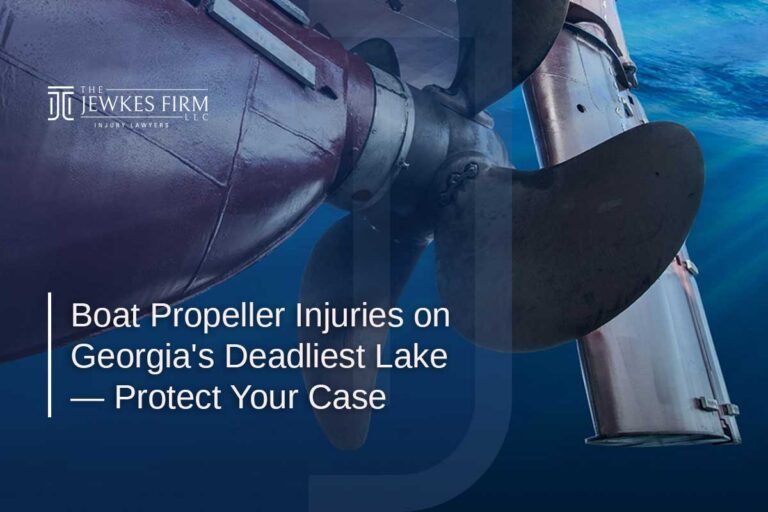
A propeller strike causes some of the most severe injuries recreational boating accidents produce. Boat propellers spin thousands of times per minute and can cause traumatic amputations, deep lacerations, nerve damage, and life-threatening blood loss in seconds — exactly the kind of catastrophic, permanent injury Shane Malloy suffered. Learn more about boat propeller injuries.
Victims or families pursuing accountability after accidents like this face several practical realities. Criminal charges against a boat operator — such as the BUI arrest in the Malloy case — can provide important evidence for a civil claim, but courts process criminal cases independently of, and on different timelines and legal standards from, civil claims for compensation. Public reporting on the Malloy case did not confirm how authorities ultimately resolved the criminal charge, and it is not publicly documented whether anyone pursued a separate civil claim — underscoring how important it is for accident victims to consult an attorney directly rather than rely on news coverage to understand their legal rights.
Evidence in boating accident cases disappears quickly: boat owners often repair or sell vessels; witnesses scatter after a single weekend on a crowded lake; and law enforcement focuses their BUI investigations on the criminal case rather than preserving evidence for future civil claims. Prompt legal involvement helps secure the DNR incident report, identify witnesses, and document the vessel and propeller before anyone changes anything — making a significant difference in a victim’s ability to recover full compensation.
Boating accident cases involve legal complexities that make experienced representation especially important. Unlike car accidents, which police departments investigate using established protocols, the Georgia Department of Natural Resources investigates boating accidents on Georgia’s lakes. Relevant insurance coverage — whether a boat owner’s policy, a marina’s liability policy, or a manufacturer’s product liability coverage — often involves less familiar territory than standard auto insurance.
A skilled Georgia boating accident attorney can obtain and interpret the DNR investigation report, identify every potentially responsible party — the operator, the boat’s owner if different from the operator, and, in appropriate cases, the manufacturer — and build claims that reflect the true, lifelong costs of catastrophic injuries like traumatic amputations. These claims include future medical care, prosthetics, lost earning capacity, and pain and suffering that criminal cases never address.
At The Jewkes Firm, we understand that a single reckless decision on the water can permanently alter a young person’s life in an instant — and that families need advocates who will pursue full accountability, not just wait for criminal cases to run their course. If you or a loved one has suffered injuries in boating accidents on Lake Lanier or any other Georgia lake, you do not have to face these questions alone.
Contact The Jewkes Firm Injury Lawyers today at (770) 771-5130 for a free, confidential consultation. Together, we can hold negligent parties accountable and work toward preventing future tragedies.

Seek immediate medical attention. Then, contact a qualified personal injury attorney experienced with Georgia boating accidents as soon as possible to preserve evidence and protect your rights. Early legal involvement is critical because witnesses may leave, and boat conditions can change quickly.
Yes. Even if criminal charges do not result in conviction, you may pursue a civil negligence claim, which uses a lower burden of proof (“preponderance of the evidence”) than criminal court, making it possible to establish liability and seek compensation.
Liability can extend beyond the boat operator. The boat owner may hold responsibility if they negligently entrusted the vessel to an unfit or intoxicated operator. Additionally, boat or motor manufacturers may face liability under product safety laws if they failed to provide reasonably available safety devices like propeller guards.
Lake Lanier reports the highest number of boating deaths and injuries in Georgia due to submerged hazards from underwater debris and structures, heavy and often inexperienced boat traffic, a high incidence of boating under the influence (BUI), and the absence of lifeguards at most swim areas.
Boat propellers spin at thousands of revolutions per minute and can cause catastrophic injuries including traumatic amputations, deep lacerations, severe nerve damage, and life-threatening blood loss. Such injuries frequently cause lifelong disabilities and require ongoing medical care.
Surviving family members may file wrongful death claims when negligence causes boating fatalities. These claims seek compensation for funeral expenses, lost support, and emotional damages.
Because the Georgia Department of Natural Resources, not local police, investigates boating accidents, and insurance claims involve complex coverage, an experienced attorney knows how to obtain DNR reports, identify all liable parties, and build a comprehensive claim for the severe financial and personal impact of the injury.
Georgia law sets statutes of limitation for personal injury and wrongful death claims. Prompt attorney consultation ensures filing within required timeframes and preserves crucial evidence.
Yes. Successful claims often include damages for future medical care, rehabilitation, prosthetics, lost earning capacity, pain and suffering, and other long-term impacts of the injury.
Sources:
GET A FREE CASE REVIEW
Shane Malloy’s injury offers a cautionary tale about a specific hazard — a spinning propeller and a careless or impaired operator — but also serves as a reminder of something broader. Lake Lanier draws 12 million visitors a year because it is beautiful and accessible, and most of those visits end without incident. However, the lake’s well-documented death toll and injury statistics show that every boater, passenger, and swimmer shares the water with genuine, data-backed risks. Preventable factors drive these risks again and again: impairment, inattention, and excessive speed.
For people hurt despite doing everything right — sitting on a boat, falling overboard in rough water, trusting another boater to operate safely — the law provides a path to accountability that exists separately from whatever happens in criminal courtrooms. Understanding and acting on that path before evidence disappears often means the difference between lifelong injury that goes uncompensated and holding the responsible party to account.










The Jewkes Firm, LLC
1155 Senoia Road
Suite 102
Tyrone, GA 30290
Advertising does not indicate a guarantee of results.
The information you obtain at this site is not, nor is it intended to be, legal advice. You should consult an attorney for advice regarding your individual situation. Contacting us does not create an attorney-client relationship.