
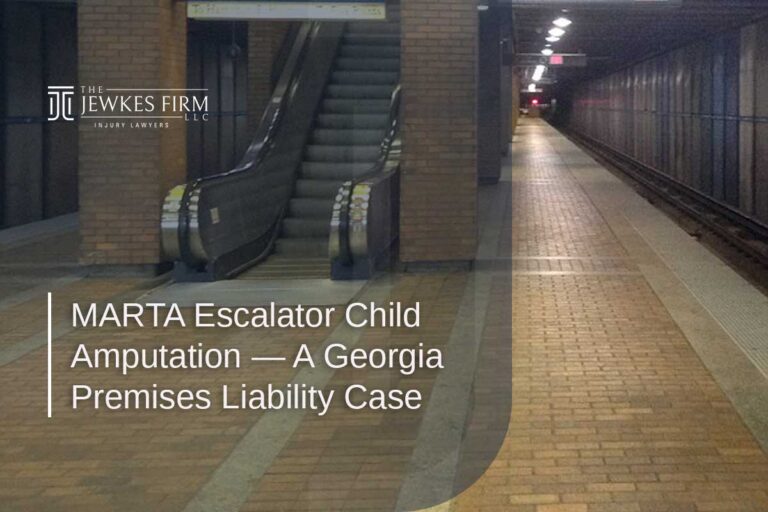
On an ordinary spring afternoon in 2016, an Atlanta family’s trip through the Vine City MARTA station turned into a nightmare. A three-year-old girl named Monique Simpson rode an escalator with her mother when the moving stairs caught her jacket. In the chaos that followed, the escalator’s protective safety guard broke away, and the machine pulled the toddler’s foot into its mechanism. Doctors at Children’s Healthcare of Atlanta amputated her right foot by the end of the day.
The Simpson family brought a case against the Metropolitan Atlanta Rapid Transit Authority (MARTA) and escalator manufacturer Schindler Elevator Corporation to remind Georgians that the machines they rely on every day — escalators, elevators, transit equipment — can turn catastrophic in seconds when maintenance lapses or safety components fail. This case also illustrates how premises liability and product liability claims can overlap, and why families facing a lifetime of medical care must identify every responsible party.
This article examines what is publicly known about the Vine City escalator incident, explains the legal theories involved, and advises Georgia families on what to do if a similar tragedy happens to their child.
SUMMARY
This article covers a serious escalator injury case in Georgia where a toddler suffered foot amputation due to a defective MARTA escalator. It explains the roles of product liability and premises liability claims, legal options for families, and the importance of prompt legal action. Featuring insights on equipment maintenance, government transit authority claims, and how The Jewkes Firm assists victims, this guide helps Georgia residents understand their rights following escalator or public transit injuries.
In 2016, Monique Simpson suffered a severe foot crush injury that led to amputation when her jacket was caught in a malfunctioning escalator at MARTA’s Vine City station. Her parents sued MARTA and Schindler Elevator for negligence and unsafe equipment design.

A couple sued MARTA and an escalator company, claiming their 3-year-old daughter lost her foot after it became caught in an escalator at the Vine City station. (Credit: MARTA website)
Monique’s parents, Sharonta and Moses Simpson, filed a lawsuit in Fulton County Superior Court alleging that their family rode an escalator at MARTA’s Vine City station on March 24, 2016, when disaster struck. The escalator caught their daughter’s jacket. As her mother tried to pull her free, the escalator’s protective guard broke off, and the moving stairs pulled in Monique’s right foot. The escalator mechanism then crushed her toes, painfully clenching her foot, the complaint says.
A MARTA service worker activated the emergency shut-off switch, but responders needed the Jaws of Life to free Monique because she was so entangled. The Atlanta Fire Department extracted her more than thirty minutes after the escalator first grabbed her jacket. While she remained trapped and conscious in excruciating pain, rescuers arranged for doctors at Children’s Healthcare of Atlanta at Egleston to authorize administering an emergency dose of fentanyl—one of the most potent painkillers—on scene.
Once freed, responders rushed Monique to Children’s Healthcare of Atlanta where surgeons operated on her the same day. The treating surgeon documented a “horribly contaminated crush injury” extending from the back of her heel pad to the bone of her smallest toe. The injury tore the muscle above her ankle away from the bone, along with surrounding nerves and blood vessels. Doctors ultimately amputated her foot after determining they could not save it. Monique later underwent multiple follow-up surgeries and received a prosthesis.
The Simpsons named MARTA and Schindler Elevator Corporation in their 2017 lawsuit, alleging that both failed to properly maintain the escalator and that Schindler’s equipment design left the escalator unsafe for the public, including small children. MARTA declined to comment publicly at the time, citing pending litigation. Georgia court and news records reviewed for this article do not show a publicly reported final resolution of the case, so readers should not assume its outcome without further verification.
Product liability law holds manufacturers, distributors, and sometimes maintenance contractors responsible when they create, distribute, or service a defective or negligently maintained product that injures someone. In Georgia, plaintiffs can base product liability claims on one or more of three theories: a design defect (manufacturers designed the product unsafely even when used as intended), a manufacturing defect (manufacturers built a specific unit incorrectly), or a failure to warn (manufacturers did not adequately warn of a known danger).
Escalators and elevators combine mechanical components — steps, guards, combs, handrails, emergency stops — that manufacturers and maintenance contractors must regularly inspect and service to keep safe. When a safety guard breaks away during ordinary use, as the Simpsons claim happened at Vine City, the failure may indicate a design flaw, a manufacturing defect, negligent maintenance, or a combination. Investigators often depend on maintenance logs, inspection records, and engineering analysis to determine who is responsible: the manufacturer, the maintenance contractor, or the property owner.
Georgia law also allows injured visitors to bring premises liability claims against the property’s owner or operator who caused their injuries. Under O.C.G.A. § 51-3-1, owners or occupiers owe a duty to exercise ordinary care to keep invitees safe — including transit passengers using MARTA stations. When MARTA knew or should have known through routine inspection that an escalator contained a broken or missing safety component, MARTA breached its duty by failing to repair it or remove the escalator from service. This failure supports a premises liability claim alongside any claim against the equipment manufacturer.
These two claims — product liability against manufacturers and premises liability against property operators — often proceed together because both equipment design/maintenance and property owner responsiveness can independently contribute to preventable injuries.
Escalators are a common part of everyday life in Georgia’s public transit system, shopping centers, and office buildings. However, as the tragic incident at MARTA’s Vine City station shows, when safety measures fail, the results can be devastating—especially for children. Recognizing the importance of regular maintenance, timely repairs, and strict adherence to safety standards is vital for preventing injuries.
Parents and guardians can take proactive steps to protect their children while using escalators and similar equipment:
Promoting awareness and ensuring compliance helps prevent future tragedies and protects Georgia families from lifelong consequences.
When public transit equipment catastrophically injures a child, families face enormous medical bills, emotional trauma from permanent disabilities, and practical hurdles proving exactly what went wrong.
Georgia law offers several ways for families to pursue accountability, but strict procedural rules make early legal guidance critical.

Three-year-old Monique Simpson lost her right foot last year after a MARTA escalator in Atlanta tore off her toes and left the girl stuck in the machine for more than 30 minutes.
Because MARTA is a public transit authority, Georgia law requires claimants to meet strict notice deadlines and sometimes apply statutory damage caps or defenses like sovereign immunity. Missing a shorter notice deadline than the general two-year statute permanently bars otherwise valid claims. Families injured on MARTA property, school buses, county roads, or other government facilities must consult an attorney immediately to comply with ante litem notice requirements.
Separately, product liability claims against manufacturers like Schindler Elevator follow Georgia’s standard personal injury statute of limitations (two years from injury) but necessitate different evidence: maintenance contracts, inspection and repair logs, internal safety bulletins, and expert engineering testimony showing how equipment should have performed. Lawyers must act promptly to send preservation letters. Evidence can be altered, lost, or destroyed if not quickly preserved.
Cases involving public transit equipment, product defects, and a young child’s catastrophic injury rank among the most complex personal injury matters a family can face. Experienced Georgia personal injury attorneys can:
If your family faces a similar tragedy, The Jewkes Firm’s experienced product liability and premises liability attorneys can help you understand your options. We also represent families pursuing child injury claims throughout Georgia, including cases involving public transit, defective equipment, and catastrophic injuries to young children.
When defective or poorly maintained equipment causes severe injury, choosing a skilled and compassionate legal team makes all the difference. At The Jewkes Firm, Attorney Jordan Jewkes and our personal injury lawyers bring extensive experience handling complex product and premises liability cases throughout Georgia. We commit to:
Don’t wait—contact us today to discuss your case and learn how we can help your family move forward.

The Jewkes Firm helps Georgia families hold negligent parties accountable for serious injuries caused by defective escalators, elevators, and other products. With personalized, aggressive legal representation, you can pursue the full compensation you deserve.
Contact Attorney Jordan Jewkes and our team now at (770) 771-5130 for your free case evaluation. Let us help you seek justice and peace of mind.
Seek emergency medical attention first. Then photograph the scene if possible, preserve the damaged equipment, and notify the property owner or transit authority. Contact a personal injury attorney promptly to protect your legal rights.
Yes, but Georgia law imposes strict notice deadlines and procedural requirements for claims against government entities. Consult an attorney immediately to avoid losing your right to sue.
You can recover medical expenses, prosthetic devices, future surgeries, pain and suffering, lost wages, and long-term care costs—especially in catastrophic injury cases involving children.
Generally, you have two years from the injury date to file a personal injury claim. However, claims against government entities may require much shorter notice periods. Contact an attorney immediately.
Liability depends on equipment design, manufacturing defects, maintenance records, and whether the property owner knew or should have known about hazards and failed to act. Expert investigation and maintenance documentation are crucial.
Sources:
GET A FREE CASE REVIEW
At its core, the Vine City escalator incident is a story about how quickly an ordinary moment — a mother and daughter riding an escalator home — can become a lifelong tragedy when mechanical safety systems fail. A broken guard, a maintenance gap, or a minor design flaw can instantly cost a three-year-old her foot.
Regardless of how the Simpson family’s case eventually resolves, their incident warns transit authorities, property owners, and equipment manufacturers across Georgia: public machines require rigorous, ongoing inspection and maintenance, not just installation and neglect. For families facing similar failures, understanding the interplay between product and premises liability—and securing experienced legal counsel promptly—can make the difference between bearing catastrophic costs alone and obtaining the accountability and compensation the law offers.
If you or a loved one have suffered serious injury from defective or poorly maintained equipment anywhere in Georgia, The Jewkes Firm stands ready to help you understand your rights and explore your legal options.









The Jewkes Firm, LLC
1155 Senoia Road
Suite 102
Tyrone, GA 30290
Advertising does not indicate a guarantee of results.
The information you obtain at this site is not, nor is it intended to be, legal advice. You should consult an attorney for advice regarding your individual situation. Contacting us does not create an attorney-client relationship.