
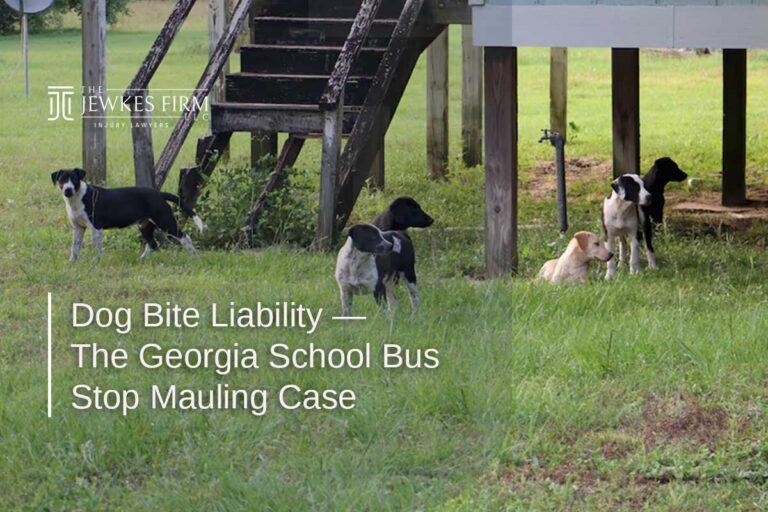
In a small South Georgia town just days before Mother’s Day, a mother of four died steps from her own home after a pack of her neighbor’s dogs attacked her and her three children as they walked home from the school bus stop. One of her sons suffered serious injuries while pushing his younger sister out of the dogs’ path. A passing stranger stopped his vehicle and fought off the dogs, likely saving the surviving children’s lives.
The case attracted national news coverage, including local Georgia TV stations, NBC News, USA Today, and Inside Edition. But perhaps the most important reporting came several days later, when a local station revealed that officials likely would not hold the dogs’ owner legally accountable — not because the attack lacked severity, but because the local “dangerous dog” ordinance had narrow language.
That gap between what clearly feels wrong and what a narrow ordinance covers highlights where Georgia’s separate civil liability law for dog attacks becomes critical. This case provides a useful lens to understand how dog bite and premises liability claims actually work in Georgia, who can bear responsibility when a pack of animals causes catastrophic harm, and why families should not assume that a “no charges” or “no violation” finding by animal control ends accountability.
Roughly a week after the attack, WALB reported a development that reframed the entire story: officials indicated that Brooks County likely would not hold the dogs’ owner liable, either criminally or otherwise. The county defines a “dangerous dog” largely by reference to a prior documented incident — specifically a dog that previously inflicted a severe injury without provocation, or that formal animal control had already classified as “potentially dangerous” and which then reoffends. Since animal control had not previously flagged any dogs involved in Williams’s attack, and none belonged to a breed the county treats as presumptively dangerous, the owner fell outside the ordinance’s reach — no matter how many dogs attacked or how severe the outcome was.
That finding, reported while the investigation was still active, is exactly the kind of result that makes cases like this one so important to understand. A local animal-control classification is not the same thing as a determination of civil legal liability, and the two can point in very different directions.
SUMMARY
This article explores Georgia’s dog bite liability laws, highlighting the limitations of local “dangerous dog” ordinances and explaining how state civil liability statutes protect victims of dog attacks. Using a recent fatal attack near Quitman, Georgia as a case study, it details the legal frameworks for dog bite and premises liability claims, wrongful death actions, and the critical role of personal injury attorneys. Learn why “no charges” by animal control does not necessarily mean no legal accountability and discover essential steps families should take after serious dog attacks in Georgia.

Courtney Williams
On the afternoon of May 9, 2024, around 4:45 p.m., deputies from the Brooks County Sheriff’s Office responded to a home in the 2000 block of Webster Road in Quitman, Georgia, after reports that a dog attacked multiple children, according to the Georgia Bureau of Investigation (GBI).
Courtney Williams, 35, a stay-at-home mother, walked with three of her children — reported ages 10, 12, and 14 — after they got off the school bus near their home, according to family members who spoke with USA Today and NBC News. A pack of dogs owned by a neighbor, described as numbering from about a dozen to more than a dozen animals across news reports, charged at the group.
Williams’ 12-year-old son, Kayden, pushed his younger sister out of the dogs’ path and was seriously injured himself, suffering deep lacerations that later required staples and stitches, according to accounts his aunt, Crystal Cox, gave to NBC News and People. A passerby stopped his vehicle, fought off the dogs, and placed the injured children into his truck to drive them to the hospital — an intervention family members credited with saving the children’s lives.
Williams did not survive the attack. When deputies arrived, they confronted several aggressive dogs on the property before they found her body in the yard, the GBI said in its official statement. Because the attack happened in Brooks County, roughly 55 to 60 miles from Tallahassee, Florida, the county medical examiner’s office conducted an autopsy to determine the precise cause of death. The GBI, working alongside the Brooks County Sheriff’s Office, opened an investigation into the animals and their owner.
Responders shot one of the dogs involved as they worked to control the pack, and local authorities planned to euthanize the animals that attacked Williams following the investigation, according to coverage from WALB News.

The incident happened on Thursday, May 9, 2024, on Webster Street in Quitman, Georgia, at a school bus stop behind the Brooks County Middle School.

A group of 13 dogs mauled Courtney Willims Cox and her son Kayden, who suffered deep lacerations all over his body. Thomasville Humane Society worked through the weekend to get the dogs off the street.
Georgia’s dog bite law holds owners or keepers civilly liable either under the “one-bite” rule if they knew or should have known of the dog's vicious tendencies, or under leash-law violations that negate the “first bite free” defense, while premises liability also applies if the property was negligently maintained to prevent the attack, and liability may extend to anyone with control over the animals, not just the legal owner.
Georgia’s civil liability statute for animal attacks, O.C.G.A. § 51-2-7, operates separately from any city or county “dangerous dog” ordinance and does not require animal control to have previously flagged the animal. Under this statute, an injured person generally can pursue civil liability against the owner or keeper in two ways:
The injured person must prove the animal had a tendency toward viciousness and that the owner knew, or reasonably should have known, about that tendency (through a prior bite, aggressive behavior, warnings from neighbors, or similar red flags) and that the owner negligently allowed the animal to roam. In other words, the Georgia one-bite rule holds dog owners civilly liable for injuries if they knew or should have known of their dog’s dangerous propensities before an attack.
If a city, county, or consolidated government ordinance requires a dog to be on a leash or under control and the owner failed to comply, Georgia courts have held that violation itself can demonstrate the owner’s knowledge. This means the owner loses the protection of the “first bite is free” rule, even without prior incidents on record.
This second path carries enormous weight in multi-dog attack cases like this one. Even when a county’s criminal “dangerous dog” ordinance does not apply due to no prior classification, violating a leash or “at large” ordinance may provide sufficient grounds to establish civil liability. Whether such a leash or control ordinance existed and whether violations occurred here is a question for an attorney to investigate directly with Brooks County. The reporting available at the time of this writing does not resolve this matter.
Dog attack cases often overlap with Georgia’s premises liability law, particularly when the dogs escaped from a yard, fence, or enclosure that the owner neglected or when the attack occurred on or near property the owner controlled. Georgia property owners and occupiers owe a duty of ordinary care to keep their premises reasonably safe. That duty includes maintaining fencing, gates, and enclosures adequate to contain animals known to be on the property, especially when a large number of dogs live there, as in this case.

Georgia’s statute applies to both the “owner” and “keeper” of an animal. The keeper can include anyone maintaining control over the dogs, such as a tenant, family member who primarily cared for the dogs, or another adult responsible for their control—even without legal title. Identifying every person with a legal relationship to the animals is often a critical early step in building a strong claim in multi-dog cases.
No criminal charges filed against a dog owner do not preclude civil liability, as local officials’ decisions on dangerous dog designations differ from civil negligence claims that address compensation for harm based on the owner’s knowledge and control of the animal.
Authorities told WALB that the owner of the dogs is unlikely to face liability due to the phrasing of the local ordinance.
According to the most recent public reports available, the authorities had not filed criminal charges against the dogs’ owner, and officials indicated the local ordinance likely would not support such charges. No civil lawsuit had been publicly reported at that time either. Readers should treat the civil and criminal status of this case as unresolved pending further developments.
The Williams case illustrates a common pattern across Georgia: after serious dog attacks, families often receive a disappointing message from animal control or county officials that “nothing can be done,” leading to the mistaken belief that civil courts will also provide no relief. The standards differ significantly. Officials use criminal or administrative “dangerous dog” designations to manage public safety going forward with quarantines, euthanasia orders, and registration requirements. By contrast, civil negligence claims under O.C.G.A. § 51-2-7 compensate people the attack already harmed, and consider distinct facts — including what the owner knew, what ordinances the local government applied at the time, and how the owner controlled or failed to control the animals.
When a dog attack kills someone, Georgia’s wrongful death statute (O.C.G.A. § 51-4-2) allows surviving spouses, and sometimes children or other family members, to pursue separate claims for the life lost’s full value, along with pain, suffering, and medical expenses the decedent endured before death. Thorough and prompt investigations are crucial, since animal control records, veterinary and complaint histories, photos of fencing or enclosures, and witness accounts become harder to obtain as time passes, especially if animal control euthanizes the involved animals or evidence deteriorates.
Surviving children in attack cases often carry physical and psychological injuries. A child who suffers bite wounds, witnesses a parent’s attack, or suffers injuries protecting a sibling—as happened here—may have independent claims covering medical treatment, scarring, and psychological trauma. Georgia law provides extended deadlines for injury claims brought on behalf of minors, but early legal guidance is vital to document injuries fully, including those that only surface months after the event.
Litigating multi-dog attack cases presents significant challenges, which is why experienced legal representation matters. A Georgia attorney who regularly handles dog bite and premises liability claims can make a meaningful difference by:
The Jewkes Firm has represented Georgia families in serious premises liability and animal attack cases. Our experienced dog attack lawyers understand both the legal complexity and the emotional weight these cases carry. If you or a loved one has suffered serious injuries or lost a family member in a dog attack anywhere in Georgia, contact us today at (770) 771-5130 for a free, no-obligation consultation.

Georgia’s dog bite law (O.C.G.A. § 51-2-7) holds dog owners or keepers liable if their animals cause injury. Owners who knew or should have known their dogs’ dangerous tendencies (the “one-bite” rule) or allowed the dogs to run at large in violation of leash laws can face civil liability.
Local “dangerous dog” ordinances focus on public safety and often require a prior incident for classification. This can limit criminal or administrative penalties. However, civil liability does not depend on prior animal control flags; victims can file civil suits regardless of criminal charges.
Liability can extend beyond the registered owner to any “keeper” or person controlling the animals—family members, tenants, and others living on the property. Property owners may also be liable under premises liability if negligent fencing or maintenance allowed escape.
Surviving family members may file wrongful death claims to recover for lost life value, along with medical and pain and suffering costs. Prompt investigation is essential to preserve evidence and build strong cases.
Yes. Owners may face civil liability if their dogs ran at large violating leash or control laws or if they negligently allowed dangerous behavior, even without prior reports or classification.
An experienced attorney investigates beyond animal control’s findings, identifies all liable parties, preserves evidence, handles insurance claims, and guides families through wrongful death or injury lawsuits, allowing victims to focus on healing.
Children may suffer physical and emotional harm. Early legal advice helps document damages and pursue compensation, considering special filing deadlines for minors.
Local dangerous dog ordinances often require prior documented incidents or classifications, which did not exist here. This reveals why criminal or administrative decisions differ from civil liability, where owners can still face responsibility.
Acting promptly preserves vital evidence like veterinary records, fence photos, witness statements, and animal control reports. Delays can jeopardize liability proof and damage recovery.
If you or a loved one suffered injury or loss in a Georgia dog attack, call The Jewkes Firm at (770) 771-5130 for a free, no-obligation consultation about your legal options.
Sources:
GET A FREE CASE REVIEW
Courtney Williams walked the short distance from a school bus stop to her front door with her children when the neighbor’s dogs attacked and killed her. Her son sustained serious injuries saving his sister. A stranger driving by acted faster and more decisively in that moment than the local system designed to prevent such tragedies. In the days that followed, the family learned the dangerous dog ordinance meant to classify dangerous dogs did not apply to these animals simply because no one had reported them before.
That outcome should trouble anyone who hears it — and it underscores why Georgia created its civil liability law separate from local animal control ordinances. Families should never accept “the ordinance didn’t apply” as a final answer about accountability for a loved one’s death or child’s injuries. Whether an owner had reason to know their animals were dangerous, whether they violated leash or containment ordinances at the attack moment, and whether the property’s fencing met reasonable care standards are distinct legal questions. Skilled attorneys, not animal control officers, should pursue those issues.
If your family faces a serious dog attack in Georgia, don’t assume that an initial “no charges” determination ends your legal options. Contact The Jewkes Firm at (770) 771-5130 for a free consultation to explore your rights.









Advertising does not indicate a guarantee of results.
The information you obtain at this site is not, nor is it intended to be, legal advice. You should consult an attorney for advice regarding your individual situation. Contacting us does not create an attorney-client relationship.