
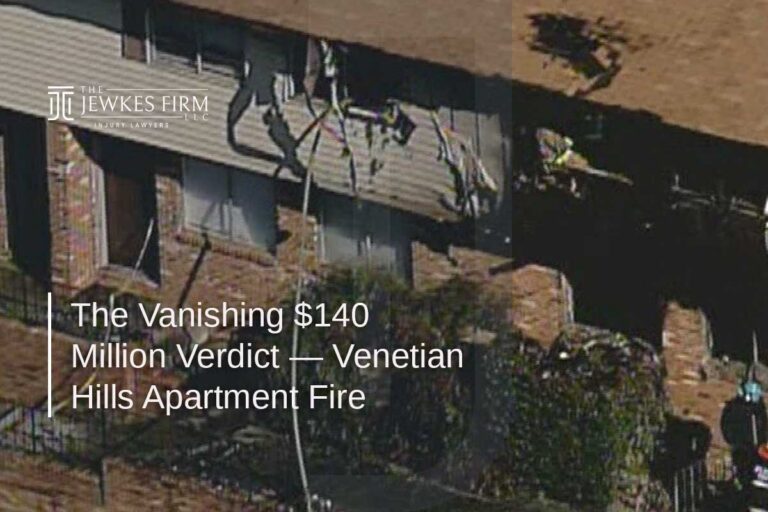
In December 2023, a DeKalb County jury handed down one of Georgia’s largest personal injury verdicts that year: $140 million against the owners of Venetian Hills Apartments, a Campbellton Road complex in southwest Atlanta. The jury blamed the owners for the 2017 fire death of 63-year-old tenant George Hughes. According to the Atlanta Journal-Constitution, the jury found that the owners ignored safety complaints for years, operated the building as an unlicensed boarding house, and failed to provide basic fire protection equipment, which turned what should have been a survivable fire into a fatal one.
Two years later, in November 2025, the Georgia Court of Appeals vacated that verdict completely and ordered a new trial. The court ruled that the trial judge’s instructions to the jury confused them so much that no one—not even appellate judges—could tell whether the jury applied the correct law. As of this writing, the parties have not settled the case. George Hughes’s family is considering asking the Georgia Supreme Court to intervene, while the landlord now has another opportunity to defend itself before a new jury.
This story lacks a final ending so far—and that is precisely why it matters. The Venetian Hills case shows how a fire that should never have been fatal can trigger a years-long legal battle over responsibility, the value of a life under Georgia law, and how fragile even a landmark jury verdict can be on appeal.
SUMMARY
The Venetian Hills apartment fire in Georgia resulted in a $140 million wrongful death verdict against the landlord for negligence and fire code violations. However, the Georgia Court of Appeals overturned the award due to unclear jury instructions, ordering a new trial. This case highlights the complexities of premises liability and landlord-tenant law, the importance of fire safety compliance, and the critical role of experienced legal counsel in navigating personal injury and wrongful death claims. Victims of unsafe property conditions can learn how to protect their rights and pursue justice under Georgia law.
The AJC reported that the fire started on March 15, 2017, in a downstairs closet of the unit George Hughes shared with a roommate. Kamara Wheeler, a woman whom the landlord’s attorneys say Hughes’s roommate invited into the apartment, set a sock on fire and fled. According to the family’s account reported by the AJC, Wheeler set the fire in retaliation after the roommate sexually assaulted her. The landlord used that version to argue the attack was unforeseeable. Wheeler later pleaded guilty to arson, according to the AJC.
Hughes, 63, was asleep upstairs when the fire ignited. The family’s attorneys said the fire burned for about 20 minutes before someone discovered it, spreading through a building that, they say, lacked smoke detectors, fire alarms, and a sprinkler system. Hughes did not survive.

Atlanta firefighters respond to a deadly fire at the Venetian Hills Apartments in southwest Atlanta in 2017.
The entire case centers on the absence of that basic equipment. Jeff Shiver, Hughes’s family attorney from Shiver Hamilton Campbell, publicly stated that working smoke alarms or sprinklers would have prevented the fire from being fatal. Court records and city documents cited by the AJC depict a complex in severe, long-documented disrepair: owners received more than 150 code-enforcement complaints since 2017 (including broken windows, damaged doors, water leaks, and pest infestations); police recorded 87 crimes at the address from 2017 to April 2023—including aggravated assaults, robberies, and a rape—and the City of Atlanta designated the complex a chronic “problem property” in January 2023. Hughes’s family’s attorneys further alleged the owners operated the complex as an unlicensed rooming house without legally required fire safety equipment since 2012.
The landlord disputes much of this. Venetian Hills’ attorneys argued at trial and on appeal that a tenant invited the arsonist on the property, making the fire a deliberate criminal act rather than a foreseeable consequence of building conditions. They claimed that smoke detectors and sprinklers, regardless of condition, cannot prevent someone from deliberately starting a fire. The company’s lawyers also contended that Hughes and other tenants already knew the building lacked fire safety equipment and therefore were aware of the hazard—an “open and obvious” condition defense commonly used in Georgia premises cases.
In December 2023, a jury awarded $140 million—primarily holding Venetian Hills 95% responsible—in one of Georgia’s largest verdicts for George Hughes’s life, pain and suffering, and legal fees, yet the dispute remains unresolved.
In December 2023, the jury divided the $140 million verdict into three parts, according to AJC reports: $75 million for the value of George Hughes’s life, $25 million for his pain and suffering, and $40 million to cover attorney fees and litigation costs. The jury assigned 95% of the fault to Venetian Hills and 5% to Kamara Wheeler, who was not a defendant in the civil case. TopVerdict.com ranked it among Georgia’s largest verdicts that year.
Venetian Hills and its insurer, Kinsale Insurance Company, appealed. According to the AJC, Kinsale also filed a separate coverage lawsuit arguing that its $1 million policy limit excludes coverage for this kind of death, so it may owe nothing regardless of the underlying case outcome. On appeal, the landlord argued for dismissal of the verdict on multiple grounds: the arson was legally unforeseeable; fire safety equipment absence should not imply liability because such equipment cannot cause arson; tenants knew the building lacked safety equipment; the damages award was excessively high; the jury instructions confused jurors; and newer Georgia tort reform laws should have barred some arguments the family’s lawyers presented.
In November 2025, the Georgia Court of Appeals agreed with the landlord on the jury-instruction issue, vacated the verdict entirely, and sent the case back for a new trial. The family’s attorneys have said they might ask the court to reconsider or seek review from the Georgia Supreme Court. Georgia premises liability attorneys interviewed by the AJC noted that large verdicts like this often get reduced or overturned on appeal and that cases this big can take years to resolve. So far, no settlement, trial date, or final resolution has emerged publicly.

This case involves two overlapping areas of Georgia law: premises liability and landlord-tenant law. Georgia’s premises liability statute, O.C.G.A. § 51-3-1, requires property owners or occupiers to exercise “ordinary care” to keep premises safe for invitees—including tenants and their lawful guests. Separately, Georgia’s landlord-tenant statutes impose distinct duties on landlords regarding rental property conditions and repairs. These two bodies of law demand different jury instructions, different standards for landlord foreseeability, and different defenses.
Landlords in Georgia have a legal duty to maintain safe living conditions for tenants. Premises liability laws and landlord-tenant statutes require property owners to take reasonable care to address hazards that can cause injury or death. When landlords violate fire safety codes, ignore repeated violations, or operate unlicensed rooming houses, courts may hold them liable for consequent damages.
This distinction became the key issue in Venetian Hills. The AJC’s coverage of the Court of Appeals decision explained that the trial judge issued jury instructions that blurred the lines between the two legal theories so badly that the appellate court could not determine whether the jury reached its verdict under landlord-tenant or premises liability law. Because the court could not identify the standard the jury applied or whether it was correct for the case’s facts, it invalidated the $140 million award entirely. The court wiped out the verdict and ordered a new trial from scratch.
The tragic Venetian Hills fire case underscores how vital it is for landlords to comply with fire safety laws by installing smoke detectors, fire alarms, and sprinkler systems, and by maintaining code-compliant properties. Tenants living in unsafe environments have rights under Georgia law, and victims’ families can pursue wrongful death claims due to landlord negligence.
For a family that spent years litigating their loved one’s death and then saw a jury vindicate them, that outcome illustrates the procedural complexity of these cases. Premises liability or wrongful death lawsuits require proving not only a dangerous condition but also the correct legal theory and jury instructions that can withstand appellate review. Georgia courts recently tightened standards for proving landlords’ duty to protect tenants from foreseeable criminal acts by third parties, including arson, assault, or shootings committed on the property. Whether the landlord could have foreseen the arson triggered by the alleged sexual assault in a unit plagued by documented crime will likely be a core issue at retrial.
Whatever happens on retrial, the underlying facts alleged in this case — years of unaddressed code violations, a building allegedly operating outside its legal permitted use, and a documented history of crime the landlord is accused of ignoring — remind us of what tenants, guests, and families of victims can do when a property owner’s negligence contributes to a serious injury or death.
Premises liability and landlord negligence lawsuits involve complex legal standards and precise jury instructions. The Venetian Hills case shows how a landmark jury verdict can fall apart on appeal due to technical or procedural issues. Without experienced legal counsel, families risk losing the compensation they deserve.
At The Jewkes Firm, Attorney Jordan Jewkes guides clients through these difficult legal processes. We thoroughly investigate code violations, collect crucial evidence, and devise strategies designed to survive appeals. Our mission is to hold negligent property owners accountable and obtain maximum compensation for victims and their families.
If you or a loved one suffered harm due to dangerous property conditions, don’t wait. Contact The Jewkes Firm today for a free consultation. Let us fight to protect your rights and pursue justice.
Premises liability and landlord negligence cases demand precise legal handling. The Venetian Hills case shows how key verdicts can be overturned on appeal without experienced counsel.
The Venetian Hills case illustrates why premises liability and wrongful death claims against commercial property owners rarely prove simple. The family here did everything right by most measures — they built a record of 150-plus code complaints and 87 documented crimes, secured a plaintiff’s verdict from a DeKalb County jury, and won one of Georgia’s largest verdicts in 2023. Still, the case unraveled on a technical question of which legal standard governed the jury.
That is not a reason to give up on a claim — it is a reason to have the right attorney from the start. An experienced Georgia personal injury and wrongful death attorney understands distinctions between premises liability and landlord-tenant law, how to develop jury instructions that survive appellate scrutiny, how to document landlord negligence through code enforcement and police records, and how to navigate insurance coverage disputes even after a jury verdict. Property owners and insurers can litigate for years across multiple appeals. Victims and families need equally capable representation.

If unsafe property conditions or landlord negligence harms you or a loved one, time is of the essence. Contact Attorney Jordan Jewkes at The Jewkes Firm for a free, confidential case evaluation. We fight for justice and holding negligent landlords accountable in Georgia.
Call us today at (770) 771-5130 or fill out our online contact form — your path to recovery starts here.
Disclaimer: This article provides information only and does not offer legal advice. The verdict described remains subject to post-trial motions and appellate review. For advice tailored to your situation, consult a qualified attorney.
Premises liability means property owners must keep their property safe for tenants and visitors. They can be liable if dangerous conditions cause injury or death.
Yes—if the landlord reasonably should have foreseen the risk and failed to install adequate safety measures such as smoke detectors or sprinklers, they can be liable for resulting injuries or deaths.
Georgia generally allows two years from the injury or death date to file claims. Deadlines vary, so consult an attorney promptly.
Important evidence includes code enforcement complaints, maintenance requests, police reports, witness testimony, photos or videos of unsafe conditions, and proof the landlord knew about hazards.
Report issues to local code enforcement and keep records. Consult a knowledgeable attorney to protect your safety and legal rights.
We provide expert legal representation by thoroughly investigating your case, identifying responsible parties, negotiating with insurers, and advocating aggressively in court to secure fair compensation.
Sources:
GET A FREE CASE REVIEW
Most case studies end with a resolution: a verdict that stands, a settlement that closes the case, or a wrong the legal system finally corrects. Venetian Hills cannot offer that ending yet. A man died. A jury found a landlord’s years of neglect responsible and awarded a massive verdict. Now a court has nullified that verdict, forcing the fight to start over.
Venetian Hills tells an ongoing story of tragedy and legal struggle. Despite a jury finding a landlord’s neglect responsible for a man’s death, the verdict was nullified, and accountability remains unresolved. This case highlights the critical importance of early actions—like filing complaints and ensuring proper safety measures—long before a case reaches trial.
If there is a lesson in that for tenants, property owners, and anyone who has ever wondered whether a broken smoke detector or an unanswered maintenance complaint really matters, it’s this:these cases are won or lost long before a jury ever hears them—that is, in the complaints that get filed (or ignored), the fire safety equipment landlords install (or fail to install), and the legal groundwork attorneys build from the very first client meeting. The alarm that failed to sound cost a life. More than eight years later, no one yet stands legally accountable.









Advertising does not indicate a guarantee of results.
The information you obtain at this site is not, nor is it intended to be, legal advice. You should consult an attorney for advice regarding your individual situation. Contacting us does not create an attorney-client relationship.