

Yes, Georgia law recognizes diminished value, and insurers must evaluate it under State Farm Mut. Auto. Ins. Co. v. Mabry. Your first move is practical, not legal: order an independent appraisal and gather every repair invoice, photo, and shop record before they disappear. You have up to four years to file, but comparables and paperwork get harder to find the longer you wait, so contact a lawyer promptly if fault is contested or your insurer stonewalls.
TL;DR:
- Insurers in Georgia are required to evaluate diminished value using evidence-based methods, not solely rely on the simplified 17c formula, which often undervalues claims.
- Collect and present detailed repair invoices, photos, and independent appraisals, as these significantly improve your chances of a favorable settlement.
- The 17c formula caps at 10% regardless of actual damage severity and does not account for real comparable sales, making market comparison more reliable.
- You have up to four years to file a claim, but gathering evidence early simplifies negotiation, especially if fault is contested or insurers delay responses.
- Filing a claim through small-claims court or Georgia DOI complaints is often sufficient for minor disputes, while larger or contested cases may require legal assistance.
Table of Contents
- Georgia Diminished Value Explained: Who Actually Qualifies
- The Legal Basis: Mabry, the DOI Directive, and Insurer Duties
- 17c Formula vs. Market Comparison: Which Number Should You Trust?
- Step-by-Step: Filing a Diminished Value Claim in Georgia
- What Your Evidence Packet and Appraisal Need to Include
- When a DIY Claim Works and When You Need a Lawyer
- Why The Jewkes Firm Treats Diminished Value as an Evidence Problem
- Get a Free Case Review From The Jewkes Firm
- Sources
Georgia Diminished Value Explained: Who Actually Qualifies
Diminished value is the gap between what your car was worth before a wreck and what it’s worth after repairs, even flawless ones. A buyer who learns your car has an accident history pays less for it, full stop, and that lost resale value is the injury Georgia law addresses. Most claims fall into two lanes: first-party (your own insurer, if your policy covers it) and third-party (the at-fault driver’s insurer, the more common route).
Georgia follows modified comparative negligence, so if you’re found largely at fault, you may recover nothing. Below that threshold, your payout shrinks proportionally to your share of blame, a rule worth understanding before you assume a clean win. Claims tend to matter most on newer, low-mileage, or higher-value vehicles, since a five-year-old economy car with 120,000 miles already carries plenty of market skepticism before any accident enters the picture.
The Legal Basis: Mabry, the DOI Directive, and Insurer Duties
The Georgia Supreme Court settled the core question in 2001. Mabry held that insurers must evaluate diminished value as part of a covered loss, meaning they can’t simply ignore it or pay for repairs and call the file closed. That single ruling is why Georgia is regularly cited as one of the friendliest states in the country for these claims.
What Mabry didn’t do is hand insurers a formula. The Georgia Department of Insurance issued a directive making clear it has never endorsed any single calculation method, including the widely used 17c formula, and that carriers may not imply otherwise to a claimant. Insurers are required to consider evidence you submit, not just their own internal number.
That combination, a legal duty to evaluate plus no mandated formula, is the practical opening for Georgia claimants. If an adjuster hands you a number and says “that’s just how it’s calculated,” ask for their worksheet in writing and cite the directive. You’re entitled to see the math, and you’re entitled to challenge it with your own comparables.
17c Formula vs. Market Comparison: Which Number Should You Trust?
The 17c formula starts with your car’s base value, applies a flat 10% cap, then multiplies by a damage severity modifier (typically 0 to 1.00) and a mileage modifier that reduces the payout further as odometer readings climb. It’s fast, cheap for insurers to run, and almost always lands low.
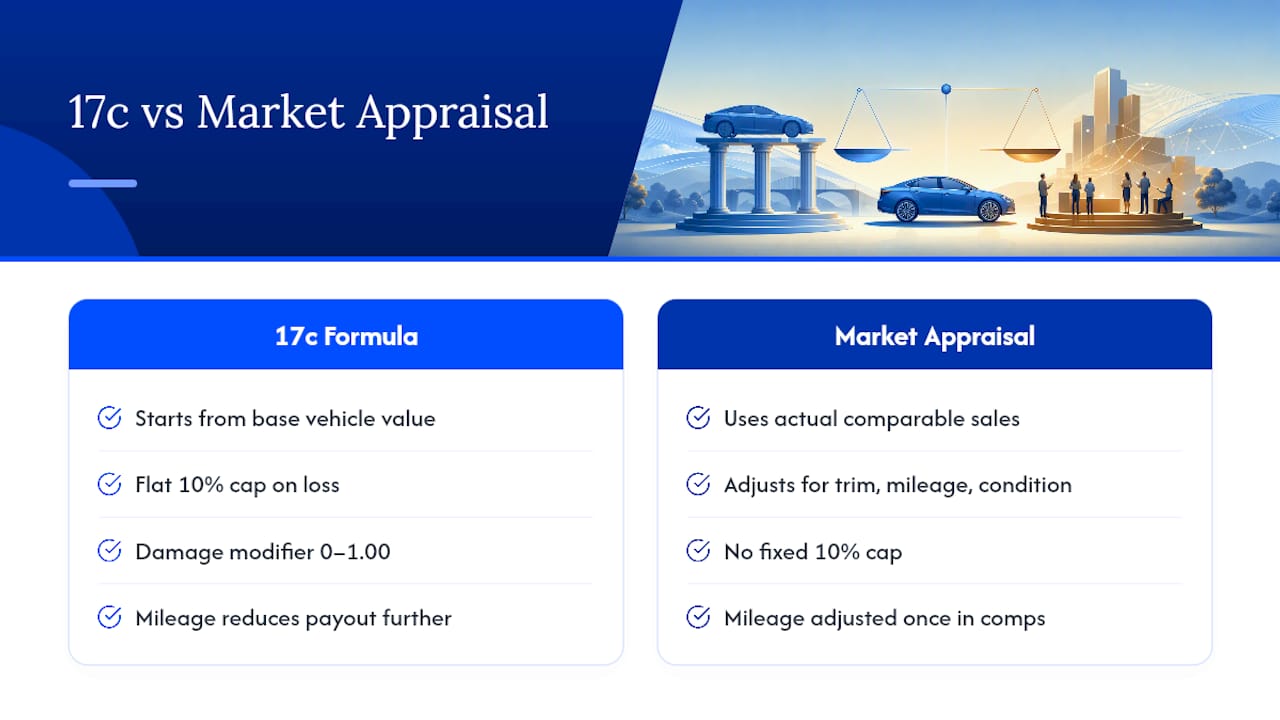
The origins and critique of 17c are well documented in insurance-regulation literature: the formula effectively double-counts mileage (which already lowered your car’s value before the crash), caps out at 10% regardless of how severe the damage actually was, and uses no real comparable sales data at all. It’s a shortcut, not a market analysis.
Market-comparison appraisal works differently. An appraiser finds actual comparable vehicles for sale, adjusts for trim, mileage, and condition, then measures how accident-disclosed listings price against clean-history ones. Kelley Blue Book’s own guidance points claimants toward this comparable-sales approach for a defensible number. Treat any 17c figure your insurer offers as the floor of negotiation, never the ceiling.
Step-by-Step: Filing a Diminished Value Claim in Georgia
- Finish repairs and lock down your paperwork. Collect every invoice, shop work order, and disassembly photo before the vehicle leaves the body shop.
- Establish your pre-accident value. Pull KBB and NADA valuations, plus two or three dealer listings for comparable trims, and screenshot everything with dates visible.
- Order an independent diminished value appraisal. A qualified appraiser will physically inspect the car and build a report around real comparable sales, not a formula.
- Send a written demand letter. Include the appraisal, your documentation, and a specific request for the insurer’s own diminished value worksheet. Send it certified mail so you have proof of delivery.
- Negotiate, and escalate if needed. If the adjuster won’t move past a 17c number or refuses to negotiate in good faith, you can file a Georgia DOI complaint or pursue the claim in small-claims court.
This process mirrors what practitioners who handle these claims regularly recommend: appraisal first, formula second. Keep copies of every communication. Adjusters move faster when they know you’re organized and not guessing.
What Your Evidence Packet and Appraisal Need to Include
A thin file gets a thin offer. A complete one gives the adjuster no room to hide behind 17c.
Document checklist:
- Repair invoices and itemized shop work orders
- Pre- and post-repair photos, including disassembly shots showing hidden structural damage
- Title and registration
- Police report or accident report number
- Maintenance records showing the car’s condition before the crash
Appraisal checklist:
- A physical inspection of the vehicle, not a desk review
- Five to ten dated comparable listings, ideally local, with mileage and trim noted
- Explicit reasoning for every adjustment made to the comps
- A written report formatted so you can attach it directly to your demand letter
Build your comps by filtering listings for similar trim, mileage band, and accident-history disclosure, then save the URLs and screenshots the day you pull them, since listings vanish fast.
Pro Tip: Request the insurer’s diminished value worksheet in writing and cite Mabry and the Georgia DOI directive when you ask. Adjusters know both, and a written request creates a paper trail if the claim later heads to a DOI complaint or court.
When a DIY Claim Works and When You Need a Lawyer
Smaller diminished value disputes often belong in magistrate court, Georgia’s small-claims venue, which handles matters up to roughly $15,000 without the cost of formal litigation. For a claim in that range, insurers frequently settle rather than absorb litigation costs, so a well-documented DIY filing can succeed on its own.
Filing a Georgia DOI complaint is free and puts your file in front of a regulator, which tends to get an insurer’s attention faster than another phone call ever will.
Hiring counsel makes more sense when fault is disputed, when you suspect bad-faith claims handling, when the dollar amount is large enough that litigation risk matters, or when the insurer has simply stopped responding. Most personal injury firms, including The Jewkes Firm, work on contingency, so a consultation costs nothing and you only pay a fee out of an actual recovery.
Why The Jewkes Firm Treats Diminished Value as an Evidence Problem
We built our approach around Georgia’s Mabry precedent because it works. Evidence wins these claims, not arguments. Our team has handled property-damage and injury cases across South Atlanta and the surrounding counties, and the pattern holds every time: clients who show up with an independent appraisal and organized repair records get better outcomes than those who accept the first number offered.
Bring your repair invoices, photos, and any appraisal you already have to a consult. We’ll tell you honestly whether your case is worth pursuing.
Request a free, no-obligation case review before your insurer’s offer becomes your only option.
— Ali
Get a Free Case Review From The Jewkes Firm
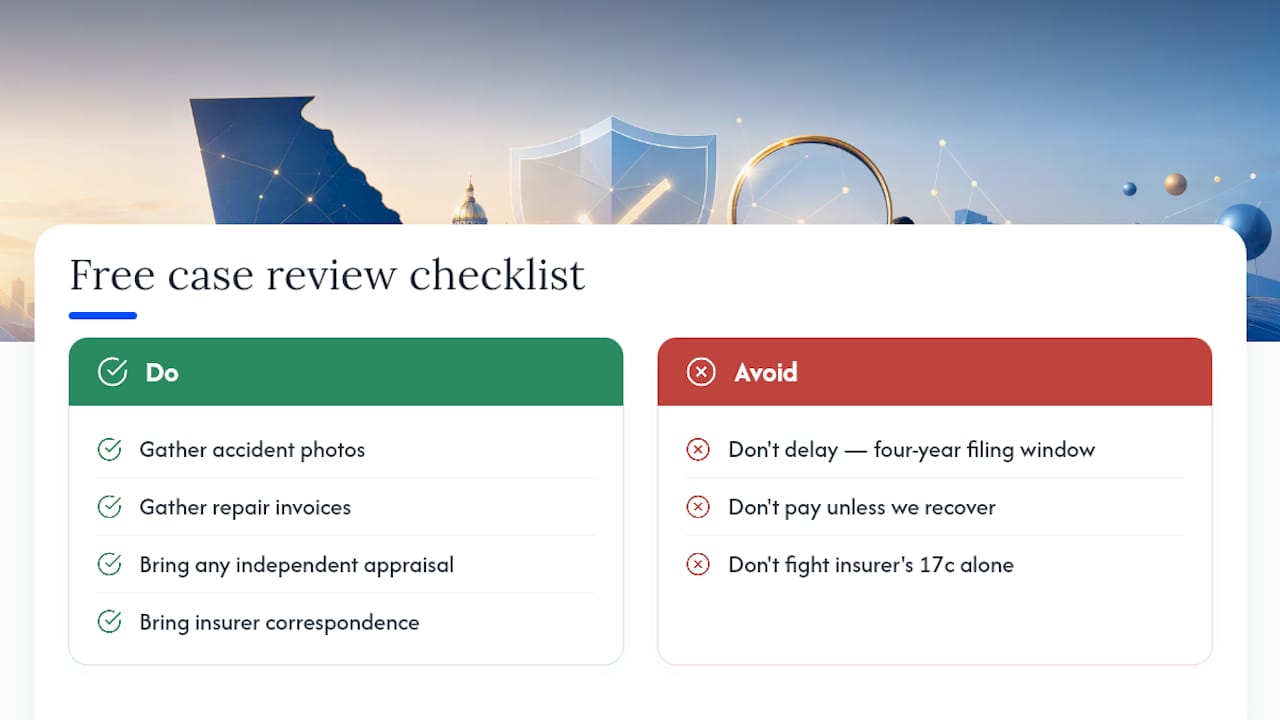
You don’t have to fight your insurer’s 17c number alone, and you don’t pay anything unless we recover for you. The Jewkes Firm reviews diminished value and accident claims across South Atlanta and the surrounding Georgia counties, and consultations cost nothing whether you sign with us or not.

Before your consult, gather what you have: accident photos, repair invoices, any independent appraisal already in hand, and your insurer’s correspondence so far. If you don’t have an appraisal yet, that’s fine. We’ll walk you through what evidence actually moves an adjuster and what doesn’t.
Every case is different, and a diminished value claim often overlaps with broader questions about fault and comparative negligence or injury compensation. Georgia’s four-year filing window won’t wait for you to feel ready. Schedule your free consultation with The Jewkes Firm today and find out where your claim actually stands.
This article is general information, not a substitute for advice from a qualified lawyer. Consult a qualified legal professional about your own circumstances before acting on anything here.
Sources
- Georgia Is a Peach for Insured’s Right to Diminished Value
- Georgia Insurance Commissioner Directive on Diminished Value (John W. Oxendine, Dec 1, 2008)
- Journal of Insurance Regulation / CIPR analysis discussing the origins and critique of the 17c formula
- Kelley Blue Book — diminished value guide
- How to File a Diminished Value Claim in Georgia (Chris Hudson Law Group)