

Key Takeaways
- Liability in truck accidents often involves multiple parties, including drivers, companies, manufacturers, and loaders, who share financial responsibility.
- Proving negligence through comprehensive evidence is essential, as federal and state regulations influence liability and damages.
Most people assume the truck driver is automatically at fault when a collision happens. That assumption can cost you. What is truck accident liability, exactly? It’s the legal determination of who is financially responsible for the damages caused by a commercial truck crash. And the answer almost never points to just one person. Over 5,100 fatalities and 125,000 injuries involve large commercial trucks annually, and behind each one is a web of potential defendants that most victims never fully explore. Understanding this from the start is what separates victims who recover full compensation from those who settle for far less.
Table of Contents
- Key takeaways
- What is truck accident liability and who can be held responsible
- How negligence laws determine fault in truck crashes
- Liability roles of the driver, company, and other parties
- Evidence that proves truck accident liability
- Steps to protect your rights after a truck accident
- My take on why truck accident liability surprises most victims
- How Jewkes Firm fights for truck accident victims in Georgia
- FAQ
Key takeaways
| Point | Details |
|---|---|
| Multiple parties share liability | Drivers, trucking companies, cargo loaders, and manufacturers can all be legally responsible for your damages. |
| State law shapes your claim | Georgia and other states use comparative negligence rules that directly affect how much compensation you can recover. |
| Regulations create legal leverage | Violations of FMCSA rules, especially hours-of-service, can establish negligence per se against the at-fault party. |
| Evidence disappears fast | ELD data, driver logs, and maintenance records must be preserved immediately or they may be lost. |
| Legal counsel changes outcomes | Experienced attorneys identify every liable party and every insurance policy, which maximizes your total recovery. |
What is truck accident liability and who can be held responsible
Truck accident liability is the legal obligation to pay for harm caused by a truck crash. It covers medical bills, lost wages, property damage, pain and suffering, and more. What makes commercial vehicle accident liability different from a standard car accident is the number of parties who can share that obligation.
Here is who may be legally responsible after a truck crash:
- The truck driver for negligent driving, fatigue, distracted operation, or violating traffic laws
- The trucking company for systemic failures in hiring, training, supervision, and vehicle maintenance
- Cargo loading companies whose improper securing of freight can cause rollovers or road debris incidents; FMCSA cargo securement rules exist precisely because failures here constitute negligence
- Vehicle or parts manufacturers when defective brakes, tires, or steering systems contribute to the crash
- Third-party maintenance contractors who serviced the truck negligently before the accident
Federal and state regulations layer on top of all of this. The Federal Motor Carrier Safety Administration (FMCSA) sets baseline standards for how commercial trucks must be operated, maintained, and loaded. When a party violates those standards, it becomes far easier to prove they are responsible in your claim.
The legal doctrine of respondeat superior plays a central role here. This principle, which translates to “let the master answer,” holds employers liable for the negligent acts of their employees while on duty. So when a driver causes a crash while hauling freight for a company, that company can be legally on the hook regardless of whether it directly caused the crash.
Pro Tip: Even if the trucking company claims the driver was an independent contractor, courts often look past that label. If the company controlled the driver’s schedule, equipment, or routes, vicarious liability may still apply.
How negligence laws determine fault in truck crashes
Establishing liability in truck crashes requires proving negligence. Every negligence claim in a truck accident rests on four elements:
- Duty: The defendant had a legal obligation to act reasonably. Truck drivers and companies have a duty to operate safely and follow federal regulations.
- Breach: The defendant failed to meet that duty. Speeding, fatigued driving, or skipping required vehicle inspections all qualify as breaches.
- Causation: The breach directly caused your injuries. You must show a clear link between their failure and your damages.
- Damages: You suffered actual, measurable harm, including medical costs, lost income, or physical pain.
State law shapes how fault percentages affect your recovery. Georgia uses a modified comparative negligence standard, where you can still recover damages as long as you are less than 50% responsible for the accident. You can learn more about how the Georgia 50% fault rule works in practice. Other states are far more restrictive. Maryland, for example, applies contributory negligence, meaning that if you bear even a small share of the blame, you may be barred from recovery entirely.
One of the most powerful tools in truck accident cases is the concept of negligence per se. When a truck driver or company violates a specific FMCSA regulation, that violation can automatically satisfy the breach element of negligence. Even a 15-minute hours-of-service violation can establish negligence in litigation, and repeated offenses may support punitive damages on top of compensatory recovery.
Pro Tip: Request a copy of the driver’s hours-of-service logs as soon as possible after your accident. Trucking companies are required to keep records, but data can be altered or destroyed. An attorney can send a legal preservation letter within days to lock that evidence down.
Liability roles of the driver, company, and other parties
Understanding responsibility in truck accidents means recognizing that liability is rarely exclusive. Multiple defendants often share it, and each brings a separate insurance policy into the picture.

| Party | Basis for Liability | Common Examples |
|---|---|---|
| Truck driver | Personal negligence | Speeding, drowsy driving, distracted operation, log falsification |
| Trucking company (vicarious) | Respondeat superior | Driver acting within scope of employment at time of crash |
| Trucking company (direct) | Negligent hiring, training, maintenance | Hiring driver with prior DUI, skipping required inspections |
| Cargo loaders | Improper loading or securing | Overloaded trailer, unsecured freight causing rollover |
| Manufacturers | Product defect | Defective brake system, tire blowout due to manufacturing flaw |
| Maintenance contractors | Negligent repairs | Brake failure after third-party service provider missed a critical defect |
Companies face direct liability beyond vicarious claims when they push unlawful driving schedules or fail to maintain safe operational practices. A company that knowingly keeps a driver on the road past federal hour limits is not just passively responsible. It is actively contributing to the danger.
Multiple insurance policies typically cover each liable party, which increases both the potential recovery and the complexity of negotiations. Insurance carriers will work to shift blame between defendants to reduce their individual exposure. Without experienced legal counsel, victims often get caught in the middle of that fight.
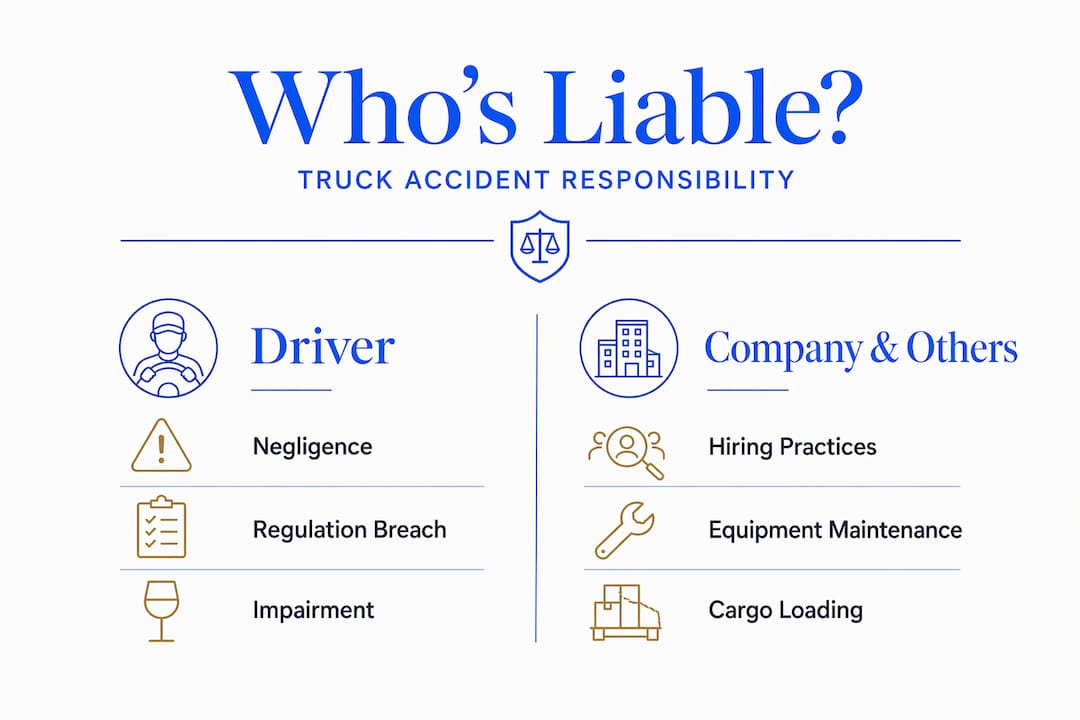
Why does this matter to you? Because identifying every liable party is crucial to securing full compensation. Settling only with the driver’s insurer, when the trucking company and a cargo loader also share fault, leaves significant money on the table.
Evidence that proves truck accident liability
The difference between a strong liability claim and a weak one almost always comes down to evidence. Here is what investigators and attorneys look for after a commercial truck crash:
- Electronic logging device (ELD) data: ELDs record driving time synchronized with federal hours-of-service limits. ELD records are preserved for six months, but acting quickly protects against tampering or selective deletion.
- Driver logs and dispatch records: These reveal whether the driver was on a legally compliant schedule and whether the company pressured unsafe behavior.
- Maintenance and inspection records: Required pre-trip inspections and service logs can show whether known mechanical defects were ignored before the crash.
- Cargo loading documentation: Bills of lading, weight tickets, and loading manifests can reveal whether the freight was secured in compliance with FMCSA cargo rules.
- Black box and event data recorder output: Commercial trucks carry onboard data recorders that capture speed, braking, and steering inputs in the seconds before impact.
- Crash scene analysis: Skid marks, vehicle positioning, road conditions, and witness statements all contribute to reconstructing what actually happened.
It is worth noting that drivers and companies can manipulate logging requirements, making early investigation not just helpful but necessary. An attorney who handles truck accident litigation will know exactly what to request, from whom, and how to challenge any suspicious gaps in the records.
Steps to protect your rights after a truck accident
The truck accident claims process rewards those who act quickly and deliberately. Here is what to do:
- Document everything at the scene. Photograph the vehicles, road conditions, skid marks, cargo, and any visible injuries. Get the truck’s license plate, DOT number, and the driver’s commercial license information.
- Seek medical attention immediately. Even if you feel fine, some injuries such as internal trauma or whiplash develop hours or days later. A medical record dated close to the accident strengthens your claim.
- Request preservation of critical records. Your attorney can send a spoliation letter to the trucking company demanding they preserve ELD data, driver logs, maintenance files, and communications. This must happen fast.
- Avoid recorded statements to insurance adjusters. Insurance companies use your own words to reduce your settlement. Do not give a recorded statement before speaking with an attorney.
- Consult a truck accident attorney early. The trucking accident litigation process in Georgia involves multiple defendants, federal regulations, and commercial insurers. Experienced legal guidance is not optional if you want fair compensation.
Do not assume the trucking company’s insurer will treat you fairly. Their goal is to pay as little as possible. Your goal is to recover what you are actually owed.
My take on why truck accident liability surprises most victims
I’ve seen how quickly victims walk away from claims they could have won. Not because the law wasn’t on their side, but because they didn’t know how many defendants were actually responsible.
Here’s what I’ve learned after years of following these cases: the trucking industry is built on tight margins and aggressive schedules. That pressure doesn’t stay in the corporate office. It flows down to drivers who feel they can’t afford to refuse a load or call out a mechanical issue. When a crash happens, the industry’s first move is almost always to make it look like the driver’s personal mistake. If you accept that framing, you lose access to the deeper liability that often carries much larger insurance limits.
I’ve also found that victims who engage attorneys early recover far more than those who wait. It isn’t just about legal arguments. It’s about evidence preservation. Every day that passes after a crash is a day the opposition can use to make critical records harder to obtain.
The uncomfortable truth is that companies encouraging hours-of-service violations expose themselves to punitive damages, not just compensatory ones. That is leverage victims don’t realize they have. Work with someone who knows how to find it and use it.
How The Jewkes Firm fights for truck accident victims in Georgia
Truck accident claims are not ordinary personal injury cases. They involve federal regulations, multiple defendants, commercial insurance policies with high limits, and corporations with legal teams working to minimize your payout from day one. The Jewkes Firm has built its practice around exactly these cases.
From the moment you call, the team works to preserve critical evidence, identify every liable party, and build a claim that reflects the full extent of your losses. You pay nothing unless The Jewkes Firm wins for you. There are no upfront costs and no risk. Whether you need help understanding liability insurance coverage or you’re ready to pursue a full claim against a trucking company, the firm is ready to stand beside you.
Call The Jewkes Firm today for a FREE CONSULTATION and let their dedicated attorneys fight for the compensation you deserve.
FAQ
What does truck accident liability mean?
Truck accident liability is the legal responsibility for damages caused by a commercial truck crash. It can be shared among multiple parties including the driver, the trucking company, cargo loaders, and manufacturers.
Who is liable in a truck accident besides the driver?
The trucking company, cargo loading contractors, vehicle manufacturers, and third-party maintenance providers can all share liability depending on the facts of the case and which regulations were violated.
How do you prove liability in a truck accident?
You prove liability by establishing the four elements of negligence: duty, breach, causation, and damages. Evidence such as ELD data, maintenance records, driver logs, and FMCSA violation records all support this process.
How does Georgia’s fault law affect my truck accident claim?
Georgia uses modified comparative negligence, meaning you can recover compensation as long as you are less than 50% at fault for the crash. Your recovery is reduced by your percentage of fault.
Why do truck accident claims involve multiple insurance policies?
Each liable party typically carries its own insurance coverage. The trucking company, the cargo loader, and the driver may each have separate policies, which is why identifying every responsible party is critical to maximizing your total compensation.