

Georgia’s modified comparative negligence system is the legal framework that determines who pays after a car accident and how much. Explaining Georgia accident fault laws means understanding that fault is assigned as a percentage, and that percentage directly controls your right to collect compensation. Georgia is an at-fault tort state, which means the driver who caused the crash bears financial responsibility. The state also requires minimum liability coverage of $25,000 per person, $50,000 per accident for bodily injury, and $25,000 for property damage under O.C.G.A. § 40-6-10. Knowing these rules before you file a claim is not optional. It is the difference between recovering your losses and walking away with nothing.
How fault is determined in Georgia car accidents
Fault determination in Georgia is a question of fact, not a simple judgment call. A jury decides fault at trial, or the parties negotiate a percentage during settlement. Either way, the outcome depends entirely on the quality of evidence each side presents.
The types of evidence that shape fault assessments include:
- Police reports: Officers document the scene, note traffic violations, and sometimes assign preliminary fault. Adjusters treat these reports as a baseline.
- Photographs and video: Dashcam footage, traffic cameras, and cell phone photos capture vehicle positions, road conditions, and damage patterns that are hard to dispute.
- Witness testimony: Bystanders and passengers provide independent accounts that can corroborate or contradict driver statements.
- Expert analysis: Accident reconstruction specialists calculate vehicle speeds, braking distances, and impact angles to establish what physically happened.
- Medical records: Injury severity and treatment timelines help connect the crash to specific damages.
Insurance adjusters do not wait for a jury. They evaluate fault evidence by anticipating what a jury would likely decide, then use that projection to set settlement offers. This means an adjuster who believes a jury would assign you 30% fault will factor that reduction into every number they put on the table.
Pro Tip: Preserve all evidence immediately after an accident. Request the police report within 24 hours, photograph every vehicle from multiple angles, and collect contact information from every witness before leaving the scene.

Fault disputes are common and consequential. When the two sides disagree on percentages, cases move toward litigation. That shift raises costs and timelines for everyone involved, which is why building a strong evidence file from day one gives you real negotiating power.

What is the 50% fault rule in Georgia?
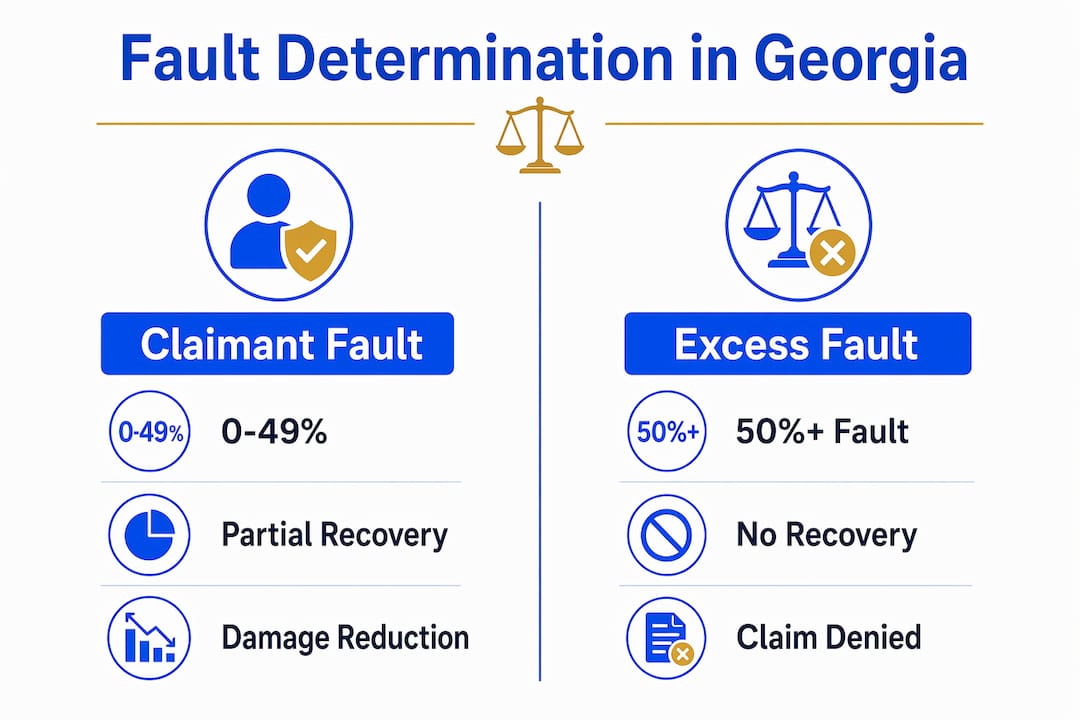
Georgia’s 50% fault rule is codified at O.C.G.A. § 51-12-33 and it creates a hard cutoff that every claimant must understand. If you are found 50% or more at fault for an accident, you recover nothing. If you are found 49% or less at fault, you recover damages reduced by your fault percentage.
The math is straightforward, but the stakes are severe:
- 0% fault: You collect 100% of proven damages from the at-fault driver.
- 25% fault: You collect 75% of proven damages.
- 49% fault: You collect 51% of proven damages. A $100,000 verdict pays you $51,000.
- 50% fault: Your recovery is barred entirely. A $100,000 verdict pays you $0.
That single percentage point between 49% and 50% is the most consequential line in Georgia accident liability rules. It explains why insurance adjusters frequently push to assign claimants exactly 50% fault. Reaching that threshold eliminates their client’s financial exposure completely.
This dynamic shapes settlement negotiations in a specific way. Defense adjusters and attorneys have a strong incentive to argue your fault upward, while your attorney’s job is to hold that number below 50%. The closer your assigned fault is to the threshold, the more aggressively both sides fight over every piece of evidence. Understanding this pressure helps you see why Georgia’s 50% fault rule is not just a legal technicality. It is the central battlefield of most contested claims.
Settlements often reflect this tension. Defendants may offer a reduced amount rather than risk a jury finding them more than 50% liable. Claimants near the threshold may accept less than full value to avoid the risk of losing everything at trial.
How does fault work in multi-party Georgia accidents?
Multi-party accidents add complexity to an already demanding process. Georgia’s modified comparative negligence framework applies to every party involved, not just the two primary drivers. Each defendant receives a fault percentage, and the claimant collects from each based on that share.
| Scenario | Fault split | Claimant recovery on $100,000 |
|---|---|---|
| Two defendants, claimant at 10% | Defendant A: 60%, Defendant B: 30% | $90,000 total ($60,000 + $30,000) |
| Two defendants, claimant at 40% | Defendant A: 40%, Defendant B: 20% | $60,000 total ($40,000 + $20,000) |
| One defendant uninsured, claimant at 20% | Defendant A: 50%, Defendant B (uninsured): 30% | Up to $50,000 from Defendant A only |
Georgia law provides no right of contribution between defendants. This means Defendant A cannot force Defendant B to share the payout. Each defendant pays only their assigned share, and if one is uninsured or underinsured, that portion of your recovery may simply disappear.
Pro Tip: If any driver involved in your accident is uninsured, contact your own insurer immediately to activate your uninsured motorist coverage. Georgia requires insurers to include UM/UIM coverage by default unless you rejected it in writing.
Uninsured and underinsured motorist coverage becomes critical in these situations. Under O.C.G.A. § 33-7-11, Georgia insurers must include UM/UIM coverage matching your bodily injury limits unless you affirmatively waived it in writing. If you never signed a written rejection, you likely have this coverage and do not know it.
What are the practical steps for Georgia accident claims?
Georgia accident liability rules create specific obligations and deadlines that claimants must meet to protect their rights. Missing any of these steps can reduce or eliminate your recovery.
Key requirements and deadlines include:
- File within two years for personal injury: O.C.G.A. § 9-3-33 sets a two-year statute of limitations for personal injury claims. Miss this deadline and the court will dismiss your case regardless of how strong it is.
- File within four years for property damage: O.C.G.A. § 9-3-31 gives you four years to pursue vehicle repair or replacement costs. This longer window applies only to property, not injuries.
- Never admit fault at the scene: Admitting fault, even casually, can jeopardize your compensation rights and complicate insurance negotiations. Stick to factual statements and let investigators determine responsibility.
- Notify your insurer promptly: Most policies require timely reporting. Delayed notification can give insurers grounds to deny coverage.
- Verify UM/UIM coverage: Check your policy documents or ask your agent whether you signed a written UM/UIM rejection. If you did not, you have coverage.
- Document all losses: Keep records of medical bills, lost wages, prescription costs, and any out-of-pocket expenses related to the accident.
The personal injury claims process in Georgia moves through a predictable sequence: evidence gathering, demand letter, insurer negotiation, and either settlement or litigation. Knowing where you are in that sequence helps you make better decisions at each stage. A detailed step-by-step claims guide can help you track those stages and avoid costly procedural mistakes.
Key Takeaways
Georgia’s modified comparative negligence system bars all recovery at 50% fault, making precise fault documentation the most critical factor in any accident claim.
| Point | Details |
|---|---|
| Georgia is an at-fault state | The driver who caused the crash pays; minimum coverage is $25,000/$50,000/$25,000 under O.C.G.A. § 40-6-10. |
| The 50% fault bar is absolute | Being found 50% or more at fault eliminates your right to recover any damages. |
| Evidence controls fault percentages | Police reports, photos, video, and expert analysis determine the fault split that drives your settlement. |
| Multi-party cases reduce recovery | Each defendant pays only their fault share; uninsured defendants leave gaps that UM/UIM coverage must fill. |
| Deadlines are strict | Personal injury claims must be filed within two years; property damage claims within four years. |
What I’ve learned about Georgia fault law that most guides skip
Most articles about Georgia accident fault laws explain the 50% rule and stop there. What they miss is how aggressively insurance adjusters use that threshold as a negotiating weapon.
I have seen cases where an adjuster’s initial fault assessment placed the claimant at exactly 50%, not 48%, not 52%, but precisely at the cutoff. That is not a coincidence. It is a calculated opening position designed to eliminate liability entirely while appearing to engage in good-faith negotiation. Claimants who do not understand the system accept this framing and walk away with nothing.
The single most underused protection in Georgia is UM/UIM coverage. A large number of drivers do not realize they have it because they never signed a written rejection. Before you assume you are exposed to an uninsured driver’s negligence, pull your policy and look for a signed waiver. If it is not there, your insurer owes you coverage.
Early legal consultation changes outcomes in a measurable way. An attorney who handles Georgia car accident claims regularly knows what a jury in your county is likely to award, what evidence adjusters weight most heavily, and where the real fault percentage is likely to land. That knowledge shifts the negotiation before it starts. Waiting until after you have already spoken to the adjuster multiple times puts you at a disadvantage that is difficult to recover from.
The personal injury guide for Georgia accident victims published by Jewkes Firm walks through these dynamics in detail. Read it before you make any statements to an insurer.
How Jewkes Firm helps Georgia accident victims protect their claims
Jewkes Firm represents accident victims across South Atlanta and surrounding Georgia counties, with a focus on getting clients the maximum compensation the law allows.

If you were injured in a Georgia car accident, fault determination is the first and most consequential step in your claim. Jewkes Firm investigates crashes thoroughly, disputes unfair fault assessments, and handles every stage of the claims process on your behalf. The firm works on a contingency fee basis, meaning you pay nothing unless they win. A FREE CONSULTATION costs you nothing and gives you a clear picture of where your case stands. Contact Jewkes Firm today to get a free case review and protect your right to recover.
FAQ
What does modified comparative negligence mean in Georgia?
Modified comparative negligence means Georgia reduces your damages by your percentage of fault and bars recovery entirely if you are 50% or more at fault, under O.C.G.A. § 51-12-33.
Who determines fault in a Georgia car accident?
A jury decides fault at trial, or the parties negotiate a fault percentage during settlement based on evidence like police reports, photos, and witness testimony.
Can I recover damages if I was partly at fault in Georgia?
Yes, as long as your fault is 49% or less. Your damages are reduced by your fault percentage, so a 30% fault finding on a $100,000 claim yields $70,000.
How long do I have to file a car accident claim in Georgia?
Personal injury claims must be filed within two years of the accident under O.C.G.A. § 9-3-33. Property damage claims carry a four-year deadline under O.C.G.A. § 9-3-31.
Should I admit fault after a Georgia car accident?
No. Admitting fault, even informally at the scene, can jeopardize your compensation rights and complicate insurance negotiations. Let investigators and attorneys assess responsibility based on evidence.
Recommended
- Maximize your accident compensation in Georgia: step-by-step
- Georgia Auto Accident Liability: 50% Fault Rule Explained
- Examples of accident claims and how to file in South Atlanta
- Train accident liability in Georgia: Your legal guide