

Use this five-point checklist to pick a lawyer in Tyrone: define your legal issue, verify licensing and disciplinary history with the state bar, confirm relevant experience and case results, understand the fee structure in writing, and meet for a consultation before you sign anything.
Each step protects you from a different risk, from wasted time to wasted money. A quick bar lookup confirms good standing, a fee conversation prevents billing surprises, and a consultation shows you how the attorney actually communicates. The American Bar Association publishes a solid framework for these first conversations, and firms like The Jewkes Firm build free consultations around exactly this kind of screening.
- Define the legal issue and outcome you want
- Check state bar licensing and disciplinary record
- Confirm relevant experience and trial or settlement history
- Get fee terms and billing details in writing
- Schedule a consultation before deciding
Pro Tip: Write your checklist answers down before the first call. Lawyers respect prepared clients, and it keeps you from forgetting a red flag once the conversation gets friendly.
Key Takeaways
Choosing the right lawyer in Tyrone comes down to verifying licensing, matching experience to your specific issue, and getting fee terms in writing before you sign.
| Point | Details |
|---|---|
| Define the issue first | Match your problem to the right practice area before searching for candidates. |
| Verify credentials | Check state bar license status and disciplinary history before any paid engagement. |
| Prioritize relevant experience | Ask about similar case volume and trial versus settlement history. |
| Get fees in writing | Confirm the fee model and retainer terms before signing anything. |
| Consider a free consultation | The Jewkes Firm offers free case reviews and contingency fees for injury claims serving South Atlanta and nearby Georgia counties. |
Table of Contents
- What legal issue and outcome are you actually solving for?
- How do you find lawyer candidates near Tyrone?
- How do you check a lawyer’s credentials and disciplinary history?
- What experience actually predicts a good outcome?
- How do fee models and retainer agreements actually work?
- How responsive should your lawyer’s team actually be?
- What should you ask at the first free consultation?
- How long do these cases usually take, and what drives the cost?
- What red flags mean you should walk away?
- How do you confirm a lawyer actually serves Tyrone?
- Ready to talk to a Tyrone-area injury attorney?
- Where to verify credentials and find more guidance
- Frequently Asked Questions
- Sources
What legal issue and outcome are you actually solving for?
Before you search for “best lawyers in Tyrone,” get specific about the problem. “Car crash with a back injury” points toward personal injury. “Divorce with young kids” points toward family law. Vague searches produce vague results.
Write down the outcome you want, the key dates, and the names of everyone involved. Bring police reports, medical bills, contracts, or correspondence to your first meeting. A clearly defined issue also tells you how urgent the search is and whether a local Tyrone attorney who knows the courthouse staff and local judges matters more than a bigger firm.
- Name the specific legal category (injury, family, criminal, contract)
- List the outcome you’re hoping for
- Gather dates, names, and documents ahead of time
- Decide how urgent the matter is
How do you find lawyer candidates near Tyrone?
Start with people you trust. Referrals from friends, coworkers, or other professionals like doctors and insurance agents tend to be more reliable than an ad. From there, state and local bar referral services connect you to vetted attorneys by practice area, and the ABA maintains its own state-by-state referral directories for finding certified programs.
Online directories and law firm ads can surface names quickly, but treat every claim as a starting point, not a verdict. Local legal aid clinics can also help if your budget is limited, since eligibility for low-cost help usually depends on income and case type.
- Ask for referrals from people you trust first
- Use bar referral services and ABA directories for vetted names
- Cross-check any lawyer ad or directory claim independently
- Consider legal aid clinics if cost is a concern
Pro Tip: Ask your regular doctor’s office or a local insurance agent for a lawyer referral. They deal with attorneys constantly and usually know who actually shows up prepared.
How do you check a lawyer’s credentials and disciplinary history?
Every state bar website lets you search for an attorney’s license status for free. “Active and in good standing” means the license is current and free of open discipline. If a lawyer’s status shows suspension, probation, or a public reprimand, ask them directly to explain it before you go further.
It also pays to ask whether the attorney carries malpractice insurance and holds any board certifications in their practice area, since insurance and staffing details shape both risk and expectations.
Verify licensing and disciplinary history, check reputation and communication, and confirm the lawyer has relevant experience before you hire, according to NYC Bar’s hiring guide.
- Search the state bar’s online license lookup
- Confirm “active” status and no pending discipline
- Ask about malpractice insurance
- Note any board certifications in the relevant practice area
What experience actually predicts a good outcome?
Years in practice mean less than relevant volume. Ask how many cases similar to yours the attorney has handled recently, and whether most were resolved through settlement or actually went to trial. If your matter might end up in front of a judge, an attorney with real trial experience matters more than one who has only negotiated.
Specialization or board certification in a specific area often signals deeper expertise than a general practice handling everything from wills to fender benders. Verify claims by asking for examples of similar cases, reading independent client reviews, and, where public, checking case records tied to the attorney’s name.
- Ask how many similar cases they’ve handled recently
- Distinguish settlement experience from trial experience
- Look for specialization or certification in your issue area
- Verify claims with case examples and independent reviews
How do fee models and retainer agreements actually work?
Most personal injury attorneys work on contingency, collecting a percentage only if you win or settle. Family law and criminal defense attorneys more often bill hourly or charge a flat fee for defined tasks. Ask which model applies to your case and why.

A written retainer agreement should spell out the fee percentage or rate, what triggers billing, and who handles the day-to-day work on your file. Get this in writing before signing anything, and ask directly whether paralegal time gets billed separately from attorney time, since fee transparency at the first meeting is one of the clearest signs of a trustworthy firm.
Statistic Callout: Attorneys who take personal injury cases on contingency are compensated only when they win or settle your claim, which is why understanding contingency structures before signing matters as much as comparing percentages.
- Ask which fee model applies and why
- Get the retainer agreement in writing
- Ask about filing fees, expert witness costs, and copying charges
- Confirm whether paralegal work is billed separately
How responsive should your lawyer’s team actually be?
Ask directly how quickly they typically return calls or emails, and whether you’ll deal mainly with the attorney or a paralegal handling routine updates. Neither answer is automatically wrong, but you should know which one you’re getting.
Clarify who performs the actual work on your case and whether junior associates or paralegals bill at a different rate. If a lawyer dodges questions about availability, has no clear point of contact, or can’t explain how they’ll escalate an urgent issue, treat that as an early warning sign.
- Ask about expected response times and preferred contact method
- Confirm who handles your file day to day
- Ask whether staff time is billed separately
- Watch for evasive answers about availability or escalation
What should you ask at the first free consultation?
Bring your documents organized by date, and use this list to structure the meeting:
- Are you licensed and in good standing with the state bar?
- How many cases like mine have you handled, and what were the outcomes?
- What’s your initial read on strategy for my situation?
- How long do you expect this to take?
- What’s your fee structure, and can I see it in writing?
- Who on your team will actually work on my file?
- Can you share a reference or client example relevant to my case?
Don’t feel intimidated asking direct questions. You’re the one hiring here, and specific questions produce answers you can actually compare.
- Organize documents by date before the meeting
- Ask every question on the list, even if it feels repetitive
- Take notes you can compare across consultations
Pro Tip: Score each consultation with a simple yes/no on five points: licensed, relevant experience, clear fee terms, comfortable communication, and a defined point of contact. Whoever scores five wins.
How long do these cases usually take, and what drives the cost?
Timelines vary widely by case type. A straightforward injury claim might settle in a few months once medical treatment concludes, while litigation that heads toward trial can stretch well over a year. Georgia’s litigation process involves multiple stages, each adding time.
Cost mainly tracks complexity: cases needing expert witnesses, extensive discovery, or an uncooperative opposing party cost more and take longer. Ask your attorney when you should expect billing statements or milestone updates so a long timeline doesn’t feel like silence.
- Expect faster resolution for straightforward settlements
- Expect longer timelines for cases headed to trial
- Complexity, experts, and discovery length drive cost
- Ask when to expect billing statements and updates
What red flags mean you should walk away?
Any lawyer who guarantees a specific outcome is overselling. No one can promise a result before reviewing your case in depth. Watch for a pattern of poor reviews about communication or billing, vague or shifting answers about fees, or a license that shows disciplinary action.
A simple decision rule works well here: pick the candidate with verified credentials, fee terms in writing, and a consultation where you actually felt heard. If two candidates tie, comparing them side by side in brief follow-up interviews usually breaks the tie. If something feels off after that, get a second opinion before signing.
- Guarantees of victory are a warning sign, not a selling point
- Evasive fee answers or disciplinary history should end the conversation
- Prioritize verified credentials, written fees, and consultation comfort
- Get a second opinion if doubt remains
How do you confirm a lawyer actually serves Tyrone?
Check that the firm has an office or regularly appears in the county where your case will be filed. Recent case filings in the same county, local client reviews, and relationships with area medical providers or accident reconstruction experts all signal genuine local presence rather than a satellite office chasing leads.
Ask about parking or transit near their office, and whether remote consultations are available if a trip downtown is inconvenient. If your matter involves a courthouse visit, ask what to expect. A local attorney’s courthouse familiarity often speeds things along in small but meaningful ways.
- Confirm office location and county service area
- Look for recent filings in your county and local reviews
- Ask about parking, transit, and remote consultation options
Pro Tip: Call the courthouse clerk’s office and ask if a firm’s name is familiar. Clerks see the same attorneys repeatedly and their reaction tells you more than any online review.
A note on what we prioritize when representing clients
At The Jewkes Firm, we build every case around the client first: free consultations, contingency fees so you pay nothing until we win, and a track record we’re glad to walk you through. . If you want local help sorting through these options, we’re glad to talk it through with you at no cost.
Ready to talk to a Tyrone-area injury attorney?
If your situation involves an accident, injury, or a loved one’s wrongful death, you don’t have to run this checklist alone. The Jewkes Firm offers free consultations built around exactly the questions covered above: licensing, experience, fees, and who handles your file, explained plainly before you commit to anything.

Bring what you have, medical records, police reports, photos, correspondence with insurers, and we’ll walk through your situation and give you a straight answer about whether we can help. Our contingency fee arrangement means you owe nothing upfront and nothing at all unless we recover compensation for you. For readers still comparing options from the comprehensive checklist above, a free consultation costs you nothing and often clarifies more than another hour of searching would. Schedule your free case review and find out where you stand.
Where to verify credentials and find more guidance
Before paying anyone, run these checks yourself:
- Your state bar’s online lawyer license lookup, to confirm active status and disciplinary history
- The American Bar Association’s consumer resources, for directory listings and vetted referral programs
- Local bar referral services, which connect you to attorneys screened for the practice area you need
Save these links and run the bar check first, before scheduling a single paid meeting.
Frequently Asked Questions
How much does an initial consultation with a lawyer in Tyrone typically cost?
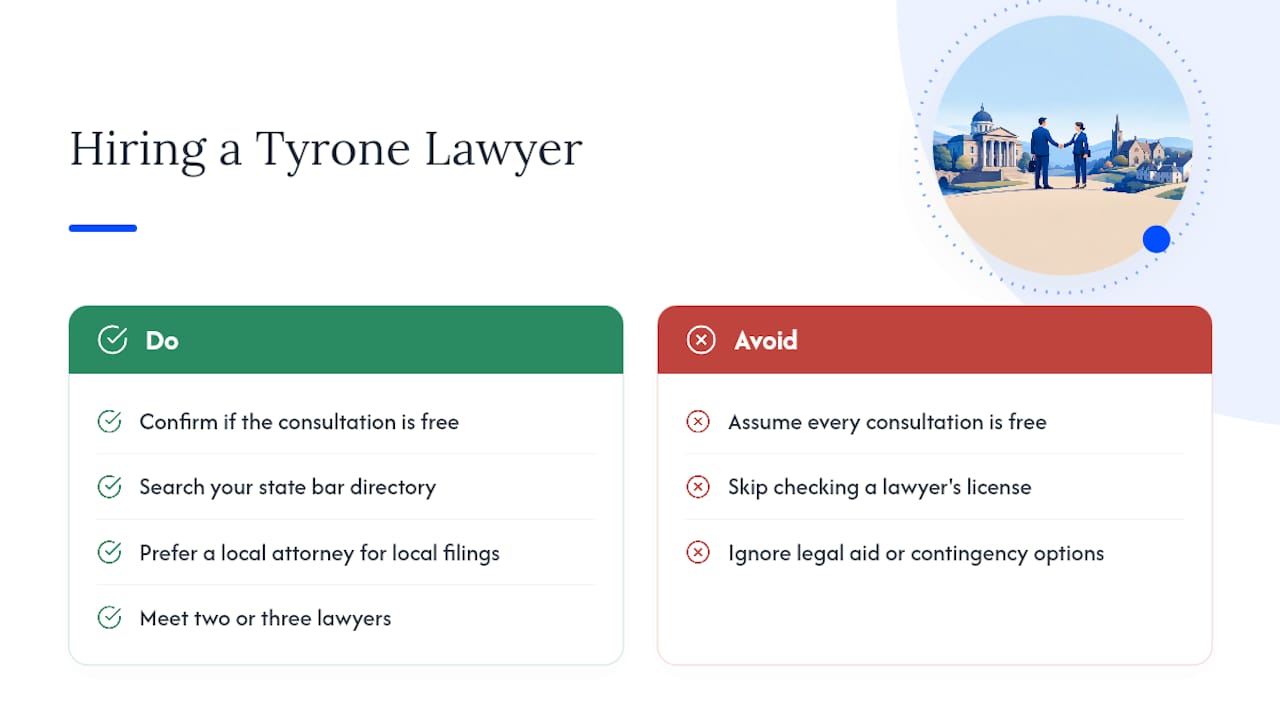
Many personal injury attorneys, including The Jewkes Firm, offer free initial consultations. Always confirm this before scheduling, since some practice areas bill hourly from the first meeting.
What’s the fastest way to check if a lawyer is licensed?
Search your state bar’s online attorney directory by name. It shows license status, admission date, and any public disciplinary record within minutes.
Should I choose a local Tyrone attorney over a bigger firm elsewhere?
For cases likely to involve local courthouse filings, a lawyer familiar with the county’s judges, clerks, and procedures often moves your case along more efficiently than an outside firm.
What if I can’t afford a lawyer for my case?
Legal aid clinics and community organizations offer free or reduced-cost help based on income and case type. Contingency fee arrangements, common in personal injury cases, also mean you pay nothing upfront.
How many lawyers should I actually meet with before deciding?
Two or three brief consultations give you enough to compare experience, fees, and communication style without dragging out the search unnecessarily.
This article is general information, not a substitute for advice from a qualified lawyer. Consult a qualified legal professional about your own circumstances before acting on anything here.
Sources
- Questions to Ask
- Before Selecting an Attorney | The State Bar of California
- How to Hire a Lawyer in New York | NYC Bar