

A wrongful death claim is a civil lawsuit that allows eligible family members to seek compensation when another party’s negligence, recklessness, or intentional act causes a loved one’s death. Under Georgia law, this process gives surviving family members a formal legal path to hold responsible parties accountable and recover damages for both financial and emotional losses. The wrongful death claim process 2026 carries the same two-year filing deadline that has defined Georgia cases for years, but families affected by recent fatalities need to act quickly. This guide walks you through every critical step, from establishing legal standing to understanding what compensation you can recover.
What is the wrongful death claim process in 2026?
A wrongful death claim acts as a stand-in for the personal injury case the deceased would have filed if they had survived. That means your attorney must establish four core elements: duty of care, breach of that duty, causation, and damages. Without all four, the claim fails regardless of how tragic the circumstances are.

Georgia law determines who has legal standing to file. The surviving spouse holds the primary right. If there is no spouse, surviving children may file. If there are no children, the deceased’s parents may bring the claim. When none of these family members exist, the administrator or executor of the estate steps in as the personal representative to pursue the case on behalf of all beneficiaries.
That personal representative carries a fiduciary duty. They must act in every beneficiary’s best interest and cannot personally profit beyond what Georgia’s statutory awards allow. If the estate has not been opened through probate, your attorney will need to address that before filing.
Before you file anything, gather these documents:
- Certified copy of the death certificate
- Any existing will or estate documents
- Medical records related to the fatal incident
- Police or accident reports
- Insurance policies held by the deceased
- Financial records showing income and employment history
Pro Tip: Contact an attorney before you contact the insurance company. Insurers record early conversations and use them to minimize payouts. Your first call should be to legal counsel, not an adjuster.
Evidence disappears fast. Families often underestimate how quickly surveillance footage gets overwritten, vehicles get repaired, and witnesses’ memories fade. An attorney can send a preservation letter immediately, which is a formal legal demand instructing the defendant to retain all relevant evidence. That single step can protect your entire case.
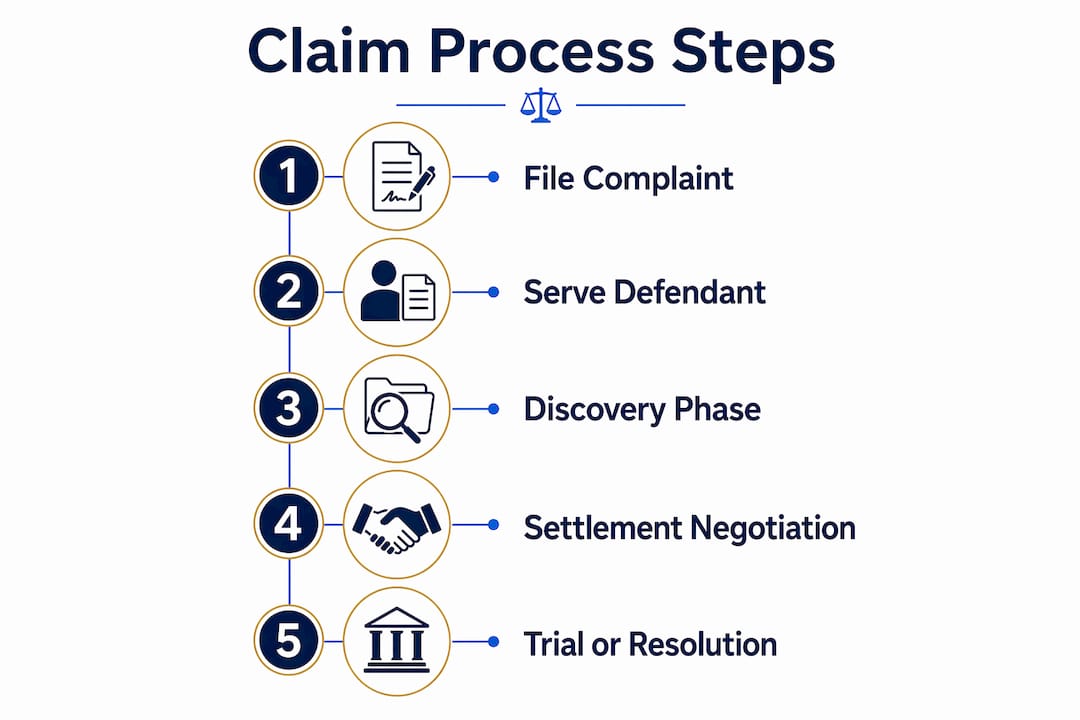
Step-by-step guide to filing a wrongful death claim in Georgia
The steps in wrongful death cases follow a defined sequence. Knowing what comes next removes uncertainty and helps you prepare.
- Hire a wrongful death attorney. Georgia’s procedural rules and court filings are not self-service. An experienced attorney handles standing verification, evidence preservation, and complaint drafting from day one. Review the advantages of legal representation before making this decision.
- Open the estate if required. If no spouse or children exist, the court must appoint a personal representative through probate before the claim can proceed.
- File the complaint. Your attorney files the formal complaint in the appropriate Georgia superior court, naming the defendant and stating the legal basis for liability.
- Serve the defendant. The defendant must be formally served with the complaint and summons within the timeframe the court requires.
- Enter the discovery phase. Both sides exchange evidence, request documents, and conduct depositions. Discovery spans 6 to 18 months in most wrongful death cases, making it the longest single phase of the process.
- Negotiate a settlement. Most wrongful death claims resolve before trial. Your attorney presents a demand package, and negotiations begin. Settlement talks can happen at any point after filing.
- Go to trial if necessary. If no agreement is reached, the case proceeds to trial. Trials occur 1 to 3 years after filing when settlement fails, and verdicts can still be appealed, extending the timeline further.
| Phase | Typical Duration |
|---|---|
| Filing and service | 1 to 3 months |
| Discovery | 6 to 18 months |
| Settlement negotiations | Ongoing; often concurrent with discovery |
| Trial (if no settlement) | 1 to 3 years after filing |
| Appeals (if applicable) | 1 to 2 additional years |
Pro Tip: Filing both the wrongful death claim and a survival action at the same time maximizes your total recovery. The survival action covers damages the deceased personally incurred before death, such as medical bills and pain and suffering, while the wrongful death claim covers your family’s losses.
What damages can Georgia families recover?
Damages in wrongful death claims fall into two categories: economic and non-economic. Understanding both helps you set realistic expectations and work with your attorney to document every loss thoroughly.
Economic damages are the measurable financial losses your family suffers. These include:
- Lost income and future earning capacity the deceased would have provided
- Medical expenses incurred before death from the fatal injury
- Funeral and burial costs
- Loss of household services the deceased performed
Non-economic damages are harder to quantify but equally compensable under Georgia law. These cover the loss of companionship, care, comfort, and society that surviving family members experience. Georgia courts allow juries to assign a dollar value to these losses, and expert testimony from economists and life care planners often shapes those numbers significantly.
| Claim type | What it covers | Who benefits |
|---|---|---|
| Wrongful death claim | Family’s losses: income, companionship, services | Surviving spouse, children, or parents |
| Survival action | Decedent’s losses: medical bills, pain and suffering before death | The estate and its beneficiaries |
Georgia follows a modified comparative fault rule. If the deceased was partially at fault for the incident, the total compensation is reduced by their percentage of fault. If their fault exceeds 50%, the family may be barred from recovery entirely. This is why thorough evidence collection matters. Every piece of documentation that shifts fault toward the defendant protects your family’s recovery.
For a detailed breakdown of how Georgia courts calculate these losses, the damages in wrongful death resource from Jewkesfirm covers the methodology attorneys use to build a valuation.
What are the deadlines for filing a wrongful death claim in Georgia?
Georgia’s statute of limitations for wrongful death cases is two years from the date of death. Miss that deadline and the court will almost certainly dismiss your case, regardless of how strong the evidence is. That two-year window sounds generous, but it closes faster than most families expect.
Key timing rules to know:
- Standard deadline: Two years from the date of death for most wrongful death claims in Georgia.
- Government defendants: Claims against a city, county, or state agency require an ante litem notice filed within 6 to 12 months, depending on the government entity. This is a separate requirement from the lawsuit itself.
- Discovery rule: In rare cases where the cause of death was not immediately known, the clock may start when the family reasonably discovered the negligent cause rather than the date of death itself.
- Minor beneficiaries: If the primary beneficiary is a minor child, Georgia law may toll the statute of limitations until the child reaches adulthood, but this exception does not apply in all circumstances.
Claims against government agencies may require filing within 6 months, which is a dramatically shorter window than the standard two-year rule. Families who lose a loved one in an incident involving a government vehicle, public transit, or a municipal facility need to consult an attorney within weeks, not months.
The consequences of missing the deadline are permanent. Georgia courts do not grant extensions for grief, financial hardship, or lack of legal knowledge. The only protection is early action. Consulting an attorney within the first 30 to 60 days after a fatality gives your legal team time to investigate, preserve evidence, and file properly before any deadline approaches.
Key takeaways
Georgia families have two years to file a wrongful death claim, and every phase from evidence preservation to settlement negotiation requires deliberate, timely action to protect maximum compensation.
| Point | Details |
|---|---|
| Who can file | Spouse, children, parents, or estate representative in that order of priority under Georgia law. |
| Evidence preservation | Send a preservation letter immediately to prevent defendants from destroying critical evidence. |
| Claim timeline | Discovery alone takes 6 to 18 months; full resolution can span 1 to 3 years or longer. |
| Two types of claims | File both the wrongful death claim and survival action together to maximize total recovery. |
| Filing deadline | Georgia’s two-year statute of limitations is strict; government claims may require action within 6 months. |
What I’ve learned from watching families navigate these cases
From my experience watching Georgia families work through wrongful death claims, the biggest mistake is waiting. Not waiting weeks. Waiting days. Families assume they have time to grieve before they deal with legal matters, and that instinct is completely understandable. But evidence does not wait for grief to pass.
The second most common mistake is treating the insurance company as a neutral party. Insurers for defendants are not there to help you. They are there to minimize the payout. Families who speak to adjusters before retaining counsel routinely make statements that get used against them later. The wrongful death attorney guide from Jewkesfirm explains exactly why early legal engagement changes the outcome.
There is also a misconception that most cases go to trial. They do not. Most wrongful death claims settle before a jury ever hears the case. But settling well requires preparation for trial. Defendants and their insurers offer better settlements when they believe the opposing attorney is ready and willing to go to court. Preparation is the leverage.
Finally, do not underestimate the emotional toll of the process. Discovery involves reliving the circumstances of your loved one’s death in detail. Depositions are difficult. Timelines stretch longer than families expect. Going in with realistic expectations, and a legal team that communicates clearly, makes the process far more manageable.
— Ali
How Jewkesfirm helps Georgia families pursue wrongful death claims
If your family has lost someone due to another party’s negligence in 2026, Jewkesfirm is ready to fight for the compensation you deserve.

Jewkesfirm handles wrongful death cases across South Atlanta and surrounding Georgia counties on a contingency fee basis. That means no upfront fees and no payment unless the firm recovers compensation for your family. From the first call, the team focuses on evidence preservation, standing verification, and building the strongest possible case. Jewkesfirm has recovered millions for Georgia families and brings that same dedication to every wrongful death case it takes. Contact the wrongful death legal team today for a FREE CONSULTATION and take the first step toward justice for your loved one.
FAQ
What is wrongful death under Georgia law?
Wrongful death is a civil claim filed when negligence, recklessness, or an intentional act causes another person’s death. Georgia law allows eligible family members to recover both economic and non-economic damages from the responsible party.
Who has the right to file a wrongful death claim in Georgia?
The surviving spouse holds the primary right to file, followed by children, then parents. If none of these family members exist, the estate’s personal representative may file on behalf of all beneficiaries.
How long does the wrongful death claim process take in Georgia?
The wrongful death lawsuit timeline typically runs from one to three years, with discovery alone taking 6 to 18 months. Cases that settle early can resolve faster, while those that go to trial take longer.
What is the statute of limitations for wrongful death in Georgia?
Georgia requires filing within two years of the date of death. Claims involving government defendants may require an ante litem notice within 6 to 12 months, so early legal consultation is critical.
What is the difference between a wrongful death claim and a survival action?
A wrongful death claim compensates the surviving family for their own losses, such as lost income and loss of companionship. A survival action compensates the estate for damages the deceased personally suffered before death, including medical bills and pain and suffering. Filing both together maximizes total recovery.